


28 Aug Freckles, Sun Spots and Age Spots Removal: Which Respond Best to Laser?
By Dr Rachel Ho | Aesthetic Doctor, Founder, The Skin Longevity Clinic, Singapore
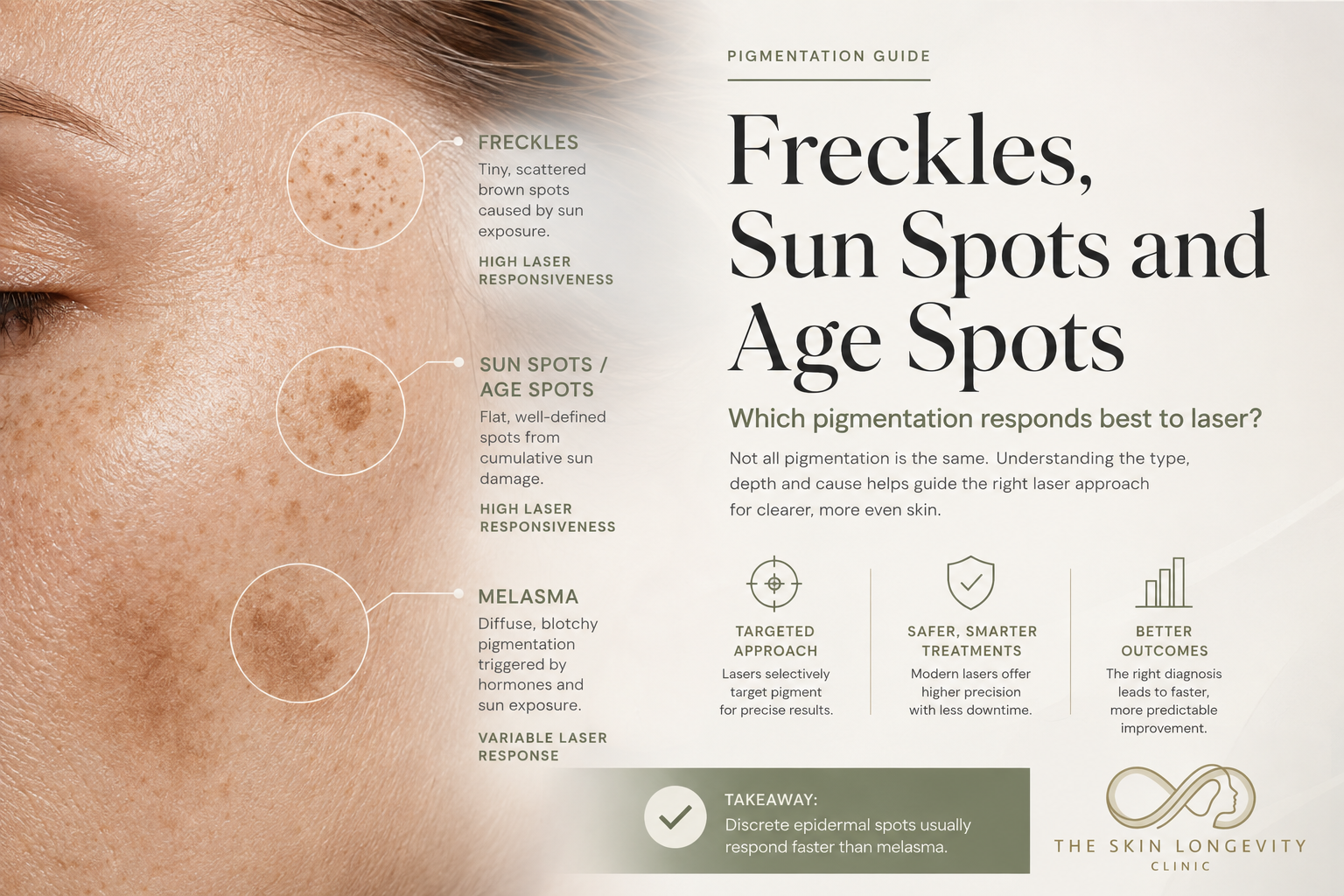
Freckles and sun spots are among the most laser responsive forms of pigmentation. Their pigment sits superficially in the epidermis, in discrete well defined lesions, so a pigment laser such as Pico laser in Singapore can fragment them predictably. Melasma and dermal pigmentation behave very differently, which is why spots should be diagnosed before they are zappe
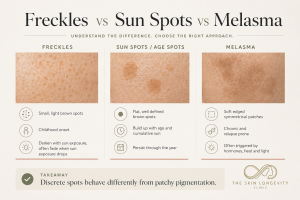
How are freckles, sun spots and melasma different? Freckles are small sun-responsive ephelides, sun or age spots are persistent solar lentigines, while melasma forms soft-edged patches that require longer-term control.
d. This guide explains the differences, the typical treatment journey and how to keep spots from returning.
Medically reviewed by Dr Rachel Ho, MBBS, MRCS, MMed (ENT), 7 October 2026.
What are freckles, sun spots and age spots?
Freckles
Freckles, medically called ephelides, are small light brown spots that appear from childhood, often scattered across the cheeks and nose. They reflect a genetic tendency combined with sun exposure, darken noticeably after sunny periods and can fade during low exposure stretches. People who freckle easily usually have skin that responds vigorously to ultraviolet light, which makes lifelong sun protection especially worthwhile.
Sun spots and age spots
Sun spots and age spots are the same lesion, medically called solar lentigines. They are flat, well defined brown spots that appear on sun exposed areas such as the cheeks, temples, forehead and the backs of the hands, accumulating with age as a record of total ultraviolet exposure. Unlike freckles they do not fade in winter. They persist and can slowly darken or enlarge over the years.
Why the distinction from melasma matters
Melasma forms soft edged symmetrical patches rather than discrete spots, and it behaves like a chronic condition rather than a fixed lesion. Lasering melasma as if it were a sun spot risks rebound darkening. If your pigmentation looks like blended patches across both cheeks, read our guide to melasma treatment in Singapore before booking any pigmentation removal. Grey brown speckles over the cheekbones may instead be Hori’s naevus, covered in stubborn pigmentation in Asian skin.
Freckles on the face: why they appear and how laser removes them
Freckles (ephelides) are small, flat, light-brown spots on the cheeks and nose that appear in childhood and darken after sun exposure. They are largely inherited and switched on by sunlight. Sun spots (solar lentigines) are different: they are caused by cumulative sun damage and appear later in life33.
Freckles are common in Chinese skin. In a survey of 9,697 Han Chinese college students, 19% had freckles: 26% of women and 12% of men. Half had a family history, and first-degree relatives of people with freckles were almost six times more likely to have them34. A 2024 genome study of 4,813 Chinese people found 59 new genetic variants linked to freckles35.
Freckles respond well to pigment lasers. In a randomised split-face trial in Asian patients, Q-switched alexandrite laser cleared freckles better than intense pulsed light28. A 785 nm picosecond laser improved freckles in Asian skin after a single session31. Because the tendency is genetic, new freckles can appear with further sun exposure. Daily sunscreen keeps the result.
What sun spots look like under the skin
Sun spots are a record of accumulated sun exposure written into the skin. The skin over a sun spot is visibly thicker than the skin beside it, and the deeper layer shows the disorganised elastic tissue that chronic sun damage leaves behind. The damaged fibroblasts in that deeper layer release signals that keep the overlying skin producing pigment, which is part of why sun spots persist rather than fading with the seasons the way freckles can. Increased blood vessel activity in the deeper skin has also been found in sun spots, which is one reason strict sun protection and, in some cases, treatments that address more than pigment alone give the most durable results. Research also shows that combining approaches, for example a pigment laser together with topical treatment and sun protection, clears sun spots more completely than any single measure.
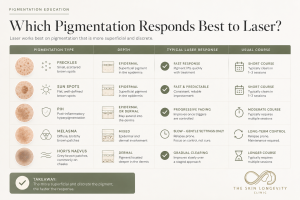
Why do some pigment conditions clear faster than others? Superficial, discrete pigment usually responds earlier, while mixed or dermal pigment requires a slower, more carefully staged course.
Which pigmentation responds fastest to laser?
Which type of hyperpigmentation responds fastest to laser?
| Pigment type | Depth | Typical laser response | Usual course |
|---|---|---|---|
| Freckles | Epidermal | Fast, spots darken then flake away | Short course, top ups for new freckles |
| Sun spots | Epidermal | Fast and predictable for most spots | Short course, occasional stubborn spots need more |
| PIH | Epidermal or dermal | Progressive fading once triggers controlled | Moderate course |
| Melasma | Mixed | Slow, gentle settings only, relapse prone | Long term control, not clearance |
| Hori’s naevus | Dermal | Gradual clearing over a staged course | Longer course with wide spacing |
The pattern is simple. The more superficial and discrete the pigment, the faster and more complete the laser response. The deeper or more reactive the pigment, the more the plan depends on patience and combination treatment, as set out in our pillar guide to pigmentation treatment in Singapore.
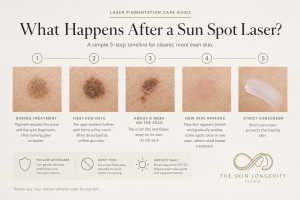
What happens after sun spot laser treatment? The treated spot typically darkens, forms a fine crust and flakes naturally before the new skin settles. Picking can increase the risk of pigmentation or scarring.
What happens when a sun spot is lasered
Understanding the normal sequence prevents unnecessary worry.
- During treatment, the spot absorbs the laser pulse and the pigment fragments. The spot often turns grey or darker immediately.
- Over the first days, the treated spot darkens further and forms a fine crust, a stage sometimes described as coffee grounds.
- Within roughly a week on the face, the crust lifts and flakes away on its own. Picking it off early risks pigmentation or scarring.
- The revealed skin is pinkish, then settles toward your normal tone. Some spots clear in one pass, others need repeat treatment.
- Strict sunscreen protects the healing skin, because fresh post laser skin pigments easily in Singapore sun.
Sun spots on the face: how laser clears them
In Asian patients with skin types III–IV, a 532 nm picosecond laser cleared more than 75% of 93% of sun spots in one session. PIH occurred in under 5% of spots26. A randomised trial found picosecond and nanosecond 532 nm lasers cleared sun spots equally well, with higher patient satisfaction on the picosecond side27. Freckles respond better to Q-switched laser than to IPL28. PIH is more common after Q-switched than long-pulsed treatment in darker skin (22% vs 6%)29, which is why pulse duration and energy are chosen for each spot.
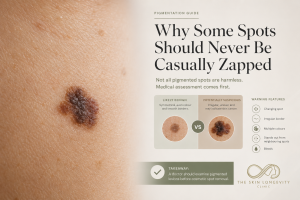
Why should a brown spot be examined before laser? A changing, irregular, multicoloured, bleeding or unusually different lesion needs medical assessment before cosmetic removal.
Why some spots should never be casually laser-ed away
Not every brown spot is a harmless lentigo. Some flat pigmented lesions, including early melanoma, can mimic a sun spot. Red flag features include a spot that is changing, has irregular borders, shows multiple colours, stands out from its neighbours or bleeds. A doctor should examine pigmented lesions before laser treatment, and anything suspicious is assessed medically rather than treated cosmetically. This safeguard is a routine part of consultations at The Skin Longevity Clinic, and our benign skin lesion removal page explains how confirmed benign lesions are handled.
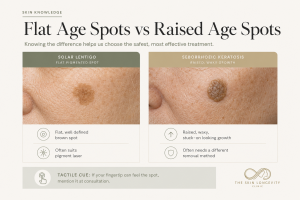
Are all age spots treated with pigment laser? A flat solar lentigo often suits pigment laser after diagnosis, while a raised, waxy seborrhoeic keratosis usually requires another removal method.
Flat age spots versus raised age spots
Not everything called an age spot is a solar lentigo. Seborrhoeic keratoses are raised, waxy, stuck on looking growths that also accumulate with age and sun, and they are frequently lumped together with flat spots in everyday conversation. The distinction matters because pigment lasers suit flat lentigines, while raised keratoses are usually better removed by other methods. If your fingertip can feel the spot, mention it specifically at consultation, because it likely needs a different tool from the laser treating its flat neighbours. Both are benign, and both deserve a proper look before removal, in line with our approach to benign skin lesion removal.
Is pico laser the best treatment for dark spots?
Patients often ask whether pico laser is the best treatment for dark spots. It depends on the spot: its depth, its cause and whether it is a sun spot, a freckle, melasma or a post-inflammatory mark. The sections below set out how pico laser works on epidermal pigment and how it compares with the Q-switched laser that preceded it.
Most dark spots involve excess melanin in the epidermis, dermis, or both. Pico laser delivers energy in extremely short pulses that break pigment into smaller particles through a pressure wave effect rather than primarily through heat4-7. This effect is called the photoaccoustic effect.
In a clinical context, picosecond lasers have shown measurable improvement in conditions driven by hyperpigmentation. For example, published work in Asian patients suggests picosecond laser treatment can reduce melanin content with fewer adverse events compared with certain nanosecond lasers alternatives in challenging pigment cases such as melasma and post inflammatory hyperpigmentation12, 14-17.
The key for skin longevity is sufficient pigment fragmentation while minimising collateral injury that can trigger rebound pigmentation, especially in Asian skin types that are more reactive to inflammation.
Pico laser versus Q-switched laser for dark spots
Both pico laser and q-switched laser treatments have a place in clinical practice. Their physics and evidence helps guide which is most appropriate for a given patient and indication.
Mechanism of Action
The Q-switched laser delivers energy in nanosecond pulses and works primarily through a photothermal mechanism. Rapid heating of melanin granules causes them to fragment through thermal expansion. The pico laser delivers energy in picosecond pulses and produces a predominantly photomechanical effect, fracturing pigment through acoustic pressure waves with significantly less heat generation in surrounding tissue4-6.
Efficacy in Pigmented Lesions
Both technologies are effective for treating epidermal pigmentation including solar lentigines and freckles. For dermal pigmentation, such as Hori’s naevus and Nevus of Ota, pico laser has demonstrated superior results in peer-reviewed research12,21.
For melasma, which is arguably the most common and most challenging pigmentation condition in Asian patients, a 2023 systematic review and meta-analysis published in Lasers in Medical Science, which included six randomised controlled trials, found that 1064 nm pico laser significantly reduced the melasma area and severity index with no significant side effects22.
Risk of Post-Inflammatory Hyperpigmentation
Evidence shows that for Asian and darker-skinned patients, pico lasers have a lower risk of PIH as compared to Q-switched lasers. Pico laser, because of its predominantly photomechanical mechanism and reduced thermal diffusion, carries a lower risk of PIH4-7.
Number of Laser Sessions Required
Pico lasers generally achieve the same or superior clinical endpoints in fewer treatment sessions than Q-switched nanosecond lasers, due to more efficient pigment fragmentation. Published estimates suggest pico laser typically requires two to five sessions for most benign pigmented lesions, while Q-switched lasers may require four to eight sessions for comparable results, depending on the type and depth of pigmentation14,20, 19-21.
In summary, Asian skin types typically have a higher baseline melanin content which makes the skin more reactive to heat. This reactivity increases the risk of complications like worsening of dark spots or thermal injury when using traditional heat based lasers. Because pico lasers rely more heavily on photoacoustic effects rather than heat, they can treat pigment with less thermal diffusion in surrounding tissue. This may reduce the risk of triggering additional pigmentation in reactive skin.
Treatment options beyond Pico laser
Pico laser is our usual first choice for discrete pigment because it fragments melanin with minimal heat, which suits Asian skin. Alternatives and complements include the Q-switched laser, an established nanosecond option for lentigines and freckles, and superficial chemical peels that support overall brightening. Topical lightening skincare plays a smaller role for discrete spots than for melasma, but ingredients discussed in this article on pigmentation lightening skincare help maintain results and manage any coexisting diffuse pigment.
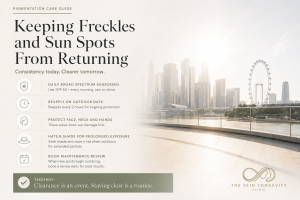
How can freckles and sun spots be kept from returning? Daily broad-spectrum sunscreen, timely reapplication, shade and early maintenance reviews help reduce new ultraviolet-driven pigmentation.
Keeping dark spots and hyperpigmentation from recurring in Singapore
A cleared sun spot does not regrow by itself, but the skin around it carries the same sun history and keeps producing new spots if exposure continues. Freckle prone skin will keep freckling with sun. Long term clarity therefore rests on daily broad spectrum sunscreen, reapplied during outdoor days, plus hats and shade for prolonged exposure. Independent reviews such as this sunscreen guide make it easier to find a formula you will wear every day. Periodic maintenance sessions can tidy up new spots as they appear.
Hyperpigmentation beyond the face, spots on hands, arms and chest
Sun spots can appear wherever sun accumulates, and in Singapore that includes the backs of the hands of every driver, the forearms of every runner and the chest of anyone who spends weekends outdoors. These areas can be treated with the same pigment lasers, with two adjustments. Healing runs slower than on the face, so crusting and fading stretch over a longer window, and the skin is less forgiving of aggressive settings, so courses are more conservative. Hands in particular respond well and are worth treating, since they carry age visibly. Sun protection afterwards has to include these areas too, which most people forget the moment sunscreen becomes a face only habit.
Preventing dark spots and hyperpigmentation in Singapore
Clearance is an event. Staying clear is a routine, and in Singapore the routine matters more than anywhere.
Make sunscreen a fixed morning step for face, neck and hands, and keep a reapplication format you will actually use, whether spray, stick or cushion. Structure outdoor exercise around the edges of the day rather than midday. Choose shade at the hawker centre table without thinking of it as vanity. Wear sunglasses and a real hat for long outdoor stretches, both of which protect the cheekbone zone where spots and freckles cluster. Book a short maintenance review when new spots begin surfacing rather than waiting for a full relapse, because tidying a few early spots is quicker and cheaper than repeating a course.
None of this requires hiding from life. It requires consistency, which is precisely what freckle and spot prone skin rewards.
What to ask your doctor about spot removal
- Are all of my spots benign, and did you screen them before treating?
- Are these freckles, sun spots, or is there melasma mixed in that changes the plan?
- How many spots will you treat per session, and what will each session cost?
- What will my face look like during the crusting week, and can I schedule around it?
- How will we handle any spot that resists the first treatment?
- What maintenance rhythm do you suggest for my lifestyle and sun exposure?
Freckles and sun spots FAQs
Are freckles genetic or sun related?
Both. The tendency is inherited, and sun exposure switches it on. Sun protection reduces darkening and new freckles even in strongly freckle prone skin.
How many sessions of Pico laser do I need for freckles?
Many patients see substantial clearing within a short course, with the exact number depending on freckle density, depth and skin tone. New freckles from ongoing sun exposure are separate from treated ones, so maintenance depends on your lifestyle and protection habits.
Why did my spots turn darker after laser?
Temporary darkening followed by crusting and flaking is the expected pathway for treated lentigines and freckles. Darkening that persists after healing may represent PIH and should be reviewed by your doctor.
Do sun spot removal creams work?
Topical lightening agents can soften lentigines modestly, but discrete spots generally respond far better to pigment laser. Creams shine as maintenance and for diffuse pigment rather than defined spots.
Can sun spots be removed in one session?
Some clear after a single treatment, others need repeats, and fresh spots can surface as surrounding sun damage matures. A course with review is more realistic than a one visit promise.
Are sun spots or age spots dangerous?
Solar lentigines themselves are benign, but they mark skin that has accumulated significant ultraviolet exposure, which also raises skin cancer risk in that skin. That is another argument for having spots examined by a doctor rather than treated blind, and for taking any changing spot seriously.
Is there a best age to treat sun spots?
Whenever they bother you and the diagnosis is confirmed. Treating earlier means fewer accumulated spots per course, while treating later simply means a slightly longer tidy up. What matters more than age is committing to sun protection afterwards, since that decides how quickly new spots arrive.
Do freckles come back after Pico laser?
Treated freckles clear, but freckle prone skin keeps its genetic tendency, so new freckles form with ongoing sun exposure. Consistent sunscreen dramatically slows this, and short maintenance sessions handle the stragglers.
How do I know if I have melasma or sun spots?
Sun spots are discrete and well defined. Melasma forms soft, symmetrical patches, often across both cheeks, and fluctuates with hormones, heat and light. Many patients have both at once, which changes the treatment order. A doctor’s examination settles it.
Freckles and sun spot removal: diagnosis first
Spot removal works best when the spots are what you think they are. Book an assessment at The Skin Longevity Clinic near Orchard Road and we will confirm your diagnosis, screen any unusual lesions and plan a course that clears your spots and keeps them away.
Related reading
- Pigmentation Treatment in Singapore for Asian Skin
- Pico Laser in Singapore: Treatment, Suitability and Recovery
- Pico Laser Price in Singapore
- Melasma Treatment in Singapore
- Acne Marks vs Acne Scars and PIH Treatment in Singapore
About Dr Rachel Ho
Dr Rachel Ho is an aesthetic physician with more than 16 years of clinical experience and the founder of The Skin Longevity Clinic near Orchard Road in Singapore. She graduated with an MBBS from the National University of Singapore and went on to complete a Master of Medicine, and she is certified by the Ministry of Health to perform lasers for pigmentation removal. She has treated over 2000 pigmentation cases, with extensive experience using both picosecond and Q-switched lasers in Asian and Caucasian skin. Alongside clinical practice she is active in education, media commentary and advisory work across beauty, skincare and aesthetic medicine. You can read more about Dr Rachel Ho or book a consultation.
References
- DermNet NZ. Solar lentigo
- DermNet NZ. Brown spots and freckles
- DermNet NZ. Sun protection
- Passeron T, Genedy R, Salah L, et al. Laser treatment of hyperpigmented lesions: position statement of the European Society of Laser in Dermatology. J Eur Acad Dermatol Venereol. 2019;33(6):987–1005
- Assessment of skin types, skin colours and cutaneous responses to ultraviolet radiation in an Asian population. Wee et al. Photodermatol Photoimmunol Photomed. 1997 Oct-Dec;13(5-6):169-72.
- Adverse Events of Nonablative Lasers and Energy-Based Therapies in Subjects with Fitzpatrick Skin Phototypes IV to VI: A Systematic Review and Meta-Analysis. Hu et al. Aesthet Surg J. 2022 Apr 12;42(5):537-547.
- Interventions to Prevent Postinflammatory Hyperpigmentation After Laser and Energy-Based Device Treatments: A Systematic Review and Network Meta-Analysis. Wongdama et al. Lasers Surg Med. 2026 Jan 14.
- Lasers and Energy-Based Devices for Treatment of Pigmented Lesions With Histologic and Ultrastructural Imaging Correlation: A Systematic Review. Lee et al. Dermatol Surg. 2026 Mar 1;52(3):239-246.
- Nonlinear absorption-based analysis of energy deposition in melanosomes for 532-nm short-pulsed laser skin treatment. Shimojo et al. Lasers Surg Med. 2023 Mar;55(3):305-315.
- Evolution of the Picosecond Laser: A Review of Literature. Torbeck et al. Dermatol Surg. 2019 Feb;45(2):183-194.
- Treatment of facial and non-facial lentigines with a 730 nm picosecond titanium: Sapphire laser is safe and effective. Kauvar et al. Lasers Surg Med. 2022 Jan;54(1):89-97.
- Comparative appraisal with meta-analysis of picosecond versus nanosecond lasers for hyperpigmented disorders and tattoos. Wu et al. Lasers Med Sci. 2025 Nov 4;40(1):465.
- The efficacy and the adverse reactions of laser-assisted tattoo removal – a prospective split study using nanosecond and picosecond lasers. Baumler et al. J Eur Acad Dermatol Venereol. 2022 Feb;36(2):305-312.
- Evaluation of the safety and efficacy of the dual wavelength picosecond laser for the treatment of benign pigmented lesions in Asians. Kung et al. Lasers Surg Med. 2019 Jan;51(1):14-22.
- Treatment of facial pigmented disorders with a 785-nm picosecond Ti:sapphire laser in Asians: A report of three cases. Hong et al. Dermatol Ther. 2022 Dec;35(12):e15919.
- Clinical Evaluation of Safety and Efficacy of a 670-nm Picosecond Laser for Treatment of Benign Pigmented Lesions in Asians. Evangelista et al. Dermatol Surg. 2021 May 1;47(5):e153-e158.
- Safety and Efficacy of a Novel 730 nm Picosecond Titanium Sapphire Laser for the Treatment of Benign Pigmented Lesions. Lipp et al. Lasers Surg Med. 2021 Apr;53(4):429-434.
- A Prospective, Split-Face, Randomized Study Comparing Picosecond to Q-Switched Nd: YAG Laser for Treatment of Epidermal and Dermal Pigmented Lesions in Asians. Ungaksornpairote et al. Dermatol Surg. 2020 Dec;46(12):1671-1675.
- 755-nm Picosecond vs. Nanosecond Alexandrite Lasers for Tattoo Removal: A Randomized, Split-Tattoo Clinical Trial. Ma et al. Plast Reconstr Surg. 2026 Feb 23.
- Treatment of Laser-Responsive Dermal Pigmentary Conditions in Type III-IV Asian Skin With a 755-nm Picosecond Pulse Duration Laser: A Retrospective Review of Its Efficacy and Safety. Koh et al. Dermatol Surg. 2020 Nov;46(11):e82-e87.
- Comparing the efficacy and safety of a 730-nm picosecond laser with a 532-nm Q-switched Nd:YAG laser for facial pigmented disorders: a retrospective comparative study. Lin et al. Eur J Med Res. 2026 Mar 4.
- Efficacy and safety of picosecond laser for the treatment of melasma: a systematic review and meta-analysis. Feng et al. Lasers Med Sci. 2023 Mar 10;38(1):84.
- Prospective comparison study of a 550 picosecond 755 nm laser vs a 50 ns 755 nm laser in the treatment of nevus of Ota. Imagawa et al. Lasers Med Sci. 2023 Jan 26;38(1):55.
- Comparison of a picosecond alexandrite laser versus a Q-switched alexandrite laser for the treatment of nevus of Ota: A randomized, split-lesion, controlled trial. Ge et al. J Am Acad Dermatol. 2020 Aug;83(2):397-403.
- A split-face, single-blinded, randomized controlled comparison of alexandrite 755-nm picosecond laser versus alexandrite 755-nm nanosecond laser in the treatment of acquired bilateral nevus of Ota-like macules. Yu et al. J Am Acad Dermatol. 2018 Sep;79(3):479-486.
- Negishi K, et al. Prospective study of removing solar lentigines in Asians using a novel dual-wavelength and dual-pulse width picosecond laser. Lasers Surg Med. 2018;50(8):851–858. doi:10.1002/lsm.22820.
- Vachiramon V, et al. Q-switched double frequency Nd:YAG 532-nm nanosecond laser vs. double frequency Nd:YAG 532-nm picosecond laser for the treatment of solar lentigines in Asians. Lasers Med Sci. 2018;33(9):1941–1947. doi:10.1007/s10103-018-2560-3.
- Wang CC, et al. A comparison of Q-switched alexandrite laser and intense pulsed light for the treatment of freckles and lentigines in Asian persons: a randomized, physician-blinded, split-face comparative trial. J Am Acad Dermatol. 2006;54(5):804–810. doi:10.1016/j.jaad.2006.01.012.
- Ho SG, et al. A comparison of Q-switched and long-pulsed alexandrite laser for the treatment of freckles and lentigines in oriental patients. Lasers Surg Med. 2011;43(2):108–113. doi:10.1002/lsm.21045.
- Hara Y, et al. Characteristics of dermal vascularity in melasma and solar lentigo. Photodermatol Photoimmunol Photomed. 2024;40(2):e12953. doi:10.1111/phpp.12953.
- Chung HJ, et al. Successful treatment of ephelides in Asian skin using the picosecond 785-nm laser. J Cosmet Dermatol. 2020;19(8):1990–1992. doi:10.1111/jocd.13260.
- Lyons AB, et al. Photoprotection beyond ultraviolet radiation: A review of tinted sunscreens. J Am Acad Dermatol. 2021;84(5):1393–1397. doi:10.1016/j.jaad.2020.04.079.
- Praetorius C, et al. Sun-induced freckling: ephelides and solar lentigines. Pigment Cell Melanoma Res. 2014;27(3):339–50. doi:10.1111/pcmr.12232.
- Yang S, et al. Prevalence and familial risk of ephelides in Han Chinese adolescents. Arch Dermatol Res. 2008;300(2):87–90. doi:10.1007/s00403-007-0810-5.
- Luo S, et al. Genome wide association study and meta-analysis identified multiple new risk loci for freckles in 4813 Chinese individuals. Pigment Cell Melanoma Res. 2024;37(6):808–821. doi:10.1111/pcmr.13183.