

06 Sep Pico Laser Downtime: What Recovery Looks Like Day by Day
Pico laser downtime depends on the mode of treatment more than on the laser itself. A low-fluence toning pass may leave nothing to see by the next morning; spot treatment of a sun spot produces a dark crust that takes about a week to lift; fractional treatment for acne scars leaves a fine grid of marks and redness for several days. This guide describes each course day by day, the aftercare that protects the result, and the symptoms that should prompt review. It supports our page on pico laser in Singapore, which covers what the laser treats and what it costs.
Increasing pain, blistering, spreading darkening beyond the treated area, or any sign of infection need assessment rather than being attributed to normal healing1.
Medically reviewed by Dr Rachel Ho, MBBS, MRCS, MMed (ENT), 7 October 2026.
How long is pico laser downtime?
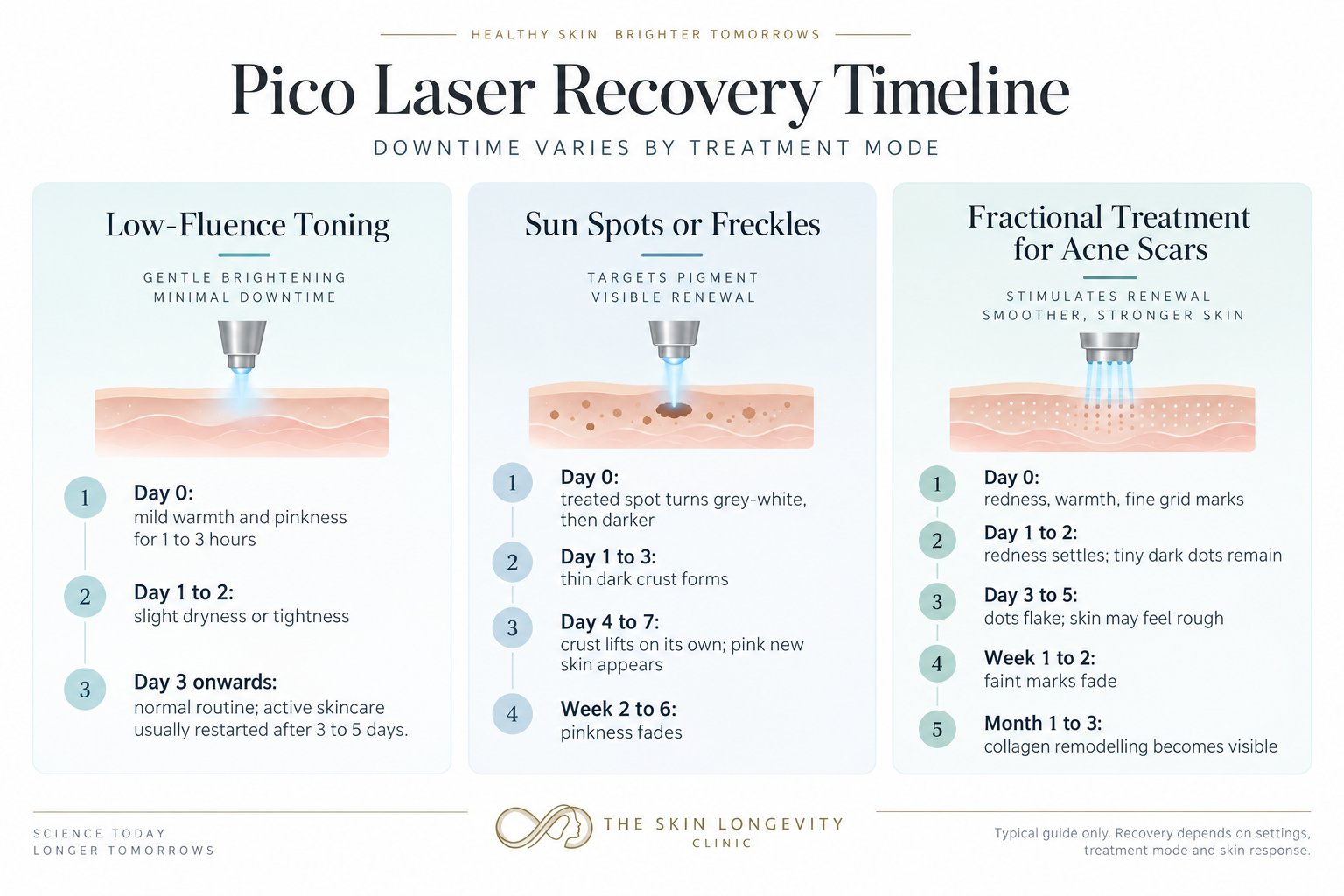
Toning (low-fluence, full face): 0 to 1 day of mild redness. Spot treatment (sun spots, freckles, age spots): 5 to 7 days for darkening and crusting to lift; pinkness for a further one to two weeks. Fractional treatment (acne scars, texture): 2 to 5 days of redness and swelling with a visible micro-grid; faint marks for up to two weeks. Tattoo removal: 1 to 2 weeks of redness, swelling and sometimes blistering, then gradual fading over the following weeks.
In the trials that recorded them, reported reactions after picosecond laser were discomfort, redness, swelling, pinpoint bleeding, crusting, blistering, transient hyper- or hypopigmentation and, rarely, scarring1,2. In a split-face randomised comparison in Asian patients, healing time and side-effect rates did not differ between picosecond and Q-switched lasers, but picosecond treatment was less uncomfortable3.
Pico laser side effects: how often do they happen?
Side effects depend on the wavelength and the mode of treatment.
- Melasma: in a meta-analysis of six randomised trials, 1064 nm picosecond laser reduced melasma scores without significant side effects. 755 nm picosecond laser caused post-inflammatory hyperpigmentation (PIH) in some patients5.
- Sun spots: in Asian patients treated with a 532 nm picosecond laser, PIH occurred in under 5% of treated spots6. In a randomised trial, adverse events did not differ between picosecond and nanosecond 532 nm lasers7.
- Repeated toning: mottled white spots have been reported after repeated low-fluence Q-switched laser toning, in some cases after only a few sessions8. This is why toning courses are limited and reviewed.
PIH usually appears as darkening 2–4 weeks after treatment and fades over weeks to months with sun protection and topical treatment.
Day by day after low-fluence toning
Day 0. Mild warmth and pinkness for one to three hours. Sunscreen applied in clinic. Make-up can usually be worn the next day.
Day 1 to 2. Skin may feel slightly dry or tight. No visible change is expected yet; brightening builds over the series.
Day 3 onwards. Normal routine. Retinoids and acids are restarted when the clinic advises, usually after three to five days.
Day by day after spot treatment of sun spots or freckles
Day 0. The spot turns grey-white for minutes, then darker than before. Mild swelling around each lesion.
Day 1 to 3. The spot forms a thin dark crust. Do not pick. Cleanse gently and pat dry.
Day 4 to 7. Crusts lift on their own, revealing pink new skin. Sunscreen and shade are essential; this is the window in which post-inflammatory hyperpigmentation forms if the area is exposed.
Week 2 to 6. Pinkness fades. Residual pigment is assessed at review; a second session is planned only if pigment remains.
Day by day after fractional treatment for acne scars
Day 0. Redness, warmth and a fine grid of pinpoint marks. Swelling peaks that evening.
Day 1 to 2. Redness settles; the grid becomes tiny dark dots as the micro-columns heal.
Day 3 to 5. Dots flake. Skin may feel rough; moisturiser is used freely.
Week 1 to 2. Faint marks fade. Texture change is not expected yet.
Month 1 to 3. Collagen remodelling produces the visible change; scars are reviewed at three months4.
Aftercare that protects the result
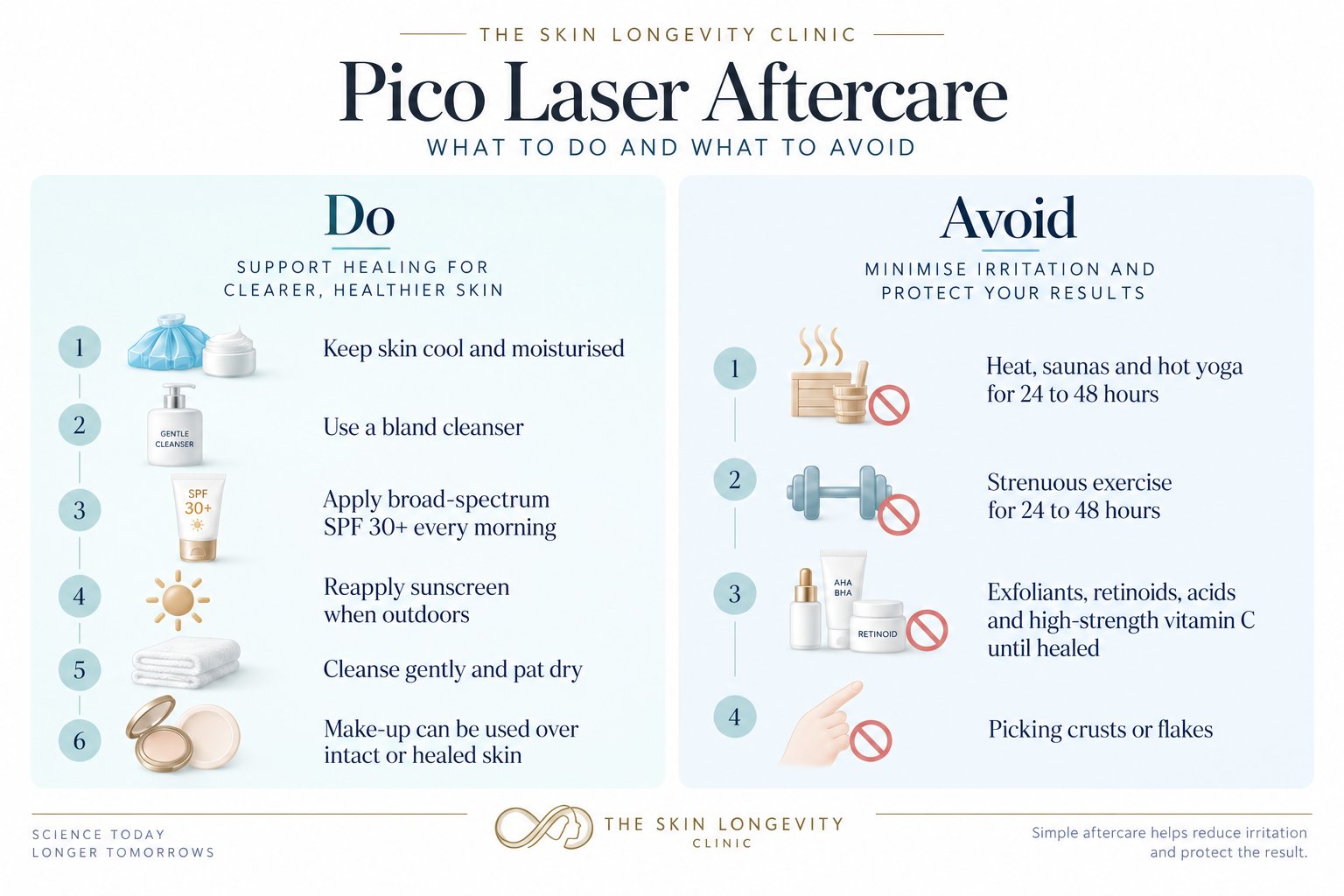
Consensus recommendations for laser aftercare in pigment-prone skin are to keep the treated skin cool and moisturised, avoid heat, saunas, hot yoga and strenuous exercise for 24 to 48 hours, use a bland cleanser, and apply broad-spectrum sunscreen of SPF 30 or higher every morning and reapply outdoors1. Exfoliants, retinoids, vitamin C at high strength and acids are paused until the skin has healed. Crusts are never picked. Make-up can be applied over intact skin after toning, and over healed skin after spot or fractional treatment.
Can I go out in the sun after pico laser?
Yes, with protection. Freshly treated skin darkens easily in Singapore sun. Use a broad-spectrum sunscreen every morning, reapply when outdoors, and add shade or a hat for the first two weeks.
For melasma-prone skin, choose a tinted sunscreen. In a randomised trial, sunscreen that also blocked visible light improved melasma more than UV-only sunscreen9. A tinted sunscreen kept melasma skin more even through summer10. Avoid tanning for four weeks before and after treatment.
Which symptoms need review?
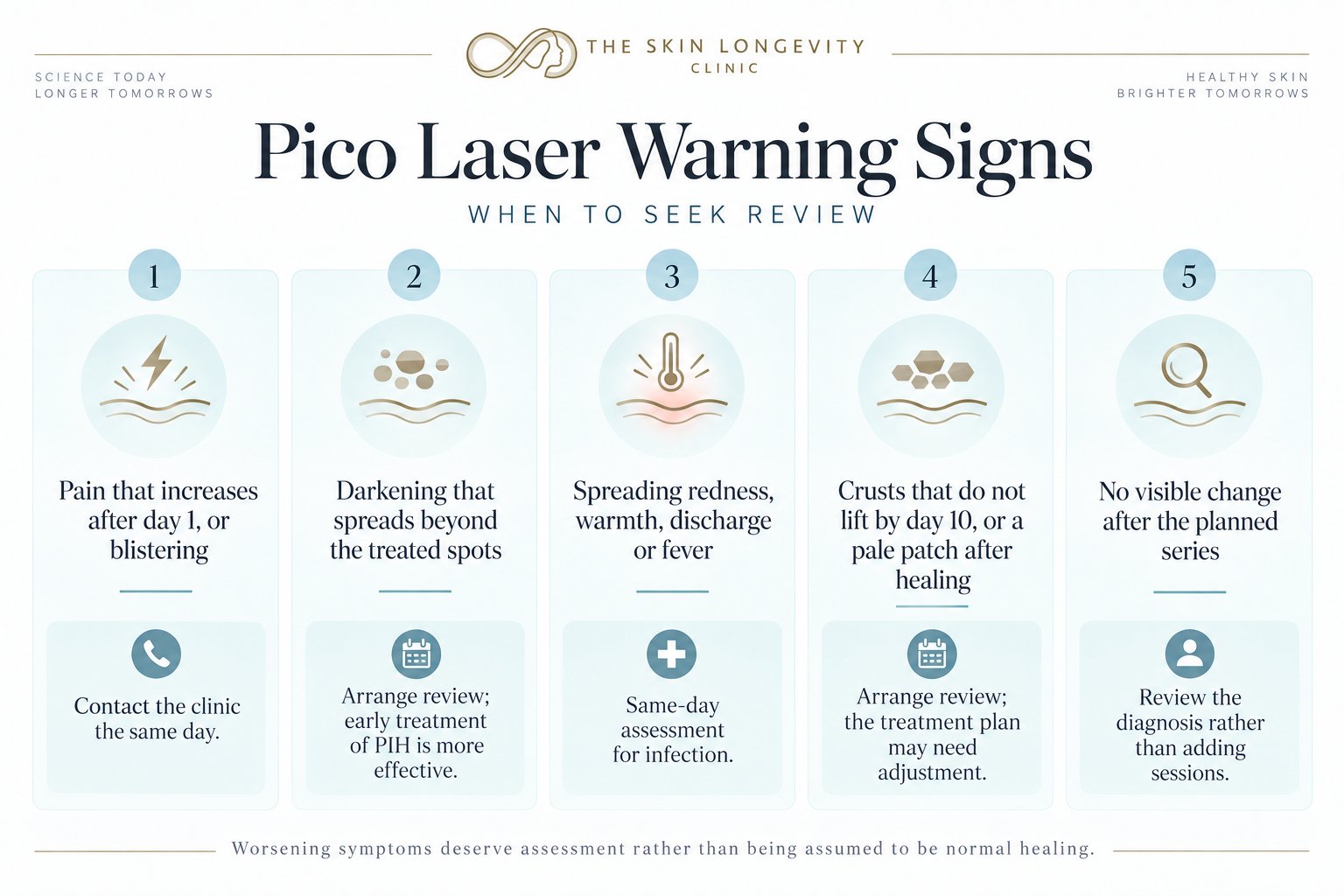
| What you notice | What to do |
|---|---|
| Pain that increases after day 1, or blistering | Contact the clinic the same day |
| Darkening that spreads beyond the treated spots | Contact the clinic for review; early treatment of PIH is more effective |
| Spreading redness, warmth, discharge, fever | Same-day assessment for infection |
| Crusts that do not lift by day 10, or a pale patch after healing | Arrange review; may need a change of plan |
| No visible change after the planned series | Review the diagnosis rather than adding sessions |
Our guide to how many pico laser sessions you need explains when improvement is assessed, and our guide to pigmentation treatment in Singapore covers each type of pigmentation and its treatment.
Contacting The Skin Longevity Clinic
Telephone +65 6514 2688, Monday to Friday 9.30 am to 5.30 pm and Saturday 9 am to 1 pm. Give the treatment date, the mode of treatment, when the symptom began and whether it is improving or worsening. The contact page lists location and appointment arrangements.
References
- Wu DC, Goldman MP, Wat H, Chan HHL. A Systematic Review of Picosecond Laser in Dermatology: Evidence and Recommendations. Lasers in Surgery and Medicine. 2021;53:9 to 49. https://pubmed.ncbi.nlm.nih.gov/32282094/
- Dong W, Wang N, Yuan X, et al. Treatment of pigmentary disorders using picosecond laser in Asian patients: a meta-analysis and systematic review. Dermatologic Therapy. 2021;34:e14709. https://pubmed.ncbi.nlm.nih.gov/33368885/
- Ungaksornpairote C, Manuskiatti W, Junsuwan N, et al. A Prospective, Split-Face, Randomized Study Comparing Picosecond to Q-Switched Nd:YAG Laser for Treatment of Epidermal and Dermal Pigmented Lesions in Asians. Dermatologic Surgery. 2020;46:1671 to 1675. https://pubmed.ncbi.nlm.nih.gov/32604235/
- Sirithanabadeekul P, Tantrapornpong P, Rattakul B, et al. Comparison of Fractional Picosecond 1064-nm Laser and Fractional Carbon Dioxide Laser for Treating Atrophic Acne Scars: A Randomized Split-Face Trial. Dermatologic Surgery. 2021;47:e58 to e65. https://pubmed.ncbi.nlm.nih.gov/32910030/
- Feng J, et al. Efficacy and safety of picosecond laser for the treatment of melasma: a systematic review and meta-analysis. Lasers Med Sci. 2023;38(1):84. https://pubmed.ncbi.nlm.nih.gov/36897459/
- Negishi K, et al. Prospective study of removing solar lentigines in Asians using a novel dual-wavelength and dual-pulse width picosecond laser. Lasers Surg Med. 2018;50(8):851–858. https://pubmed.ncbi.nlm.nih.gov/29608215/
- Vachiramon V, et al. Q-switched double frequency Nd:YAG 532-nm nanosecond laser vs. double frequency Nd:YAG 532-nm picosecond laser for the treatment of solar lentigines in Asians. Lasers Med Sci. 2018;33(9):1941–1947. https://pubmed.ncbi.nlm.nih.gov/29948457/
- Chan NP, et al. A case series of facial depigmentation associated with low fluence Q-switched 1,064 nm Nd:YAG laser for skin rejuvenation and melasma. Lasers Surg Med. 2010;42(8):712–9. https://pubmed.ncbi.nlm.nih.gov/20848553/
- Castanedo-Cazares JP, et al. Near-visible light and UV photoprotection in the treatment of melasma: a double-blind randomized trial. Photodermatol Photoimmunol Photomed. 2014;30(1):35–42. https://pubmed.ncbi.nlm.nih.gov/24313385/
- Polena H, et al. Comparison of Visible Light-Protective Tinted Sunscreen to Untinted Sunscreen to Protect Melasma Patients During Summer: A Prospective Randomized Investigator-Blinded Study. J Cosmet Dermatol. 2025;24(10):e70450. https://pubmed.ncbi.nlm.nih.gov/41014037/