

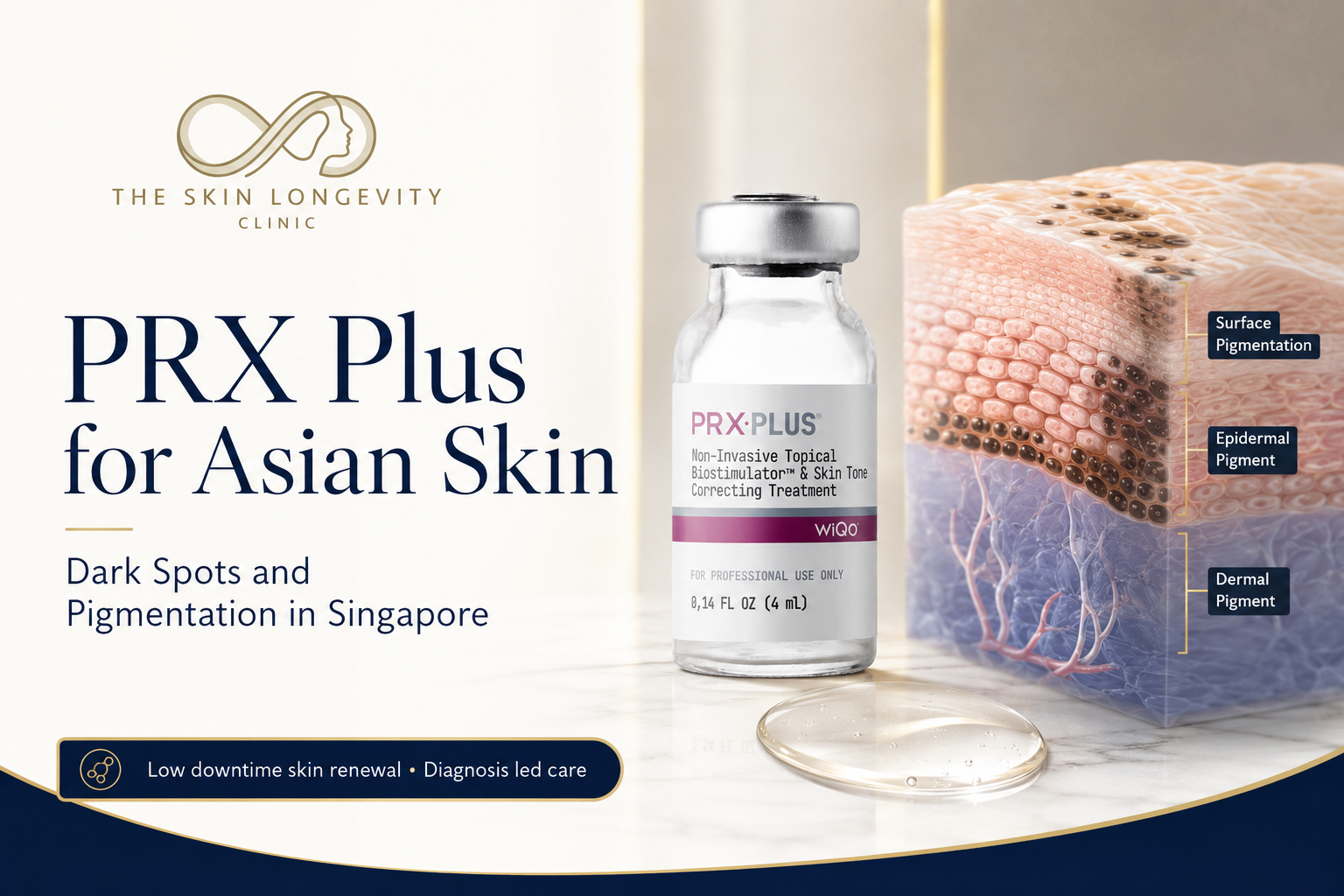
05 Aug PRX Plus for Asian Skin: Dark Spots and Pigmentation Singapore
By Dr Rachel Ho | Aesthetic Doctor, Founder, The Skin Longevity Clinic, Singapore
PRX Plus for Asian Skin: Which Dark Spots Can It Help?
Dark spots are among the most common skin concerns in Singapore, but they do not all arise from the same process. Freckles, sun spots, post inflammatory hyperpigmentation, melasma and deeper dermal pigmentation can look similar in photographs, yet their depth, behaviour and response to treatment are different.
PRX Plus may be considered when pigmentation occurs alongside dullness, rough texture or generally uneven skin tone. Its role is broader than removing an isolated brown spot. The treatment is better understood as a low downtime skin renewal option that may improve the overall clarity and quality of suitable Asian skin.
The starting point remains a diagnosis. A treatment that suits mild brown post acne marks may be ineffective for Hori’s naevus, while an aggressive approach to melasma may trigger more inflammation and rebound pigmentation. Reviews of post inflammatory hyperpigmentation and cosmetic procedures in skin of colour consistently emphasise the importance of diagnosis, conservative treatment selection and inflammation control1,2,5.
For an overview of the different pigment conditions seen locally, read our guide to hyperpigmentation treatment in Singapore for Asian skin.
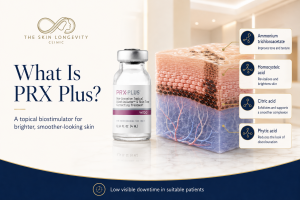
What is PRX Plus? It is an in-clinic topical biostimulator formulated to support skin brightness, texture and tone with little visible peeling in suitable patients.
What is PRX Plus?
PRX Plus is an in clinic topical treatment formulated with ammonium trichloroacetate, homocysteic acid, citric acid and phytic acid. It is described as a topical biostimulator because it is applied through a professional massage technique rather than injected into the skin.
The treatment is frequently compared with a chemical peel because it contains acid based ingredients. The clinical experience is different from a conventional peel, where visible exfoliation and shedding are central to treatment. PRX Plus is designed to support brightness, texture and skin quality with little visible peeling in most suitable patients.
Direct clinical evidence for PRX Plus is still developing. A registered study evaluated four PRX Plus treatments given two weeks apart together with a structured home care programme6.
PRX Plus also differs from Pico laser. Pico laser delivers short pulses of energy to selected pigment targets, while PRX Plus is applied topically and supports broader skin renewal. One may be more appropriate than the other depending on whether the concern is a defined pigment lesion, diffuse dullness, rough texture or a combination.
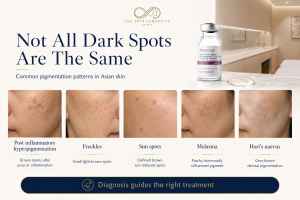
Dark spots in Asian skin may represent PIH, freckles, sun spots, melasma or Hori’s naevus. Identifying the pigment type and depth helps determine whether PRX Plus, skincare or laser treatment is more appropriate.
Why Asian skin needs a diagnosis first before embarking on PRX Plus Treatments
Post inflammatory hyperpigmentation, often shortened to PIH, develops when inflammation stimulates melanocytes to produce excess pigment. It is more common and may persist longer in people with more melanised skin, including many Asian patients1,2,.
The trigger may be acne, eczema, scratching, friction, a strong skincare reaction or an earlier procedure. This creates an important paradox in pigmentation treatment. A procedure intended to lighten a mark can make it darker if it causes excessive irritation1,2,5.
Ethnicity does not determine one fixed skin type, and Asian skin spans a wide range of complexions and sensitivities. Assessment should therefore consider the individual’s baseline tone, previous PIH, barrier health, active inflammation and history of reacting to peels or lasers. Reviews of cosmetic procedures in skin of colour recommend conservative settings, careful preparation and close attention to post treatment inflammation5.
Singapore’s year round sunlight, heat and visible light exposure also influence pigment recurrence. These factors are especially relevant for melasma, which behaves as a chronic and recurrent pigmentary disorder rather than a collection of ordinary dark spots3,4.
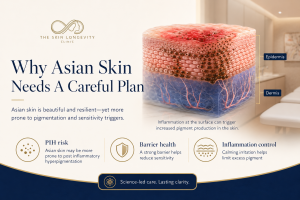
Medical skin cross-section showing how inflammation may stimulate excess pigment and increase post-inflammatory hyperpigmentation risk in Asian skin.
Which dark spots can improve with PRX Plus?
Dull and uneven skin tone
PRX Plus is very helpful when the complexion looks generally dull, uneven or rough rather than when there is one sharply defined lesion. Improvements in surface smoothness can change how light reflects from the skin, creating a clearer and more radiant appearance.
Brighter looking skin does not necessarily mean that every focus of pigment has been removed. Early PRX Plus research has evaluated overall signs of photoageing and skin quality rather than proving clearance of every pigmentation diagnosis6.
Post inflammatory hyperpigmentation
Flat brown marks left after acne are a form of post inflammatory hyperpigmentation (PIH). PRX Plus may be considered after active inflammatory acne has settled, particularly when the marks are accompanied by roughness, visible pores or general dullness.
PIH treatment works best when the inflammatory trigger is controlled. Continuing acne, friction or irritation can create new pigment even while older marks are being treated1,2.
The treatment does not correct the collagen loss responsible for ice pick, boxcar or rolling acne scars. These scars require a separate assessment for treatments such as subcision, fractional laser, radiofrequency microneedling or collagen stimulating procedures.
Superficial hyperpigmentation
Superficial pigment sits closer to the epidermis and may respond to topical skincare, controlled renewal treatments and selected peels. PRX Plus cann gradually improve these dark spots.
The broader chemical peel literature shows that superficial procedures can improve selected epidermal pigmentation in skin of colour, but results depend on the peeling agent, treatment depth, preparation and aftercare2,5.
Defined sun spots or freckles often require more targeted pigment treatment. A doctor may recommend Pico laser when the pigment’s colour, depth and distribution make energy based treatment more appropriate.
Melasma
PRX Plus canbe included in a broader melasma programme when the aims include improving brightness, texture and skin tolerance. Its role should be viewed as supportive rather than curative.
Melasma is driven by ultraviolet exposure, visible light, heat, hormones, inflammation and communication between cells in the epidermis and dermis. Chemical peel reviews describe peels as adjunctive treatments rather than standalone cures, particularly in darker skin types where excessive irritation may cause rebound pigmentation3,4.
Daily photoprotection and suitable pigment suppressing skincare remain central. Maintenance is usually required even after the complexion improves3,4.
PRX Plus and common types of dark spots in Singapore
| Pigmentation concern | Role of PRX Plus |
|---|---|
| Brown post acne marks | Lightens post inflammatory dark spots |
| Uneven skin tone | Improves brightness and surface smoothness |
| Superficial hyperpigmentation | Lightens these superficial hyperpigmentation, can be combined with other modalities to improve results. |
| Melasma | Lightens melasma, can be combined with other modalities to improve results. |
| Freckles and sun spots | Improves surrounding skin tone |
| Hori’s naevus | Limited role |
| Changing or irregular dark spots | Treatment should wait |
Which dark spots need a different approach to PRX Plus?
Freckles and sun spots
Freckles and solar lentigines are discrete epidermal pigment lesions. PRX Plus may improve the surrounding complexion, but a pigment laser can provide more direct targeting when the diagnosis is clear.
New spots can still form with continued ultraviolet exposure. Sunscreen therefore protects the result regardless of the treatment chosen.
Hori’s naevus and dermal pigmentation
Hori’s naevus produces grey brown or slate coloured spots over the cheekbones. The pigment sits within the dermis, beyond the level addressed by most topical skincare and superficial renewal treatments.
A longer laser course is usually required. Hori’s naevus can also coexist with melasma, which makes correct diagnosis particularly important before treatment begins.
Active inflammatory conditions such acne, eczema and rosacea
Active acne, eczema, rosacea flares and a damaged barrier increase the risk of irritation and PIH. Stabilising inflammation first usually gives the skin a safer starting point for pigmentation treatment1,2,5.
A calm barrier improves comfort and reduces inflammatory signals that can continue driving pigment production.
Irregular or changing skin lesions
A dark spot that changes in size, shape, colour or surface should be examined before cosmetic treatment. Brightening skincare, peels and lasers can alter the appearance of a lesion and delay diagnosis.
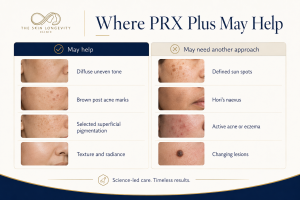
PRX Plus may support diffuse uneven tone, brown post-acne marks, selected superficial pigmentation and skin texture. Defined sun spots, dermal pigment and changing lesions may require another approach.
What happens during a PRX Plus treatment?
The skin is first cleansed and assessed. PRX Plus is then applied in sections using a controlled massage technique before the remaining solution is removed and suitable post treatment products are applied.
Patients commonly describe tingling, warmth or tightness during treatment. The session is relatively short, and most people return to ordinary activities afterwards.
The number of applications and treatment sessions depends on the treatment area, skin tolerance and concern. The registered study used four sessions at two week intervals, although this protocol should not be interpreted as appropriate for every patient6.
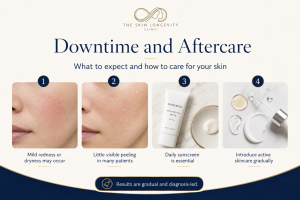
PRX Plus downtime is usually limited, although mild redness, dryness or light flaking may occur. Daily sunscreen and gradual reintroduction of active skincare help protect pigmentation-prone Asian skin.
Downtime and possible side effects of PRX Plus
Visible peeling is usually limited, although dryness, tightness, mild redness or light flaking can occur. The response varies with barrier condition, treatment intensity, home skincare and individual sensitivity.
Possible adverse effects include:
- Persistent irritation
• Increased sensitivity
• Dryness or peeling
• Temporary redness
• Post inflammatory hyperpigmentation
• Reactivation of an underlying inflammatory condition
Patients with more melanised skin may develop PIH after excessive irritation or inflammation. This risk is well documented across the broader literature on peels and cosmetic procedures in skin of colour11,2,5.
Stronger exfoliating acids, retinoids and irritating scrubs may need to be paused around treatment. The exact timing should follow the clinic’s instructions.
Aftercare for PRX Plus in Singapore’s climate
A gentle cleanser and barrier supporting moisturiser help maintain comfort after treatment. Broad spectrum sunscreen should be applied daily and reapplied when outdoor exposure is prolonged.
Patients with melasma or recurrent pigmentation may benefit from tinted sunscreen containing iron oxides because visible light can contribute to pigment persistence. Heat management, avoiding unnecessary friction and controlling active acne are equally relevant3,4.
New active skincare should be introduced gradually. Adding several brightening acids immediately after treatment can increase inflammation without accelerating pigment clearance.
PRX Plus versus other pigmentation treatment options
| Treatment | Main strength | Better suited to |
|---|---|---|
| PRX Plus | Broad brightness, texture and low downtime renewal | Dullness, uneven tone and selected superficial pigmentation |
| Pico laser | Targeted pigment fragmentation | Freckles, sun spots, Hori’s naevus and selected post acne marks |
| Prescription skincare | Daily pigment suppression and maintenance | Melasma, PIH and long term control |
| Conventional chemical peel | Controlled epidermal exfoliation | Selected superficial pigment and texture concerns |
| Combination programme | Addresses more than one mechanism | Mixed pigment, recurrent melasma and overlapping skin quality concerns |
PRX Plus versus other pigmentation options
The treatment with the strongest name recognition is not automatically the correct choice. Pigment depth, active inflammation, recurrence risk and downtime tolerance shape the final plan.
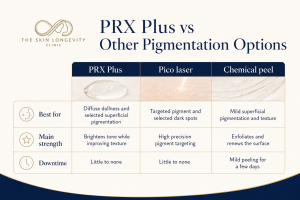
PRX Plus vs Pico laser vs chemical peel: PRX Plus supports broad tone and texture, Pico laser targets selected pigment, while chemical peels provide controlled surface renewal.
Who is suitable for PRX Plus?
PRX Plus is suitable for patients with dullness, uneven tone, PIH, selected superficial pigmentation, rough texture or enlarged looking pores. It also suit patients who want gradual skin renewal with little visible downtime.
Treatment may be postponed or changed when there is active dermatitis, inflamed acne, infection, significant barrier damage, recent tanning or an undiagnosed pigmented lesion. Pregnancy, medication use and previous reactions to procedures should also be reviewed during consultation.
The evidence for PRX Plus in darker Asian phototypes remains limited. Patients with a strong history of PIH therefore require especially careful assessment and conservative treatment planning2,6.
Dr Rachel Ho’s clinical perspective on PRX Plus treatments in Singapore
Asian patients often arrive asking for one treatment to remove dark spots. My first question is what type of dark spot they have, because a brown mark after acne, melasma and dermal pigment may look similar while requiring completely different treatment plans.
PRX Plus is most useful when pigmentation is part of a wider skin quality concern involving dullness, texture and low tolerance for downtime. A defined or deeper pigment lesion may need laser treatment, while unstable melasma may need skincare and inflammation control before any procedure.
The treatment should follow the diagnosis. A low downtime procedure still needs careful selection in pigmentation prone skin.
Frequently asked questions about PRX Plus in Singapore
Is PRX Plus safe for Asian skin?
PRX Plus may be considered for Asian skin after assessment of skin tone, barrier condition, active inflammation and PIH history. Direct controlled evidence across darker Asian phototypes remains limited, so careful patient selection and aftercare are important.[5,6]
Can PRX Plus remove dark spots?
PRX Plus can improve diffuse uneven tone and selected superficial pigmentation. Defined freckles, sun spots, deeper dermal pigmentation and changing lesions may require a different approach.
Is PRX Plus suitable for post acne marks?
Flat brown post acne marks may improve once active acne is controlled. Indented acne scars require collagen remodelling treatments rather than pigmentation treatment alone.
Can PRX Plus treat melasma?
PRX Plus may support brightness and texture as part of a broader melasma plan. Photoprotection, pigment suppressing skincare and maintenance remain necessary because melasma tends to recur.[3,4]
Does PRX Plus cause peeling?
Most patients experience little visible peeling, although mild dryness, tightness or flaking can occur. Describing the treatment as having no downtime would overlook these possible short term effects.
Is PRX Plus better than Pico laser?
Each treatment has a different role. PRX Plus supports broad skin renewal, while Pico laser offers more targeted treatment for selected pigment and texture concerns.
Takeaway on PRX Plus treatments for Asian skin in Singapore
PRX Plus can enhance brighter, smoother and more even looking skin with limited downtime. Its strongest role is in diffuse dullness, texture and selected superficial pigmentation rather than every type of dark spot.
Asian skin requires a measured plan because inflammation can create persistent PIH. Diagnosis, barrier health, sun protection and realistic expectations determine whether PRX Plus, Pico laser, chemical peels or a combination is most appropriate1,2,5.
References
- Mar K, et al. Treatment of post inflammatory hyperpigmentation in skin of colour. Journal of Cosmetic Dermatology. 2024.
- Davis EC, Callender VD. Postinflammatory hyperpigmentation: a review of the epidemiology, clinical features and treatment options in skin of colour. Journal of Clinical and Aesthetic Dermatology. 2010;3:20 to 31.
- Sarkar R, et al. Chemical peels in melasma: a review with consensus recommendations. Indian Journal of Dermatology. 2017;62:578 to 584.
- Mpofana N, et al. Treatment of melasma on darker skin types: a scoping review. Cosmetics. 2023;10:25.
- Desai M, et al. Cosmetic procedures in patients with skin of colour. Journal of Clinical Medicine. 2023;12:1955.
- Homocysteic Acid Biostimulator for Photoaged Facial Skin. Clinical trial registration NCT07722351. This is a registered study record rather than a peer reviewed journal publication.