

06 Oct Microneedling in Singapore, Including Types, RF Microneedling, Results and Recovery
Microneedling in Singapore covers several different procedures that share one principle. Fine needles create tiny controlled injuries in the skin, and the wound healing response that follows lays down new collagen. The term is applied to everything from home rollers and salon microneedling facials to doctor-performed fractional radiofrequency (RF) microneedling. These are not the same treatment, and the differences between them decide what can realistically be improved.
This guide from The Skin Longevity Clinic explains the types of microneedling available in Singapore, how microneedling compares with RF microneedling, which skin concerns respond, how many sessions are usual, what recovery involves and who should not have it. The procedure itself is described in detail on the clinic’s treatment page for RF microneedling in Singapore.
Medically reviewed by Dr Rachel Ho, MBBS, MMed (ENT). Last reviewed 6 October 2026.
What is microneedling and how does it work?
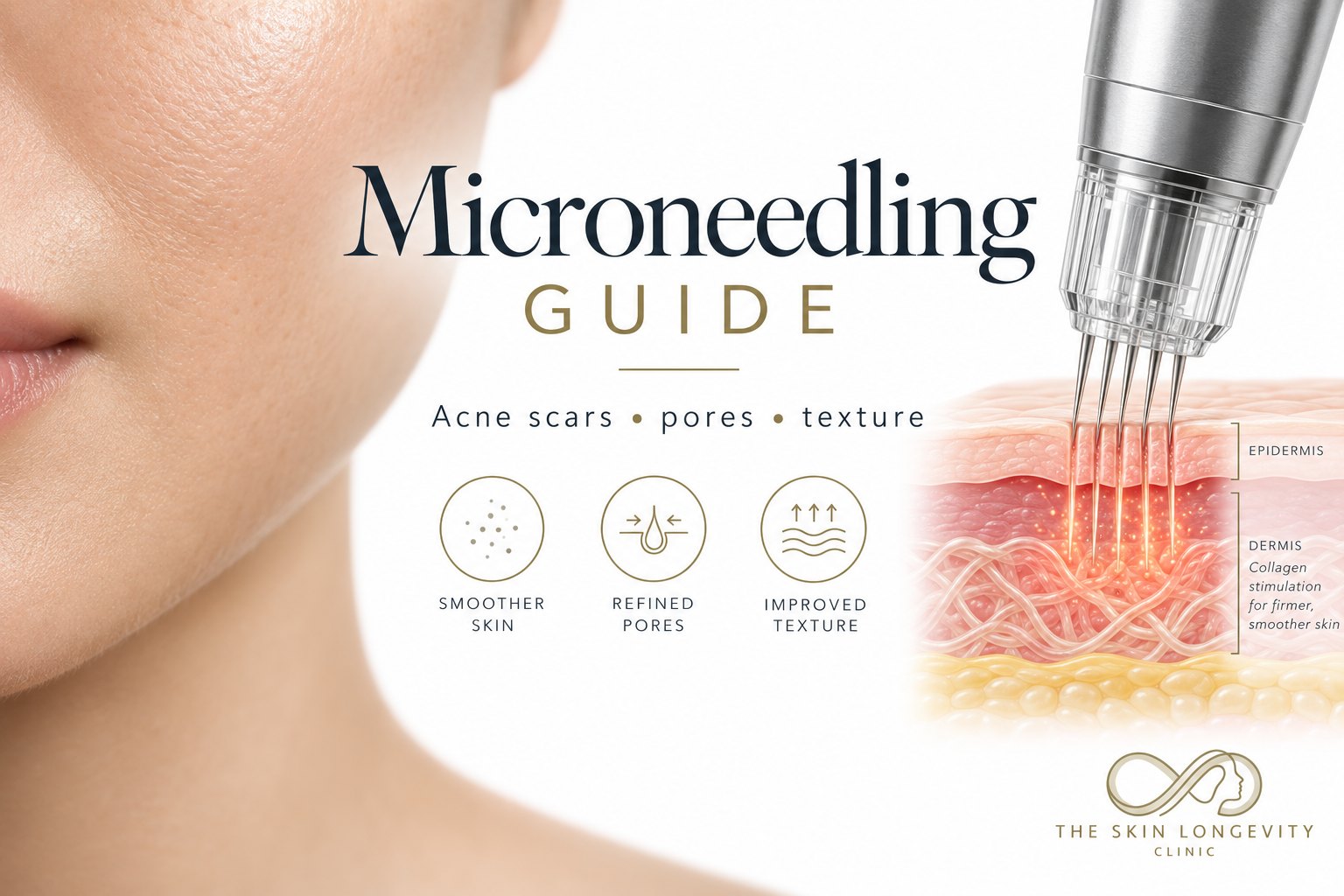
Microneedling, also called percutaneous collagen induction, uses sterile needles to create hundreds of microscopic channels in the skin. Each channel is a small wound, and the brief bleeding and inflammation it provokes release the growth factors that start repair. Over the following weeks fibroblasts, the cells that build the dermis, are activated and produce new collagen and elastin while the existing collagen is remodelled. Because each session adds to the collagen laid down by the last, most protocols use a course rather than a single visit1.
Needle depth decides which layer of skin the treatment reaches. Shallow needling of 0.25 to 0.5 mm affects the epidermis and upper dermis and is used mainly to improve product absorption or surface radiance. Scar remodelling requires the mid to deep dermis, which lies at 1.5 to 3.5 mm on the cheek depending on skin thickness and scar type. Depth, needle density, the radiofrequency energy level where it is used, and the number of passes are the variables a doctor adjusts for each patient1.
Types of microneedling in Singapore
Dermaroller and at-home microneedling. Rollers and stamps sold for home use carry short needles, typically 0.25 to 0.5 mm. At that depth the needles stop in the epidermis and upper dermis and cannot reach scar tissue, and reuse of a non-sterile roller carries an infection risk because the device cannot be sterilised at home. They do not replace clinic treatment for acne scars.
Microneedling pen (mechanical microneedling). A motorised pen with a disposable needle cartridge is used in salons and clinics, and the depth is adjustable. Without energy delivery, the result depends entirely on the mechanical injury, so improvement in pitted scars is modest and accrues gradually over several sessions2.
Microneedling with platelet-rich plasma (PRP), exosomes or skin boosters. The channels created by needling are sometimes used to deliver PRP, exosome preparations or polynucleotides into the dermis. In Singapore, exosome products are not approved for injection, so they are applied topically onto freshly needled skin. Evidence that any of these additions improves on needling alone is still limited3.
Fractional RF microneedling. Insulated or non-insulated microneedles deliver radiofrequency energy at a set depth, so the dermis is heated directly while the surface is spared. The heat contracts the old collagen and triggers a stronger remodelling response than needle injury alone. This is the form of microneedling with the strongest clinical evidence for atrophic acne scars and enlarged pores, and it is the form offered at The Skin Longevity Clinic4,5. The procedure is explained step by step on the service page for fractional RF microneedling for acne scars and skin texture.
Microneedling vs RF microneedling compared
| Mechanical microneedling | RF microneedling | |
|---|---|---|
| Stimulus | Needle injury only | Needle injury plus radiofrequency heat delivered at the needle tip |
| Where the effect happens | Along the needle track, including the epidermis | Mostly at depth, because insulated needles spare the epidermis |
| Main use | Surface texture, fine lines, product delivery | Atrophic acne scars, enlarged pores, early laxity, melasma (selected) |
| Evidence in acne scars | Moderate improvement over many sessions | Comparable to fractional lasers in randomised trials, with less post-inflammatory hyperpigmentation5,6 |
| Pigmentation risk in Asian skin | Low | Low, because the epidermis is largely spared7 |
| Typical course | 4 to 6 sessions | 3 to 4 sessions, 4 to 6 weeks apart |
The radiofrequency component is what changes the outcome, because heat released inside the dermis contracts and remodels collagen in a way that needle injury alone does not. In a randomised split-face trial, fractional microneedling radiofrequency produced greater improvement in ice-pick and boxcar scars and a larger reduction in acne lesions than bipolar radiofrequency applied to the skin surface8. A 2021 critical review of radiofrequency microneedling concluded that the evidence for atrophic acne scars is the most consistent of all its indications4.
What can microneedling treat?
Acne scars. Rolling and boxcar scars respond best, because their base is broad enough for new collagen to lift. Ice-pick scars are too narrow and deep for needles to remodel and usually need TCA CROSS (chemical reconstruction of skin scars with trichloroacetic acid) first, and tethered rolling scars need subcision to release the fibrous bands that hold them down. RF microneedling then treats the texture that remains. A systematic review of fractional RF microneedling as monotherapy for acne scars found consistent improvement across studies, with Asian cohorts well represented5. Each scar type is matched to its treatment in the clinic’s guides to acne scar treatment in Singapore, subcision for acne scars and TCA CROSS for ice pick scars.
Enlarged pores. Pores look larger when the collagen around the follicle opening loses its support, and dermal heating tightens that collagen. In a prospective study of 30 patients, acne scar grade and the global assessment of large pores improved in more than 70 percent after fractional RF microneedling, with measurable gains in dermal density9. Other pore treatments are compared under large pores treatment in Singapore.
Active acne. Heat delivered at the depth of the sebaceous glands reduces oil output, and fractional RF microneedling reduced inflammatory and non-inflammatory lesions and sebum output in a prospective trial of 25 patients with moderate to severe acne10. At The Skin Longevity Clinic, active acne with oily skin is usually directed to selective sebaceous gland ablation, a different RF microneedling protocol that targets the oil gland itself.
Fine lines and early skin laxity. Dermal heating stimulates new collagen, and periorbital wrinkles improved in a Korean cohort with Fitzpatrick type IV to V skin after three sessions7. Established sagging involves structures deeper than the dermis, so the clinic assesses other options, described under skin tightening treatments in Singapore.
Melasma and pigmentation. Pulsed-type RF microneedling has reduced melanin index and erythema in refractory melasma in Korean studies, and a 2026 systematic review supports it as an adjunct to sun protection and topical treatment11,12. It is not a first-line melasma treatment, because any heat can provoke melasma in susceptible skin. The evidence is reviewed under RF microneedling for melasma, and the clinic’s full approach under melasma treatment in Singapore.
Is microneedling suitable for Asian skin?
Post-inflammatory hyperpigmentation (PIH) is the main concern in Fitzpatrick type III to V skin after any resurfacing, because the melanocytes in darker skin respond to inflammation by producing excess pigment. Fractional RF microneedling with insulated needles heats the dermis while sparing the epidermis, where those melanocytes sit, so PIH rates are low. One Korean study of skin types IV to V recorded mild hyperpigmentation in 10 percent of patients, and a 2026 meta-analysis of eight randomised trials found the PIH risk to be roughly a quarter of that seen after fractional CO2 laser6,7. Settings are still adjusted for darker skin, daily sun protection is required, and a history of PIH or melasma is discussed at the consultation.
How many microneedling sessions are needed and when do results show?
Collagen remodelling takes weeks, because new collagen is first laid down and then reorganised over the following months. Most patients notice smoother texture 4 to 6 weeks after the first session, and scar improvement is judged 3 months after the last session. Clinical trials of fractional RF microneedling for acne scars typically used three to four sessions at four to six week intervals5,8. Maintenance is decided individually, and the clinic reviews at 3 months rather than booking open-ended courses. The timing of the result review is set out on the service page under how soon can results be assessed.
What is the downtime after microneedling?
Mechanical microneedling causes redness for 1 to 2 days. Fractional RF microneedling causes redness, mild swelling and pinpoint crusting for 2 to 4 days, and makeup is usually possible from day 2 or 3. A meta-analysis comparing RF microneedling with fractional CO2 found that redness resolved about 1.7 days sooner after RF microneedling and that pain scores were lower6. The clinic’s day-by-day guide is RF microneedling downtime and aftercare.
Does microneedling hurt?
Topical anaesthetic is applied for 15 to 30 minutes before RF microneedling. Most patients describe heat and pressure rather than sharp pain, because the needles are fine and the anaesthetic numbs the surface where most pain receptors sit. Deeper settings used for scars are more uncomfortable than superficial passes, as the heat is released below the layer the cream reaches, which is one reason treatment intensity is matched to the indication rather than set to the maximum.
Is 40 too old for microneedling?
Age does not exclude microneedling, because fibroblasts respond to needling at any adult age and acne scars can be treated throughout adulthood. Collagen production slows after 40, however, so results for texture and fine lines may need more sessions. Established laxity is better addressed with skin tightening or collagen biostimulators, because it reflects loss of support below the dermis rather than surface texture.
What are the risks of microneedling?
Expected effects are redness, swelling, pinpoint bleeding and dryness. Uncommon effects include PIH, acne flares, prolonged redness and, rarely, tram-track marks from excessive pressure with mechanical devices. For RF microneedling specifically, the US Food and Drug Administration issued a safety communication in October 2025 after reports of fat loss, nerve injury and scarring when devices were used outside their cleared parameters13. The clinic’s protocol stays within cleared depth and energy settings and avoids high energy over thin tissue such as the temples and jawline, where fat and nerves lie close to the surface. Home devices and non-medical settings carry an infection risk from needle reuse.
Who should not have microneedling?
Microneedling is deferred or declined in several situations. Active skin infection or cold sores at the site are a contraindication, because needling spreads the organism across the treated area. Active inflammatory acne in the treatment area is deferred unless the acne protocol is chosen. A keloid tendency is a contraindication, because the controlled injury can itself provoke a raised scar. Oral isotretinoin within the last 6 months is a reason to wait, as the drug slows wound healing. Pregnancy is excluded because safety has not been studied. Uncontrolled diabetes and bleeding disorders impair healing and prolong bleeding from the needle channels. A pacemaker or other implanted electronic device excludes RF microneedling specifically, because the radiofrequency current can interfere with the device.
Microneedling vs other treatments for acne scars and texture
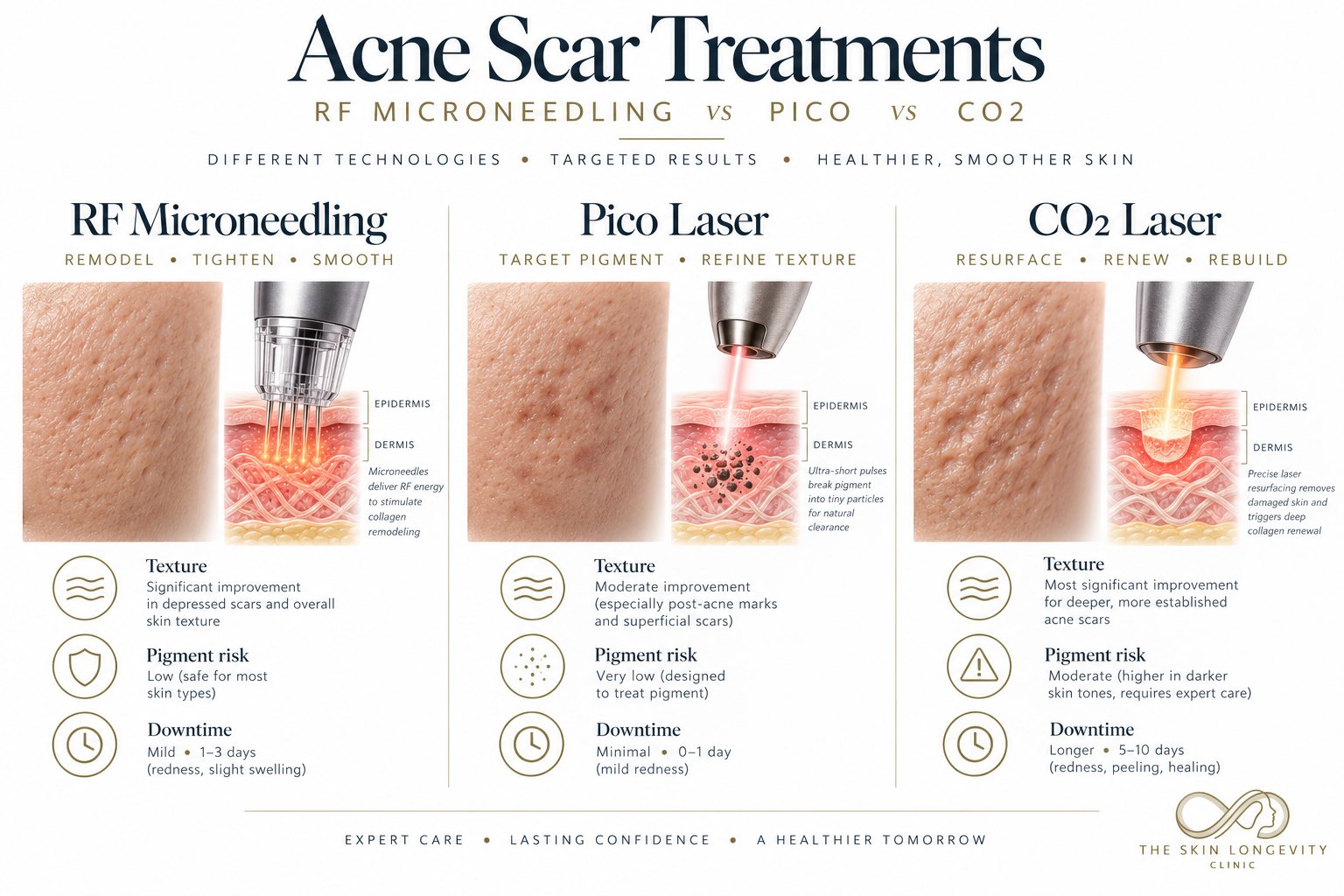
| Treatment | Best for | Downtime | PIH risk in Asian skin |
|---|---|---|---|
| RF microneedling | Rolling and boxcar scars, pores, early laxity | 2 to 4 days | Low6 |
| Fractional CO2 laser | Deeper atrophic scars | 5 to 7 days | Higher6 |
| Fractional pico laser | Shallow scars, pores, pigmentation | 1 to 3 days | Low14 |
| Subcision | Tethered rolling scars | Bruising 1 to 2 weeks | Low |
| TCA CROSS | Ice-pick scars | Crusting 5 to 7 days | Moderate |
| Skin boosters | Skin quality, hydration | 1 to 2 days | Low |
The comparison guide is RF microneedling vs pico laser vs fractional CO2.
How to choose where to have microneedling in Singapore
Microneedling is offered in beauty salons, aesthetic clinics and dermatology clinics, and the settings differ in who performs the treatment and in the depth and energy the operator is permitted to use. The questions that matter are who performs the treatment, which device is used and whether it is cleared for the indication, how depth and energy are chosen, whether the skin is assessed for PIH risk, and what the plan is if the scars do not respond. The clinic’s checklist is 12 questions to ask an aesthetic clinic.
Microneedling at The Skin Longevity Clinic
Dr Rachel Ho performs RF microneedling personally after a consultation that identifies the scar type, the pore pattern and the PIH risk, and sets the depth and energy for each area. The device used and the full procedure are described on the RF microneedling in Singapore page. Consultations are held at Scotts Medical Center, Orchard, and patients can contact the clinic to arrange one.
Dr Rachel Ho discusses microneedling and RF microneedling for acne scars, pores and skin texture in her doctor’s guide to RF microneedling.
Microneedling FAQs
Is RF microneedling better than microneedling?
For atrophic acne scars and enlarged pores, RF microneedling is the stronger treatment. The radiofrequency component produces deeper dermal remodelling with the epidermis spared, and randomised trials show greater scar improvement than needling or surface RF alone8. For superficial radiance, mechanical microneedling is sufficient.
How much does microneedling cost in Singapore?
Cost depends on the device, the area treated, the depth and energy needed and the number of sessions. The Skin Longevity Clinic provides a quotation after the consultation, once the scar type and the session plan are known.
How often can you do microneedling?
Mechanical microneedling is repeated every 4 weeks. RF microneedling is repeated every 4 to 6 weeks for three to four sessions, followed by a review.
Can microneedling make acne scars worse?
Over-aggressive treatment or needling over active infection can worsen scarring or trigger PIH. Appropriate depth, sterile technique and settings matched to the skin type keep this risk low.
Can I wear makeup after microneedling?
Makeup can usually be worn from day 2 to 3 after RF microneedling, once the pinpoint crusts have settled and there is no open skin.
Does microneedling help with large pores?
RF microneedling can reduce the appearance of large pores. Dermal density increased and pore appearance improved in more than 70 percent of patients in a prospective RF microneedling study9.
Can microneedling be combined with other treatments?
Microneedling is often combined with other treatments. Subcision performed before RF microneedling improved mixed acne scars more than RF microneedling alone in a split-face trial15. Skin boosters and polynucleotides are sometimes applied after needling.
Is microneedling safe for darker skin?
Fractional RF microneedling with insulated needles has a low PIH rate in Fitzpatrick type IV to V skin, and settings and aftercare are adjusted for the skin type7.
Selected references
- Alessa D, Bloom JD. Microneedling Options for Skin Rejuvenation, Including Non-temperature-controlled Fractional Microneedle Radiofrequency Treatments. Facial Plast Surg Clin North Am. 2020;28(1):1-7. doi:10.1016/j.fsc.2019.09.001. PMID 31779933.
- Weiner SF. Radiofrequency Microneedling: Overview of Technology, Advantages, Differences in Devices, Studies, and Indications. Facial Plast Surg Clin North Am. 2019;27(3):291-303. doi:10.1016/j.fsc.2019.03.002. PMID 31280844.
- Salameh F, Shumaker PR, Goodman GJ, et al. Energy-based devices for the treatment of acne scars: 2022 international consensus recommendations. Lasers Surg Med. 2022;54(1):10–26. doi:10.1002/lsm.23484.
- Tan MG, Jo CE, Chapas A, Khetarpal S, Dover JS. Radiofrequency Microneedling: A Comprehensive and Critical Review. Dermatol Surg. 2021;47(6):755-761. doi:10.1097/DSS.0000000000002972. PMID 33577211.
- Niaz G, Ajeebi Y, Alshamrani HM, Khalmurad M, Lee K. Fractional radiofrequency microneedling as a monotherapy in acne scar management: a systematic review of current evidence. Clin Cosmet Investig Dermatol. 2025;18:19–29. doi:10.2147/CCID.S502295.
- Argobi Y, Tobeigei F, Alasiri FI. Fractional CO2 Laser Versus Micro Needling Radiofrequency for Post Acne Scarring: A Meta-Analysis of RCTs. J Cosmet Dermatol. 2026;25(3):e70765. doi:10.1111/jocd.70765. PMID 41821146.
- Lee SJ, Kim JI, Yang YJ, Nam JH, Kim WS. Treatment of periorbital wrinkles with a novel fractional radiofrequency microneedle system in dark-skinned patients. Dermatol Surg. 2015;41(5):615-22. doi:10.1097/DSS.0000000000000216. PMID 25899885.
- Min S, Park SY, Yoon JY, Suh DH. Comparison of fractional microneedling radiofrequency and bipolar radiofrequency on acne and acne scar and investigation of mechanism: comparative randomized controlled clinical trial. Arch Dermatol Res. 2015;307(10):897-904. doi:10.1007/s00403-015-1601-z. PMID 26472097.
- Cho SI, Chung BY, Choi MG, Baek JH, Cho HJ, Park CW, et al. Evaluation of the clinical efficacy of fractional radiofrequency microneedle treatment in acne scars and large facial pores. Dermatol Surg. 2012;38(7 Pt 1):1017-24. doi:10.1111/j.1524-4725.2012.02402.x. PMID 22487513.
- Kim ST, Lee KH, Sim HJ, Suh KS, Jang MS. Treatment of acne vulgaris with fractional radiofrequency microneedling. J Dermatol. 2014;41(7):586-91. doi:10.1111/1346-8138.12471. PMID 24807263.
- Park BJ, Jung YJ, Ro YS, Chang SE, Kim JE. Therapeutic Effects of New Pulsed-Type Microneedling Radiofrequency for Refractory Facial Pigmentary Disorders. Dermatol Surg. 2022;48(3):327-333. doi:10.1097/DSS.0000000000003367. PMID 34999602.
- Kumar N, et al. The efficacy and safety of radiofrequency microneedling for melasma: a systematic review and qualitative evidence synthesis. Aesthet Surg J Open Forum. 2026;8:ojag075. doi:10.1093/asjof/ojag075.
- US Food and Drug Administration. Potential risks with certain uses of radiofrequency (RF) microneedling: FDA safety communication. 15 October 2025. www.fda.gov
- Sirithanabadeekul P, Tantrapornpong P, Rattakul B, Sutthipisal N, Thanasarnaksorn W. Comparison of Fractional Picosecond 1064-nm Laser and Fractional Carbon Dioxide Laser for Treating Atrophic Acne Scars: A Randomized Split-Face Trial. Dermatol Surg. 2021;47(2):e58-e65. doi:10.1097/DSS.0000000000002572. PMID 32910030.
- Faghihi G, Poostiyan N, Asilian A, Abtahi-Naeini B, Shahbazi M, Iraji F, et al. Efficacy of fractionated microneedle radiofrequency with and without adding subcision for the treatment of atrophic facial acne scars: A randomized split-face clinical study. J Cosmet Dermatol. 2017;16(2):223-229. doi:10.1111/jocd.12346. PMID 28432727.