


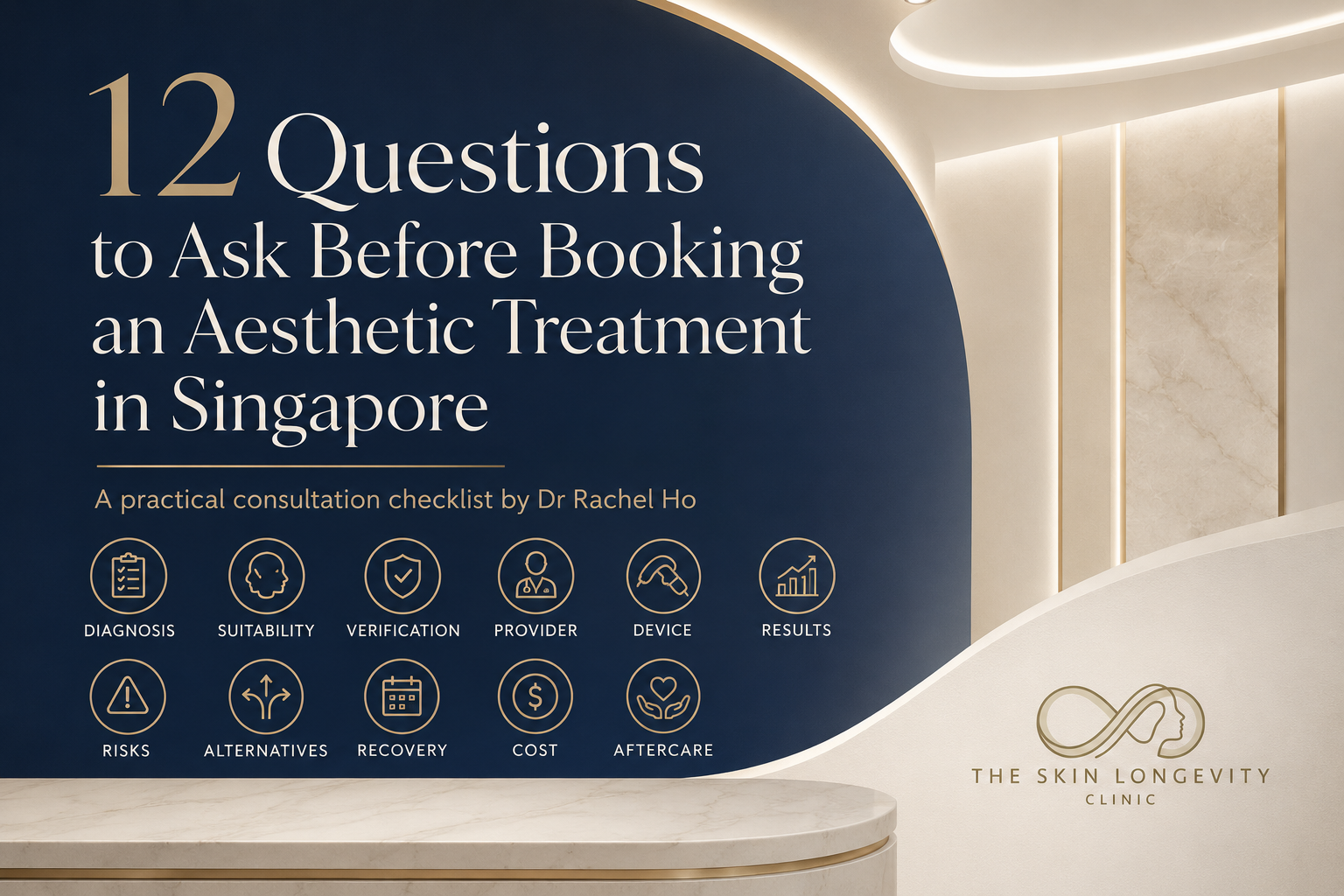
30 Aug 12 Questions to Ask an Aesthetic Clinic in Singapore
By Dr Rachel Ho | Aesthetic Doctor, Founder, The Skin Longevity Clinic, Singapore
Medically reviewed by Dr Rachel Ho, MBBS, MRCS, MMed (ENT), August 2026.
Many people begin by typing best aesthetic clinic Singapore into Google, then comparing reviews, prices or the name of a treatment seen online. Those details can be useful, although the consultation usually reveals more about the quality of care.
The phrase best aesthetic clinic is not an official medical ranking. A more meaningful comparison asks whether the clinic is licensed, the doctor is registered, the diagnosis makes sense and the proposed plan is proportionate to your goals.
One clinic may be well suited to acne scar management and less relevant to someone seeking conservative facial balancing. The right choice also depends on your skin type, facial anatomy, health history, tolerance for downtime, budget and appetite for maintenance.
These twelve questions can help you assess an aesthetic clinic in Singapore before you agree to treatment. A thoughtful clinic should answer them clearly and give you enough time to decide.
Why ask these questions before aesthetic treatment?
Look for a licensed healthcare provider, an appropriately registered doctor, a diagnosis before treatment, a personalised explanation of suitability, realistic outcomes, clear risks, a complete cost estimate and accessible aftercare. The quality of these answers is usually more useful than the length of a treatment menu or the size of a social media following.
For location and how a first visit works, see the aesthetic clinic in Orchard, Singapore.
For a quick comparison, take the following questions into the consultation. Each answer should be specific to you rather than a generic script.
- What is the diagnosis or underlying cause of my concern?
- Why is this treatment suitable for me?
- How can I verify the clinic and doctor?
- Who will assess me, perform the treatment and review me?
- Which product or device will be used, and why?
- What result is realistic for me?
- How many sessions may I need, and when should I judge the result?
- What are the common side effects and material risks?
- What are the reasonable alternatives, including waiting?
- How should I prepare, and what will recovery involve?
- What is the complete cost of the treatment plan?
- Who should I contact after treatment, and how are complications managed?

Dr Rachel Ho advises patients to begin with the diagnosis. The treatment should follow the underlying cause rather than the name of a product, device or procedure.
1. What is the diagnosis or underlying cause of my concern?
An aesthetic concern is an observation rather than a diagnosis. Pigmentation may reflect melasma, post inflammatory change, sun related lentigines or another condition, while a tired appearance can arise from skin quality, volume loss, bone support, muscle activity or several factors together.
The recommendation should follow the diagnosis. Singapore Medical Council guidance expects doctors to obtain sufficient information through a medical history, clinical examination and relevant investigations or records before offering an opinion, management plan or treatment1.
Ask the doctor to explain the likely cause in plain language and to identify any uncertainty. A treatment name alone does not explain why that treatment fits the problem.

Treatment suitability is personal. Medical history, skin condition, facial anatomy, treatment goals, acceptable downtime and budget can all change whether a procedure is appropriate.
2. Why is this treatment suitable for me?
Suitability depends on more than age or a photograph. Your medical conditions, medicines, supplements, allergies, pregnancy status, previous procedures, past reactions, current skin activity, facial anatomy, goals and available recovery time can all change the balance of benefit and risk.
For dermal fillers, a clinical review found that careful patient selection and attention to factors before, during and after treatment can help reduce complications2. The same principle applies more broadly because a technically sound procedure can still be the wrong choice for a particular person.
A thoughtful assessment should also explore motivation, expectations and the degree of distress attached to appearance. A 2024 systematic review reported a weighted prevalence of body dysmorphic disorder of 25 percent in cosmetic dermatology samples, although the cosmetic sample was relatively small and the included studies varied3. Singapore Medical Council guidance also requires reasonable care around psychological or psychiatric illnesses involving self and body image before aesthetic procedures1.
Screening is a safeguard rather than a judgement. A pause or referral may sometimes serve a patient better than another procedure, particularly when the expected cosmetic change is unlikely to relieve the underlying distress.

Patients in Singapore should verify both the healthcare provider and the doctor through official registers, then ask about qualifications and experience with the specific procedure.
3. How can I verify the clinic and doctor?
Patients can search the HealthHub directory for licensed healthcare service providers and use the Singapore Medical Council Professional Search to check a doctor. Every medical practitioner must be registered with the Singapore Medical Council and hold a valid Practising Certificate before practising medicine in Singapore4,5.
Ask about the doctor’s actual registration, qualifications and experience with the specific procedure or concern. Singapore Medical Council guidance also sets out approved aesthetic procedures and competence requirements for doctors6.
Awards, social media visibility and polished branding can supplement your research, but they do not replace official verification. Years in medicine alone also do not show how often someone performs a particular treatment.

Before treatment, ask who will examine you, select the dose or device settings, perform the procedure and manage follow up. Clinical responsibility should be clear at every stage.
4. Who will assess me, perform the treatment and review me?
The person you meet during consultation may not be the person carrying out every part of the plan. Ask who will examine you, select the settings or dose, perform the procedure, provide aftercare and assess any problem that arises.
Singapore Medical Council consent guidance states that patients should be informed about the people performing invasive procedures that carry higher risks1. When several team members are involved, their roles and clinical responsibility should be clear before treatment begins.

Ask for the exact product or device and the clinical reason it was selected. Newer or more expensive technology does not automatically provide a better result.
5. Which product or device will be used, and why?
Ask for the exact product name or device model, what it is intended to do and why it was selected over the reasonable alternatives. The answer should connect the technology to your diagnosis, skin type, anatomy and treatment goal.
For injectable treatments, ask about the product category, brand, amount and regulatory status. The Health Sciences Authority states that dermal fillers and botulinum toxin injections require its approval before they can be supplied and should be administered by qualified medical practitioner7.
A newer or more expensive machine does not automatically produce a better result. Patient selection, device settings, operator technique, maintenance and aftercare all influence safety and outcome.
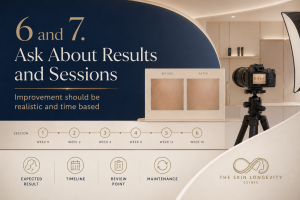
A sound treatment plan defines the expected degree of improvement, likely number of sessions, review point and maintenance. Standardised photographs make later comparisons more meaningful.
6. What result is realistic for me?
Results should be described in degrees rather than absolutes. Ask what is likely to improve, what may remain unchanged, when the change should become visible and how long the effect may reasonably last.
Standardised photographs can make later review more meaningful. A 2023 scoping review of dermatology photography found that camera type, settings, lighting, environment and standardisation all affect image quality8.
Useful before and after comparisons therefore keep the angle, distance, lighting, expression and camera setup as consistent as possible. Photographs should support an honest assessment rather than create an impression that ordinary variation is a treatment effect.
7. How many sessions may I need, and when should I judge the result?
Procedure time and result time are different. Some changes appear early, while collagen remodelling, pigment clearance or improvement across a treatment course may take longer.
Ask for an estimated number of sessions, the usual interval, the point at which response will be reviewed and any likely maintenance. A sensible plan should also explain what happens when progress is limited, including whether the diagnosis or treatment strategy will be reconsidered.
This question matters for both expectations and cost. A low price for one session has limited value when the probable plan involves several sessions and ongoing maintenance.
8. What are the common side effects and material risks?
A useful consent discussion separates expected temporary effects from uncommon but important complications. Ask how often each problem occurs, which personal factors may increase the risk, what the clinic does to reduce it and which symptoms require an urgent review.
Singapore Medical Council guidance states that patients should understand the purpose, benefits, significant limitations, material risks, possible complications and alternatives before consenting1. The discussion should be specific to the procedure and to your circumstances rather than a hurried signature on a standard form.
Pigment change deserves particular attention in Singapore. A review of post inflammatory hyperpigmentation found that it affects skin of colour disproportionately and that procedures such as chemical peels and lasers may worsen it in some patients9.
Ask how your skin tone, recent tanning, melasma history, active inflammation and previous pigment reactions influence the plan. Lower risk does not mean zero risk, and a careful explanation should avoid both alarmism and false reassurance.

Informed consent should explain expected effects, material risks, important complications and reasonable alternatives, including waiting. Patients should understand the trade offs before deciding.
9. What are the reasonable alternatives, including waiting?
Several routes may address the same concern. Depending on the diagnosis, alternatives may include skincare, prescription treatment, another procedure, surgery, referral, observation or leaving the area alone.
Shared decision making brings medical evidence together with the patient’s values and preferences. A review in cosmetic medicine described this two way process as an essential part of evidence based care because it helps determine whether expected benefits and harms fit the individual10.
Ask why the proposed option suits your priorities better than the alternatives. A clear answer should discuss trade offs such as degree of improvement, downtime, reversibility, maintenance, cost and risk.

The complete plan should cover preparation, realistic downtime, written aftercare, expected sessions, reviews and maintenance costs. A single session price rarely represents the full commitment.
10. How should I prepare, and what will recovery involve?
Preparation varies by procedure, so broad instructions can be misleading. Ask which medicines, supplements, skincare products, sun exposure, dental work, travel, exercise and upcoming social events are relevant to your treatment.
Downtime should be described as a realistic range rather than a promise of zero disruption. Ask about expected redness, swelling, bruising, tenderness, peeling or temporary changes in appearance, together with less common reasons for a longer recovery.
Written aftercare should distinguish normal recovery from warning signs. It should also state when you can resume makeup, exercise, heat exposure, sun exposure and active skincare for the procedure you are having.
11. What is the complete cost of the treatment plan?
Ask for a written estimate that includes consultation, the treatment area, product quantity, numbing, consumables, GST, the expected number of sessions, planned reviews and maintenance. This makes it easier to compare like with like rather than comparing one promotional number with a complete plan.
Package terms also matter. Check the validity period, expiry, transfer and refund terms, what happens to unused sessions and how the plan changes if the doctor later recommends stopping or switching treatment.
Price is a legitimate part of informed choice, but it is not a reliable proxy for quality. The lowest initial fee may have a higher total cost, while the most expensive recommendation may still be unnecessary for your concern.

Dr Rachel Ho advises patients to confirm who to contact, which symptoms require urgent review and how complications will be managed or referred before treatment begins.
12. Who should I contact after treatment, and how are complications managed?
Ask for the contact pathway before the procedure. You should know who reviews routine concerns, how to seek urgent advice, whether a planned review is included and when the clinic would refer you to another service.
Certain complications require prompt recognition. International consensus guidance on hyaluronic acid fillers emphasises prevention, early identification and preparedness for adverse events, which means a clinic providing fillers should have a clear response plan rather than an improvised one11.
A reassuring answer is specific. It explains the contact method, who will assess you, which warning signs are urgent and how the clinic manages or refers complications.
What should a good aesthetic consultation feel like?
A useful consultation should leave you clearer, even when you decide to wait. You should understand the likely diagnosis, treatment priorities, optional additions, expected improvement, limitations, risks, recovery, total cost and follow up.
Pressure to purchase immediately, generic bundles, guaranteed outcomes, reluctance to identify a product or device and an unclear review plan deserve further questions. A promotion alone does not prove poor care, but concern arises when commercial urgency replaces examination, informed consent and clinical reasoning.
Singapore rules require advertisements for aesthetic procedures by licensed healthcare providers to be accurate and truthful and to avoid inducing unnecessary use of healthcare services. This is another reason to treat the search term best aesthetic clinic Singapore as a request for evidence and transparency rather than a contest of superlatives12.
A clinical approach at The Skin Longevity Clinic
At The Skin Longevity Clinic, consultations are built around skin biology, facial anatomy and longer term planning. The Skin Longevity Assessment considers barrier function, pigment stability, inflammation, collagen support, facial structure and relevant lifestyle factors before recommendations are made.
Dr Rachel Ho is the founder of The Skin Longevity Clinic and has more than 16 years of clinical experience in Singapore. Patients can use the twelve questions in this guide at this clinic or any other aesthetic clinic, because informed choice should travel with the patient13.
Related reading from The Skin Longevity Clinic
The following guides expand on clinic verification, the first consultation, treatment pricing and warning signs. Reading them together gives a fuller framework for comparing aesthetic clinics in Singapore.
- Best Aesthetic Clinic Singapore? How to Choose Safely
- First Aesthetic Clinic Consultation Singapore: What to Expect
- Aesthetic Clinic Red Flags Singapore: Hard Selling and Packages
- Aesthetic Treatment Prices Singapore: Cost Guide for 2026
Frequently asked questions
How do I choose the best aesthetic clinic in Singapore?
Compare licensing, doctor registration, the quality of the assessment, suitability, realistic outcomes, risk disclosure, total cost and aftercare. The best fit for one concern or patient may differ from the best fit for another.
Should I book treatment during my first aesthetic consultation?
Treatment does not have to take place during the first visit. Taking time to read the plan, consider the risks and costs or seek another opinion is reasonable, especially for elective procedures.
How can I check whether an aesthetic clinic and doctor are registered in Singapore?
Search for the healthcare provider in the HealthHub directory and check the doctor through the Singapore Medical Council Professional Search. A clinic can also explain its licence details, but official directories provide independent verification.
Does the latest aesthetic device usually give the best result?
Technology matters, although novelty alone does not establish suitability or safety. Diagnosis, patient selection, settings, technique and follow up can matter as much as the device name.
What is the most important question to ask an aesthetic doctor?
Start by asking what is causing the concern. Once the diagnosis or anatomical explanation is clear, the discussion about treatment choice, expected benefit, alternatives and risk becomes much more meaningful.
Can a doctor advise me to avoid treatment?
A responsible consultation may conclude that treatment should be delayed, modified or avoided. This can occur when the likely benefit is small, the risk is disproportionate, the skin is not ready or the procedure is unlikely to meet the patient’s expectations.
References
- Singapore Medical Council. Ethical Code and Ethical Guidelines. 2016. Sections A2, B10, C5, C6 and G4.
- De Boulle K, Heydenrych I. Patient factors influencing dermal filler complications: prevention, assessment, and treatment. Clinical, Cosmetic and Investigational Dermatology. 2015;8:205 to 214. DOI 10.2147/CCID.S80446.
- Saade N, et al. The prevalence of body dysmorphic disorder in outpatient dermatology clinics: a systematic review. Clinical and Experimental Dermatology. 2024;49(11):1309 to 1315. DOI 10.1093/ced/llae204.
- Ministry of Health Singapore. Watchlist and official verification directories. Updated August 2026.
- Singapore Medical Council. Registration and Practising Certificate requirements. Updated October 2025.
- Singapore Medical Council. Guidelines on Aesthetic Practices for Doctors. 2016 edition. Webpage updated August 2026.
- Health Sciences Authority. Consumer advisory on dermal fillers and botulinum toxin injections. 2023.
- Kashetsky N, et al. Photography and Image Acquisition in Dermatology a Scoping Review: Techniques for High Quality Photography. Dermatologic Surgery. 2023;49(9):877 to 884. DOI 10.1097/DSS.0000000000003864.
- Anvery N, Christensen RE, Dirr MA. Management of post inflammatory hyperpigmentation in skin of color: A short review. Journal of Cosmetic Dermatology. 2022;21(5):1837 to 1840. DOI 10.1111/jocd.14916.
- Ubbink DT, Santema TB, Lapid O. Shared Decision Making in Cosmetic Medicine and Aesthetic Surgery. Aesthetic Surgery Journal. 2016;36(1):NP14 to NP19. DOI 10.1093/asj/sjv107.
- Signorini M, et al. Global Aesthetics Consensus: Avoidance and Management of Complications from Hyaluronic Acid Fillers. Plastic and Reconstructive Surgery. 2016;137(6):961e to 971e. DOI 10.1097/PRS.0000000000002184.
- Ministry of Health Singapore. Regulation of Advertisements for Aesthetic Treatments. 2024.
- The Skin Longevity Clinic. Dr Rachel Ho and the Skin Longevity Assessment. Accessed August 2026.
This article provides general education and does not replace an individual medical consultation. Suitability, risks, recovery and results depend on the person and procedure.