

22 Oct XERF vs Volnewmer in Singapore: A Doctor’s Comparison of Two Monopolar RF Treatments
By Dr Rachel Ho | Aesthetic Doctor, Founder, The Skin Longevity Clinic, Singapore
Medically reviewed by Dr Rachel Ho, MBBS, MRCS, MMed (ENT), 22 October 2026.
Dr Rachel Ho is an aesthetic doctor and the founder of The Skin Longevity Clinic. She holds an MBBS from the National University of Singapore, the MRCS (Edinburgh) and a Master of Medicine, with more than 16 years of clinical experience spanning facial reconstructive surgery and aesthetic medicine. Her work has been featured in Vogue Singapore, Harper’s Bazaar, CNA Lifestyle and The Straits Times. She also writes about skincare science at drrachelho.com.
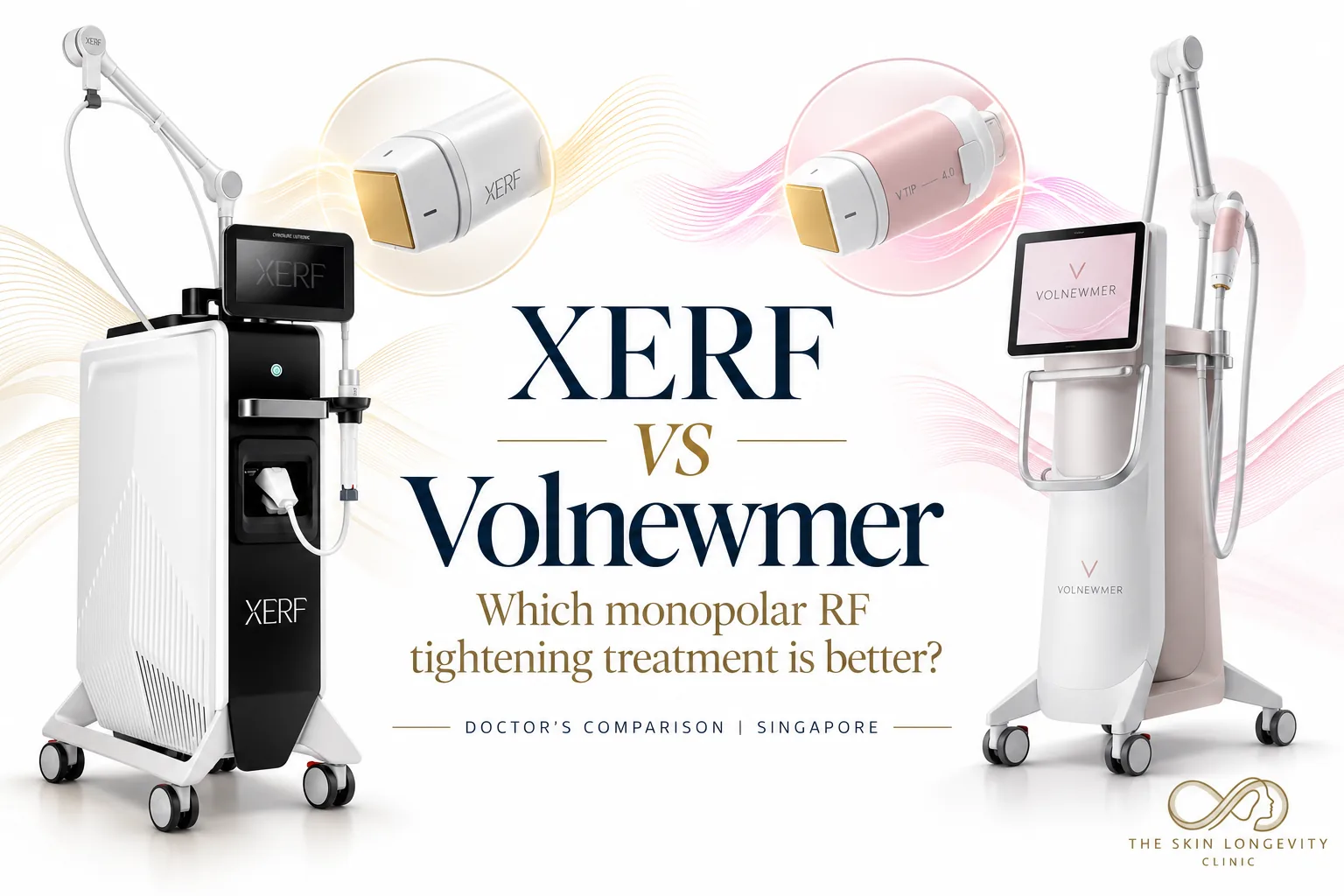
XERF and Volnewmer are both monopolar radiofrequency (RF) skin tightening devices made in Korea, and both are now offered in Singapore. Both treat skin laxity in the same way, by heating the dermis without needles or downtime so that existing collagen contracts and new collagen is laid down over the following weeks. The engineering differs. XERF delivers two frequencies, 6.78 MHz and 2 MHz, in one shot with three depth settings and cryogen cooling.1,2 Volnewmer delivers a single 6.78 MHz frequency with continuous water cooling.3,4
This comparison sets out what each device does, what the published studies show and why The Skin Longevity Clinic chose XERF. Where the evidence for either device is limited, the gap is stated rather than filled with manufacturer claims.
XERF vs Volnewmer at a glance
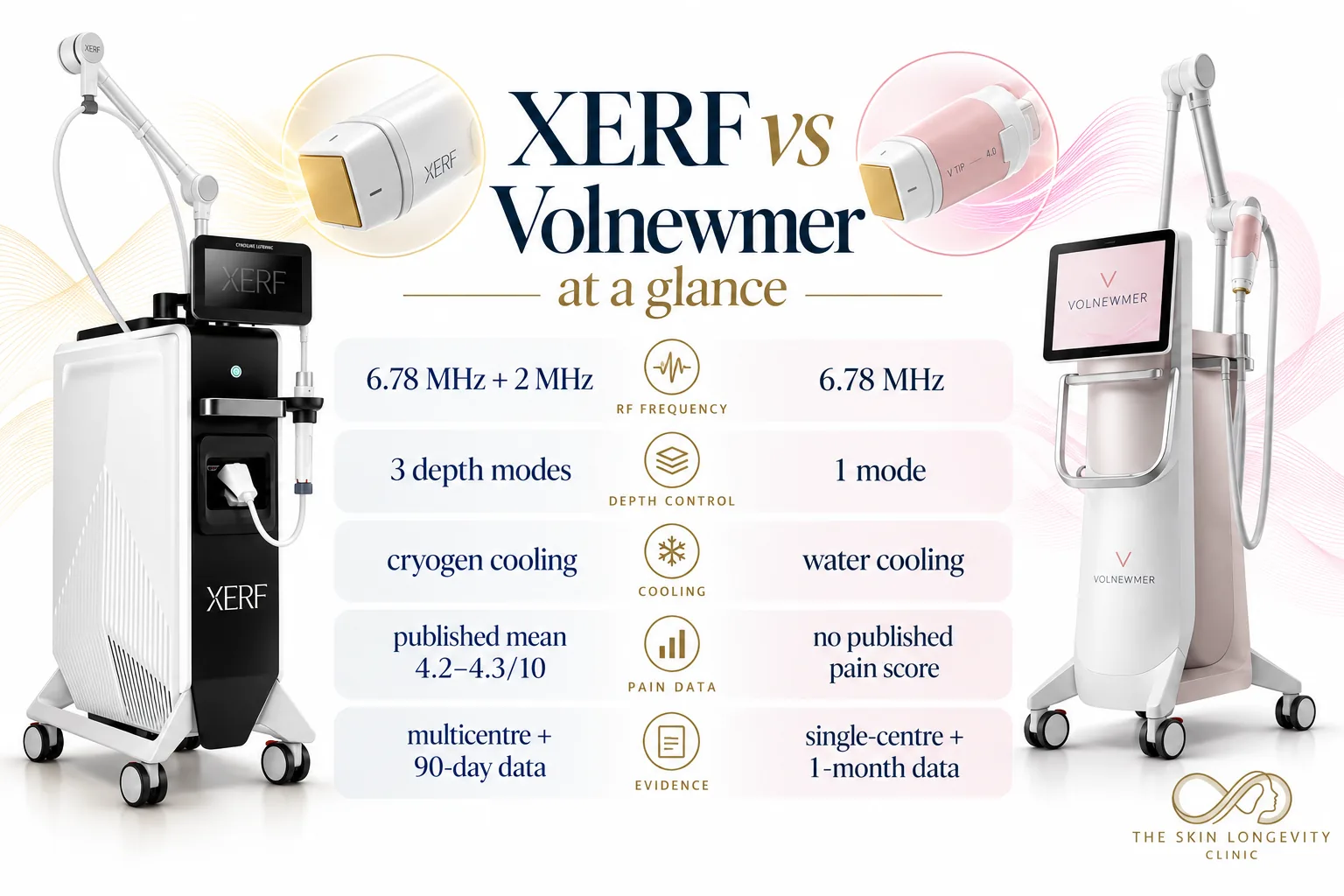
| Feature | XERF | Volnewmer |
|---|---|---|
| Manufacturer | Cynosure Lutronic, Korea1 | Classys, Korea3 |
| RF frequency | 6.78 MHz followed by 2 MHz in a single shot1,5 | 6.78 MHz only3,6 |
| Depth settings | Three, namely shallow (dermis), middle (superficial fat) and deep (deeper support layers)1,2 | One mode. Tip size changes the area treated, not the depth3,4 |
| Epidermal cooling | Integrated cryogen delivery, three levels1,13 | Continuous water contact cooling with tip vibration3,14 |
| Overheating safeguard | Real-time surface temperature monitoring. RF shuts off automatically above 43 °C13 | Real-time impedance check. Output stops if the tip lifts off the skin3,14 |
| Pulse delivery | WaveFit pulse train of sub-pulses adjusted to depth and energy2 | Single continuous pulse per shot with real-time impedance check3,4 |
| Tips | Four Effectors, 60 (20 × 30 mm), 40, 10 (10 × 10 mm) and 05 (10 × 5 mm)5,13 | I 0.25 cm², F 3.0 cm², V 4.0 cm², S 16.0 cm²3 |
| Published clinical studies | Prospective multicentre study (39 patients, 4 sites, 90-day follow-up). Retrospective 3D study with FACE-Q (16 patients, 3 months). Porcine histology of dual vs single frequency2,5,8 | Two single-centre, single-author studies (45 and 30 patients, 1-month follow-up). One case report6,7,9 |
| Measured pain without numbing cream | Mean visual analogue scale (VAS) score 4.2 of 10 (39 patients) and 4.3 of 10 (16 patients)2,5 | No pain scores published6,7 |
| Regulatory status | US Food and Drug Administration (FDA) cleared 2025 (K251327). Korean Ministry of Food and Drug Safety (MFDS)10 | US FDA cleared 2024 (K240248). Korean MFDS3 |
| Session time | 15 to 30 minutes, no numbing cream13 | Not stated3,14 |
| Manufacturer’s stated duration | 6 to 9 months after two sessions1 | Not stated. Brochure shows results at 8 and 12 weeks3,14 |
What is XERF?
XERF is a non-invasive monopolar RF device that passes current from a treatment tip through the skin to a return pad, and the tissue in the path of that current heats because it resists the flow.2 Monopolar means a single active electrode with the return pad placed elsewhere on the body, so the current travels through the full thickness of the skin and the fat beneath it, whereas bipolar RF passes current between two electrodes on the handpiece and stays close to the surface. Its distinguishing feature is dual frequency, with each shot delivering 6.78 MHz energy followed by 2 MHz energy.1,5 The higher frequency concentrates heat in the dermis and along the fibrous septa, the collagen-rich partitions that run through the fat layer and anchor the skin to the deeper structures, whereas the lower frequency penetrates further and heats the subcutaneous layer more broadly.5,8 Combining the two in one pulse is intended to heat the dermis, the dermal-subcutaneous junction and the deeper support layers in a single pass.8
The operator selects one of three depth modes, shallow, middle or deep, and one of ten energy levels, and the device shapes each shot as a train of sub-pulses (WaveFit) matched to that setting.1,2 Cryogen is sprayed onto the skin surface during each shot to protect the epidermis, and numbing cream is therefore not routinely required.1,2 The tip delivers energy evenly across its surface (“spider pattern”) to avoid hot spots at the edges, and a sensor monitors the skin surface temperature during every shot, switching the RF off automatically if it exceeds 43 °C.2,13 A full-face session takes 15 to 30 minutes without anaesthesia.13
Treatment areas on the manufacturer’s label include the brow and forehead, mid-face and cheeks, jawline and jowls, the submental area beneath the chin, the neck and fine lines.1 For the clinic’s own protocol, see the XERF skin tightening page and the XERF guide.
What is Volnewmer?
Volnewmer is a monopolar RF device from Classys, the Korean manufacturer of the Ultraformer high intensity focused ultrasound (HIFU) platform. It delivers a single 6.78 MHz frequency at up to 115 W through one electrode, with a real-time impedance check before each shot that confirms the tip is in full contact with the skin before energy is released.3,4 Instead of cryogen, the tip is cooled by water that circulates continuously, which the manufacturer describes as contact cooling of the epidermis.3,7 The electrode edges are recessed inside the tip (“hidden edge”) and the tip surface is curved so that heat spreads evenly rather than concentrating at the rim.3,14 Discomfort is managed with a four-step vibration and cooling setting rather than numbing cream, and the output stops if the tip loses contact with the skin.14 The consumable tips are rated for 3,000 to 6,000 shots and carry no time lock, which the manufacturer presents as a cost advantage to clinics.14
Four tips cover the eye area (0.25 cm²), the jawline and chin (3.0 cm²), the face (4.0 cm²) and the body (16.0 cm²).3 The published Volnewmer protocols use the 4.0 cm² tip at energy level 5 (115 J, 28.75 J/cm²) for 200 to 300 shots across the face.6,7 Volnewmer received US FDA 510(k) clearance in 2024.3
Dual frequency vs single frequency RF, what the histology shows
The frequency design is the central technical difference between the two devices, and it has been tested directly. A 2025 study in Lasers in Medical Science modelled 6.78 MHz, 2 MHz and dual-frequency monopolar RF in multilayered skin and then treated living porcine skin with each mode.8 The computational model showed that 2 MHz produced broader and deeper heating within fat, whereas 6.78 MHz produced more localised heating along the fibrous septa, the water-rich partitions through which current passes more readily than through fat. Dual frequency combined both effects, with the most pronounced thermal reaction at the dermal-subcutaneous junction.
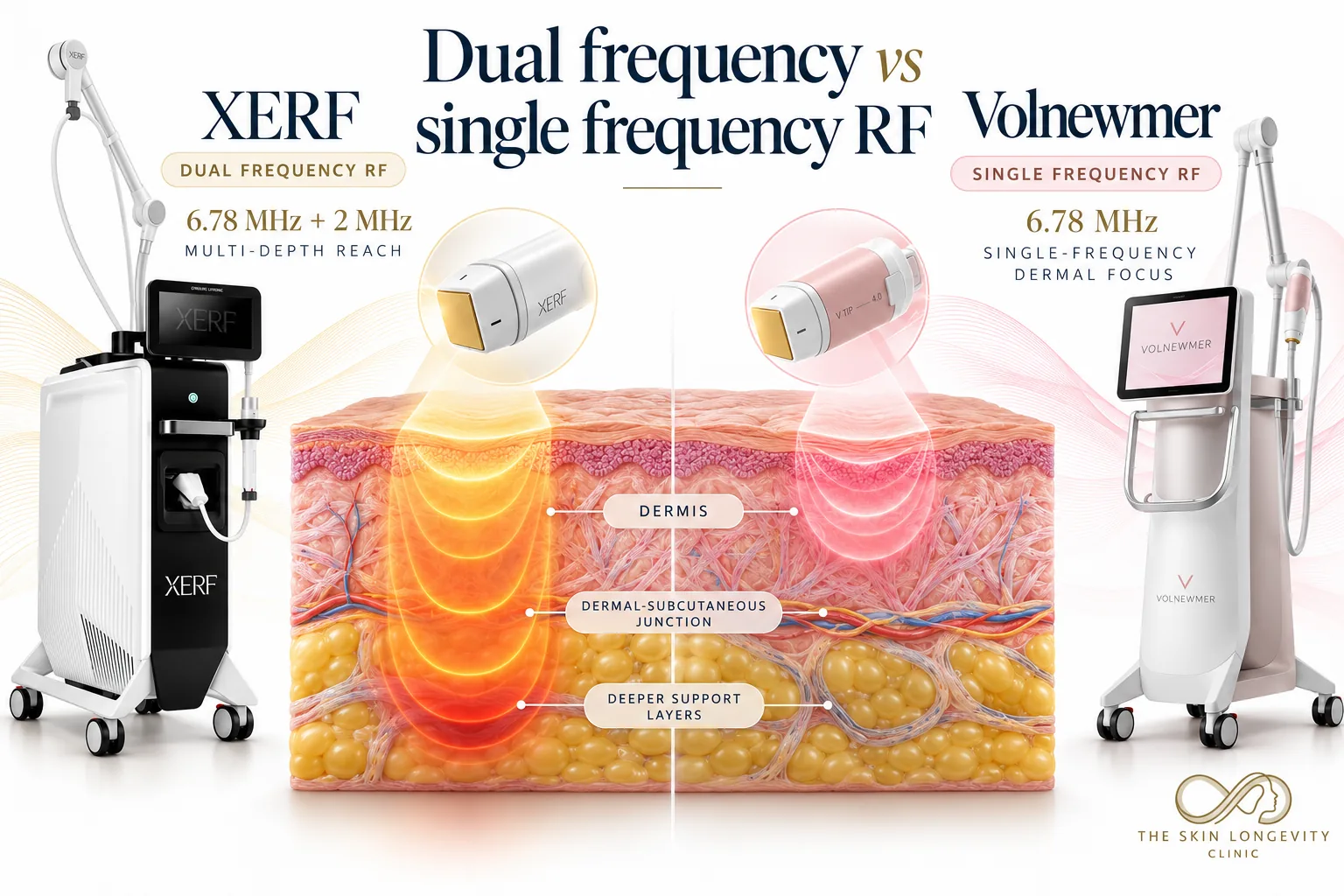
On histology, the dual-frequency specimens showed significant collagen and elastin remodelling across the dermis and the fibrous septa, with no death of fat cells (adipocytes), and the remodelling was more extensive and more persistent at later time points than with either single frequency.8 The authors concluded that dual-frequency treatment has greater tissue remodelling potential than single-frequency treatment.
Two caveats apply to this study. It was conducted in pig skin rather than human faces, and several of its authors are employees of the device manufacturer.8 It is nonetheless the only controlled, histology-based comparison of 6.78 MHz alone against 6.78 MHz plus 2 MHz, and it favours the dual-frequency design that XERF uses and Volnewmer does not.
Depth control, three XERF depth settings vs one Volnewmer mode
Facial laxity does not arise at a single depth. Thinning of the dermis, loss of septal support at the dermal-fat junction and loosening of the deeper fascial layer each contribute, and their proportions differ between the forehead, the periorbital area around the eyes, the cheek and the jawline.5 XERF’s shallow, middle and deep modes change how the energy is distributed between the two frequencies and the sub-pulses, so that the operator can match the target layer to the zone being treated.1,2 In the prospective multicentre study, the depth mode was selected per facial zone and per indication.2
Volnewmer offers one energy mode and varies the treated area through tip size.3,4 A larger tip heats a wider patch of skin, but the depth of heating is fixed by the penetration profile of 6.78 MHz alone. Classys describes the target as the papillary and reticular dermis, the upper and lower layers of the dermis.3 For a patient whose main problem is dermal thinning, that target is appropriate. For a patient with jowling or submental laxity, where the support layers below the dermis matter, a single-depth device is less likely to reach the tissue responsible.
Cooling and comfort, XERF cryogen vs Volnewmer water cooling
Both devices cool the skin surface so that the dermis can be heated without burning the epidermis, which sits directly beneath the tip and would otherwise reach a damaging temperature first. XERF uses an integrated cryogen delivery system with three cooling levels that sprays coolant during each shot, backed by the surface-temperature cut-off.1,2,13 Volnewmer uses water circulating through the tip at a constant temperature, with handpiece vibration to distract from the heat. The Volnewmer case report gives a device surface target of 12 to 14 °C.3,9,14
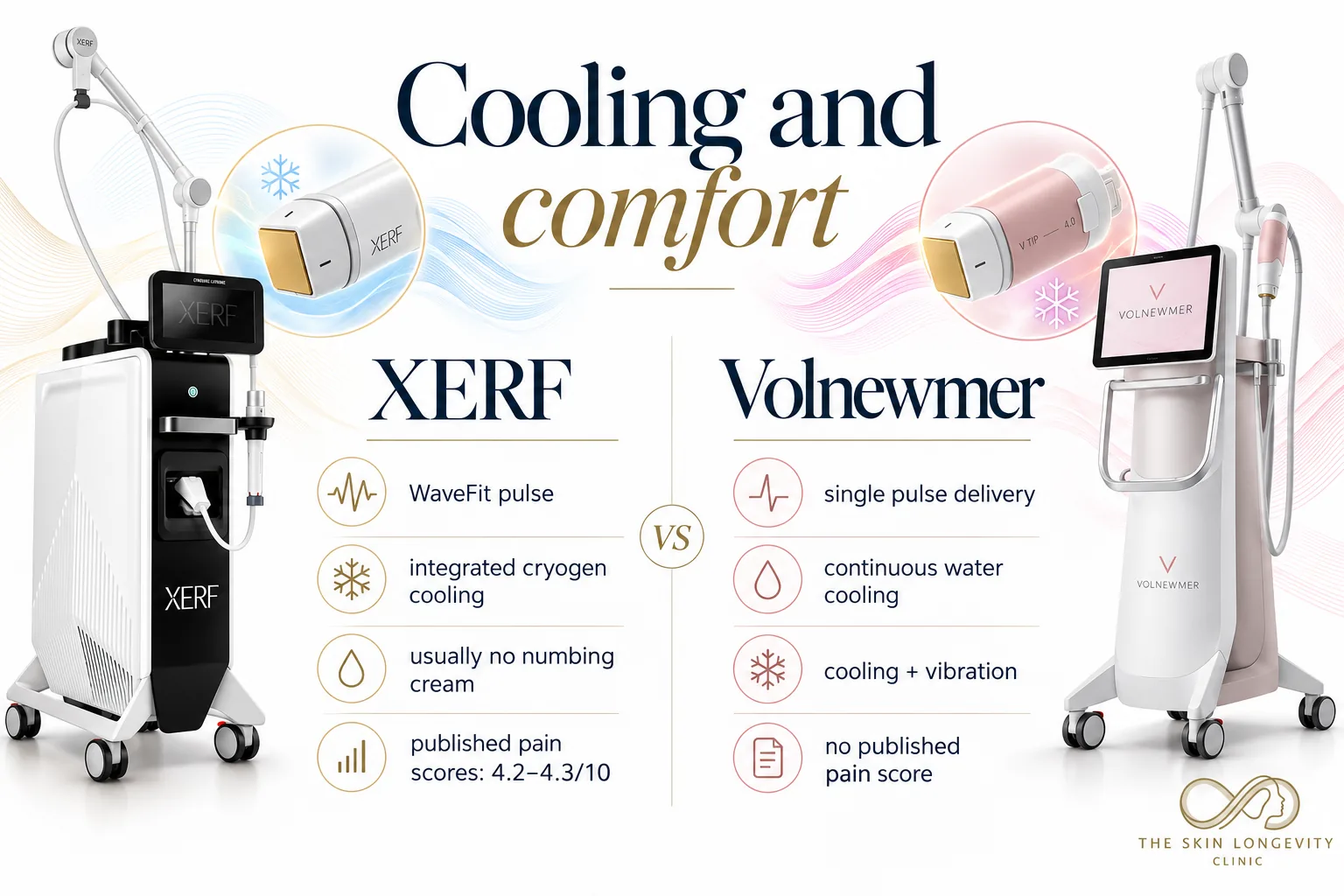
Comfort has been measured for XERF. In the multicentre study, 39 patients were treated without topical anaesthesia and reported an average pain score of 4.2 out of 10.2 In the retrospective study, the mean procedural pain score was 4.3 out of 10, with 38% reporting mild pain, 50% moderate and 12% severe. Numbing cream was applied only on request, in four of 16 patients.5 Energy was titrated to a target of mild to moderate discomfort, because the heat the patient feels is the operator’s indication that the dermis has reached the temperature needed for collagen contraction.5
For Volnewmer, the manufacturer describes the treatment as “virtually pain-free”,4 but neither published clinical study reports a pain score.6,7 The fine-wrinkle study records that a sliding technique was used “when the patient reacted to the heat” and that the segmented 200-millisecond pulses of the cooling system “can result in more pain”.7 A claim of comfort that has not been measured cannot be compared with one that has.
XERF vs Volnewmer tips and treatment areas
Volnewmer’s 16 cm² S tip gives it a large-area body applicator.3 XERF’s largest tip is the Effector 60 at 20 × 30 mm (6 cm²), so body treatment is performed with gliding passes that move the tip continuously across the area. The clinic’s approach is set out on the XERF body treatment page.5
Around the eyes the advantage reverses. XERF’s Effector 10 and Effector 5 tips were designed for the forehead, temple and infra-brow region and are used in deep mode, which the authors of the periorbital tip study argue overcomes the shallow penetration of conventional small tips.11 Volnewmer’s 0.25 cm² I tip is used for the eye area in its single mode, with no published periorbital outcome data.3 The clinic’s approach to the periorbital area is described on the XERF eye small tip page.
What the published evidence shows for XERF vs Volnewmer
XERF has been tested more rigorously, in more patients and over a longer follow-up, and the one study that compared its dual-frequency design against single-frequency RF favoured the dual-frequency approach.
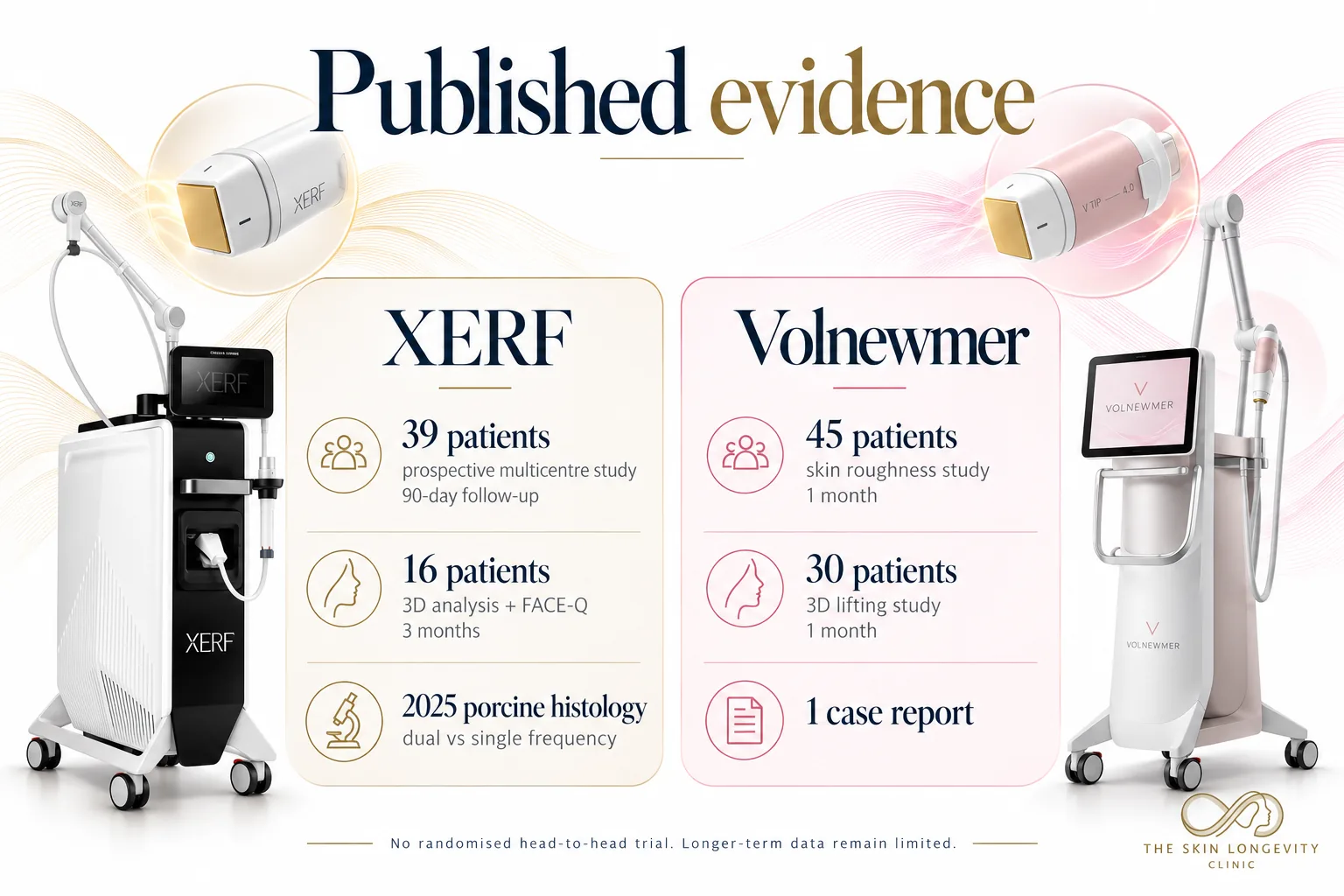
For XERF, a prospective study at four clinics treated 39 patients with two sessions. At 90 days, 92.3% were rated improved by the treating doctors and 84.6% of patients scored their own satisfaction at 4 or more out of 6, with no lasting side effects.2 A second study used 3D scanning and a validated questionnaire (FACE-Q) in 16 women after one session. Brows and upper eyelids lifted progressively over three months, skin texture and pore scores improved, and facial satisfaction rose significantly and remained elevated at three months.5 The only side effects were a few days of redness.2,5
For Volnewmer, the two published clinical studies come from a single doctor at a single clinic and end at one month. One measured skin roughness in 45 patients and found a 26% improvement at one month.7 The other measured lift in 30 women with a 3D scanner and found about 1.7 to 1.9 mm in the cheeks and lower face at one month.6 Neither reports pain scores or tabulates side effects, and the manufacturer’s own case report notes that no histology, pain or satisfaction data were collected.6,7,9
The only direct comparison of the two technologies is the 2025 porcine histology study described above, which treated living skin with 6.78 MHz alone (the Volnewmer approach), 2 MHz alone, and both together (the XERF approach). Dual frequency produced more extensive collagen and elastin remodelling, reaching both the dermis and the deeper support fibres, and the effect lasted longer, with no damage to fat cells.8
No monopolar RF device, including these two, has a randomised trial against a competitor or follow-up beyond a few months. A 2022 systematic review found the category effective with mostly minor, temporary side effects but called for larger and longer studies.12 Within those limits, the evidence that exists favours XERF.
XERF and Volnewmer results, how soon they appear and how long they last
Both devices produce an immediate change, because heat above the denaturation threshold of collagen partially unwinds the existing fibres so that they shorten, and the tissue swells mildly, followed by a gradual improvement over 6 to 12 weeks as the heat injury prompts fibroblasts to lay down new collagen.2,5,6 In the XERF multicentre study, the proportion of patients rated improved rose from 84.6% at 30 days to 92.3% at 90 days, which is the expected course of a collagen response.2 The clinic’s own case series is shown on the XERF before and after page. In the Volnewmer 3D study, lifting measured immediately after treatment was maintained at one month, and texture scores were higher at one month than on the day of treatment.6 Classys’s brochure shows single-patient 3D scans at 8 and 12 weeks with volume increases of 14 to 17 cc at three months, which are case images rather than study results.14
Cynosure Lutronic states that XERF results typically last six to nine months after two sessions four to six weeks apart, with maintenance once or twice a year.1 Classys does not state a duration for Volnewmer.3,4 Neither figure comes from a controlled trial, so the clinic reviews each patient at three months and sets the maintenance interval from the individual response rather than from the brochure.
XERF and Volnewmer recovery and possible side effects
Expected effects for both devices are warmth, redness and mild swelling lasting from a few hours to a day or two.2,5,9 In the XERF studies, the only adverse events were transient redness (erythema) and swelling (oedema), which resolved without treatment, with no burns, no persistent complications and no imaging evidence of fat loss.2,5 The Volnewmer case report describes transient erythema resolving within two hours. The two Volnewmer clinical studies do not tabulate adverse events.6,7,9
The general risks of monopolar RF apply to both devices, namely surface burns if cooling fails or the tip is held still at high energy, uneven heating at tip edges, and fat atrophy if subcutaneous fat is overheated.12 XERF’s spider-pattern tip and Volnewmer’s hidden-edge tip are each designed to reduce edge heating.2,3 The dual-frequency histology study found no fat cell death at treatment settings.8 Monopolar RF is contraindicated in patients with a pacemaker, metal implants in the treatment field, permanent fillers in the treatment area, active infection or pregnancy.2
XERF vs Volnewmer cost in Singapore, how to compare quotations
Prices for both treatments in Singapore are quoted per session or per package, and a quotation for either device should state the same five things, namely the areas included, the number of shots or passes, the tip sizes used, the energy settings and who performs the treatment. A low per-session price with fewer shots is not comparable with a full-face protocol of 300 shots, because the collagen response depends on how much tissue is heated to the target temperature. The XERF price guide sets out the questions to ask. At The Skin Longevity Clinic, XERF is quoted after the consultation, once the areas and number of sessions are known.
Why The Skin Longevity Clinic uses XERF
Dr Rachel Ho chose XERF over single-frequency monopolar RF for four reasons that follow from the evidence above.
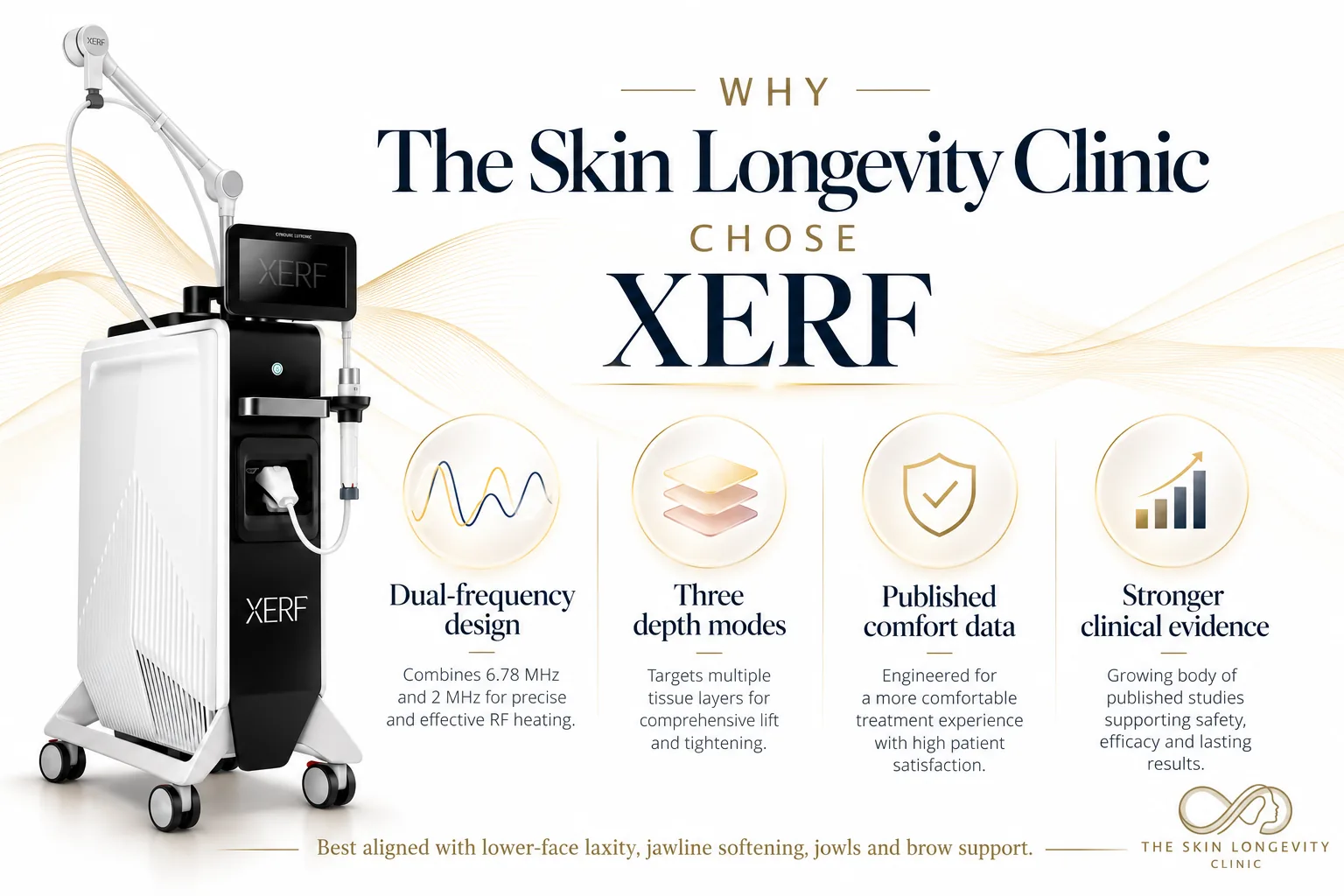
First, the dual-frequency design is the one that has been tested against single 6.78 MHz in controlled histology and showed more extensive and more durable remodelling.8 Second, three depth modes allow the periorbital area, the cheek and the jawline to be treated at the layer where each patient’s laxity sits, which matters for Asian faces, where jowling and submental laxity are common presentations.2,5 Third, XERF’s comfort profile has been measured and published, with treatment tolerated without numbing cream at a mean pain score of about 4 out of 10.2,5 Fourth, the XERF evidence base includes a prospective multicentre trial with a 90-day endpoint and a validated patient-reported outcome measure.2,5
Volnewmer is a soundly engineered single-frequency device with a large body tip, and for a patient whose only concern is fine texture and dermal firmness it is a reasonable option. For lower-face laxity, jowls, submental fullness and brow descent, which are the concerns most patients bring to a skin tightening consultation, the published data support XERF.
Skin tightening addresses laxity but not volume loss, so it is one tool among several. Where volume loss is the main problem, collagen biostimulators are used first or in sequence. Where deeper lifting is needed, HIFU, which heats the deeper fascial layer rather than the dermis, is compared, as set out in XERF vs Ultherapy. The sagging skin treatment page explains how these are sequenced.
Frequently asked questions about XERF vs Volnewmer
Is XERF better than Volnewmer?
On the published evidence, XERF has the stronger case. Its dual-frequency design produced more extensive and persistent collagen remodelling than single 6.78 MHz in a controlled histology study, it offers three depth settings, and it has a prospective multicentre study with 92.3% of patients rated improved at 90 days. Volnewmer’s studies are single-centre with one-month follow-up. Patient experiences at the clinic are collected on the XERF review page.
What is the difference between XERF and Volnewmer?
XERF delivers 6.78 MHz and 2 MHz in one shot with three depth modes, cryogen cooling and a surface-temperature cut-off. Volnewmer delivers 6.78 MHz only, in one mode, with continuous water cooling and tip vibration. Both are monopolar RF devices made in Korea and cleared by the US FDA.
Which is better for jowls, a double chin or a softening jawline?
XERF is the better suited of the two. These concerns involve the support layers beneath the dermis, which is what the 2 MHz component and the deep mode are designed to reach. The XERF multicentre study specifically assessed lower-face lifting. Volnewmer’s published data concern surface roughness and millimetre lift at one month.
Which is better for the eye area and brow?
XERF has two small Effectors (10 × 10 mm and 10 × 5 mm) used in deep mode for the brow, temple and infra-brow region, and a 3D study showed progressive brow and upper-eyelid lift over three months. Volnewmer has a 0.25 cm² eye tip in its single mode, with no published periorbital outcome data. See the XERF eye small tip page.
Is Volnewmer the same as Thermage?
Volnewmer and Thermage are not the same device. Both are single-frequency monopolar RF devices with surface cooling, but they are made by different companies with different tips and pulse designs. Neither has a published randomised comparison against the other, and neither uses a second frequency.
Does XERF hurt more than Volnewmer?
XERF’s pain has been measured at a mean of about 4 out of 10 without numbing cream. Volnewmer has no published pain scores, so a direct comparison is not possible. Both are tolerated without anaesthesia in most patients. XERF relies on cryogen cooling and Volnewmer on water cooling with vibration.
Does XERF need numbing cream?
Numbing cream is not routinely needed for XERF. In both XERF clinical studies, treatment was performed without topical anaesthesia, and in one study four of 16 patients asked for it. Energy is set to the level at which the skin feels comfortably hot, which indicates that the target layer is being heated.
How long does a XERF or Volnewmer session take?
A XERF session takes 15 to 30 minutes depending on the number of shots. Classys does not state a session time for Volnewmer. The published protocols used 200 to 300 shots across the face.
How many sessions of XERF or Volnewmer are needed, and how long do results last?
XERF’s protocol is two sessions four to six weeks apart, with results stated by the manufacturer to last six to nine months, then maintenance once or twice a year. Volnewmer’s published studies used a single session with one-month follow-up, and the manufacturer gives neither a session protocol nor a duration.
Can I have XERF if I have already had Volnewmer or Thermage?
XERF can be performed after Volnewmer or Thermage. All three are non-invasive monopolar RF treatments that leave no implant or filler behind. A gap of about three months from the last RF session allows the previous collagen response to complete before the next treatment is assessed.
Can XERF and Volnewmer treat the body?
Both devices can treat the body. Volnewmer has a 16 cm² body tip. XERF treats the body with its Effector 60 and Effector 40 tips using gliding passes. The clinic’s XERF body protocol covers the abdomen, arms and thighs, as set out on the XERF body treatment page.
Is XERF available in Singapore?
XERF is available in Singapore. It is distributed by Vanguard Aesthetics and is offered at The Skin Longevity Clinic at Scotts Medical Center. The XERF skin tightening page describes who is suitable and how the clinic plans treatment.
Dr Rachel Ho’s takeaway on XERF vs Volnewmer
Both devices heat the skin to tighten it. The difference lies in how much of the laxity each can reach and how well that reach has been demonstrated. XERF reaches the dermis and the deeper support layers in one pass, allows the depth to be chosen for each zone, and has multicentre, 90-day data behind it. Volnewmer treats the dermis adequately but is a single-frequency, single-depth device with one-month data. For the lower face, jawline and brow, XERF is the device the clinic uses, and the full protocol is on the XERF treatment page. Assessments take place at Scotts Medical Center, 9 Scotts Road. Appointments can be booked through the contact page or by calling +65 6514 2688.
References
Show all 14 references
- Cynosure Lutronic. XERF: dual-frequency monopolar RF, integrated cryogen delivery, depth settings, treatment protocol and duration of results. Manufacturer product page. https://www.cynosurelutronicemea.com/product/xerf/
- Weiss RA, Wang J, DiBernardo B, Bhatia AC. Clinical Outcomes Following Dual-Frequency Noninvasive Monopolar Radiofrequency Treatment for Facial Laxity and Lower Face Lifting: A Prospective Multicenter Study. Cureus. 2026;18(3):e104546. doi:10.7759/cureus.104546. PMID 41930066. Device studied: XERF.
- Classys. Volnewmer: specifications, tips, continuous water cooling, impedance detection, FDA K240248. Manufacturer product page. https://classys.com/product/volnewmer/
- Classys / Cryomed Aesthetics. Introducing Volnewmer: Monopolar RF Reinvented. Aesthetic Medical Practitioner. 2024;(39). https://classys.com/wp-content/uploads/sites/2/2026/03/202403_Introducing-Volnewmer-Monopolar-RF-Reinvented.pdf
- Erlich G, Dahan E, Wolf Y. Objective and subjective retrospective evaluation of XERF, a novel single-shot dual-frequency non-invasive monopolar radiofrequency. Lasers Med Sci. 2026;41(1):194. doi:10.1007/s10103-026-04996-0. PMID 42611100. Device studied: XERF.
- Kim J. Comparative Three-dimensional Analysis of Facial Lifting Effects across Five Aesthetic Units following Continuous Radiation 115-Watt 6.78-MHz Monopolar Radiofrequency Therapy. Plast Reconstr Surg Glob Open. 2024;12(9):e6137. doi:10.1097/GOX.0000000000006137. PMID 39247577. Device studied: Volnewmer.
- Kim J. Evaluating the Efficacy of Continuous Water-Cooling 115-Watt 6.78-MHz Monopolar RF Therapy for Fine Wrinkle Reduction. Plast Reconstr Surg Glob Open. 2024;12(2):e5623. doi:10.1097/GOX.0000000000005623. PMID 38410623. Device studied: Volnewmer.
- Ko K, Ryu HG, Park J, et al. Computational modeling and histologic analysis of 6.78- and 2-MHz monopolar radiofrequency-induced thermal reactions. Lasers Med Sci. 2025;40(1):501. doi:10.1007/s10103-025-04746-8. PMID 41315066.
- Rosellini I, Cho CH. Continuous Water-Cooling Monopolar Radiofrequency for Non-Invasive Skin Tightening: Technical Innovations of the Volnewmer System. J Aesthet Surg Laser Sci. 2026;1(1):28–35. https://www.jasls.org/journal/view.html?uid=5&vmd=Full. Device studied: Volnewmer (case report).
- Cynosure Lutronic. Cynosure Lutronic Announces U.S. Clearance of the XERF Device. Business Wire, 18 August 2025. https://www.businesswire.com/news/home/20250818405332/en/
- Erlich G, Dahan E, Skorochod R. Dual-Frequency Non-invasive Monopolar Radiofrequency for Periorbital Tightening: Introduction of Novel Small Treatment Tips. Cureus. 2026;18(1):e101187. doi:10.7759/cureus.101187. PMID 41523730. Device studied: XERF.
- Rohrich RJ, Schultz KP, Chamata ES, et al. Minimally Invasive Approach to Skin Tightening of the Face and Body: Systematic Review of Monopolar and Bipolar Radiofrequency Devices. Plast Reconstr Surg. 2022;150(4):771–780. doi:10.1097/PRS.0000000000009535. PMID 35877937.
- Cynosure Lutronic. XERF Patient Brochure (APAC edition and Korean edition): three depths and ten intensity levels, Wave Fit Pulse, Effector surface temperature monitoring with automatic shut-off above 43 °C, three-level ICD cooling, Effector 60/40/10/05, session time 15 to 30 minutes, MFDS approval. Distributed in Singapore by Vanguard Aesthetics. Manufacturer brochure, 2025.
- Classys. Volnewmer Advanced RF Technology: product brochure (CS_Brochure_Device_VNM_B2B_2022_V1). Curved surface and hidden-edge tip, real-time impedance detection, four tips, four-step vibration and cooling, 3,000 to 6,000 shots per consumable, no time lock, VECTRA 3D case images at 8 and 12 weeks. Manufacturer brochure, January 2022.