

30 Sep Crow’s Feet Treatment in Singapore: Causes and Options
Crow’s feet are the fine lines that fan out from the outer corner of each eye when you smile or squint. They are among the earliest expression lines to appear, and how they are treated depends on how much of each line comes from muscle movement and how much from changes in the skin itself1.
At The Skin Longevity Clinic, the assessment starts with how the lines look when you smile, when your face is relaxed and how the skin around the eyes has changed over time.
What are crow’s feet?
Crow’s feet, known medically as lateral canthal lines, are wrinkles at the outer corners of the eyes. They form where the orbicularis oculi, the ring-shaped muscle that closes the eye and lifts the cheek when you smile, folds the thin skin beside the eye1.
Crow’s feet are one of several wrinkle types covered in wrinkle treatment in Singapore.
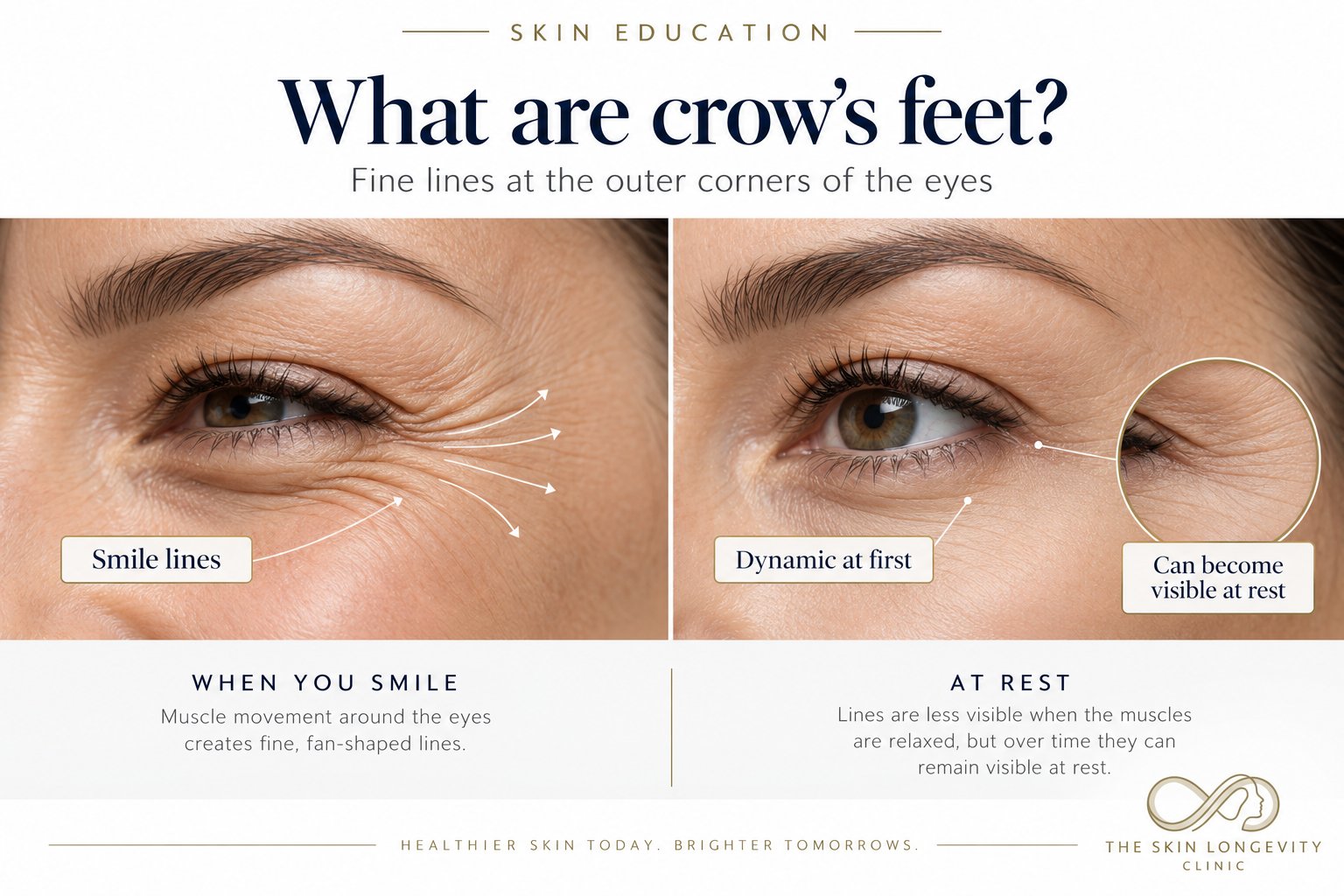
At first they appear only during expression. Over years of repeated folding and sun exposure, some lines stay visible when the face is at rest1.
What causes crow’s feet around the eyes?
Three things usually act together:
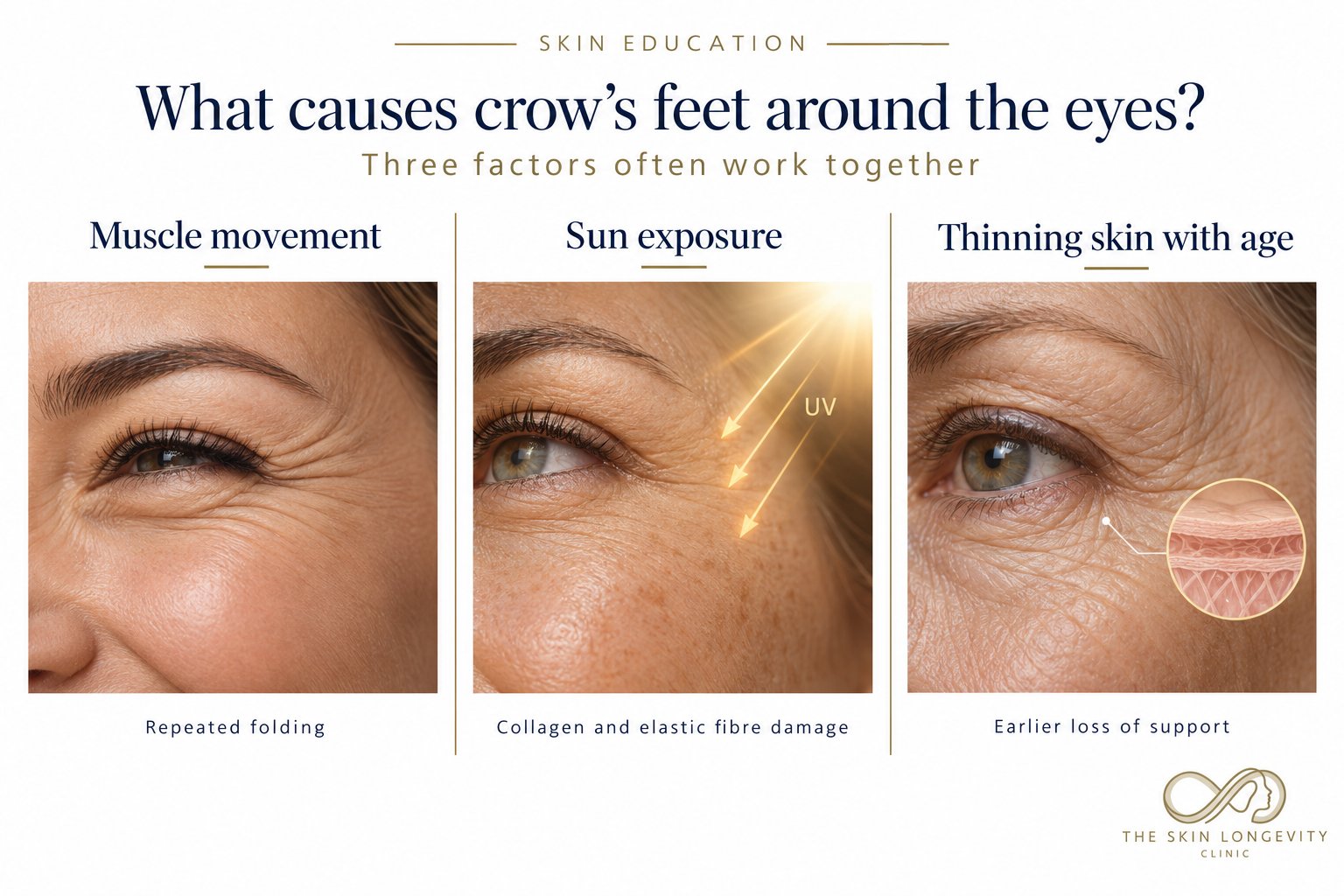
- Muscle movement: smiling, laughing and squinting fold the skin in the same place thousands of times1.
- Sun exposure: ultraviolet light breaks down collagen and elastic fibres. In a randomised trial of 903 adults, daily sunscreen users showed 24 per cent less skin ageing over four and a half years than people who used sunscreen only occasionally3.
- Thinning skin with age: the skin beside the eye is thin and loses support earlier than thicker facial skin4.
Crow’s feet or under-eye wrinkles: are they the same?
No. Crow’s feet sit beside the eye and are mainly driven by movement. Lines directly beneath the eye often reflect skin texture, volume change or the eyelid itself, and a treatment studied for crow’s feet is not automatically suitable below the eye1.
How to reduce crow’s feet without injections
- Daily broad-spectrum sunscreen and sunglasses reduce further sun damage and squinting3.
- Prescription retinoid cream: in a two-year placebo-controlled trial of 204 adults, tretinoin cream improved fine and coarse wrinkling from sun damage5. It needs careful use around the eyes because of irritation.
- Crow’s feet eye creams: moisturisers make fine lines look softer while the skin is hydrated. They do not change the muscle movement that forms crow’s feet.
- Chemical peels and resurfacing can improve surface texture, with recovery and pigment risk depending on depth6.

Botulinum toxin for crow’s feet: what the trials show
Botulinum toxin reduces how strongly the orbicularis oculi contracts, which softens the lines that form when you smile2.
- In a phase 3 trial of 445 adults with moderate to severe crow’s feet, 66.7 per cent of treated participants reached “none” or “mild” lines at maximum smile after 30 days, compared with 6.7 per cent on placebo (investigator assessment)7.
- A second phase 3 trial of 917 adults found similar results, 54.9 per cent against 3.3 per cent, whether crow’s feet were treated alone or together with frown lines8.
- Most side effects in both trials were mild or moderate7,8.
The aim is to soften the lines while keeping a natural smile. Treatment that is too strong or placed too low can change how the cheek lifts when you smile.
How long do results last?
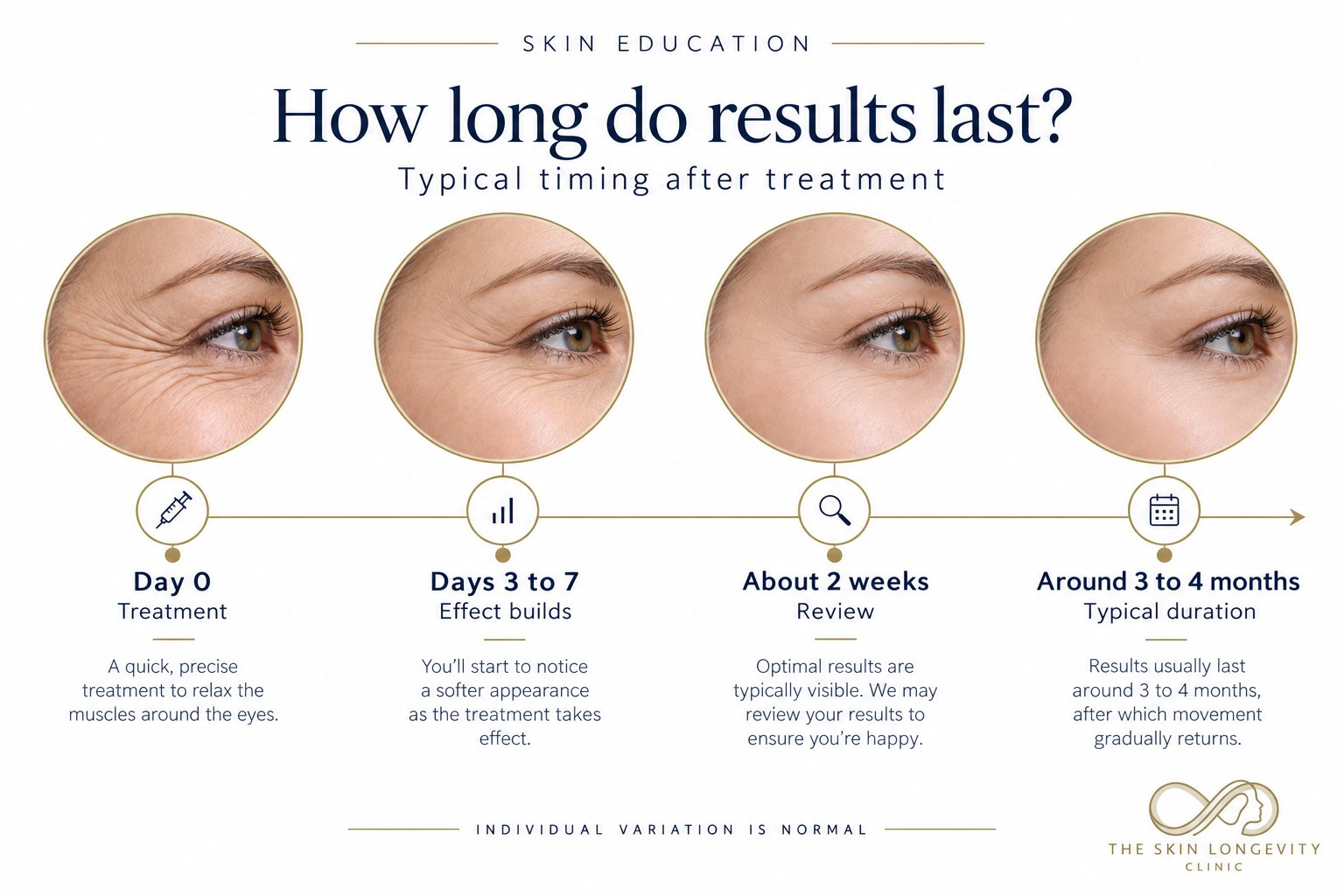
The effect builds over several days and is usually assessed at about two weeks. It commonly lasts around three to four months, with individual variation2. Our guide to how long botulinum toxin lasts explains why timelines differ.
Side effects of treating crow’s feet
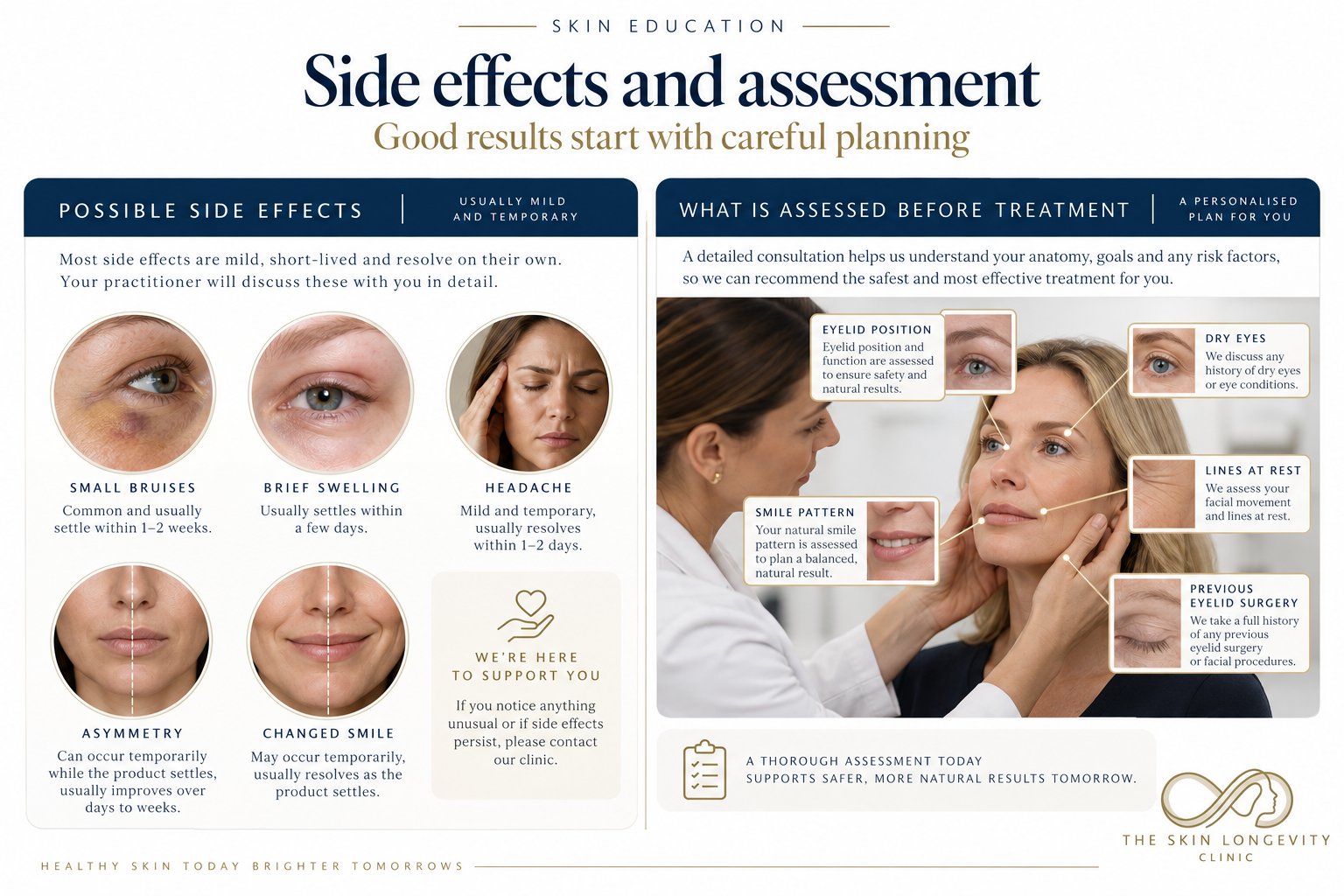
- Common: small bruises, brief swelling and headache7.
- Less common: a change in smile shape, asymmetry, or drooping of the lower eyelid or cheek.
- Seek prompt review for new double vision, marked eyelid drooping or other new visual symptoms9.
Dry eyes, previous eyelid surgery or difficulty closing the eyes should be mentioned before treatment10.
Assessment for crow’s feet at The Skin Longevity Clinic
Dr Rachel Ho looks at the lines at rest and when smiling, and at skin quality, sun damage and eyelid position before recommending sunscreen and skincare, a medical treatment or a combination. Lines that remain at rest may need skin-directed treatment as well as movement-directed treatment.
For the wider upper face, read our guide to forehead lines, frown lines and crow’s feet. For general information, see our botulinum toxin guide. You can arrange an assessment at Scotts Medical Center, 9 Scotts Road.
Frequently asked questions about crow’s feet
At what age do crow’s feet appear?
Expression lines beside the eyes often appear in the late twenties or thirties. Sun exposure and skin type affect when they stay visible at rest3.
Can crow’s feet go away on their own?
Lines that appear only when smiling fade when the face relaxes. Lines visible at rest do not reverse on their own, but sunscreen and retinoid cream can slow further change3,5.
Will treating crow’s feet change my smile?
It should not when the treatment is placed and dosed for your anatomy. A changed smile or cheek lift is a recognised side effect, which is why the smile is assessed before treatment.
References
- Small R. Botulinum toxin injection for facial wrinkles. Am Fam Physician. 2014;90(3):168–175. www.aafp.org
- Small R. Botulinum toxin procedures: a practical approach to cosmetic injections. Am Fam Physician. 2026;113(5):449–456. www.aafp.org
- Hughes MCB, Williams GM, Baker P, Green AC. Sunscreen and prevention of skin aging: a randomized trial. Ann Intern Med. 2013;158(11):781–790. doi:10.7326/0003-4819-158-11-201306040-00002. PMID 23732711.
- Coleman SR, Grover R. The anatomy of the aging face. Aesthet Surg J. 2006;26(1 Suppl):S4–S9. doi:10.1016/j.asj.2005.09.012.
- Kang S, Bergfeld W, Gottlieb AB, et al. Long-term efficacy and safety of tretinoin emollient cream 0.05%. Am J Clin Dermatol. 2005;6(4):245–253. doi:10.2165/00128071-200506040-00005. PMID 16060712.
- SingHealth. Chemical peels. www.singhealth.com.sg
- Carruthers A, Bruce S, de Coninck A, et al. Efficacy and safety of onabotulinumtoxinA for the treatment of crows feet lines: a multicenter, randomized, controlled trial. Dermatol Surg. 2014;40(11):1181–1190. doi:10.1097/DSS.0000000000000128. PMID 25347451.
- Moers-Carpi M, Carruthers J, Fagien S, et al. Efficacy and safety of onabotulinumtoxinA for treating crow’s feet lines alone or in combination with glabellar lines: a multicenter, randomized, controlled trial. Dermatol Surg. 2015;41(1):102–112. doi:10.1097/DSS.0000000000000220. PMID 25485803.
- Bacharach J, Lee WW, Harrison AR, Freddo TF. A review of acquired blepharoptosis. Eye. 2021;35:2468–2481. doi:10.1038/s41433-021-01547-5.
- Goodman GJ, Liew S, Callan P, Hart S. Facial aesthetic injections in clinical practice: pretreatment and posttreatment consensus recommendations to minimise adverse outcomes. Australas J Dermatol. 2020;61(3):217–225. doi:10.1111/ajd.13273.