


07 Aug Wrinkle Treatment in Singapore: Forehead Lines, Frown Lines & Crow’s Feet | Skin Longevity Clinic
By Dr Rachel Ho | Aesthetic Doctor, Founder, The Skin Longevity Clinic, Singapore
Wrinkle Treatment in Singapore: Forehead Lines, Frown Lines and Crow’s Feet
Facial wrinkles are not all the same, and that is the single most useful thing to understand before considering any treatment. Some lines are driven by muscle movement, some by changes in the skin itself, and many by a combination of the two. This guide covers the wrinkles people most often want to treat, namely forehead lines, frown lines and crow’s feet, and explains why the right approach depends on what is causing each line rather than on the line alone.
For the full overview of areas, results and safety, see the patient guide to botulinum toxin in Singapore.
Medically reviewed by Dr Rachel Ho, MBBS, MMed (Otolaryngology). Last reviewed 17 July 2026.
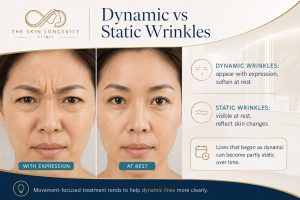
Dynamic vs static wrinkles: Dynamic lines appear during expression, while static lines remain visible at rest. This distinction helps determine whether a wrinkle is driven mainly by movement, skin change or both.
Dynamic versus static wrinkles
The first distinction to grasp is between dynamic and static lines. A dynamic line appears during expression and softens when the face is at rest. A static line is visible even when the face is still. Over years, repeated movement combines with changes in the skin so that lines which began as purely dynamic can become partly static4. This matters because a treatment aimed at muscle movement tends to help dynamic lines more clearly than static ones, and a line that is already fixed at rest often involves skin changes that a muscle-focused approach does not address2.
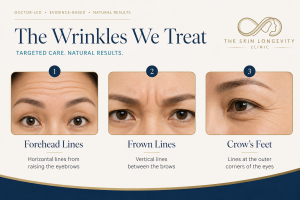
The wrinkles we treat: Forehead lines, frown lines and crow’s feet involve different muscles and different treatment considerations. Each area should be assessed on its own terms.
Forehead wrinkles
Horizontal forehead lines come from the muscle that raises the eyebrows. Because that muscle also supports brow position, forehead lines cannot be considered in isolation from the brows, and assessment weighs how much forehead movement is helping to hold the brows up. This is why the forehead is one of the areas where careful judgement matters most.
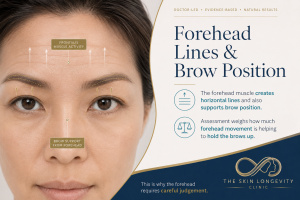
Forehead lines and brow position: The forehead muscle creates horizontal lines but also supports brow position. This is why forehead-line treatment requires careful facial assessment.
Frown wrinkles (between the brows)
The vertical lines between the eyebrows, known as frown lines or glabellar lines, come from the muscles that pull the brows together during concentration or expression. They are among the most commonly treated lines, and over time they can shift from dynamic to partly static.
Crow’s feet wrinkles
The lines that radiate from the outer corner of the eye come from the muscle that closes and squints the eye. They are also strongly influenced by skin quality and sun exposure, which is why two people of the same age can have very different eye-area lines.
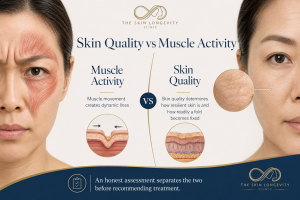
Skin quality vs muscle activity: Some wrinkles are driven mainly by repeated muscle movement, while others reflect skin quality, collagen loss and ageing. The right treatment depends on which factor is dominant.
Skin quality versus muscle activity: the key difference in wrinkle treatments
A recurring theme across all three areas is that muscle movement is only one contributor. Skin quality, shaped by sun exposure, ageing and the natural decline in collagen and elastin, determines how resilient the skin is and how readily a fold becomes a fixed line4. Where skin quality is the main issue, a treatment aimed at muscle will do little, which is why an honest assessment separates the two before recommending anything.
Dr Rachel Ho’s clinical perspective: I treat wrinkles by cause, not by location. Two forehead lines that look similar can need different approaches if one is driven by movement and the other by skin change. Working this out first, and being clear about what each option can and cannot do, is what leads to a natural result and a satisfied patient.
Why the same treatment is not appropriate for every wrinkle
Because lines differ in cause, they differ in the right response. A dynamic line responds well to reduced muscle movement. A static line may need attention to the skin itself. A line with both components may need more than one approach over time. Treating every wrinkle as though it were the same is the most common reason results disappoint, and avoiding that is the purpose of assessing the cause first.
Other options such as skincare, resurfacing and energy-based treatments beyond botulinum toxin
Where skin quality is a significant contributor, other categories of treatment are often part of the discussion. Sun protection and appropriate skincare support the skin over the long term. Resurfacing and energy-based treatments target skin texture and quality rather than muscle movement. These are mentioned to show that wrinkle treatment is broader than a single injectable, and the right combination for an individual is a matter for personal assessment rather than a fixed rule.

Results timeline and limitations: When botulinum toxin is used for dynamic facial lines, change often begins within a few days, develops more fully over about two weeks and commonly lasts around three to four months.
Results timeline and limitations of botulinum toxin injections for wrinkles
Where botulinum toxin is used for dynamic lines, a change usually begins within a few days and develops more fully over about two weeks, commonly lasting in the region of three to four months before movement returns1,2. The main limitation is that this addresses the movement component, not fixed skin changes, so expectations should be set accordingly. Duration and results vary between individuals, and no exact figure applies to everyone.
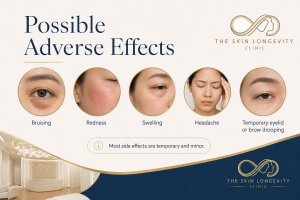
Possible adverse effects: Most wrinkle-treatment side effects are temporary and minor, such as bruising, redness, swelling or headache. Less commonly, a nearby muscle may be affected, causing temporary asymmetry or drooping.
Possible adverse effects of botulinum toxin injections for facial wrinkles
Most side effects are temporary and minor, such as small bruises, redness or swelling and headache. Less commonly, the medicine can affect a nearby muscle and cause temporary asymmetry or a drooping of an eyelid or brow, which resolves as the effect wears off4.

Dr Rachel Ho’s clinical perspective: Two wrinkles that look similar may need different approaches if one is driven by movement and the other by skin change. A natural result starts with identifying the true cause first.
Frequently asked questions about BTX injections for wrinkles
Which wrinkles respond best to botulinum toxin treatment?
Dynamic lines, which appear during expression, tend to respond more effectively to botulinum toxin, which treats neuromuscular communication compared to static lines that are visible at rest. An assessment clarifies how much of a line is dynamic.
Can botulinum toxins treatment remove deep lines at rest?
Not entirely. Fixed lines often involve skin changes that a muscle-focused approach does not address, and they may need combination treatments on top muscle relaxing with botulinum toxin injections.
How long do results for botulinum toxin injections last for facial wrinkles?
A result commonly lasts around three to four months before movement returns, though this varies between individuals and areas.
A 2025 randomised split-face trial evaluated botulinum toxin combined with a hyaluronic acid microdroplet injectable for moderate to severe periorbital wrinkles5.
Is skincare still relevant if I treat wrinkles with botulinum toxin injections?
Yes. Skin quality is a major contributor to how lines form and persist, so skincare and sun protection remain relevant regardless of other treatment.
Are the three areas treated the same way with botulinum toxin injections?
No. The forehead, frown lines and crow’s feet involve different muscles and different considerations, which is why each of these wrinkles are addresssed individually.
Related articles in this series on wrinkle treatments and botulinum toxin injections
This article is part of an eleven-part patient education series on botulinum toxin. The suggested reading and publishing order is:
- Botulinum Toxin in Singapore: Areas, Results, Safety and Medical Assessment
- Masseter Hypertrophy and Jaw Slimming in Singapore: Causes and Treatment Options
- Wrinkle Treatment in Singapore: Forehead Lines, Frown Lines and Crow’s Feet (this article)
For more from the author, visit Dr Rachel Ho at drrachelho.com.
About the author
Dr Rachel Ho holds an MBBS from the National University of Singapore and a Master of Medicine in Otolaryngology. She is the founder of The Skin Longevity Clinic, a doctor-led practice at Scotts Medical Center, Pacific Plaza, and has more than 16 years of clinical experience in Singapore. Her clinical focus includes skin longevity and quality, facial harmony and proportion, and evidence-based aesthetic medicine. She maintains active continuing professional development, including attendance at the Aesthetic and Anti-Aging Medicine World Congress (AMWC) in Monaco in 2026, and is recognised for her work in education, media commentary and advisory roles across aesthetic medicine. She has contributed commentary and features for publications including Her World, ELLE (ELLE Beauty Awards 2026) and L’Officiel Singapore. Dr Rachel Ho is a registered medical practitioner in Singapore.
Read more about Dr Rachel Ho at drrachelho.com and on her profile at The Skin Longevity Clinic.
References
- Small R. Botulinum Toxin Procedures: A Practical Approach to Cosmetic Injections. American Family Physician. 2026. Available at aafp.org
- Camargo CP, Xia J, Costa CS, et al. Botulinum Toxin Type A for Facial Wrinkles. The Cochrane Database of Systematic Reviews. 2021. Available at cochranelibrary.com
- Hallett M. One Man’s Poison: Clinical Applications of Botulinum Toxin. The New England Journal of Medicine. 1999. Available at nejm.org
- Carruthers A, Carruthers J, De Boulle K, et al. Treatment of Crow’s Feet Lines and Forehead Lines with OnabotulinumtoxinA. Medicine. 2023. Available at pubmed.ncbi.nlm.nih.gov
- Neves MLBB, et al. Efficacy and Durability of the Association of Botox and Skinvive in the Treatment of Moderate/Severe Wrinkles in the Periorbital Region: A Randomized, Split-Face Clinical Trial. Journal of Cosmetic Dermatology. 2025. PMID 40814769.
Editorial and corrections policy: Reviewed for medical accuracy and updated when clinical information changes.
This article provides general education and does not determine individual suitability. A qualified medical practitioner can assess symptoms, medical history, possible causes, alternatives and relevant risks.