Pigmentation Treatment in Singapore: Hyperpigmentation Removal for Asian Skin
Pigmentation in Asian skin
Pigmentation is the most common reason patients in Singapore consult The Skin Longevity Clinic, and the most common reason a previous treatment elsewhere disappointed them. Brown patches that look alike can be freckles, sun spots, melasma, Hori’s naevus, post-acne marks or a mixture, and each responds to a different plan. This page explains how Dr Rachel Ho tells them apart, which treatments suit each type, and why “pigmentation removal” in Asian skin is a plan rather than a single session. The main laser used for pigment at this clinic is pico laser; its role, limits and cost are covered on that page.
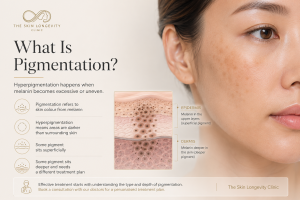
Hyperpigmentation occurs when melanin becomes excessive or uneven, and pigment depth affects the treatment plan.
What is pigmentation and hyperpigmentation?
Pigmentation refers to the colour of the skin produced by melanin, a pigment made by melanocytes in the deeper layer of the epidermis. When melanin production becomes excessive or uneven, patches or spots appear darker than the surrounding skin. Doctors call this hyperpigmentation.
Hyperpigmentation is not a single disease by itself. Instead, hyperpigmentation is a description that covers many different conditions, each with its own cause, depth and treatment response. Some types of hyperpigmentation are located superficially, while some are desposited deeper in the dermis. Some types of hyperpigmentation, such as melasma, involve both layers along with blood vessel changes and a tendency to relapse. This is why an accurate diagnosis matters more than the choice of any single machine or “laser setting” .
Medically reviewed by Dr Rachel Ho, MBBS, MRCS, MMed (ENT), 7 October 2026.
Why pigmentation and hyperpigmentation are so common in Asian skin and in Singapore?
Asian skin generally falls within Fitzpatrick skin types III to V. These skin types contain more baseline melanin and more reactive melanocytes than lighter skin types. When Asian skin is inflamed, injured or overexposed to ultraviolet light, the melanocytes respond quickly and sometimes excessively. The result is a higher tendency toward melasma, post inflammatory hyperpigmentation and rebound darkening after aggressive treatments.
Singapore adds an environmental layer to this biological one. The island sits close to the equator, so ultraviolet exposure is intense throughout the year. Heat, humidity and visible light also play a role, especially in melasma, which can darken with heat and light even when sunscreen blocks ultraviolet rays. Daily commutes, outdoor exercise and driving all contribute cumulative exposure, which is why sun protection remains the foundation of every pigmentation plan atThe Skin Longevity Clinic.
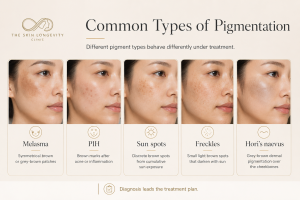
Melasma, PIH, sun spots, freckles and Hori’s naevus can look similar, but they do not behave the same under laser treatment.
Melasma appears as symmetrical brown to grey brown patches, most often on the cheeks, forehead, upper lip and nose. It is linked to hormones, pregnancy, oral contraceptive use, genetics, heat, visible light and ultraviolet exposure. Melasma is a chronic condition that is managed rather than permanently removed, and treating it too aggressively with lasers can make it worse. Read more in our guide to melasma treatment in Singapore.
Post inflammatory hyperpigmentation
Post inflammatory hyperpigmentation, often shortened to PIH, is the brown staining left behind after inflammation or injury. Acne is the most common trigger in Singapore, but eczema, insect bites, aggressive scrubs and even earlier laser treatments can cause it. PIH is more common and more persistent in darker skin types. Our article on acne marks and PIH treatment in Singapore explains how acne marks differ from true acne scars. Pico laser can clear brown acne marks once the acne is controlled7,8.
Sun spots and age spots
Sun spots, also called solar lentigines or age spots, are discrete, well defined brown spots on sun exposed areas such as the cheeks, temples and the backs of the hands. They reflect cumulative ultraviolet exposure over the years. Discrete spots like these often respond well to pigment lasers, which is covered in detail in our guide to freckles, sun spots and age spots.
Freckles
Freckles are small, light brown spots that usually appear in childhood or the teenage years and darken with sun exposure. They are partly genetic and partly sun related. Freckles typically lighten well with pigment lasers, although new freckles can appear with ongoing sun exposure if protection is inconsistent.
Freckles and age spots are different types of dark spots and respond differently to laser.
Hori’s naevus and dermal hyperpigmentation
Hori’s naevus, also known as acquired bilateral naevus of Ota like macules or ABNOM, presents as grey brown to slate coloured macules over both cheekbones. The pigment sits in the dermis, which is deeper than the pigment in melasma or freckles. Dermal pigmentation does not respond to creams and needs a different laser strategy over a longer course. It is also commonly mistaken for melasma, and the two frequently coexist. Our article on why pigmentation returns or darkens after laser covers what to do next.
What recent research tells us about hyperpigmentation
Modern research has reshaped how doctors understand these conditions, and it reinforces the diagnosis first approach to treatments for best results.
Melasma is no longer seen as a pathology involving excess melanin in isolation. It involves melanocytes, surrounding skin cells, the fibroblasts in the deeper skin, mast cells and the small blood vessels of the dermis, with inflammation and increased blood vessel activity both contributing to the pigment. This is why calming and protecting the skin matters as much as targeting the colour, and why aggressive heat based treatment tends to backfire in melasma.
Sun spots tell a similar story from a different angle. The skin over a sun spot is visibly thicker than nearby skin, the deeper layer shows the disorganised elastic tissue of long term sun damage, and the damaged fibroblasts there release signals that keep the overlying skin producing pigment. Increased blood vessel density in the deeper skin has been found in both sun spots and melasma, which is one reason plans that address blood vessel activity as well as pigment can perform better.
The practical takeaway is consistent. Pigmentation is driven from more than one layer and more than one cell type, so the most reliable results come from combining sun protection, topical treatment and correctly chosen procedures rather than relying on any single step.
How to tell the difference between pigment types
The table below summarises the features doctors weigh during an assessment. It is a guide for understanding, not a substitute for an in person diagnosis.
Common types of hyperpigmentation in Singapore
Pigment type
Typical appearance
Usual depth
Common triggers
Tendency to recur
Melasma
Symmetrical brown or grey brown patches on
cheeks, forehead, upper lip
Epidermal, dermal or mixed
Hormones, pregnancy, heat, ultraviolet and
visible light
High, needs long term control
PIH
Brown marks at sites of previous acne or
injury
Epidermal or dermal
Acne, eczema, trauma, procedures
Recurs if inflammation continues
Sun spots
Discrete, well defined brown spots on sun
exposed skin
Epidermal
Cumulative sun exposure
New spots form with ongoing exposure
Freckles
Small scattered light brown spots from a
young age
Epidermal
Genetics plus sun exposure
Darken and reappear with sun
Hori’s naevus
Grey brown macules over both cheekbones
Dermal
Genetic predisposition in East Asian skin
Pigment persists without laser treatment
A thorough clinical history, examination under good lighting and sometimes assessment tools that highlight pigment depth all contribute to the diagnosis. Because several types often coexist on the same face, a treatment plan usually has to address more than one condition at a time. This is one of the reasons why a detailed consultation and evaluation precedes any laser recommendation at our clinic.
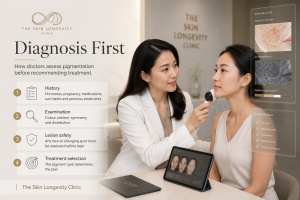
Pigmentation treatment in Singapore should begin with diagnosis, because different pigment types require different timelines, treatments and maintenance plans.
How doctors assess pigmentation before recommending treatment
A pigmentation consultation is a diagnostic exercise before it is anything else. Expect your doctor to work through several layers.
The history comes first: When the pigment appeared, whether it fluctuates, what makes it darker, pregnancy and hormonal history, contraceptive use, medications, previous treatments and their outcomes, your sun exposure patterns and your current skincare all narrow the differential. A patch that appeared in the months after starting a contraceptive pill points differently from spots that have accumulated slowly since your thirties, or marks that map onto last year’s breakouts.
Examination follows, under good lighting and often with magnification. The doctor assesses colour tone, since brown suggests superficial pigment while grey or slate tones suggest dermal pigment, along with the pattern, symmetry, border definition and distribution across the face.
Finally comes lesion safety. Any pigmented spot that is new, changing, irregular in border or colour, or simply different from its neighbours deserves medical scrutiny before any cosmetic treatment. Lasering an undiagnosed lesion is never acceptable practice. Confirmed benign lesions can then be treated on their merits, as described on our benign skin lesion removal page.
Only after these steps does treatment selection begin, and by then the plan has usually chosen itself, because each pigment type carries its own playbook.
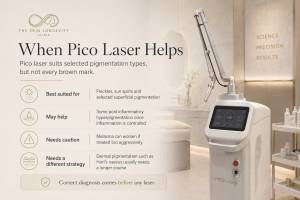
Pico laser may help selected pigmentation types, but the safest treatment plan depends on pigment depth, skin tone and recurrence risk
Laser for pigmentation: when pico laser helps
A picosecond laser delivers energy in extremely short pulses. The short pulse duration shatters pigment particles mechanically with less heat spread into surrounding skin compared with older nanosecond technology. Less heat generally means a gentler treatment for darker skin types, which is relevant for pigmentation prone Asian skin.
Pico laser tends to be well suited for the following situations.
Discrete epidermal pigment such as freckles and sun spots
Brown acne marks and other epidermal PIH once active inflammation is controlled
Dermal pigment such as Hori’s naevus, treated over a longer course
Overall tone and dullness through gentle low energy pico toning
For a fuller breakdown of suitability, see Pico laser in Singapore for pigmentation, what it treats and what it does not.
When Pico laser is not the first choice
Pico laser is a tool, not a cure all for pigmentation. There are situations where pico laser treatments should be delayed, used cautiously or avoided.
Active acne or eczema. Treating pigment while inflammation continues invites new PIH. The underlying condition is addressed first, as explained on our acne treatment page.
Redness or red marks. Red acne marks (post inflammatory erythema) reflect blood vessels rather than melanin, so a pigment laser is not the right modality of treatment.
Unrealistic timelines. Pico laser treatments clear excess pigment gradually. Anyone promising complete removal in a single session for every pigment type should be questioned.
Undiagnosed lesions. Any spot that is changing, irregular or unusual should be medically assessed before cosmetic laser treatment. Our doctors screen for this during consultation.
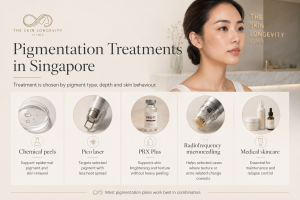
Pigmentation treatment is chosen according to pigment type, depth, skin behaviour and recurrence risk.
Most pigmentation plans combine several elements rather than relying on one machine.
Sun protection
Broad spectrum sunscreen worn daily is the single most important step for every pigmentation condition. For melasma, tinted sunscreens that block visible light add meaningful protection. Independent reviews of sunscreen textures and formulas, such as this sunscreen review guide, can help you find one you will actually wear every day.
Topical treatment
Prescription and cosmeceutical ingredients such as tranexamic acid, hydroquinone, retinoids, azelaic acid, alpha arbutin and vitamin C reduce pigment production and speed up clearance. Practical guidance on lightening ingredients is available in this article onskincare for pigmentation and dark spots. For melasma, oral or topical tranexamic acid may be discussed where medically appropriate, explained further in this review of tranexamic acid for hyperpigmentation.
Pico laser
Picosecond laser treatment targets pigment with ultra short pulses. It is used for freckles, sun spots, PIH, selected stable melasma at conservative settings and dermal pigment such as Hori’s naevus. Details are on ourPico laser treatment page. In a 2023 meta-analysis of six randomised trials, 1064 nm picosecond laser reduced melasma severity scores without significant side effects, while 755 nm picosecond laser was not superior to topical lightening agents and caused PIH in some patients9. In a split-face trial, 1064 nm picosecond and nanosecond lasers improved melasma equally. The picosecond side was less painful, and each side had a 12.5% recurrence rate10.
Q-switched laser
The Q-switched laseris the established nanosecond pigment laser. It remains effective for many pigment types and is sometimes preferred for specific indications or budgets. The comparison between the two technologies is covered in Pico laser vs Q-switched laser vs IPL vs chemical peel.
Secret RF microneedling for melasma
Secret RF is a fractional microneedle radiofrequency device. Fine needles deliver heat into the dermis and spare most of the surface skin. This matters for melasma because the dermis under a melasma patch is abnormal. It shows solar elastosis, a disrupted basement membrane, extra blood vessels and senescent fibroblasts that keep signalling to melanocytes11,12,13.
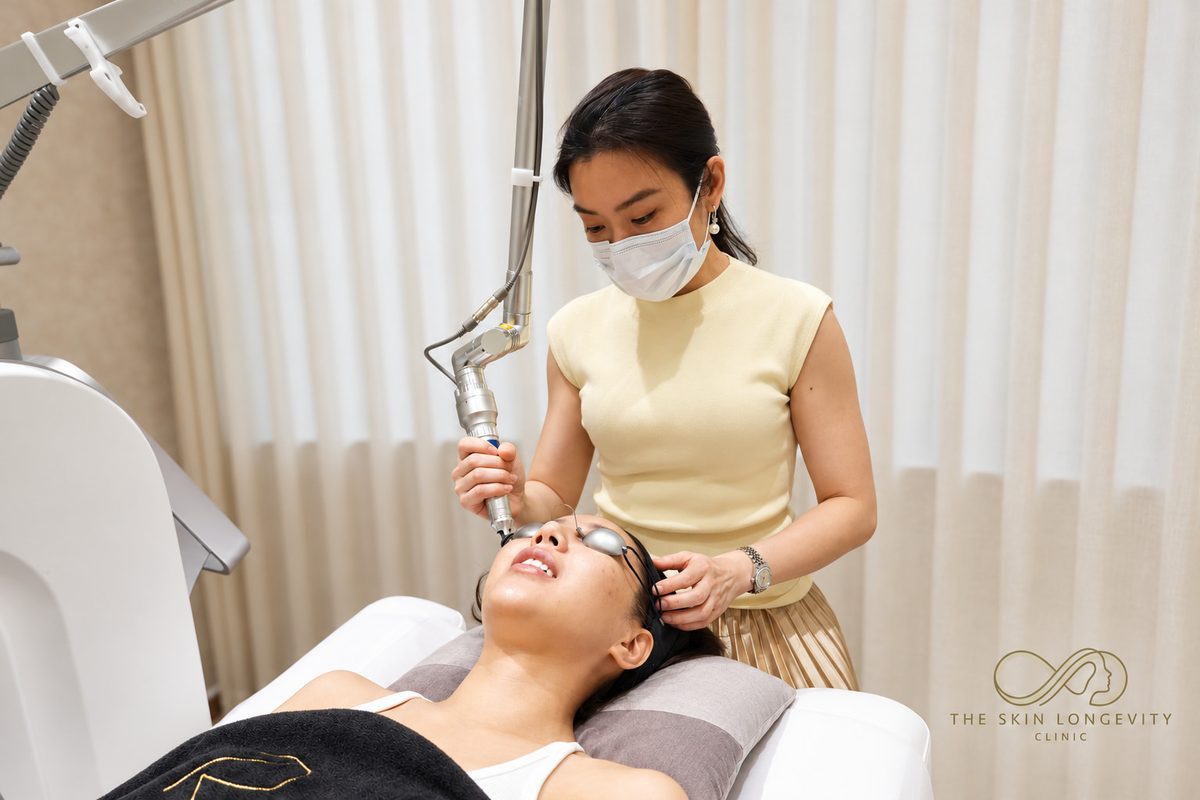
Pico laser treatment for pigmentation, with eye protection.
A 2026 systematic review of 12 studies found that RF microneedling consistently lowered melasma severity scores, with results held up to 6 months and a low rate of PIH in darker skin types. Combining it with low-fluence Q-switched Nd:YAG laser gave more pigment reduction than either alone14. In a 50-patient retrospective study, median mMASI fell by 32% and 54% of patients reached a 30% or greater reduction15. A Japanese series was more modest: 90% were stable or improved, but only 28% reached a 30% reduction16. We use RF microneedling as an adjunct for melasma, not as a stand-alone cure. The US FDA has warned about burns, scarring and nerve injury when RF microneedling is used incorrectly, so it should be performed by a doctor17.
Exosome and skin booster treatment for pigmentation
Laboratory studies show that exosomes released by keratinocytes regulate how much pigment melanocytes produce18. In people, the evidence is still early. A clinical study of umbilical cord stem-cell exosomes, applied after microneedling or laser to help penetration, improved melasma compared with the control group19. Plant-derived exosome case series also report lighter pigmentation20. There are no large randomised trials yet. At the clinic, exosomes are used to support barrier recovery after pico laser or RF microneedling, not as a primary pigment treatment. More on our exosome skin treatment page.
Tranexamic acid and topical treatment for melasma
In a placebo-controlled trial, oral tranexamic acid reduced mMASI by 49% at 3 months, against 18% with placebo21. A 2024 meta-analysis of 22 studies found oral tranexamic acid gave the largest fall in MASI, ahead of injected and topical forms22. Oral tranexamic acid is a prescription medicine and needs screening for clotting risk. Triple combination cream (hydroquinone, tretinoin and a mild steroid) cleared or nearly cleared melasma in 77% of patients at 8 weeks23. Hydroquinone above 4%, or used for more than 3 months, is associated with exogenous ochronosis24, so courses are limited and supervised.
Sunscreen for melasma
Visible light darkens pigment-prone skin. In a randomised trial, adding visible-light protection to hydroquinone improved melasma more than UV-only sunscreen25. Tinted sunscreens with iron oxides also reduced melasma relapses over summer26,27. Untinted mineral sunscreens do not block visible light, because the particles are too small to be seen on the skin28. See our sunscreen for melasma guide.
Chemical peels and PRX
Chemical peels exfoliate pigmented cells and improve tone, and they pair well with lasers in combination plans. PRX-Plus is a biorevitalisation peel used for brightening with minimal peeling, described further in our article on PRX-Plus for skin brightening.
Combination planning
Stubborn or mixed pigmentation usually improves fastest when topical treatment, sun protection and procedures are sequenced deliberately. A doctor who understands all the options can stage them so each step supports the next rather than competing with it. Background reading on how doctors think through laser selection is available in this guide coveringwhat to know before having lasers for pigmentation.
Laser treatment for pigmentation: which laser for which pigment
Laser treatment for pigmentation works when the laser matches the pigment and its depth. Pigment lasers (pico and Q-switched) fragment melanin; vascular lasers treat the redness that sits alongside some pigmentation. Using the wrong laser, or settings that are too strong for Asian skin, is the most common cause of post-inflammatory hyperpigmentation after treatment6,7.
Low-fluence 1064 nm pico or Q-switched toning as a limited course, with topical treatment and sun protection9,10,30; RF microneedling for selected cases14
Controlled rather than cured; aggressive or frequent toning risks rebound and white spots29
Laser is one part of the plan. Sun protection and topical treatment come first for melasma and post-inflammatory hyperpigmentation, and a doctor confirms the diagnosis before any laser is used.
Treatment suitability at a glance
Treatment of common types of dark spots in Singapore
Condition
Sunscreen and topicals
Pico laser
Q-switched laser
Chemical peel or PRX
Melasma
Foundation of treatment
Selected stable cases at gentle settings
Low energy toning
Gentle peels as adjuncts
PIH and acne marks
First line together with acne control
Helpful for brown marks
Helpful for brown marks
Useful for tone and texture
Sun spots
Prevents new spots
Usually responds well
Usually responds well
Adjunct
Freckles
Prevents darkening
Usually responds well
Usually responds well
Adjunct
Hori’s naevus
Little effect on dermal pigment
Treatment of choice over a course
Alternative option
Adjunct
How many sessions are usually needed?
The honest answer is that it depends on the diagnosis. Discrete sun spots and freckles often show visible lightening after the first few sessions. PIH improves progressively as the pigment clears and the underlying trigger stays controlled. Dermal pigment such as Hori’s naevus needs a longer course with spacing between sessions. Melasma is different again, because the aim is steady control with conservative settings rather than rapid clearance, and maintenance is expected. A realistic session plan is laid out during consultation and revisited as your skin responds, which is explained further in our Pico laser results timeline article.
What affects pigmentation treatment cost in Singapore
Prices for pigmentation treatment vary widely between clinics because the underlying plans differ. Factors that influence cost include the type and depth of pigment, the size of the treated area, whether a full face or spot treatment is performed, the laser platform used, the doctor’s assessment and review structure, the number of sessions required and what aftercare is included. A low headline price may reflect a brief low energy session rather than a complete treatment plan. We explain how to read quotations sensibly in our guide to Pico laser price in Singapore.
Downtime, side effects and rebound pigmentation risk
Most pigment laser sessions involve mild redness that settles within hours to days. Treated sun spots and freckles often darken and form fine crusts before flaking off. Temporary dryness and sensitivity are common. The more important risks in Asian skin are post laser PIH and rebound darkening of melasma, both of which are linked to excessive energy, inadequate sun protection or treating the wrong diagnosis. This is why conservative settings, correct diagnosis and structured aftercare matter more than chasing speed. A full explanation is in our article on Pico laser downtime and aftercare. Repeated low-fluence Q-switched laser toning can cause mottled white spots (guttate hypopigmentation). In one case series, this appeared after as few as 6 sessions29. This is why we cap toning courses and review the skin between sessions.
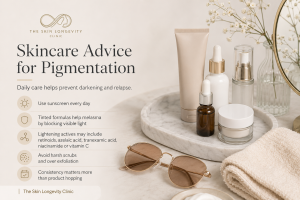
Daily sunscreen, tinted protection, and consistent skincare are essential for melasma and pigmentation maintenance.
Aftercare and maintenance
Aftercare protects your results. The essentials are strict daily sunscreen, gentle cleansing, moisturiser to support the skin barrier, avoiding picking at crusts and pausing exfoliating acids and retinoids until the skin settles. For melasma, maintenance also means ongoing trigger control, since heat, light and hormones do not stop after a laser course ends. Patients who keep up sun protection and their prescribed topicals keep their results far longer than those who stop everything once the pigment fades.
Pigmentation within a skin longevity plan
Pigmentation rarely travels alone. The same ultraviolet exposure that produces sun spots also degrades collagen, and the same inflammation that leaves acne marks stresses the skin barrier. This is why we treat pigmentation as one chapter of a longer skin health story rather than an isolated cosmetic errand. Clearing pigment while continuing to protect collagen, barrier function and hydration produces skin that looks well as a whole, not merely less spotted. Patients who want the full picture of their skin’s trajectory can start with a structuredskin longevity assessment, which maps pigment alongside texture, laxity and photoageing so treatments can be sequenced sensibly over years rather than bought impulsively.
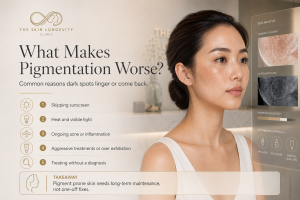
For Asian skin, treating pigmentation too aggressively can trigger inflammation and rebound darkening.
Common pigmentation mistakes we see in Singapore
Certain patterns repeat in patients who arrive after years of frustration, and they are worth naming because each one is avoidable.
Waiting to accumulate pigment before treating it is a costly one. Some patients prefer to let spots build up and clear everything in one go later. In my experience this backfires, because delaying treatment can make pigmentation harder to remove, and the eventual result is rarely as good as it would have been had the person come earlier.
Treating without a diagnosis is the most common. A package of toning sessions bought for what turned out to be Hori’s naevus, or spot removal attempted on melasma, wastes both money and skin tolerance. The condition determines the tool, never the reverse.
Skipping sunscreen while spending on procedures is the second. Laser clears existing pigment while ultraviolet light manufactures new pigment daily. Paying for one without stopping the other is rowing against the current.
Over exfoliating is the third. Scrubs, layered acids and aggressive home devices keep the skin mildly inflamed, and inflamed Asian skin answers with pigment. Gentler routines often lighten pigmentation on their own simply by removing the daily insult.
Product hopping is the fourth. Lightening ingredients need consistent use over weeks to show their effect. Changing products every fortnight resets the clock each time and makes it impossible to know what worked.
Stopping everything after clearance is the fifth. Pigment prone skin stays pigment prone. Maintenance is lighter work than treatment, but it is not optional for conditions like melasma.
What to ask your doctor at a pigmentation consultation
A good consultation should leave you able to answer these questions. Bringing them with you keeps the conversation focused.
What type or types of pigmentation do I have, and how confident is the diagnosis?
Is my pigment epidermal, dermal or mixed, and what does that mean for my plan?
Is my melasma stable enough for any laser, or should we stabilise first?
Which treatment sequence do you recommend, and why this order?
What settings and wavelengths will be used, and how will you adjust if my skin reacts?
What is my realistic recurrence risk, and what will maintenance involve?
What is the total cost of the recommended course, including reviews and aftercare?
What should I do if my skin darkens after a session?
Pigmentation Treatment Guides: Melasma, Sun Spots and Laser Treatment
Each type of pigmentation has its own guide covering causes, laser treatment for pigmentation, skincare and recurrence.
Year round ultraviolet exposure, heat, visible light, hormones, genetics and skin inflammation all contribute. Most patients have more than one factor at play, and often more than one pigment type on the same face.
What is the difference between pigmentation and hyperpigmentation?
Pigmentation refers to normal skin colour from melanin. Hyperpigmentation means areas that have become darker than the surrounding skin because of excess or uneven melanin.
Can pigmentation be removed permanently?
Discrete lesions such as individual sun spots can clear fully, although new spots can form with continued sun exposure. Melasma is controlled rather than cured. Hori’s naevus can clear substantially over a laser course. Whatever the type, sun protection determines how long results last.
Why does pigmentation come back after treatment?
Because the underlying drivers continue. Sun exposure, heat, hormones and inflammation keep stimulating melanocytes. Treatment clears existing pigment, while maintenance and protection prevent new pigment from forming.
Can laser make melasma worse?
Yes. Aggressive laser settings can inflame melasma and trigger rebound darkening. This is why melasma is stabilised first and treated with conservative settings, if laser is used at all.
Which pigmentation types respond fastest to laser?
Freckles and sun spots usually respond fastest because the pigment is superficial and discrete. PIH improves steadily once its trigger is controlled. Melasma and dermal pigment need longer, more carefully staged plans.
What skincare ingredients help pigmentation?
Sunscreen first, then evidence supported lightening ingredients such as hydroquinone under medical supervision, retinoids, azelaic acid, cysteamine, tranexamic acid, alpha arbutin, niacinamide and vitamin C. A doctor can match ingredients to your pigment type and skin sensitivity.
What is the best pigmentation cream in Singapore?
There is no single best pigmentation cream; the right one depends on the type of pigmentation. For melasma, doctors may prescribe hydroquinone for limited periods under supervision, a triple combination cream, or tranexamic acid. Azelaic acid, cysteamine, retinoids, niacinamide, alpha arbutin and vitamin C are also used. Long, unsupervised use of hydroquinone can cause a blue-grey darkening called exogenous ochronosis. Any cream works better with a broad spectrum, tinted sunscreen that also protects against visible light.
Why can’t Singapore clinics show public before and after photos?
Singapore regulations restrict the use of before and after photographs in advertising for aesthetic procedures. Clinics may discuss representative outcomes with you in person during consultation, where results can be explained with proper context.
What should I expect during a pigmentation consultation?
A medical history covering hormones, medications, sun habits and previous treatments, an examination of your pigment under good lighting, a working diagnosis, and a staged plan covering skincare, procedures, expected timelines, costs and maintenance.
What is the difference between melasma, freckles, sun spots and PIH?
Melasma forms soft symmetrical patches driven by hormones, heat and light, and it fluctuates. Freckles are small genetic sun responsive spots from a young age. Sun spots are discrete fixed spots that accumulate with years of exposure. PIH is staining left at sites of previous inflammation such as acne. They differ in cause, depth and treatment, and they frequently share the same face, which is why diagnosis leads the plan.
Are chemical peels good for pigmentation?
Superficial peels help epidermal pigment, dullness and tone, and they complement laser courses well. They cannot reach dermal pigment such as Hori’s naevus, and deeper peels need caution in Asian skin because aggressive peeling can itself trigger PIH. In the right role, as part of a plan, they are a valuable and economical tool.
Why is pigmentation more common in Asian skin?
Asian skin carries more baseline melanin and more reactive melanocytes than lighter skin types. Inflammation, heat and sun exposure all trigger a stronger pigment response, which raises the rates of melasma, PIH and rebound pigmentation after aggressive treatment. The same biology also means Asian skin ages with fewer wrinkles, so pigment control is often the highest value investment in how the skin looks over time.
Is sunscreen alone enough to treat pigmentation?
Sunscreen prevents pigment from deepening and returning, and mild recent pigment can fade meaningfully under strict protection alone. Established melasma, dense sun spots and dermal pigment usually need active treatment layered on top. Think of sunscreen as the condition for success rather than the whole cure.
Why is tinted sunscreen recommended for melasma?
Plain sunscreens block ultraviolet light but let visible light through, and visible light darkens melasma. Tinted sunscreens containing iron oxides block a meaningful portion of visible light as well, which is why they are specifically recommended for melasma prone patients.
When are lasers suitable for pigmentation?
When the diagnosis is confirmed, any reactive component such as melasma is stable, active inflammation like acne is controlled, and the patient understands the timeline and aftercare. Lasers are brought into a plan, not used as the plan.
Which pigmentation types need long term maintenance?
Melasma leads the list, followed by freckle prone skin with heavy sun exposure and patients whose PIH triggers, such as acne or eczema, remain active. Cleared sun spots and treated Hori’s naevus need less maintenance beyond sun protection.
Is Secret RF good for melasma?
RF microneedling improves melasma severity in studies and has a low PIH risk. It works best combined with laser and medical treatment14,15.
Do exosomes remove pigmentation?
Early studies are promising, but there are no large trials. Exosomes are used to support recovery, not as a primary treatment19.
Which laser is safest for melasma in Asian skin?
Low-fluence 1064 nm picosecond or Q-switched laser, in limited courses combined with sunscreen and topical or oral treatment9,10,30.
Pigmentation treatment at The Skin Longevity Clinic
The Skin Longevity Clinic is a doctor led aesthetic clinic at Scotts Medical Center in Pacific Plaza, a short walk from Orchard Road in Singapore. Pigmentation care here starts with diagnosis rather than a machine. Every plan is built around your pigment type, skin tone and lifestyle, drawing onPico laser, Q-switched laser, chemical peels, PRX-Plus, prescription topicals and structured maintenance, all within a broader skin longevity philosophy. You can read about the clinic’s approach on the our doctor pageor book a pigmentation assessmentto start with a diagnosis.
Laser for pigmentation is highly operator dependent. There are many variables that can be adjusted, and only with experience and expertise can one consistently achieve good outcomes. This is why I begin every case with an accurate diagnosis rather than a machine.
Glossary
Melanin is the pigment that gives skin its colour. Melasma is a chronic hormonally influenced pigment condition. PIH is pigment left behind after inflammation. Solar lentigines are sun spots from cumulative ultraviolet exposure. Hori’s naevus is dermal pigmentation over the cheekbones in Asian skin. Picosecond laser delivers ultra short pulses that shatter pigment with minimal heat. Q-switched laser is the established nanosecond pigment laser. Rebound pigmentation is darkening that follows overly aggressive treatment. Fitzpatrick skin type is a classification of how skin responds to sun.
About Dr Rachel Ho
Dr Rachel Ho is an aesthetic physician with more than 16 years of clinical experience and the founder of The Skin Longevity Clinic near Orchard Road in Singapore. She graduated with an MBBS from the National University of Singapore and went on to complete a Master of Medicine, and she is certified by the Ministry of Health to perform lasers for pigmentation removal. She has treated over 2000 pigmentation cases, with extensive experience using both picosecond and Q-switched lasers in Asian and Caucasian skin. Alongside clinical practice she is active in education, media commentary and advisory work across beauty, skincare and aesthetic medicine. You can read more about Dr Rachel Ho or book a consultation.
Chaowattanapanit S, et al. Postinflammatory hyperpigmentation: A comprehensive overview: Treatment options and prevention. J Am Acad Dermatol. 2017;77(4):607–621. doi:10.1016/j.jaad.2017.01.036.
Lee YJ, et al. Treatment of Melasma and Post-Inflammatory Hyperpigmentation by a Picosecond 755-nm Alexandrite Laser in Asian Patients. Ann Dermatol. 2017;29(6):779–781. doi:10.5021/ad.2017.29.6.779.
Feng J, et al. Efficacy and safety of picosecond laser for the treatment of melasma: a systematic review and meta-analysis. Lasers Med Sci. 2023;38(1):84. doi:10.1007/s10103-023-03744-y.
Feng J, et al. Comparison of Picosecond and Nanosecond Nd:YAG 1064-nm Lasers in the Treatment of Melasma: A Split-Face Randomized Clinical Trial. Plast Reconstr Surg. 2023;151(4):772–777. doi:10.1097/PRS.0000000000009994.
Phansuk K, et al. Dermal Pathology in Melasma: An Update Review. Clin Cosmet Investig Dermatol. 2022;15:11–19. doi:10.2147/CCID.S343332.
Kang HY, Picardo M. Melasma: When Dermal Photoageing Precedes Melanocyte Ageing. Exp Dermatol. 2026;35(9):e70364. doi:10.1111/exd.70364.
Hara Y, et al. Characteristics of dermal vascularity in melasma and solar lentigo. Photodermatol Photoimmunol Photomed. 2024;40(2):e12953. doi:10.1111/phpp.12953.
Kumar N, et al. The Efficacy and Safety of Radiofrequency Microneedling for Melasma: A Systematic Review and Qualitative Evidence Synthesis. Aesthet Surg J Open Forum. 2026;8:ojag075. doi:10.1093/asjof/ojag075.
Kim HB, et al. Clinical Effects and Safety of Radiofrequency Microneedling for the Management of Melasma: A Retrospective Study. Aesthet Surg J Open Forum. 2026;8:ojag143. doi:10.1093/asjof/ojag143.
Imaizumi A, et al. A Retrospective Analysis of Radiofrequency Microneedling for Melasma Management in the Japanese Population. Clin Cosmet Investig Dermatol. 2026;19:601440. doi:10.2147/CCID.S601440.
US Food and Drug Administration. Potential Risks with Certain Uses of Radiofrequency (RF) Microneedling: FDA Safety Communication. Read the FDA notice.
Lo Cicero A, et al. Exosomes released by keratinocytes modulate melanocyte pigmentation. Nat Commun. 2015;6:7506. doi:10.1038/ncomms8506.
Wang T, et al. Stem cell-derived exosomes in the treatment of melasma and its percutaneous penetration. Lasers Surg Med. 2023;55(2):178–189. doi:10.1002/lsm.23628.
Majewska L, et al. Efficacy of Rose Stem Cell-Derived Exosomes (RSCEs) in Skin Treatment: From Healing to Hyperpigmentation Management: Case Series and Review. J Cosmet Dermatol. 2025;24(1):e16776. doi:10.1111/jocd.16776.
Del Rosario E, et al. Randomized, placebo-controlled, double-blind study of oral tranexamic acid in the treatment of moderate-to-severe melasma. J Am Acad Dermatol. 2018;78(2):363–369. doi:10.1016/j.jaad.2017.09.053.
Calacattawi R, et al. Tranexamic acid as a therapeutic option for melasma management: meta-analysis and systematic review of randomized controlled trials. J Dermatolog Treat. 2024;35(1):2361106. doi:10.1080/09546634.2024.2361106.
Torok HM. A comprehensive review of the long-term and short-term treatment of melasma with a triple combination cream. Am J Clin Dermatol. 2006;7(4):223–230. doi:10.2165/00128071-200607040-00003.
Ishack S, Lipner SR. Exogenous ochronosis associated with hydroquinone: a systematic review. Int J Dermatol. 2022;61(6):675–684. doi:10.1111/ijd.15878.
Castanedo-Cazares JP, et al. Near-visible light and UV photoprotection in the treatment of melasma: a double-blind randomized trial. Photodermatol Photoimmunol Photomed. 2014;30(1):35–42. doi:10.1111/phpp.12086.
Boukari F, et al. Prevention of melasma relapses with sunscreen combining protection against UV and short wavelengths of visible light: a prospective randomized comparative trial. J Am Acad Dermatol. 2015;72(1):189–190.e1. doi:10.1016/j.jaad.2014.08.023.
Polena H, et al. Comparison of Visible Light-Protective Tinted Sunscreen to Untinted Sunscreen to Protect Melasma Patients During Summer: A Prospective Randomized Investigator-Blinded Study. J Cosmet Dermatol. 2025;24(10):e70450. doi:10.1111/jocd.70450.
Lyons AB, et al. Photoprotection beyond ultraviolet radiation: A review of tinted sunscreens. J Am Acad Dermatol. 2021;84(5):1393–1397. doi:10.1016/j.jaad.2020.04.079.
Chan NP, et al. A case series of facial depigmentation associated with low fluence Q-switched 1,064 nm Nd:YAG laser for skin rejuvenation and melasma. Lasers Surg Med. 2010;42(8):712–719. doi:10.1002/lsm.20956.
Chen J, et al. Efficacy of low-fluence 1064 nm Q-switched Nd:YAG laser for the treatment of melasma: a meta-analysis and systematic review. J Cosmet Dermatol. 2022;21(7). doi:10.1111/jocd.15126.
Espósito ACC, et al. Update on Melasma, Part I: Pathogenesis. Dermatol Ther (Heidelb). 2022;12(9):1967–1988. doi:10.1007/s13555-022-00779-x.
Wong THS, et al. Picosecond Laser Treatment for Acquired Bilateral Nevus of Ota-like Macules. JAMA Dermatol. 2018;154(10):1226–1228. doi:10.1001/jamadermatol.2018.2671.