

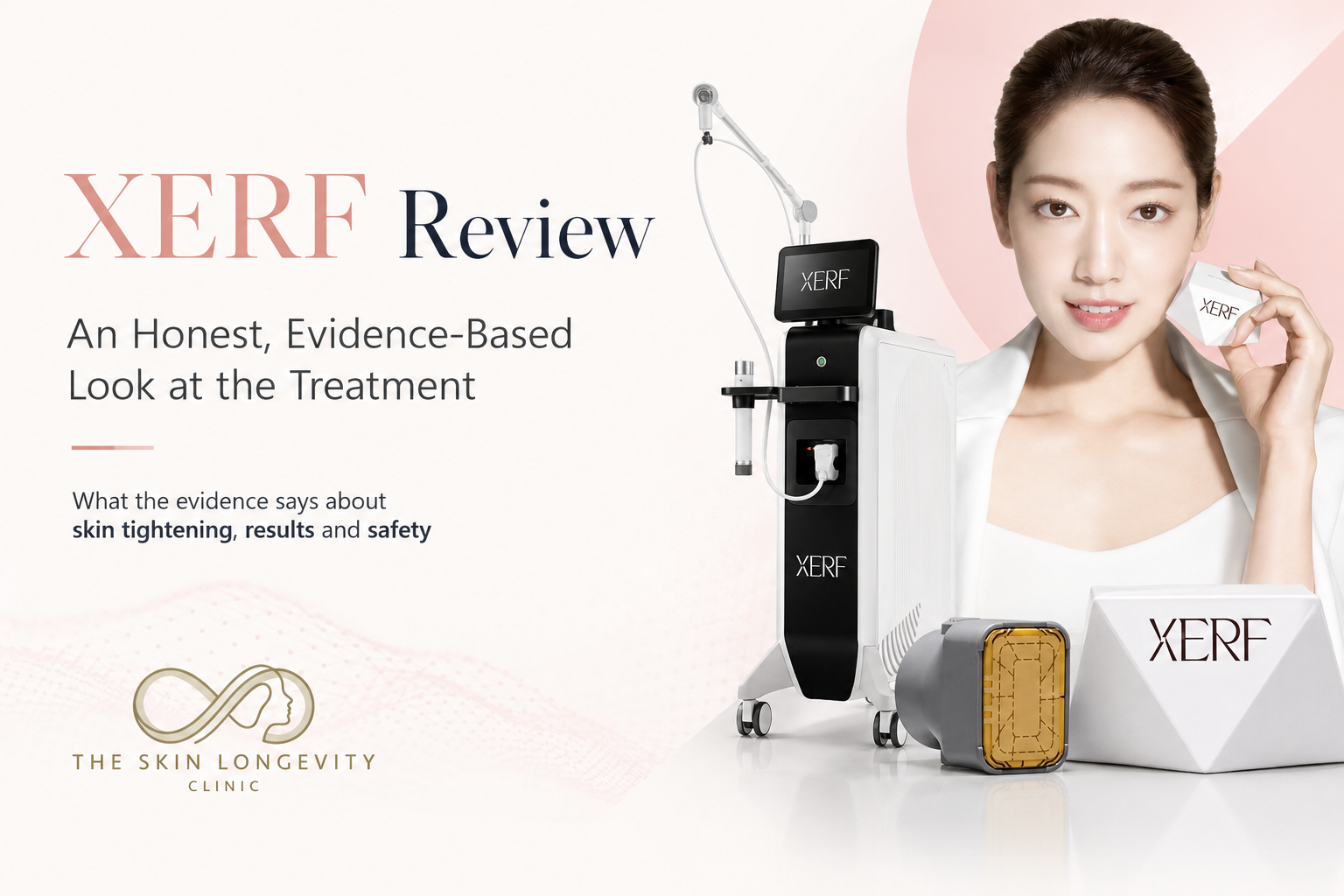
03 Jul XERF Review: An Honest, Evidence-Based Look at the Treatment
By Dr Rachel Ho | Aesthetic Doctor, Founder, The Skin Longevity Clinic, Singapore
Most people who search for a XERF reviews on Google, AI, ChatGPT, Reddit and other online platforms are asking a simple, sensible question. Does XERF work, and is it worth it? Online reviews can help, but they only answer part of that question. A more reliable review looks beyond individual opinions to what the clinical evidence actually shows and to what XERF can realistically deliver. This article reviews XERF from that angle, so that you can judge it properly rather than on impressions alone.
If you want the full background first, our complete guide to XERF in Singapore explains the technology and who it suits.
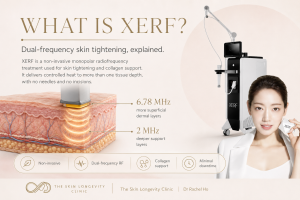
XERF uses dual-frequency monopolar radiofrequency energy to deliver controlled heat at different tissue depths for skin tightening and collagen support.
Why Online Reviews of XERF Only Tell Part of the Story
Patient reviews are genuinely useful for understanding the experience of aesthetic treatments. They tell you about the booking experience, the comfort of the treatment, the clarity of the consultation and how a clinic communicates. These accounts and review are valid and worth knowing.
However, online patients reviews are weaker as evidence of whether a treatment works. There are several reasons. Reviews are often written as anecdotal experiences after treatment, sometimes before the gradual collagen result has had time to develop, so they capture an early impression rather than the final outcome. Every reviewer has different skin, a different concern and a different starting point, so one person’s result does not predict yours. Many patients have XERF as part of a wider plan, which makes it hard to attribute a result to XERF alone. And people who feel very strongly, either happy or unhappy, are more likely to write at all.
The sensible approach is to use XERF reviews for what they are good at, which is service and experience, and to use clinical evidence for the question of whether the treatment works.
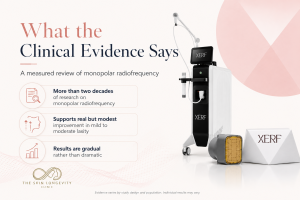
Clinical evidence on monopolar radiofrequency supports real but modest improvement in mild to moderate skin laxity when patients are appropriately selected
What the Clinical Evidence Says About Radiofrequency Tightening
XERF itself is a relatively new device, so there is not yet a large body of XERF-specific trials. What there is, however, is more than two decades of research on monopolar radiofrequency for skin tightening, which is the technology XERF is built on.
A 2011 review by El Domyati and colleagues in the Journal of the American Academy of Dermatology examined radiofrequency facial rejuvenation and described measurable effects on the skin’s collagen. A 2024 systematic review by Shin and colleagues, published in the journal Cosmetics, looked specifically at the efficacy and safety of monopolar radiofrequency for skin tightening and concluded that it is a reasonable option for mild to moderate laxity. A 2021 prospective clinical trial of a latest-generation monopolar radiofrequency device enrolled 40 patients aged 30 to 60 with mild or moderate skin laxity, and reported that at two months, 53.1 percent of patients described an improvement of more than half, with no severe adverse events. An earlier clinical trial by Wollina, published in 2011, similarly reported improvement in facial laxity.
Read honestly, this evidence supports a clear conclusion. Monopolar radiofrequency produces a real but modest improvement in mild to moderate laxity. It is gradual, it is not dramatic and it does not work equally well for everyone. That is a fair and useful summary, and it is more reliable than any single review.
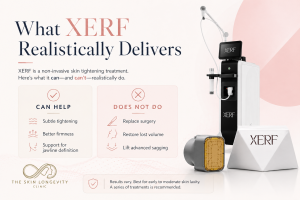
XERF can support tightening, firmness and jawline definition, but it does not replace surgery, restore lost volume or lift advanced sagging.
What XERF Realistically Delivers
Putting the evidence together, a realistic review of XERF looks like this. For the right patient, XERF can improve skin firmness, give a subtle tightening and support better definition along the jawline. The change builds gradually over weeks to months as new collagen forms.
What XERF does not do is equally important, for patients to be realistic about their results from XERF treatments. It does not lift advanced sagging, it does not replace lost facial volume and it does not produce a surgical result. A review that promises any of these is overstating the treatment. XERF is a collagen support and tightening treatment with a modest, gradual effect, and it should be judged on that basis.

XERF is a non invasive radiofrequency treatment with no needles. Warmth, redness and tenderness are usually short lived when treatment is suitable and properly performed.
What the Evidence Shows About Safety of XERF treatments
Safety is part of any honest review. Radiofrequency has a reasonably favourable safety profile when it is used appropriately. A useful feature for Singapore patients is that radiofrequency does not target melanin, so the risk of pigment-related side effects is comparatively low compared with some light-based treatments. The common effects, such as warmth, mild redness and tenderness, are usually short-lived.

How to read XERF reviews critically before choosing skin tightening treatment
How to Read XERF Reviews Critically
If you do read XERF reviews, a few questions make them more useful. When was the review written, and was it early enough that the gradual result had not yet developed? Did the reviewer have a concern similar to yours, or quite a different one? Was the treatment doctor-led and properly assessed? Was XERF done alone, or alongside other treatments? Do any before-and-after photos use consistent lighting and angles, or do they vary in ways that flatter the result?
A review that survives these questions is worth something. One that does not should be treated as an impression, not as evidence.
The Most Useful Review Is Your Own Assessment of XERF
In the end, the most reliable review of XERF for you is not written by a stranger. It is the assessment of whether radiofrequency tightening fits your particular skin and pattern of ageing. A treatment that suits one person can be the wrong choice for another with a similar-looking concern, because the underlying cause may differ.
This is why an assessment matters more than a search for testimonials. Our guide to the XERF treatment procedure explains what a proper assessment involves.
Separating Marketing Claims From Evidence
XERF, like every popular treatment, is surrounded by marketing language, and a useful review separates the claims from the evidence. Several phrases deserve a careful eye.
- Claims of an instant lift overstate the treatment. Radiofrequency produces a small immediate effect and a larger gradual one, so a genuine result is mostly visible months later, not minutes after a session.
- Claims that XERF replaces a facelift are not accurate. XERF is a tightening and collagen support treatment for mild to moderate laxity. A facelift addresses advanced sagging by removing tissue. They are not interchangeable.
- Claims that XERF suits everyone are also worth questioning. The evidence supports radiofrequency for mild to moderate laxity in suitable patients, not as a universal answer to every ageing concern.
- Claims of permanent results are misleading, because collagen continues to decline with age and results are maintained rather than fixed.
None of this means XERF is overhyped as a treatment. It means the treatment is often better than the language used to sell it. A measured, evidence-based description, a real but modest improvement that develops gradually in the right patient, is both more honest and more useful than the marketing version. When you read a XERF review, holding it against these points helps you judge whether you are reading evidence or advertising. A treatment that is described accurately, with its limits stated plainly, is usually being offered by someone worth trusting. Exaggerated language, by contrast, is a signal to ask more questions before you commit.
Frequently Asked Questions about XERF
Does XERF actually work?
The clinical evidence on monopolar radiofrequency, the technology behind XERF, supports a real but modest improvement in mild to moderate skin laxity. It works gradually as new collagen forms, and it works best in suitable patients. It does not work as a substitute for surgery, and results vary between individuals.
Is XERF worth the money?
XERF can be worth it if your concern is mild to moderate laxity and your expectations are realistic. It is poor value if you are expecting a surgical result, or if your main problem is volume loss rather than laxity. Whether it is worth it for you depends on the diagnosis, which is what a consultation establishes. Our guide to XERF price in Singapore discusses cost and value.
Are XERF before-and-after photos reliable?
They can be, but only if the photos use consistent lighting, angle and timing, and only if the patient’s concern is similar to yours. Clinics naturally show their better results, so photos are best treated as examples of what is possible rather than a promise of your own outcome.
What is the downside of XERF?
The main limitations are that the result is modest and gradual, that it is not permanent because ageing continues, and that it is unsuitable for advanced sagging or volume loss. Side effects are usually minor and short-lived. The biggest risk is not a side effect at all, but choosing XERF when it does not fit your concern.
Related XERF and Skin Tightening Guides
These articles form a connected library on XERF and skin tightening at The Skin Longevity Clinic. You may also find the following guides helpful:
- XERF in Singapore: a complete guide
- XERF price in Singapore
- XERF treatment: the procedure explained
- XERF vs Ultherapy compared
XERF at The Skin Longevity Clinic, Singapore
The Skin Longevity Clinic is a doctor-led practice in the Orchard area of Singapore that assesses XERF as part of a wider treatment plan. Rather than relying on reviews, the most useful step is an honest assessment of whether XERF suits your skin. You can contact the clinic to arrange a consultation.