


06 Aug ECM Skin Booster Under Eye Singapore: Fine Lines and Dark Circles
By Dr Rachel Ho | Aesthetic Doctor, Founder, The Skin Longevity Clinic, Singapore
The under eye area can make a face look tired even after a good night of sleep. Fine lines, translucent skin, dark eye circles, hollowing and eye bags often occur together, yet each feature develops for a different reason.
ECM skin boosters are an emerging option for patients in Singapore whose main concern is thin, crepey or poor quality under eye skin. Their role is to support the dermal environment rather than create the immediate volume associated with conventional tear trough fillers.
This distinction is important. Improving the quality of the lower eyelid skin may soften fine lines and make vascular shadows less obvious, but it cannot correct every cause of dark eye circles or under eye ageing.
FAQ on ECM skin boosters for under eye/ tear trough
| FAQ about ECM skin boosters for under eyes | Answers to ECM Skin boosters for under eyes |
|---|---|
| What does an ECM skin booster target? | Fine lines, crepey texture, thin looking skin and reduced dermal support |
| Can it treat dark circles? | It may help when thin skin and vascular visibility contribute to the darkness |
| Does it fill the tear trough? | Its main role is skin quality rather than structural volume replacement |
| Can it remove eye bags? | Fat prolapse, fluid retention and marked excess skin require different approaches |
| Is it an alternative to under eye filler? | It can be an alternative for selected skin quality concerns, but it does not provide the same contour correction |
| When do results appear? | Improvement is expected to develop gradually as the dermis responds |
| Is the evidence established? | Early results are encouraging, although direct under eye studies remain limited |
What is an ECM skin booster?
ECM stands for extracellular matrix. The extracellular matrix is the support network surrounding cells in the dermis and includes collagen, elastin, glycosaminoglycans and other structural molecules involved in skin strength, elasticity, hydration and repair.
Some ECM skin boosters use processed acellular dermal matrix. Cellular material is removed during processing, leaving a structural scaffold intended to support fibroblast activity and dermal remodelling.
A 2026 randomised, split face and double blinded trial evaluated an injectable particulate human acellular dermal matrix in 20 adults. The treated side showed greater improvements in several measurements, including skin density, elasticity, wrinkle depth, hydration and barrier related parameters, compared with the side treated with hyaluronic acid1.
The study provides useful early evidence, but its limitations deserve attention. Treatment was performed on the cheeks rather than the lower eyelids, the sample was small and follow up continued for 20 weeks. These findings therefore support the biological concept of ECM treatment without proving the same degree of benefit in delicate under eye skin.
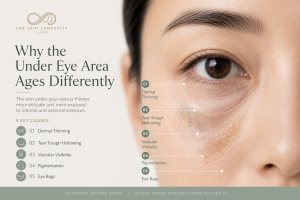
Under-eye ageing can result from dermal thinning, tear-trough hollowing, visible blood vessels, pigmentation and eye bags. Identifying the dominant cause helps determine whether an ECM skin booster or another treatment is more appropriate.
Why does the under eye area age differently?
The lower eyelid has some of the thinnest and most mobile skin on the face. Repeated blinking and facial expression occur over a region with relatively little soft tissue support, while the cheek and eyelid structures beneath it continue to change with age.
Under eye ageing usually reflects several changes occurring at the same time.
1. Dermal thinning and collagen loss
The skin gradually becomes thinner and less elastic as collagen, elastin and other matrix components change. Fine creases become more visible, while reduced skin opacity allows the colour of underlying vessels and muscle to show through.
Ultraviolet exposure can accelerate these changes. This is especially relevant in Singapore, where ultraviolet exposure occurs throughout the year.
2. Tear trough hollowing
The tear trough is the groove extending from the inner corner of the eye towards the upper cheek. Its appearance is influenced by ligament anatomy, facial fat, cheek support, skin quality and the shape of the underlying bone.
An anatomical study demonstrated that the tear trough ligament contributes to the fixed boundary that creates this groove2. More recent clinical reviews emphasise that tear trough treatment should be matched to the degree of hollowing, skin quality, lower eyelid laxity and fat prolapse rather than chosen from the appearance of the shadow alone3.
3. Changes in cheek support
Loss or redistribution of cheek volume can make the eyelid and cheek junction look less smooth. A shallow groove may become deeper, while the contrast between a hollow area and an adjacent eye bag becomes more pronounced.
Treating only the lower eyelid may therefore produce an incomplete result in patients whose under eye concern is partly caused by reduced midface support.
4. Orbital fat and eye bags
The lower eyelid contains orbital fat held behind supporting structures. Age related changes can allow this fat to become more prominent, producing a fixed eye bag.
Fluid retention can create a different type of puffiness that changes during the day. Allergies, sinus congestion, rubbing, sleep patterns and salt intake may aggravate this component. ECM treatment does not remove prolapsed fat or correct substantial fluid retention.
5. Pigmentation and inflammation
Brown under eye discolouration may come from constitutional pigmentation, sun exposure, eczema, allergic dermatitis or post inflammatory hyperpigmentation. Repeated rubbing can worsen both inflammation and pigmentation.
A Singapore study involving patients at the National Skin Centre found that periorbital dark circles in Asian patients could be classified into vascular, constitutional, post inflammatory and shadow related types. Vascular dark circles were the most common category in that study4.
6. Vascular visibility
Thin lower eyelid skin may allow blue, purple or grey vascular tones to become more apparent. A mixed picture is common, with pigmentation, visible vessels, hollowing and skin laxity contributing together.
A dermoscopic study found overlapping pigmentary, vascular and inflammatory findings in many patients with periorbital darkness. This helps explain why a single treatment frequently produces only partial improvement5.
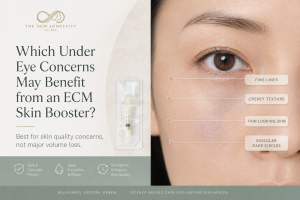
An ECM under-eye treatment may suit selected patients whose main concern is fine lines, crepey texture, thin-looking skin or vascular dark circles. Its role is gradual skin-quality support rather than major volume replacement.
Which under eye concerns may benefit from an ECM skin booster?
An ECM skin booster may be considered when examination shows that dermal quality is an important part of the concern. Suitable features may include fine static lines, early crepiness, thin looking skin, reduced elasticity and vascular visibility made worse by limited skin thickness.
The aim is gradual improvement in the condition and support of the skin. Patients seeking a large change in under eye contour are likely to need another treatment category.
Under eye concern and likely treatment direction
Under eye concern and likely treatment recommendations
| Main concern | Treatment recommendations often considered |
|---|---|
| Fine lines and crepey skin | ECM booster, hyaluronic acid skin booster, polynucleotide treatment, resurfacing or selected energy treatment |
| Thin skin with vascular visibility | Dermal quality treatment, vascular treatment or a combination |
| Brown pigmentation | Medical skincare, pigment treatment, control of eczema or inflammation |
| Tear trough hollowing | Midface support, carefully selected tear trough filler or structural treatment |
| Prominent eye bags | Assessment of fat, fluid, skin laxity and surgical suitability |
| Dynamic wrinkles | Botulinum toxin in selected areas and doses |
| Significant excess skin | Resurfacing, tightening or surgical assessment depending on severity |
| Mixed dark circles | A staged combination based on the dominant causes |
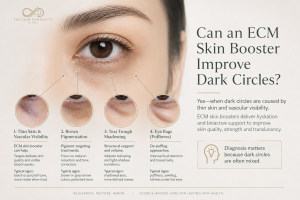
An ECM skin booster may soften dark circles caused partly by thin skin and visible blood vessels. Brown pigmentation, tear-trough shadowing and eye bags require treatments directed at those different causes.
Can an ECM skin booster improve dark eye circles?
An ECM skin booster may improve the appearance of dark circles when thin or crepey skin allows underlying vessels to show through. Better dermal quality and skin density may reduce some of this transparency, although the amount of improvement varies.
Dark circles caused mainly by brown pigmentation require pigment directed treatment. A deep tear trough creates a structural shadow and may need volume support, while a prominent eye bag requires assessment of fat, fluid and lower eyelid laxity.
Studies of Asian populations have repeatedly found that periorbital darkness is often vascular, structural or mixed rather than purely pigmentary4,6. Diagnosis is therefore more useful than choosing a treatment solely because the area looks dark.
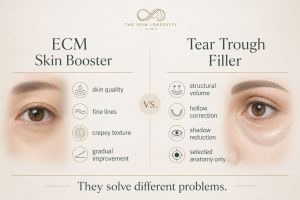
ECM skin booster versus tear-trough filler: an ECM treatment mainly supports fine lines, crepey texture and dermal quality, while filler restores volume in selected structural hollows. They address different under-eye concerns.
Is an ECM skin booster an alternative to tear trough filler?
ECM skin boosters and tear trough fillers address different anatomical problems. An ECM treatment focuses mainly on skin quality and dermal support, while a hyaluronic acid filler occupies space and reduces a hollow or shadow by changing the contour.
For patients with fine lines, crepiness and adequate underlying volume, adding filler may provide little benefit and could create unnecessary fullness. A skin quality treatment may be the more suitable direction in this group.
Patients with a true tear trough and good lower eyelid anatomy may still benefit more from carefully planned structural support. Current reviews describe filler as an option for selected mild deformities with good skin quality and limited laxity or fat prolapse, while surgery remains more predictable for advanced structural concerns3.
ECM skin booster compared with tear trough filler
ECM skin booster compared VS tear trough filler
| ECM skin booster | Tear trough filler |
|---|---|
| Supports dermal quality | Restores structural volume |
| Results develop gradually | Contour change is more immediate |
| May improve fine texture and crepiness | May reduce shadows caused by hollowing |
| Does not directly fill a deep groove | Does not correct every pigment or skin quality concern |
| Less suitable for major volume loss | Less suitable for fluid prone or markedly puffy lower eyelids |
| Requires realistic expectations about subtle change | Requires careful patient selection to avoid swelling and irregularity |
Why do some patients prefer under eye rejuvenation without filler?
Patients may prefer a non filler approach because they do not want additional under eye volume. Others have anatomy associated with puffiness, fluid retention or a poorly defined eyelid and cheek junction, where filler may make the area appear heavier.
Hyaluronic acid tear trough filler can produce high satisfaction in appropriately selected patients. Systematic reviews also report bruising, swelling, blue grey discolouration and contour irregularity among the recognised adverse effects7,8
Delayed swelling and palpable lumps have also been reported after tear trough filler treatment. These risks do not mean that filler should be avoided in every patient, but they reinforce the importance of matching treatment to anatomy rather than treating all tired looking eyes with volume9.
Rare vascular complications can occur with facial filler injections. Careful technique, anatomical knowledge, conservative volumes and emergency preparedness remain essential whenever fillers are used10.
ECM skin booster versus other under eye skin boosters
The term skin booster includes several treatment categories with different compositions and intended effects. They should not be assumed to work in the same way.
Treatment options for under eyes
| Treatment category | Main role around the eyes |
|---|---|
| ECM skin booster | Matrix support, dermal quality, fine texture and early crepiness |
| Hyaluronic acid skin booster | Hydration, smoothness and fine surface crepiness |
| Polynucleotide treatment | Repair support, hydration and gradual improvement in skin quality |
| Collagen biostimulator | Gradual collagen support, depending on formulation and placement |
| Tear trough filler | Structural correction of selected hollows and shadows |
A randomised periocular study comparing polynucleotide and non crosslinked hyaluronic acid injections found improvement with both treatments. Some measurements of elasticity, roughness and pore volume favoured polynucleotide treatment, although these findings apply to those materials and should not be used as proof of ECM efficacy [11].
What happens during an ECM skin boosters under eye treatment?
Treatment begins with an assessment of the lower eyelid, tear trough, cheek support, skin thickness, pigmentation, vascular visibility, swelling tendency and eye bag anatomy. Photographs may be taken to document the starting point and evaluate gradual changes.
The treatment area is cleaned and topical anaesthetic may be applied. The ECM material is placed in selected areas according to the treatment plan, with the amount and depth adjusted to the patient’s anatomy and the properties of the formulation.
Small injection bumps, redness, swelling, tenderness or bruising can occur afterwards. Under eye swelling can look more conspicuous than swelling elsewhere on the face because the skin is thin and the area is prone to fluid accumulation.
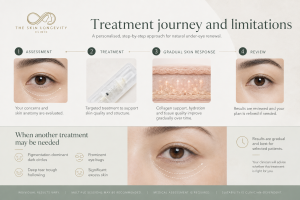
ECM under-eye rejuvenation begins with assessment, followed by targeted treatment, gradual skin response and review. Pigmentation, deep hollowing, prominent eye bags or substantial excess skin may require a different or combined treatment plan.
When should results appear after ECM skin boosters to the under eyes?
Some patients may notice early improvement in smoothness as initial swelling settles. More meaningful changes in fine texture and dermal quality are expected to develop gradually over the following weeks.
The number of sessions depends on the starting condition of the skin, treatment response and formulation used. A review after the initial treatment allows the doctor to decide whether another session or a complementary treatment would add value.
What are the limitations of ECM under eye rejuvenation?
The current evidence for injectable ECM treatment is early. The strongest recent controlled study involved 20 adults, treated the cheeks and followed for 20 weeks, so long term under eye effectiveness and safety remain incompletely defined1.
An ECM skin booster cannot remove prolapsed orbital fat, replace substantial lost volume or directly clear brown pigmentation. It also cannot tighten a large amount of excess lower eyelid skin.
Patients should understand the source and composition of the material being injected. Some formulations use human tissue derived acellular dermal matrix, making clear disclosure and informed consent particularly important.
Who is suitable for under eye ECM skin boosterrs
ECM under eye treatment may suit patients with fine lines, crepey texture, thin looking skin or mild dermal quality changes. It may also be considered by people who want gradual rejuvenation without obvious under eye volumisation.
Suitability becomes less likely when the main concern is marked fluid retention, substantial fat prolapse, severe lower eyelid laxity, active eczema, infection or unstable inflammation. Deep structural hollowing may also require support beyond a skin booster.
When should another treatment besides ECM skin booster be considered?
Pigment directed treatment such as pico laser is more appropriate when brown melanin is the dominant cause of dark circles. Vascular treatment may be considered when visible vessels or erythema are prominent, while eczema and habitual rubbing should be controlled before an elective injectable procedure.
Tear trough filler may be discussed when a true structural hollow is the main concern and the anatomy is suitable. Surgery may provide a more predictable correction for established fat prolapse, significant excess skin or moderate to severe lower eyelid ageing.
Combination treatment is often useful because the under eye area can contain several overlapping problems. The safest approach is usually staged, allowing each concern to be treated without adding unnecessary volume, inflammation or downtime.
Frequently asked questions about ECM skin boosters for under eye or tear trough
Can an ECM skin booster remove dark circles?
ECM skin boosters can reduce the appearaance of dark circles caused partly by thin skin and vascular visibility. Pigmentation, deep hollowing and eye bags require treatments directed at those specific causes.
Does an ECM skin booster fill the tear trough?
Its principal role is to support skin quality rather than replace substantial lost volume. A defined structural tear trough may still require midface support, filler or another anatomical treatment.
Can ECM skinboosters reduce under eye wrinkles?
Fine lines associated with crepey skin and reduced dermal support can improve ECM skin boosters that restore the skin matrix. Deeper wrinkles caused by repeated movement, significant laxity or advanced photodamage may need a combination treatment with botulinum toxin.
Are ECM skin boosters better than polynucleotides for the under eyes?
The two categories contain different materials and have different proposed mechanisms. Direct comparative trials between under eye ECM and polynucleotide treatments are currently lacking, so selection should follow the patient’s skin concern, anatomy and preferences.
Can ECM skin boosters replace under eye filler?
It can provide a non filler option when the main concern is skin quality rather than hollowing. It cannot create the same immediate structural correction as a properly selected tear trough filler.
Can ECM skin boosters treat eye bags?
Skin quality may improve when mild crepiness contributes to the appearance of an eye bag. Prolapsed fat, fluctuating fluid retention and substantial excess skin require separate assessment.
Is there downtime for ECM skin boosters treatments?
Temporary swelling, redness, tenderness, injection bumps and bruising may occur. The extent and duration vary with the treatment area, technique, formulation and individual tendency to swell.
Is an ECM skin booster safe under the eyes?
Early facial studies have reported encouraging short term safety, but direct controlled evidence for lower eyelid use remains limited. Careful selection, appropriate consent and precise technique are especially important in this delicate area.
Dr Rachel Ho’s clinical perspective on ECM skin boosters for under eye/ tear trough particles.
Under eye rejuvenation begins with separating skin quality from structure. A patient with crepey skin needs a different plan from someone with a deep tear trough, pigmentary dark circles, fluid retention or prolapsed fat.
ECM skin boosters add an interesting option for patients whose main concern is thin, tired looking or finely wrinkled under eye skin. I approach them as a skin quality treatment rather than a substitute for every type of filler, laser or eye bag procedure.
The goal is a fresher lower eyelid that still looks natural. Treatment should improve the correct layer, respect the anatomy and remain proportionate to the concern.
Takeaway for ECM skin boosters for under eye rejuvenation
ECM skin boosters may support fine lines, crepey texture and thin under eye skin in selected patients. They may also make vascular dark circles appear softer when improved dermal quality reduces the visibility of underlying vessels.
Results are expected to be gradual, and the evidence remains early. A proper assessment should first determine whether the tired appearance comes from skin quality, pigmentation, vascularity, hollowing, fluid or eye bags before treatment is selected.
References
- Lee YI, Chau NH, Nguyen NH, et al. Injectable Particulated Human Acellular Dermal Matrix Booster for Skin Restoration: An Integrated Randomized, Split Face, Double Blinded Clinical Trial and Preclinical Study. International Journal of Molecular Sciences. 2026;27(5):2193.
- Wong CH, Hsieh MKH, Mendelson B. The Tear Trough Ligament: Anatomical Basis for the Tear Trough Deformity. Plastic and Reconstructive Surgery. 2012;129(6):1392 to 1402.
- Termanini KM, Alghoul MS. Tear Trough Deformity: Update on Anatomy and Clinical Management. Aesthetic Surgery Journal. 2026;46(6):577 to 585.
- Ranu H, Thng S, Goh BK, Burger A, Goh CL. Periorbital Hyperpigmentation in Asians: An Epidemiologic Study and a Proposed Classification. Dermatologic Surgery. 2011;37(9):1297 to 1303.
- Chhabra N, Khare S, Sachdev D. Dermoscopy as an Efficient Aid to Diagnose Pigmentary and Vascular Components of Periorbital Melanosis. Journal of Cosmetic Dermatology. 2022;21(11):5880 to 5886.
- Huang YL, Chang SL, Ma L, Lee MC, Hu S. Clinical Analysis and Classification of Dark Eye Circles. International Journal of Dermatology. 2014;53(2):164 to 170.
- Liu X, et al. The Efficacy and Safety of Hyaluronic Acid Injection in Tear Trough Deformity: A Systematic Review and Meta Analysis. Aesthetic Plastic Surgery. 2024.
- Trinh LN, McGuigan KC, Gupta A. Dermal Fillers for Tear Trough Rejuvenation: A Systematic Review. Facial Plastic Surgery. 2022.
- Trinh LN, Gupta A. Delayed Complications Following Dermal Filler for Tear Trough Augmentation. Journal of Cosmetic Dermatology. 2022.
- Doyon VC, Liu C, Fitzgerald R, et al. Update on Blindness From Filler: Review of Prognostic Factors, Management Approaches and a Century of Published Cases. Aesthetic Surgery Journal. 2024;44(10):1091 to 1104.
- Lee YJ, Kim HT, Lee YJ, et al. Comparison of the Effects of Polynucleotide and Hyaluronic Acid in Periocular Rejuvenation. Journal of Cosmetic and Laser Therapy. 2022.