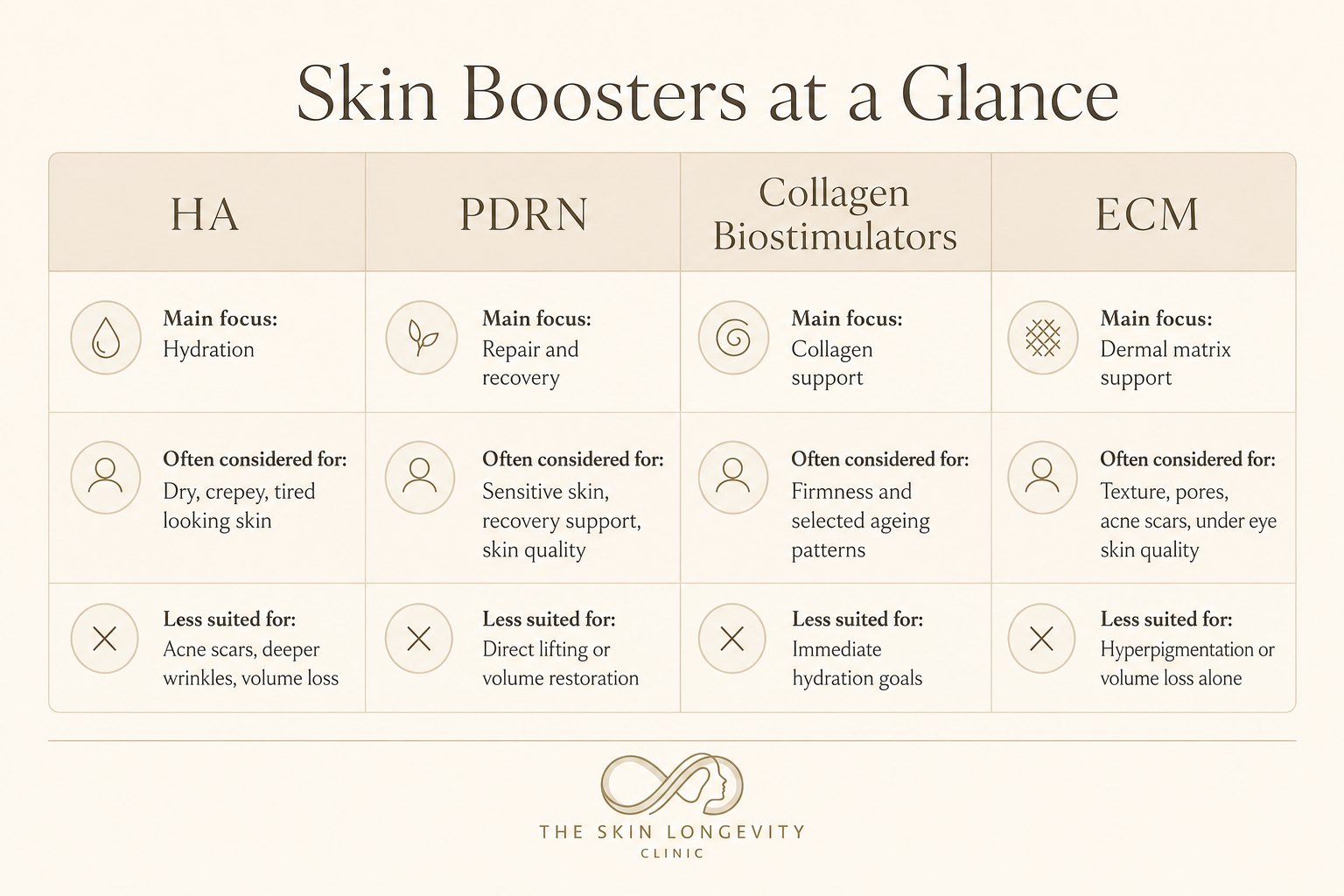
HA, Polynucleotide, PDLLA, ECM and Exosome Compared
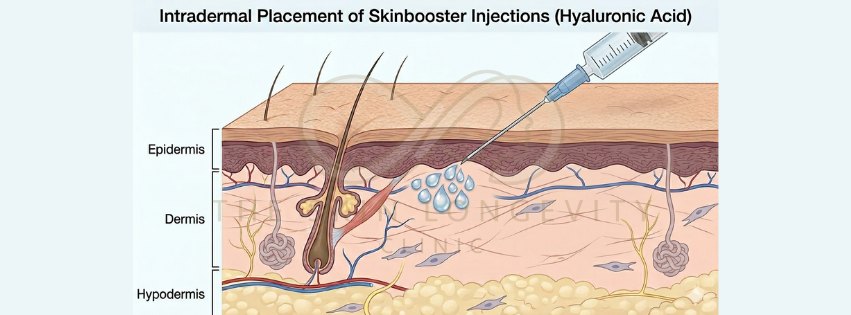
Skin boosters are injectable treatments placed in the superficial to mid dermis to change skin quality: hydration, texture, fine lines, pore appearance and elasticity. They do not add volume in the way a dermal filler does.1 Five categories are used at The Skin Longevity Clinic in Singapore, and each acts through a different mechanism. This page compares them so that the consultation starts from the right question: what the skin needs, rather than which product is being advertised.
Dr Rachel Ho assesses skin quality, history and goals before any skin booster is proposed. Her informational guide to the category is on drrachelho.com: skinboosters in Singapore, a doctor’s guide.
How skin boosters differ from dermal fillers and collagen biostimulators
Dermal fillers are crosslinked hyaluronic acid gels placed deeper to restore volume and contour. Skin boosters use softer or non-crosslinked material placed superficially to change the skin itself.1 Collagen biostimulators such as poly-L-lactic acid and calcium hydroxylapatite are injected deeper again and stimulate collagen over months; PDLLA sits between the two groups and is covered in both this page and the collagen biostimulator guide.
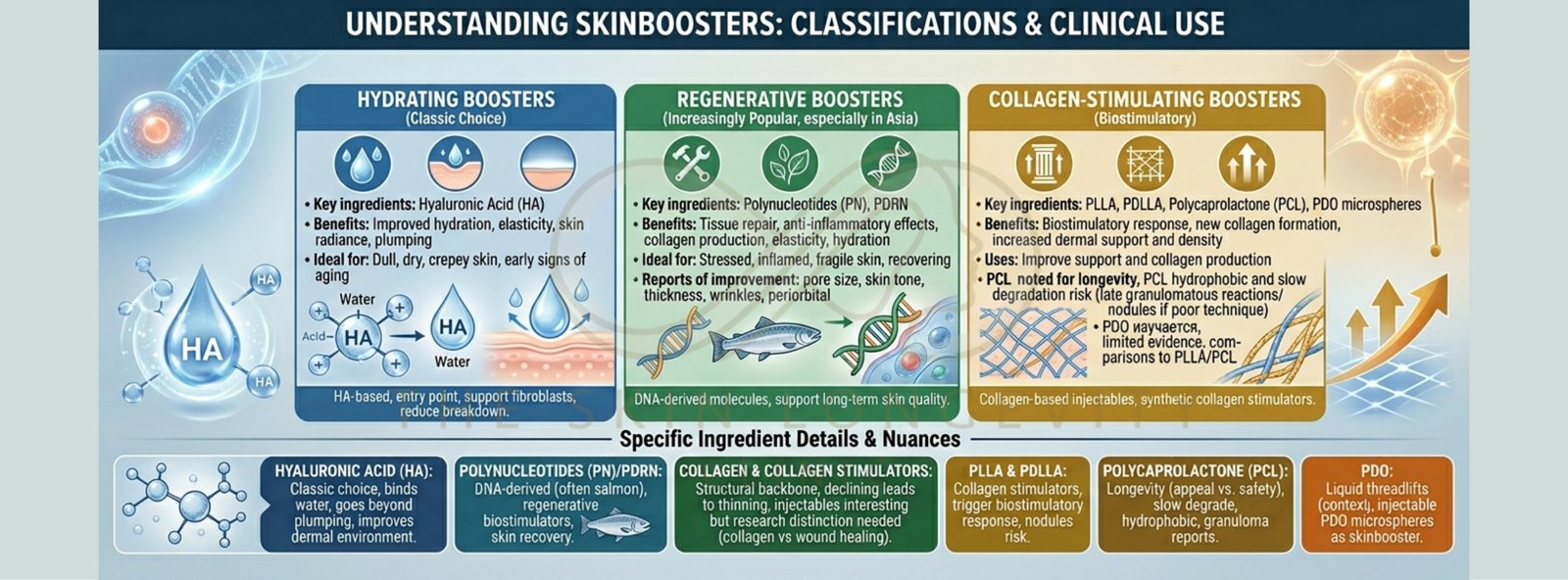
Other injectables are sometimes sold as skin boosters: polycaprolactone and polydioxanone microspheres (long-lasting collagen stimulators with a smaller evidence base and reports of late nodules), multi-ingredient “cocktail” boosters of hyaluronic acid with glycerol, amino acids or vitamins (harder to study because no single ingredient can be credited), and low-dose intradermal botulinum toxin for texture and oil control. These are discussed at consultation where relevant; they are not the clinic’s first-line skin boosters.
Skin booster classification by mechanism: hydrating, regenerative and collagen-stimulating.
Which skin booster suits which skin concern
Dehydrated, dull or crepey skin: hyaluronic acid skin booster first.2 Polynucleotide if the skin is also thin or slow to recover.5
Fine lines around the eyes: polynucleotide has the most specific data for crow’s feet4; hyaluronic acid for surface hydration.
Enlarged pores and rough texture: ECM skin booster10 or PDLLA7; both are compared with energy-based options on the large pores treatment page.
Mild laxity and early sagging: PDLLA7,8; deeper laxity is a skin tightening question.
Post-acne skin and shallow acne scars: polynucleotide or PDLLA alongside the acne scar treatment plan.
Pigmentation and uneven tone: the brightening skinboosters and exosome-assisted procedures, within a pigmentation treatment plan.
Treatment goal
Skin booster category usually considered
Why
Hydration and fine crepiness
Hyaluronic acid skin booster
Hyaluronic acid attracts water and improves the feel of dry or tired-looking skin
Repair and recovery support
Polynucleotide skin booster
Used for skin recovery, inflammation support and overall skin quality
Firmness and gradual collagen response
PDLLA or collagen biostimulators
Stimulate gradual collagen production and dermal support
Texture, pores and selected acne scars
ECM skin booster
Dermal matrix support and skin quality in selected patients
Under-eye skin quality
ECM, hyaluronic acid or polynucleotide, depending on diagnosis
The cause may be thin skin, hollowing, pigmentation, vascular shadowing or dermal quality
Laxity or sagging
RF skin tightening, collagen biostimulators or a combination plan
Skin boosters alone do not address deeper laxity or structural support
Volume loss
Dermal fillers or collagen biostimulators
Skin boosters do not replace lost facial volume
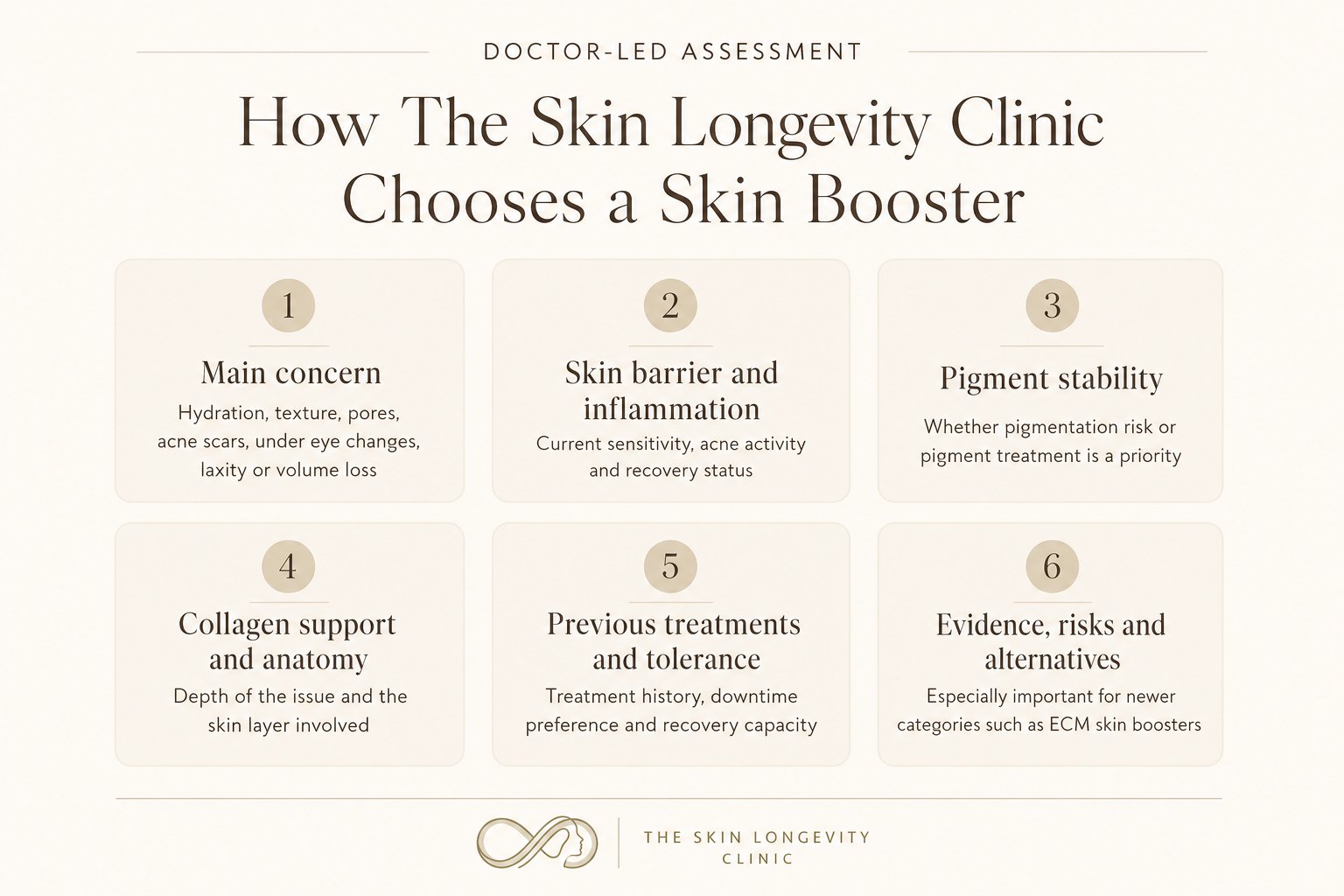
How a skin booster treatment is selected at The Skin Longevity Clinic
The assessment covers skin hydration, texture, laxity, pore pattern, pigmentation and any active acne. Skin boosters are deferred while acne is active and are not used over infected or inflamed skin. Medical history covers autoimmune disease, keloid tendency, pregnancy and breastfeeding, previous filler or biostimulator treatment, and allergies (polynucleotide products are fish-derived). The plan names the category, the number of sessions and the review point at which the response is judged.
Six factors assessed before a skin booster is proposed.
What happens during a skin booster session
Topical anaesthetic is applied for 20–30 minutes. Injections are placed by microdroplet, cannula or injector device depending on the product and area. A session takes 30–45 minutes. Small bumps at the injection points settle within 24–72 hours for hyaluronic acid and up to 5 days for polynucleotide and ECM products.5,10 Make-up can be worn from the next day.
Skin boosters are placed in the dermis, not the deeper planes used for fillers.
Skin booster results, sessions and maintenance
Hyaluronic acid results are visible at 2–4 weeks and last 6–12 months.2 Polynucleotide and PDLLA responses build over 8–12 weeks as collagen forms.4,7 The ECM trial measured improvement in pore area, hydration and elasticity from week 12 to week 20.10 Maintenance is planned at review, not sold in advance.
Skin booster side effects and risks
All categories share injection-related effects: bruising, swelling, small bumps and, rarely, infection.6 Product-specific risks include delayed inflammatory nodules or granulomas after PDLLA9, and vascular injury when any material is injected near the tear trough or temple. Exosome products are not approved for injection in the United States, and the clinic uses them topically only.11 Any lump lasting beyond two weeks should be reviewed.
Can skin boosters be combined with other treatments?
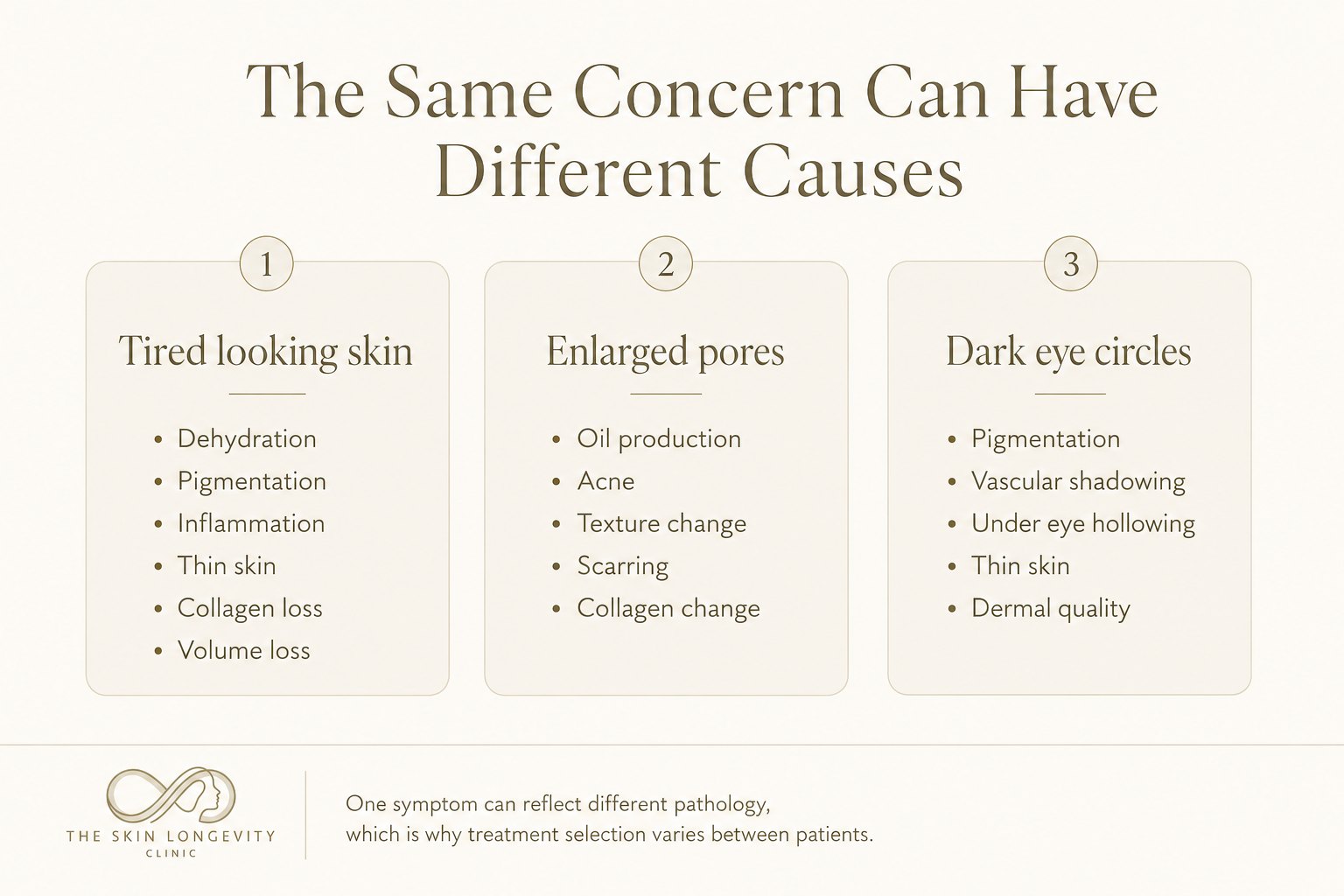
Yes, when different skin layers or concerns are involved, and in a planned sequence. For acne scars, RF microneedling or fractional laser is combined with a polynucleotide or PDLLA booster. For melasma and post-inflammatory pigmentation, sunscreen, pico laser or chemical peels come first and a brightening or hydrating booster follows. For volume loss or sagging, fillers or collagen biostimulators are needed before, or instead of, a skin quality injectable. Treatments are spaced two to four weeks apart; stacking them too quickly raises swelling, irritation and pigmentation risk. The same complaint can need different treatments: tired-looking skin may be dehydration, pigmentation, hollowing or thin skin, and only some of those are skin booster questions.
Concern
Possible causes
Planning note
Tired-looking skin
Dehydration, pigmentation, inflammation, thin skin, collagen loss, volume loss
A skin booster may help skin quality; volume loss or pigmentation needs another approach
RF microneedling, fractional laser, subcision, ECM or collagen support
Sagging or laxity
Skin laxity, collagen loss, fat pad descent, volume loss
Skin boosters support skin quality; tightening, lifting or volume support may be required
The same concern can have different causes; the cause decides whether a skin booster is the right treatment.
What affects skin booster cost in Singapore
Cost depends on the category, the product volume, the number of areas and the number of sessions in the course. A quote is given after consultation, when the plan is known.
There is no single best product. Hyaluronic acid has the broadest evidence for hydration2, polynucleotide for under-eye fine lines4, PDLLA for collagen stimulation7, ECM for pore size10. The choice follows the skin finding.
Are skin boosters the same as fillers?
No. Fillers add volume in deeper planes; skin boosters change skin quality in the superficial dermis.1
How long do skin boosters last?
Hyaluronic acid 6–12 months2; polynucleotide and PDLLA are reviewed at 3–6 months with maintenance planned from the response.4,7
Can skin boosters be combined with laser or RF microneedling?
Yes, in sequence. Energy-based treatments and skin boosters are usually spaced two to four weeks apart so each can be assessed on its own.
Are skin boosters safe during pregnancy?
Skin boosters are deferred during pregnancy and breastfeeding because safety data are lacking.
Skin booster assessment at The Skin Longevity Clinic
A skin booster is chosen for what the skin needs, not for the product name. Dr Rachel Ho first assesses hydration, texture, pores, laxity and pigment, then matches one category (hyaluronic acid, polynucleotide, PDLLA, ECM or exosome) to the main concern.
The approach at the clinic is conservative:
treat the concern that matters most first
use the fewest sessions that reach the goal
review the skin at each visit before adding a second category
Assessments take place at Scotts Medical Center, 9 Scotts Road. Book through the contact page or call +65 6514 2688.
References
Rho NK, Kim HS, Kim SY, et al. Injectable “Skin Boosters” in Aging Skin Rejuvenation: A Current Overview. Arch Plast Surg. 2024;51(6):528–541. doi:10.1055/a-2366-3436.
Ghatge AS, Ghatge SB. The Effectiveness of Injectable Hyaluronic Acid in the Improvement of the Facial Skin Quality: A Systematic Review. Clin Cosmet Investig Dermatol. 2023;16:891–899. doi:10.2147/CCID.S404248.
Belmontesi M, De Angelis F, Di Gregorio C, et al. Injectable Non-Animal Stabilized Hyaluronic Acid as a Skin Quality Booster: An Expert Panel Consensus. J Drugs Dermatol. 2018;17(1):83–88. PubMed.
Kim JH, Kim ES, Kim SW, Hong SP, Kim J. Effects of Polynucleotide Dermal Filler in the Correction of Crow’s Feet Using an Antera Three-Dimensional Camera. Aesthetic Plast Surg. 2022;46(4):1902–1909. doi:10.1007/s00266-022-02832-8.
Cavallini M, Bartoletti E, Maioli L, et al. Consensus report on the use of PN-HPT (polynucleotides highly purified technology) in aesthetic medicine. J Cosmet Dermatol. 2021;20(3):922–928. doi:10.1111/jocd.13679.
Lee KWA, Chan KWL, Lee A, et al. Polynucleotides in Aesthetic Medicine: A Review of Current Practices and Perceived Effectiveness. Int J Mol Sci. 2024;25(15):8224. doi:10.3390/ijms25158224.
Seo SB, Park H, Jo JY, Ryu HJ. Skin rejuvenation effect of the combined PDLLA and non cross-linked hyaluronic acid: A preliminary study. J Cosmet Dermatol. 2024;23(3):794–802. doi:10.1111/jocd.16085.
Lee KWA, Chan LKW, Lee AWK, et al. Poly-d,l-lactic Acid (PDLLA) Application in Dermatology: A Literature Review. Polymers (Basel). 2024;16(18):2583. doi:10.3390/polym16182583.
Perez Willis KM, Ramirez Galvez R. Granuloma after the Injection of Poly-D,L-Lactic Acid (PDLLA) Treated with Triamcinolone. Case Rep Dermatol Med. 2024;2024:6544506. doi:10.1155/2024/6544506.
Lee YI, Chau NH, Nguyen NH, et al. Injectable Particulated Human Acellular Dermal Matrix Booster for Skin Restoration: An Integrated Randomized, Split-Face, Double-Blinded Clinical Trial and Preclinical Study. Int J Mol Sci. 2026;27(5):2193. doi:10.3390/ijms27052193.
US Food and Drug Administration. Public Safety Notification on Exosome Products. 6 December 2019. doi:10.1002/lsm.23628.