

Can Sebaceous Gland Ablation Permanently Cure Acne?

Can sebaceous gland ablation permanently cure acne? Dr Rachel Ho reviews the evidence for selective sebaceous gland ablation and recurring acne in Singapore.

Can Sebaceous Gland Ablation Permanently Cure Acne?

Can Sebaceous Gland Ablation Permanently Cure Acne?

Written and medically reviewed by Dr Rachel Ho
Aesthetic Doctor and Founder, The Skin Longevity Clinic, Singapore
Updated September 2026

Have you encountered a pimple or acne that seems to recur in the same region, despite your best efforts at medications or treatments?  This recurring pattern of acne has created interest in selective sebaceous gland ablation, which is called selective sebaceous gland electrothermolysis in the medical literature. In selective sebaceous gland ablation, an insulated microneedle delivers controlled radiofrequency energy towards selected sebaceous glands associated with inflammatory acne3,4.

The early clinical results of selective sebaceous gland ablation are encouraging and studies show fewer inflammatory lesions and sustained improvement in some treated patients3,4,6.

Can sebaceous gland ablation permanently cure acne?

A randomised controlled study of selective sebaceous gland ablation in 2020 included 63 patients who completed three treatments at four week intervals. This study found that Inflammatory lesion counts improved significantly at 12 weeks compared with microneedling and extraction alone4. Based on this study, we can conclude that selective sebaceous gland ablation can produce sustained improvement and reduce recurrence from selected treated follicles1-4.

Selective sebaceous gland ablation at a glance

FAQ about selective sebaceous gland ablation

Question about selective sebaceous gland ablation Evidence based answer
What is selective sebaceous gland ablation? A targeted procedure that uses an insulated microneedle and radiofrequency energy to treat selected sebaceous glands associated with recurrent inflammatory acne3,4.
Can selective sebaceous gland ablation permanently cure acne? A permanent cure cannot be guaranteed for all patients. Two of 12 patients in the initial pilot study developed clinically evident relapse within one year3.
Which acne pattern responds best to selective sebaceous gland ablation Localised inflammatory lesions that recur in facial regions3,4.
Is selective sebaceous gland ablation an isotretinoin alternative? Selective sebaceous gland ablation offers a local procedural option for selected recurrent lesions. 2,7,8.
How many treatments were used in the selective sebaceous gland ablation studies? The two principal selective electrothermolysis studies used three treatment sessions3,4.
Is selective sebaceous gland ablation the same as fractional RF microneedling? Selective treatment targets individual follicles. Fractional RF microneedling distributes energy across a wider dermal field and is commonly used for scars, pores and texture4,6.
When are results assessed? Improvement develops over several weeks. The randomised study assessed its main clinical outcome at 12 weeks4.
What is the recovery like afterselective sebaceous gland ablation? Redness, swelling, tenderness and small crusts may occur for several days3,4,10.
What are the risks of selective sebaceous gland ablation? Burns, infection, pigment change, scarring, uneven texture and unintended tissue effects are possible with radiofrequency procedures9,10.
Does selective sebaceous gland ablation treat existing acne scars? Its main purpose is to reduce active recurrent acne. Established pigmentation and structural acne scars require separate treatment.

These findings support a focused role for selective sebaceous gland treatment rather than a universal replacement for medical acne care. The clinic’s dedicated guide to RF Microneedling for Acne and Selective Sebaceous Gland Ablation in Singapore explains the consultation, procedure, recovery and current treatment planning in greater detail.

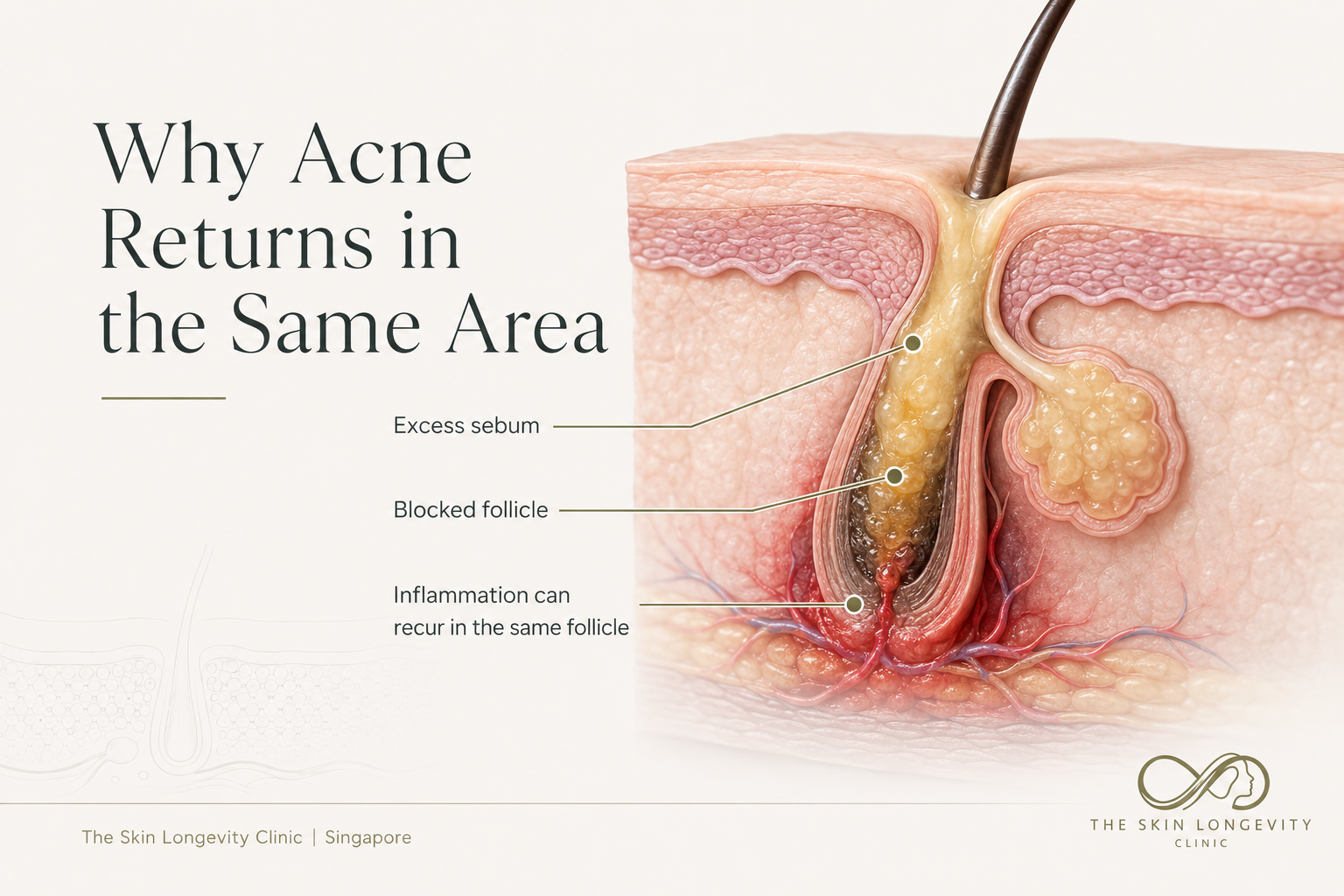
Medical illustration showing why acne can recur in the same area, with excess sebum, a blocked follicle and inflammation within the pilosebaceous unit.

Acne can repeatedly flare from a small group of follicles that remain prone to blockage, excess sebum and inflammation. Treating the sebaceous gland addresses one local contributor, rather than every cause of acne.

Why does acne return in the same area?

Acne begins within the pilosebaceous unit, which consists of a hair follicle and its associated sebaceous gland. Its development involves excess sebum, abnormal follicular keratinisation, changes involving Cutibacterium acnes and immune mediated inflammation1,2.

A small group of follicles may remain especially prone to blockage and inflammation. This can produce the familiar pattern of a chin, jawline or cheek lesion that seems to settle and refill repeatedly.

Sebum is an important part of this process, but it is not the only contributor. Treating a selected sebaceous gland may reduce local inflammatory activity, while topical treatment may still be needed to prevent blocked pores and hormonal or systemic treatment may remain appropriate for wider disease1,2.

Medical illustration of selective sebaceous gland electrothermolysis using an insulated microneedle and radiofrequency energy to target a sebaceous gland.

Selective sebaceous gland electrothermolysis delivers controlled radiofrequency energy through an insulated microneedle towards selected sebaceous gland tissue associated with recurrent inflammatory acne.

What is selective sebaceous gland electrothermolysis?

Selective sebaceous gland electrothermolysis uses a fine microneedle with insulation along part of its shaft. The uninsulated tip delivers radiofrequency energy near the intended tissue depth, while the insulation helps limit heating along the needle path4,5.

Radiofrequency energy creates heat within tissue rather than targeting melanin in the way that a pigment laser does. The controlled thermal effect is intended to injure or reduce the activity of selected sebaceous gland tissue4,5.

Ablation in this context refers to controlled thermal treatment rather than surgical removal of the gland. The procedure is performed follicle by follicle, so surrounding sebaceous glands remain untreated.

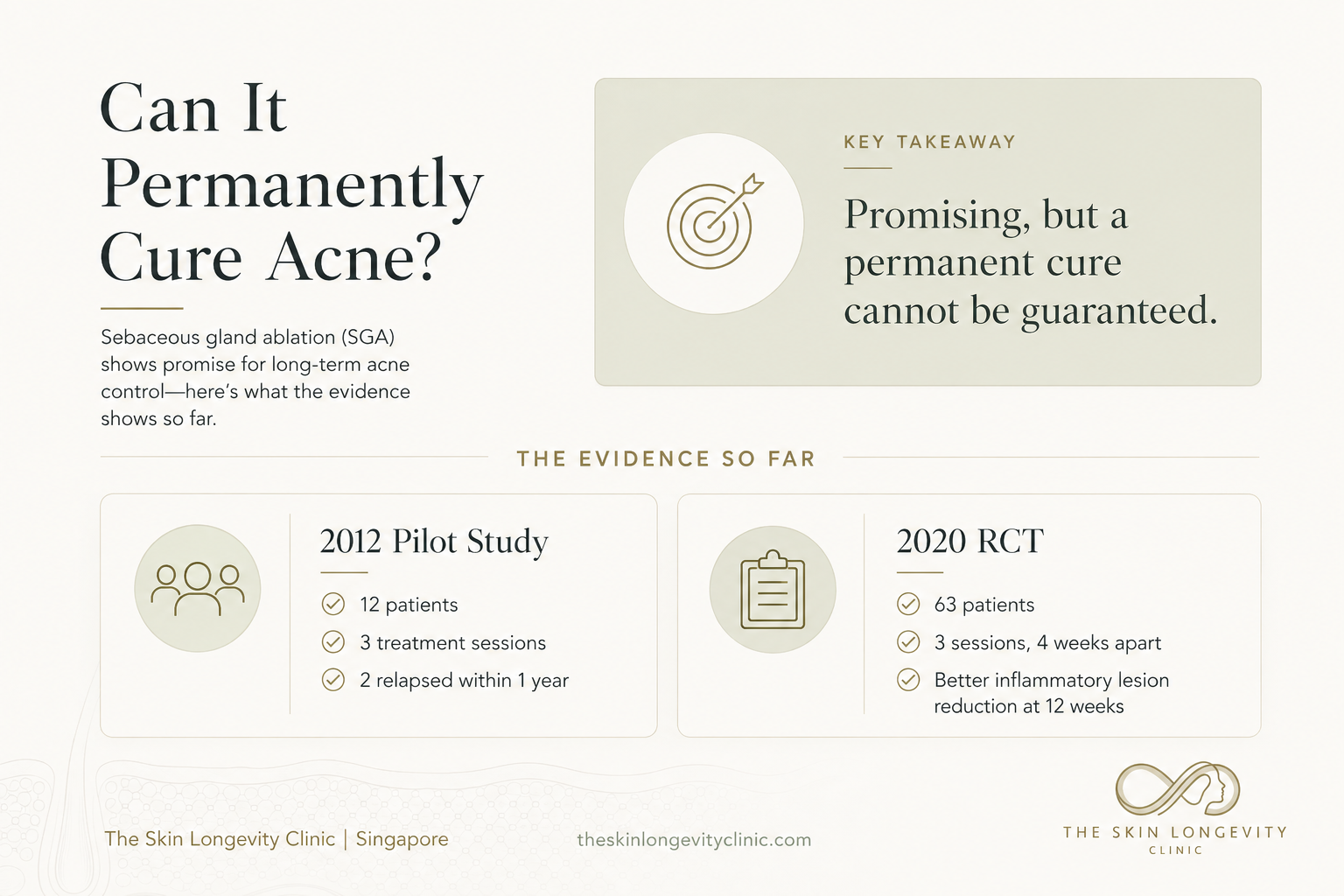
Clinical evidence infographic summarising studies of selective sebaceous gland ablation for acne, including a 2012 pilot study and 2020 randomised controlled trial.

Early studies report improvement after selective sebaceous gland treatment, but relapse in some patients means a permanent acne cure cannot currently be guaranteed.

What does laboratory evidence show?

A rabbit ear model found histological changes and damage within sebaceous glands after treatment with insulated radiofrequency microneedles5. This supports the proposed mechanism of directing thermal injury towards sebaceous gland tissue5.

Animal findings cannot prove that every treated human gland is permanently destroyed. The human trials measured lesion counts and clinical recurrence rather than performing biopsies of every treated follicle over many years3-5.

What do the human studies for selective sebaceous gland ablation show?

Evidence for selective sebaceous gland ablation

Evidence source What was studied Main finding Important limitation
Lee and colleagues, 2012 Twelve patients received three sessions of selective sebaceous gland electrothermolysis3 All patients improved after the final session, while two experienced clinically evident relapse within one year3 Very small sample and no separate untreated control group
Ahn and colleagues, 2020 Sixty three patients completed a randomised study involving three sessions at four week intervals4 Inflammatory lesion counts improved significantly at 12 weeks compared with microneedling and extraction alone4 Short controlled follow up 
Kwon and colleagues, 2017 An insulated microneedle radiofrequency treatment was studied in a rabbit ear model5 Histological sebaceous gland injury supported the proposed mechanism5 Not a human study
Zhang and colleagues, 2024 A review examined several radiofrequency approaches used for active acne6 Radiofrequency techniques showed potential effects on lesions, sebum and inflammation6 Devices, needles, treatment fields and protocols varied considerably

The clinical evidence for selective sebaceous gland ablation consists mainly of one prospective pilot study and one later randomised controlled trial3,4,6.

The 2012 pilot provides the only direct one year follow up among these selective treatment studies. Its relapse finding supports the possibility of sustained remission while also showing why complete permanence should not be promised3.

Infographic comparing treatment approaches for localised recurrent acne, comedonal acne, hormonal acne, severe acne and established acne marks or scars.

There is no single best acne treatment for every patient. Treatment depends on whether acne is localised, widespread, hormonally influenced, scar forming or already leaving marks and scars.

What is the best acne treatment in Singapore?

Acne lesions and role of selective sebaceous gland ablation

Acne pattern Treatment commonly prioritised Possible role of sebaceous gland ablation
Widespread blackheads and whiteheads Topical retinoid and suitable combination skincare2,8 May not be required unless recurrent
Mild inflammatory acne Topical retinoid with benzoyl peroxide or another suitable combination2,8 May be considered for selected lesions that continue to recur
Adult female or hormonally influenced acne Topical care with selected hormonal treatment where medically suitable2 May treat recurrent follicles while the hormonal driver is managed separately
Localised same area inflammatory acne Medical skincare with targeted treatment of persistent follicles This is the pattern most closely aligned with selective gland ablation3,4
Severe, widespread or scar forming acne Early isotretinoin assessment where medically appropriate2,7,8 A local procedure alone is unlikely to control the full disease burden
Brown marks or established scars Pigment or scar specific treatment after active acne is controlled Gland ablation aims to reduce new lesions rather than erase existing damage

The best acne treatment in Singapore depends on lesion type, severity, distribution, scarring risk, hormonal pattern, medical history and previous response. Current guidelines strongly support topical retinoids, benzoyl peroxide, selected topical antibiotics and oral doxycycline within appropriate treatment plans2.

Oral isotretinoin is strongly recommended for severe acne, acne causing scars or substantial psychological burden, and disease that has failed suitable topical or oral treatment2.A network meta analysis of 221 randomised trials ranked isotretinoin as the most effective pharmacological treatment overall2.

Readers who want the complete treatment ladder can continue with Acne Treatments in Singapore: What Actually Works?. Dr Rachel Ho’s Acne Treatment Singapore: A Doctor’s Guide to What Works also compares topical medication, oral treatment and selected clinic procedures in greater detail.

Clinical evidence infographic summarising studies of selective sebaceous gland ablation for acne, including a 2012 pilot study and 2020 randomised controlled trial.

Early studies report improvement after selective sebaceous gland treatment, but relapse in some patients means a permanent acne cure cannot currently be guaranteed.

Is selective sebaceous gland ablation an isotretinoin alternative?

Selective sebaceous gland ablation VS Isotretinoin

Acne treatment Selective sebaceous gland ablation Oral isotretinoin
Treatment scope Selected follicles or limited facial zones Acne prone skin throughout the treated body
Evidence base Small pilot study, one randomised controlled study and broader indirect RF evidence3,4,6 Extensive trials, systematic reviews and international guidelines2,7,8
Most relevant pattern Recurrent inflammatory acne concentrated in identifiable follicles Severe, widespread, nodular, scar forming or treatment resistant acne
Main advantage Local treatment without ongoing whole body drug exposure Strongest average pharmacological efficacy for severe acne
Main limitation Untreated follicles and wider acne drivers remain Systemic adverse effects, pregnancy precautions and medical monitoring
Expected role One targeted component within a broader acne plan Principal systemic treatment when severity and scarring risk justify it

Selective gland ablation may offer a local isotretinoin alternative for a patients with several recurrent inflammatory follicles. Its scope and evidence are very different from those of oral isotretinoin.

Isotretinoin acts systemically and affects sebaceous activity, follicular blockage and inflammation across acne prone skin. Selective electrothermolysis treats mapped follicles individually and has been evaluated in far fewer patients2.

A patient who cannot take isotretinoin or prefers to avoid it may reasonably ask about local procedures. The smaller evidence base and narrower treatment field should be explained clearly before selective ablation is described as an equivalent alternative.

Readers considering oral treatment can read Isotretinoin Singapore: Benefits, Side Effects and Safety. The article explains why isotretinoin remains especially important when acne is widespread, painful or already creating scars.

Example of localised recurring inflammatory acne on the cheek and jawline that may be considered for selective sebaceous gland ablation after medical assessment.

Selective sebaceous gland treatment is most relevant when inflammatory acne repeatedly returns from a limited number of identifiable follicles rather than appearing diffusely across the face.

Who may benefit from selective sebaceous gland ablation?

Acne treatments and considerations

Clinical feature Why it may support consideration
The same small area repeatedly becomes inflamed Suggests that a limited group of pilosebaceous units remains active
Papules, pustules or deeper lesions are concentrated in one zone Allows targeted treatment rather than a broad field procedure
Suitable topical treatment has helped incompletely Persistent follicles may be treated while maintenance skincare continues
Medication tolerance is limited A local procedure may reduce reliance on medication in selected patients
A patient prefers a procedural option Treatment can be discussed after comparing the relative evidence and risks
New lesions are leaving repeated brown marks Reducing inflammatory episodes may reduce the formation of additional marks

The procedure is most relevant when inflammatory acne repeatedly returns from a limited number of identifiable follicles. A smaller treatment area makes follicle by follicle treatment more practical.

The procedure should follow confirmation that the lesions are acne. Folliculitis, rosacea, perioral dermatitis and other acne like eruptions require different treatment.

Adult women with cyclical jawline acne may still have recurring follicles that can be treated locally. Dr Rachel Ho’s Adult Female Acne: A Doctor Explains discusses how hormonal influences and local follicular inflammation can coexist.

When may another treatment be more suitable?

Widespread comedonal acne usually needs treatment that reaches the entire acne prone area. Topical retinoids and benzoyl peroxide combinations have much stronger evidence for this pattern than follicle by follicle ablation2,8.

Diffuse inflammatory acne may require combination topical therapy, a limited course of an oral antibiotic, hormonal treatment or isotretinoin according to severity2. A targeted procedure should not delay effective control while new scars are forming.

Deep nodules, rapid worsening, widespread truncal acne and significant psychological distress support earlier medical escalation2. A consultation should also consider pregnancy plans, medication history and previous treatment response before recommending a procedure.

Four steps of selective sebaceous gland ablation for acne: follicle mapping, numbing, targeted radiofrequency treatment and extraction.

Selective sebaceous gland treatment is performed follicle by follicle. The process includes identifying recurrent pores, numbing the area, targeted radiofrequency treatment and subsequent extraction or clean-up where appropriate.

What happens during treatment?

  1.         Mapping. Under magnification, Dr Ho identifies the actively inflamed and repeatedly recurring lesions, and each culprit pore is marked. This step is diagnosis as much as preparation. The procedure works pore by pore, and choosing the right pores is the doctor’s job.
  2.         Numbing. Topical anaesthetic sits for 30-45 minutes, and local anaesthetic is added for deeper lesions where needed.
  3.         Ablation. Dr Ho inserts the insulated microneedle into each marked pore and deliver the radiofrequency pulse. Patients feel brief warm pinpricks, and most report it is far more tolerable than they expected.
  4.         Extraction. One to three days later comes a short clean-up visit. The treated follicles’ contents of sebum, keratin and coagulated debris with a second radiofrequency treatment. Skipping this step is one of the commonest reasons gland treatments underdeliver elsewhere.

How many sessions of selective sebaceous gland ablation are needed?

Both principal selective electrothermolysis studies used three treatment sessions3,4. The later randomised trial spaced those sessions at approximately four week intervals4.

A research protocol should not be converted into a fixed promise for every patient. The number of lesions, response after the first treatment, recovery and continued formation of new acne all influence the clinical plan.

Results are usually assessed over several weeks rather than immediately. The randomised study measured the principal improvement at 12 weeks, while the pilot study included a one year recurrence assessment3,4.

What is the downtime for selective sebaceous gland ablation?

Transient redness was reported in the initial pilot study and settled within several days3. Swelling, tenderness, small crusts and temporary darkening may also occur after targeted radiofrequency treatment.

Recovery varies with the number and depth of treated lesions. Gentle cleansing, moisturiser, sunscreen and avoidance of picking support healing.

Increasing pain, blistering, spreading redness, discharge or a persistent contour change deserves medical review. These features may indicate infection, excessive thermal injury or another complication.

Infographic showing expected downtime and potential risks after selective sebaceous gland ablation, including redness, swelling, crusting, pigment change and scarring.

Temporary redness, swelling, tenderness and crusting may occur after selective sebaceous gland treatment. Potential complications include pigment change, burns, infection, scarring and uneven texture.

What are the risks of selective sebaceous gland ablation?

Selective sebaceous gland ablation creates controlled heat within living tissue. Burns, persistent inflammation, infection, pigment change, scarring, uneven texture and unwanted local tissue effects are possible when depth, energy or patient selection is unsuitable9,10.

The United States FDA issued a safety communication in October 2025 after receiving reports of burns, scarring, fat loss, disfigurement and nerve damage with certain uses of RF microneedling devices10.The communication addressed RF microneedling broadly and did not provide a specific complication rate for selective single microneedle acne treatment10.

This distinction matters, but it should not lead to complacency. The safety communication reinforces the need for trained medical delivery, appropriate device selection, careful depth control and prompt review of an unexpected reaction.

Is selective sebaceous gland ablation treatment suitable for Asian skin?

A review of radiofrequency procedures in skin of colour found generally low reported rates of scarring and hyperpigmentation, although the available studies were limited and involved several different devices and indications9. A guarantee of zero pigmentation or scarring would therefore be inaccurate9.

Skin tone, recent tanning, active inflammation, barrier condition and previous post inflammatory pigmentation should influence the treatment plan. Conservative settings remain important even when the device does not directly target pigment.

Will treating sebaceous glands make the whole face dry?

The procedure treats selected follicles rather than every sebaceous gland on the face. Generalised facial dryness is therefore not the intended outcome.

The direct studies are too small to define uncommon long term changes in local oil production with precision3,4. Temporary tightness, dryness or crusting can still occur around treated follicles during healing.

Patients with widespread oiliness or comedonal acne usually need broader skincare or medical treatment. Local gland treatment should not be presented as a full face oil suppression procedure.

Does sebaceous gland ablation treat acne marks or scars?

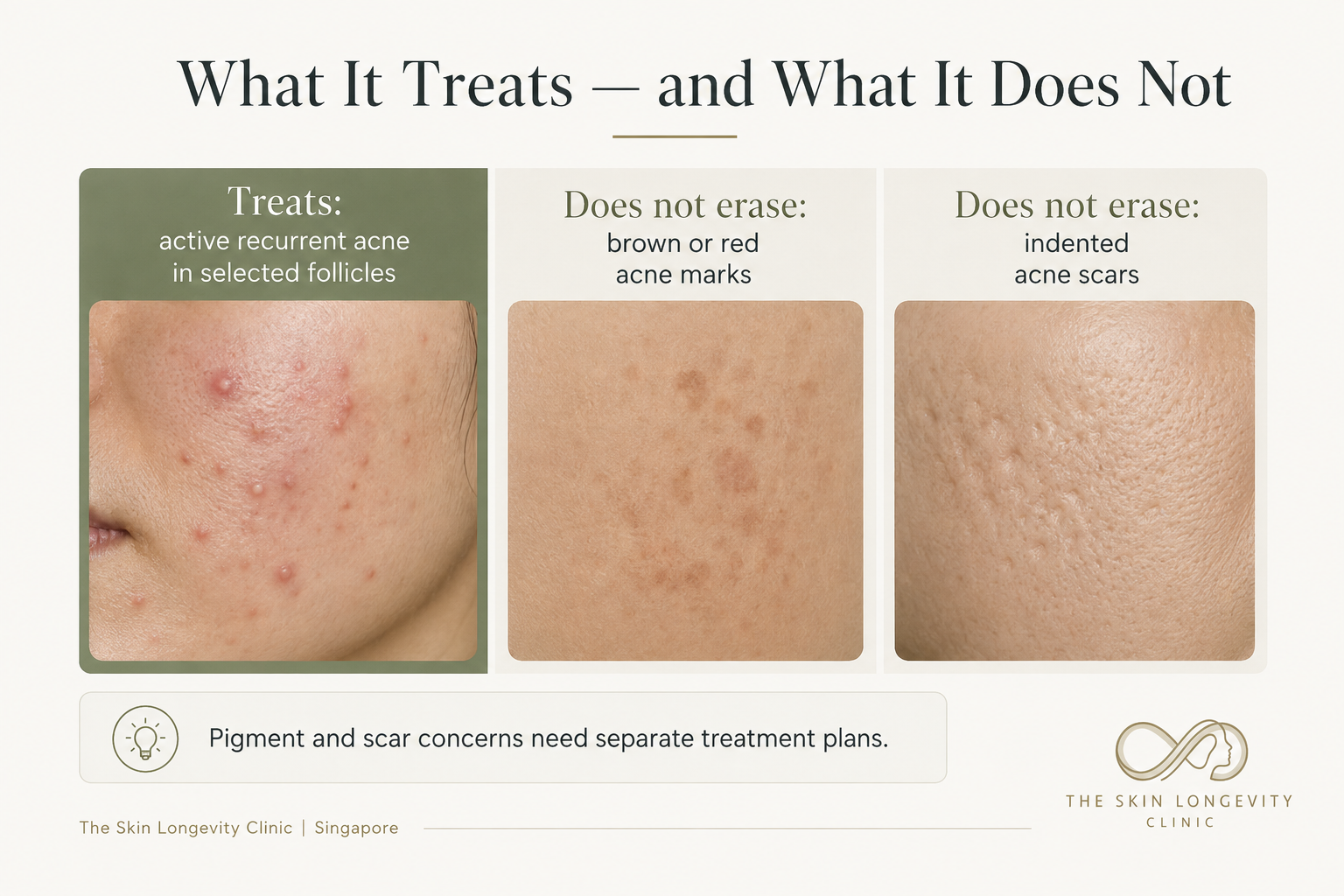
Selective sebaceous gland ablation is intended to reduce active recurrent acne. Flat brown marks, red marks and indented scars remain after inflammation and need their own treatment plans.

Brown post acne marks may respond to pigment regulating skincare, selected chemical peels or pigment laser treatment once active acne is controlled. The clinic’s Acne Marks and PIH Treatment in Singapore guide explains when Pico laser or another pigment treatment may be considered.

Indented acne scars represent structural collagen loss. Readers can continue with Acne Scar Treatment in Singapore for the roles of subcision, fractional resurfacing, RF microneedling and scar specific combination treatment.

Comparison showing that selective sebaceous gland ablation treats active recurrent acne but does not remove post-acne pigmentation or indented acne scars.

Selective sebaceous gland ablation is intended to reduce active recurrent acne. Brown or red acne marks and established indented scars require separate pigment or scar-specific treatment.

Dr Rachel Ho’s clinical perspective on selective sebaceous gland ablation

I find selective sebaceous gland treatment effective in recalcitrant acne, especially if it recurs in the same region. Selective sebaceous gland treatment can complement other acne treatments such as lasers and topical medications. A

Frequently asked questions

Can sebaceous gland ablation permanently cure acne?

Current human evidence does not establish a guaranteed permanent acne cure. Early studies found substantial improvement, but relapse occurred in two of 12 patients during one year of follow up3.

Is selective sebaceous gland ablation an alternative to isotretinoin?

It may provide a local procedural option for selected recurrent follicles, especially when systemic treatment is unsuitable or declined. Severe, widespread or scar forming acne has much stronger evidence for isotretinoin when the medicine is medically appropriate2,7,8.

Is selective sebaceous gland ablation the same as RF microneedling for acne scars?

Selective electrothermolysis targets individual acne prone follicles with a highly focused needle application. Fractional RF microneedling treats a broader field of dermal tissue and is more commonly used for acne scars, pores and texture4,6.

Can selective sebaceous gland ablation treat hormonal acne?

Recurring follicles within a hormonal acne pattern may improve after targeted treatment. Hormonal stimulation can still create lesions in untreated areas, so medical or hormonal treatment may remain necessary1,2.

Can selective sebaceous gland ablation treat cystic acne?

Selected deep inflammatory lesions may be considered when they repeatedly arise from a limited area. Widespread nodular or scar forming acne usually warrants early assessment for systemic treatment2.

Can selective sebaceous gland ablationtreat blackheads and whiteheads?

An individual blocked follicle may be included in treatment, but widespread comedonal acne usually responds better to a topical retinoid and appropriate combination skincare2,8. Follicle by follicle treatment is generally impractical when hundreds of small comedones are present.

How many sessions of selective sebaceous gland ablationare required?

The two principal selective electrothermolysis studies used three sessions3,4.The appropriate course should follow lesion number, response and recovery rather than a fixed online promise.

Is selective sebaceous gland ablation safe for Asian skin?

Radiofrequency does not use melanin as its main target, which can be advantageous across different skin tones9. Post inflammatory pigmentation, burns and scarring remain possible after excessive heat or inflammation9,10.

Can acne return after selective sebaceous gland ablation?

Acne can return in treated or untreated areas. Continuing hormonal stimulation, blocked follicles, incomplete gland treatment and active acne elsewhere can all contribute1,3,4.

Does selective sebaceous gland ablation reduce oily skin?

Oil production may decrease in selected treated follicles. Selective sebaceous gland ablation does not suppress untreated sebaceous gland or treat generalised facial oiliness.

Conclusion on selective sebaceous gland ablation for acne

Selective sebaceous gland ablation may help when inflammatory acne repeatedly returns from identifiable follicles. A small pilot study and one randomised controlled trial found clinical improvement after three sessions, but the current evidence does not support a guaranteed permanent acne cure3,4.

The treatment may serve as a local isotretinoin alternative for carefully selected recurrent lesions. Isotretinoin remains the better supported option for severe, widespread or scar forming acne, while topical and hormonal treatments remain important for other patterns2,7,8.

The most realistic goal is sustained improvement in selected treated areas, supported by an appropriate wider acne plan. An honest treatment discussion should explain both the potential for longer remission and the reasons recurrence can still occur.

Scientific references

  1. Moradi Tuchayi S, Makrantonaki E, Ganceviciene R, et al. Acne vulgaris. Nature Reviews Disease Primers. 2015;1:15029. doi:10.1038/nrdp.2015.29.
  2. Reynolds RV, Yeung H, Cheng CE, et al. Guidelines of care for the management of acne vulgaris. Journal of the American Academy of Dermatology. 2024;90(5):1006.e1 to 1006.e30. doi:10.1016/j.jaad.2023.12.017.
  3. Lee JW, Kim BJ, Kim MN, Ahn GY, Aso H. Selective sebaceous gland electrothermolysis as a treatment for acne: a prospective pilot study. International Journal of Dermatology. 2012;51(3):339 to 344. doi:10.1111/j.1365-4632.2011.05255.x.
  4. Ahn GR, Kim JM, Park SJ, Li K, Kim BJ. Selective sebaceous gland electrothermolysis using a single microneedle radiofrequency device for acne patients: a prospective randomised controlled study. Lasers in Surgery and Medicine. 2020;52(5):396 to 401. doi:10.1002/lsm.23152.
  5. Kwon TR, Seok J, Jang JH, et al. Targeting of sebaceous glands to treat acne by micro insulated needles with radiofrequency in a rabbit ear model. Lasers in Surgery and Medicine. 2017;49(4):395 to 401. doi:10.1002/lsm.22599.
  6. Zhang X, Zhou M, Liu Y, Zeng R. Recent advances in the treatment of acne using radiofrequency techniques. Lasers in Medical Science. 2024;39:92. doi:10.1007/s10103-024-04039-6.
  7. Huang CY, Chang IJ, Bolick N, et al. Comparative efficacy of pharmacological treatments for acne vulgaris: a network meta analysis of 221 randomised controlled trials. Annals of Family Medicine. 2023;21(4):358 to 369. doi:10.1370/afm.2995.
  8. Mavranezouli I, Daly CH, Welton NJ, et al. A systematic review and network meta analysis of topical pharmacological, oral pharmacological, physical and combined treatments for acne vulgaris. British Journal of Dermatology. 2022;187(5):639 to 649. doi:10.1111/bjd.21739.
  9. Syder NC, Chen A, Elbuluk N. Radiofrequency and radiofrequency microneedling in skin of colour: a review of usage, safety and efficacy. Dermatologic Surgery. 2023;49(5):489 to 493. doi:10.1097/DSS.0000000000003733.

Current safety reference

  1. United States Food and Drug Administration. Potential Risks with Certain Uses of Radiofrequency Microneedling. Safety Communication. 15 October 2025.