

19 Sep Chemical Peel Aftercare: Recovery, Makeup and Skincare
Chemical peel aftercare centres on gentle cleansing, moisturising and sun protection while the treated skin recovers1,2. Makeup, retinoids and exfoliating products are reintroduced according to the preparation used and how the skin is healing, rather than one timetable for everyone2.
Knowing when to wash your face, return to exercise or restart a favourite serum can make recovery easier to plan. This guide focuses on superficial facial peels, while explaining where deeper treatments require different care.
Follow the written instructions provided for your procedure whenever they differ from general advice1. Medium depth and deep peels may require wound care, dressings and closer follow up, so their recovery should be managed separately3,4.
How long does chemical peel recovery take?
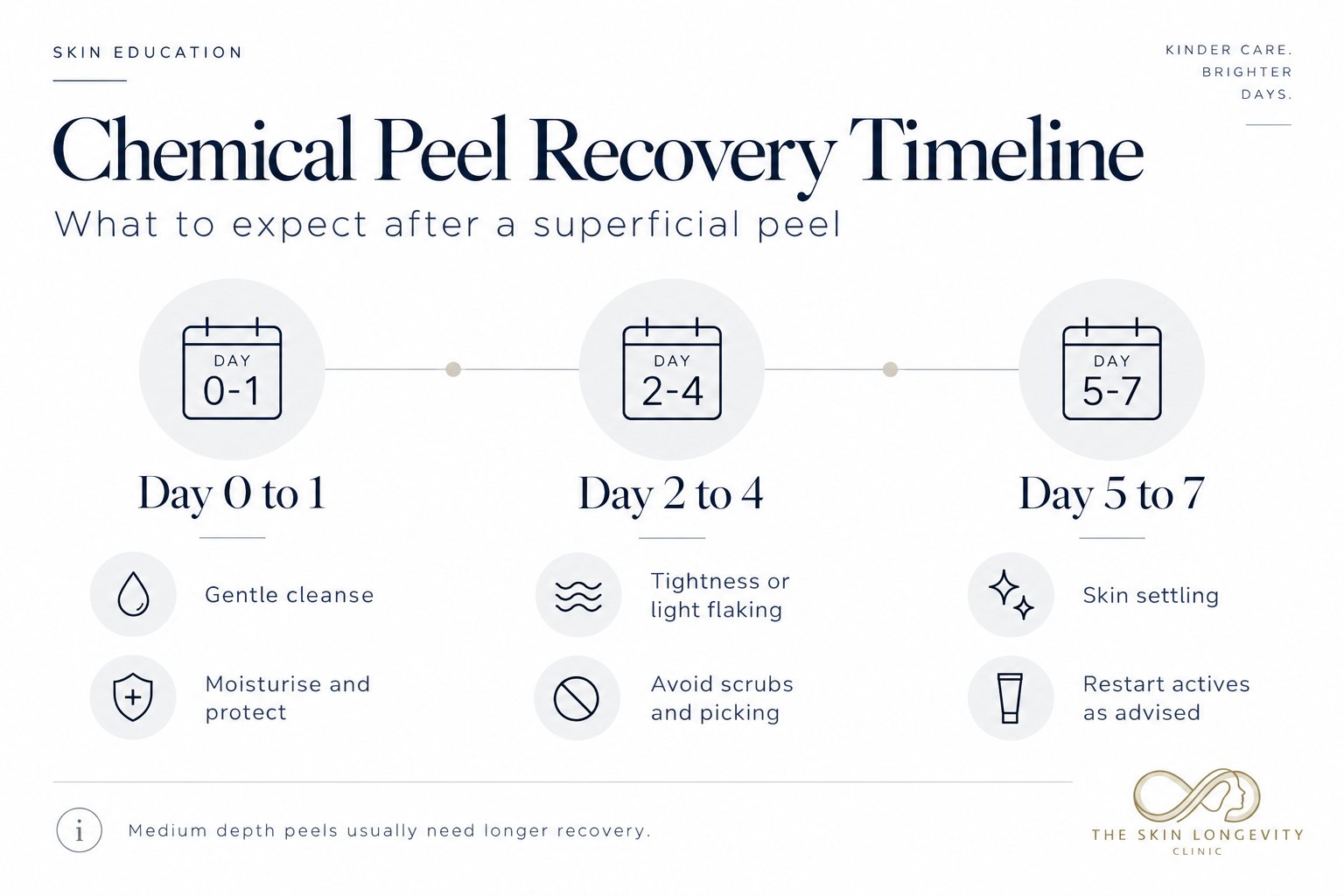
Recovery depends on the depth of treatment, the preparation and the skin’s response3. The following ranges provide an orientation rather than a deadline for every patient4.
| Peel depth | Approximate initial healing period |
|---|---|
| Superficial | Around one to seven days4 |
| Medium depth | Around seven to fourteen days4 |
| Deep | Around fourteen to twenty one days, with more extensive aftercare4 |
Redness can persist beyond initial healing, particularly after deeper treatment4. Returning to work, restarting active skincare and feeling ready for an important event may therefore happen at different points.
For an event or holiday, discuss the timing before treatment. Allow for the possibility that your skin may take longer to settle than expected.
When can I wash my face after a chemical peel?
The timing of your first wash depends on the peel protocol. Some preparations are removed during the appointment, while others remain on the skin for a specified period, so follow the instructions for the treatment you received1.
Once cleansing is permitted, use a mild cleanser and handle the skin gently1,5. Leave scrubs, cleansing brushes and exfoliating cloths aside while the surface recovers5.
A short, cool compress may help mild discomfort when recommended by your treating clinician1. Persistent burning or increasing pain should prompt a review rather than repeated attempts to soothe the skin with new products5.
Which moisturiser should I use after a chemical peel?
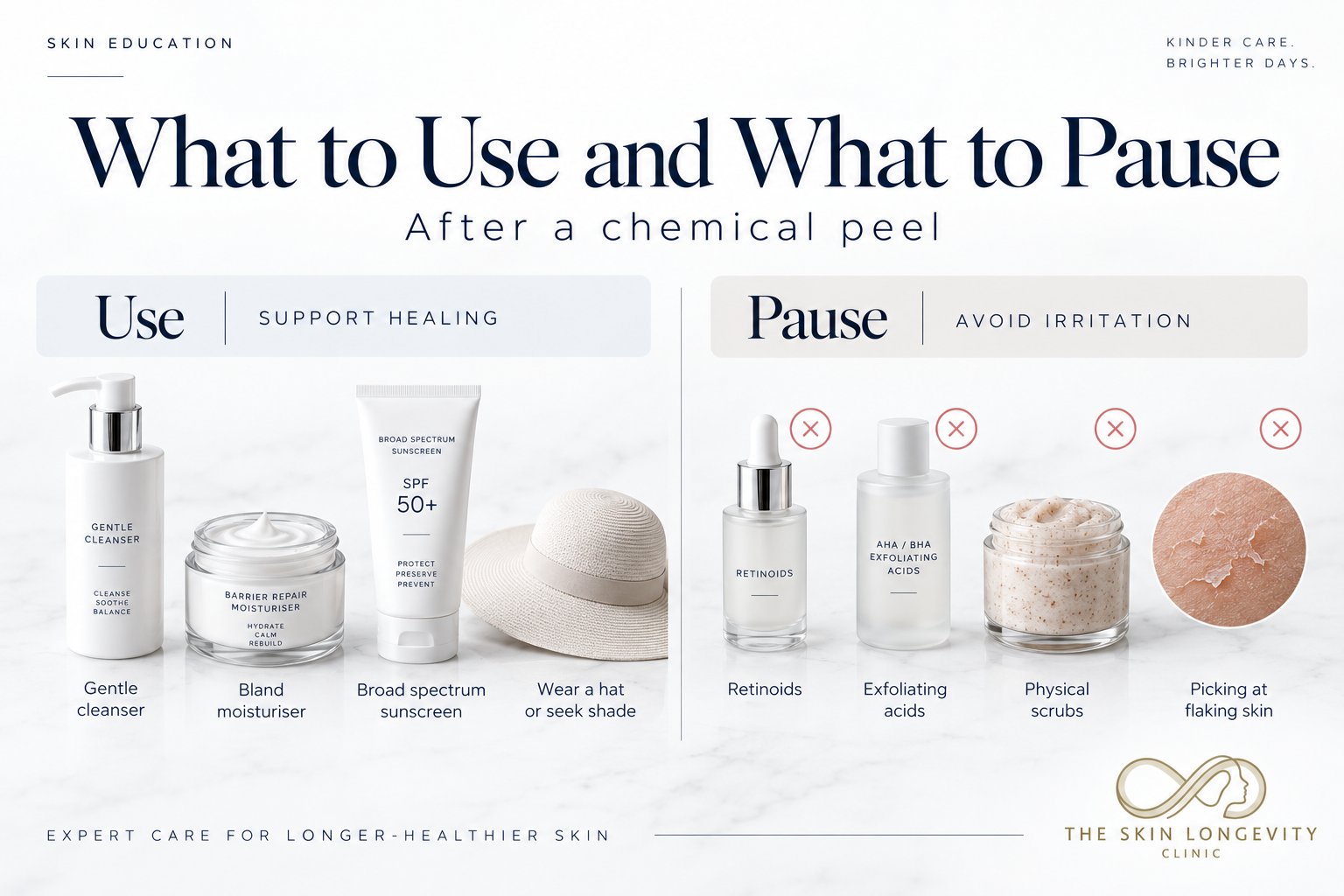
A bland moisturiser helps keep recovering skin comfortable, and moisturising is a consistent component of published aftercare guidance1,6. Use the preparation recommended for your peel, including an ointment where one has specifically been prescribed1.
Choose simplicity over a long ingredient list. Product selection should account for the procedure, existing skin conditions and tolerance, rather than assuming that every product labelled hydrating is suitable6.
Our guide to dry skin and dehydrated skin explains the broader distinction between these concerns. During peel recovery, keep the focus on the moisturiser and application schedule in your aftercare plan.
Should I moisturise less to encourage peeling?
Continue moisturising as directed rather than deliberately allowing the skin to become dry and cracked1,5. Allow flakes to separate naturally, without picking, rubbing or pulling them away5.
Visible shedding should not become the objective of aftercare. Dr Rachel Ho’s skin barrier guide provides more background on caring for skin that feels tight or sensitive.
How should I protect my skin from the sun?
Sun protection is important after chemical peeling because pigment changes are a recognised complication5. Use shade, protective clothing and a hat alongside the sunscreen instructions provided for your treatment2,7.
For skin that is ready for sunscreen, choose broad spectrum protection with SPF 30 or higher7. Reapply approximately every two hours when outdoors and after swimming or sweating, following the product instructions7.
Raw or open areas may need a different wound care plan before ordinary skincare is applied3. Ask the treating clinician which preparation is appropriate rather than applying a product that causes persistent burning.
For patients recovering in Singapore, consider the outdoor parts of your day, including the commute, school pickup and weekend activities. Planning shaded routes and postponing prolonged outdoor outings can make the aftercare plan easier to follow.
When can I wear makeup after a chemical peel?
After some very light peels, makeup may be possible on the same day or the following day4. Treatments that leave the surface more disrupted require a longer pause, with expert guidance recommending that makeup wait until healing is complete2.
Use the condition of the skin and your aftercare instructions, rather than the calendar alone, to decide when to restart. Raw, weeping or persistently irritated areas should be assessed before they are covered with makeup4,5.
Before treatment, mention any event for which makeup is important. This allows recovery expectations to be discussed before the appointment rather than adjusted around an unavoidable commitment afterwards.
When can I restart retinol, vitamin C and exfoliating acids?
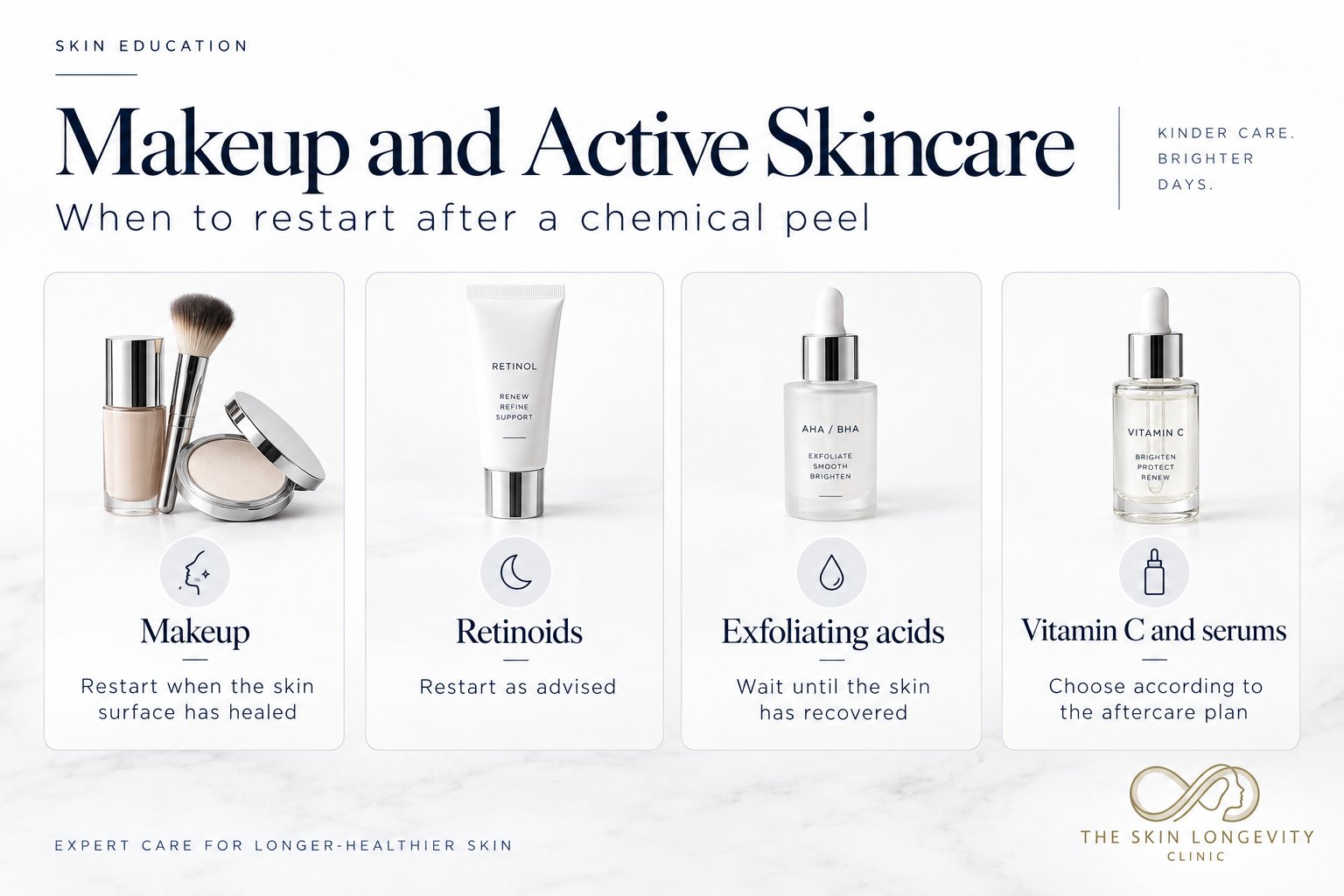
Retinoids and exfoliating acids can increase irritation while skin is recovering, so they are usually paused during the healing period2,5. Restarting should follow the agreed plan once the surface has recovered, rather than an automatic instruction to resume everything on a particular day2.
| Product or ingredient | What to consider before restarting |
|---|---|
| Retinol, retinal and prescription topical retinoids | Wait until healing is complete and follow the prescribed restart schedule2. |
| Glycolic acid, lactic acid, salicylic acid and exfoliating toners | Keep additional exfoliation out of the routine while the skin is shedding or irritated2,5. |
| Vitamin C and other cosmetic serums | Suitability depends on the complete formulation and the aftercare protocol, rather than the ingredient name alone2,6. |
| Prescribed acne or pigmentation treatment | Ask the prescriber which products to pause and when to resume them, taking the underlying condition into account2,6. |
Some professionally selected hydrating or antioxidant preparations may be included immediately after particular peels2. That does not make every serum containing similar ingredients suitable for freshly treated skin.
Keep a written list of the products being paused and their planned restart. Dr Rachel Ho’s guide to acids in skincare can help identify exfoliating ingredients that appear in everyday cleansers, toners and serums.
When can I exercise, swim or use a sauna?
Expert consensus advises avoiding vigorous exercise and hot environments during early recovery8. Plan a pause from activities such as intense gym sessions, hot yoga, steam rooms and saunas, with the length of that pause based on the treatment and skin response8.
Swimming should also wait until the treating clinician advises that it is appropriate9. Returning to ordinary daily activities does not necessarily mean the skin is ready for prolonged heat, heavy sweating or time in a pool.
Tell the clinic about sporting commitments before scheduling the peel. The discussion can then account for the activity involved rather than relying on a fixed interval intended for a different procedure.
What about waxing or another facial treatment?
Mention any planned waxing, facial massage, laser or microneedling appointments to the treating doctor. Agree their timing before adding another procedure while the skin is recovering2,6.
Keep exfoliating scrubs and tools out of the recovery routine5. A second treatment should address an appropriate concern after assessment, rather than be used to remove lingering flakes.
Why is my skin not peeling after a chemical peel?
Some superficial peels produce little visible flaking3. The amount of shedding varies with the preparation and treatment depth, and minimal desquamation has been described with selected superficial peeling approaches3.
Visible peeling alone therefore cannot establish whether a treatment has succeeded or failed. The more useful review considers the original concern, the treatment performed and the result once the skin has settled.
Continue the prescribed care rather than add stronger acids or repeat the peel to encourage shedding1,5. Dr Rachel Ho’s chemical peel review explains what different approaches can achieve and where the evidence is limited.
Is redness or darkening after a chemical peel expected?
Temporary redness and scaling can occur during recovery, with their extent influenced by treatment depth3. Persistent or worsening changes deserve assessment rather than being assumed to be part of the process10.
Redness, stinging and sensitivity
Ongoing redness or burning can reflect irritation, contact dermatitis or another complication, particularly when symptoms are becoming more pronounced10. Review is appropriate when the skin is increasingly uncomfortable or reacting to the products recommended for recovery5,10.
Let the clinic know what was applied and when the symptoms changed. Keep the routine limited to the agreed care while awaiting advice, rather than trying several soothing or exfoliating products in succession.
Brown patches
Post inflammatory hyperpigmentation is a recognised complication of chemical peels10. It needs to be distinguished from temporary surface changes by examining the skin and reviewing its course10.
Arrange an assessment for persistent or increasing darkening. Scrubbing the area or applying another strong exfoliant may add irritation instead of resolving the pigment concern5.
New bumps or pustules
Acne like eruptions, folliculitis and milia can occur after resurfacing procedures10. New bumps should therefore be assessed rather than automatically described as purging or proof that the peel is working10.
Share your complete aftercare routine with the clinician. Include any additional masks, oils or ointments that were not part of the original instructions.
When should I contact the clinic?
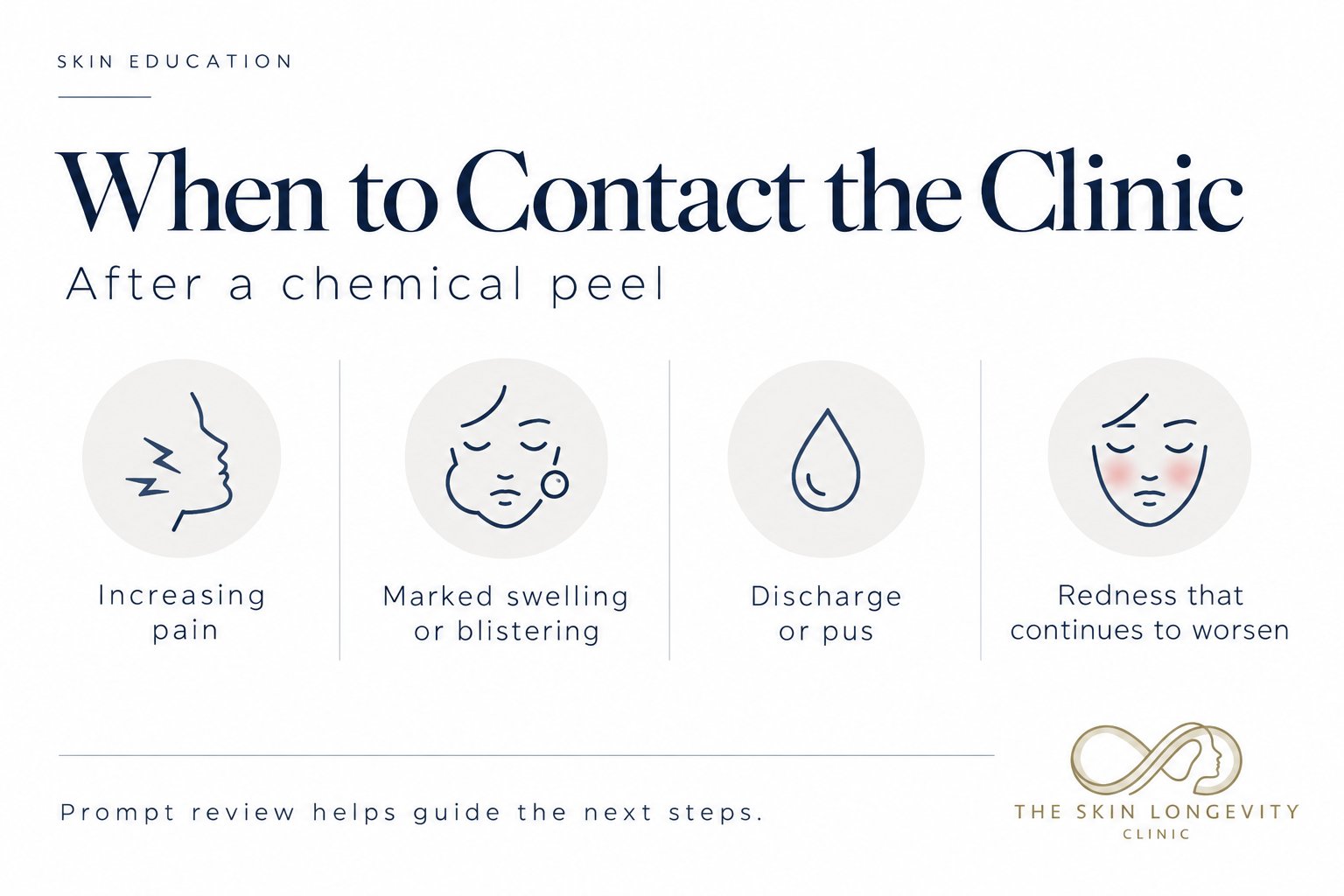
Contact the treating clinic promptly for increasing pain, marked swelling, blistering, discharge, pus or redness that continues to worsen5. Clusters of painful blisters or erosions, including a possible cold sore outbreak, also need assessment10.
Severe symptoms, eye pain or a change in vision require urgent medical assessment rather than waiting for a routine follow up10. General online advice cannot determine whether these changes represent normal healing or a complication.
For care provided here, use The Skin Longevity Clinic’s contact details to request a review. Have the treatment date, symptom timeline and products used available to help the team understand what has happened.
How do I know when to return to my usual routine?
Healing should guide the next step, with the original skincare routine resumed according to the treating clinician’s instructions2. Resolution of flaking alone is insufficient when the skin remains sore, raw or persistently inflamed2,5.
Detailed product schedules draw largely on clinical guidance and expert recommendations, with limited trials comparing complete aftercare routines2,6. This is why instructions for a particular peel take priority over a generic day by day schedule.
Our chemical peel assessment and treatment guide explains how preparation, suitability and follow up fit together. Use it alongside this aftercare article when planning treatment around your usual skincare and activities.
The aim of chemical peel aftercare
A manageable recovery routine should leave you clear about what to apply, what to pause and when to ask for help. More peeling or more skincare products should not become the measure of progress.
Keep the written instructions accessible and raise concerns early. Decisions about resuming products or arranging another treatment can then follow an assessment of the skin, rather than pressure to meet a fixed recovery date.
References
-
Khunger N; IADVL Task Force. Standard guidelines of care for chemical peels. Indian Journal of Dermatology, Venereology and Leprology. 2008;74 Supplement:S5 to S12. IJDVL
-
McDonald C, Yip L, Sullivan J, Liu W, Lin F, Goodman G. A Guide to Periprocedural Skin Care Regimen for Injectable and Nonenergy Cosmetic Procedures Based on a Consensus of 6 Aesthetic Practitioners. Aesthetic Surgery Journal Open Forum. 2025;7:ojaf121. doi:10.1093/asjof/ojaf121. Expert consensus recommendations. OUP Academic
-
Soleymani T, Lanoue J, Rahman Z. A Practical Approach to Chemical Peels: A Review of Fundamentals and Step by Step Algorithmic Protocol for Treatment. Journal of Clinical and Aesthetic Dermatology. 2018;11(8):21 to 28. JCAD Online
-
American Academy of Dermatology. Chemical peels: FAQs. Patient guidance on healing, makeup and aftercare. American Academy of Dermatology
-
Anitha B. Prevention of Complications in Chemical Peeling. Journal of Cutaneous and Aesthetic Surgery. 2010;3(3):186 to 188. doi:10.4103/0974-2077.74500. JCAS
-
Nikolis A, Nestor MS, Czuwara J, et al. Concomitant Use of Dermo Cosmetic Skin Care in Aesthetic Procedures: Systematic Review with Expert Panel Recommendations. Clinical, Cosmetic and Investigational Dermatology. 2026;19:577128. doi:10.2147/CCID.S577128. Dove Press
-
American Academy of Dermatology. Sunscreen FAQs. Guidance on broad spectrum protection, SPF and reapplication. American Academy of Dermatology
-
Ding Y, Gao L, He L, et al. Expert Consensus on the Clinical Application of Chemical Peels in China (2022). International Journal of Dermatology and Venereology. 2024;7(4):249 to 256. doi:10.1097/JD9.0000000000000363. MedNexus
-
Australian Society of Plastic Surgeons. Chemical Peel. Patient guidance on recovery and returning to activities. Australian Society of Plastic Surgeons
-
Nikalji N, Godse K, Sakhiya J, Patil S, Nadkarni N. Complications of Medium Depth and Deep Chemical Peels. Journal of Cutaneous and Aesthetic Surgery. 2012;5(4):254 to 260. doi:10.4103/0974-2077.104913. JCAS