
Secret DUO in Singapore: 1540 nm Erbium Glass Laser and RF Microneedling for Pores, Fine Lines and Glow
By Dr Rachel Ho | Aesthetic Doctor, Founder, The Skin Longevity Clinic, Singapore
Medically reviewed by Dr Rachel Ho, MBBS, MRCS, MMed (ENT), 2 November 2026.
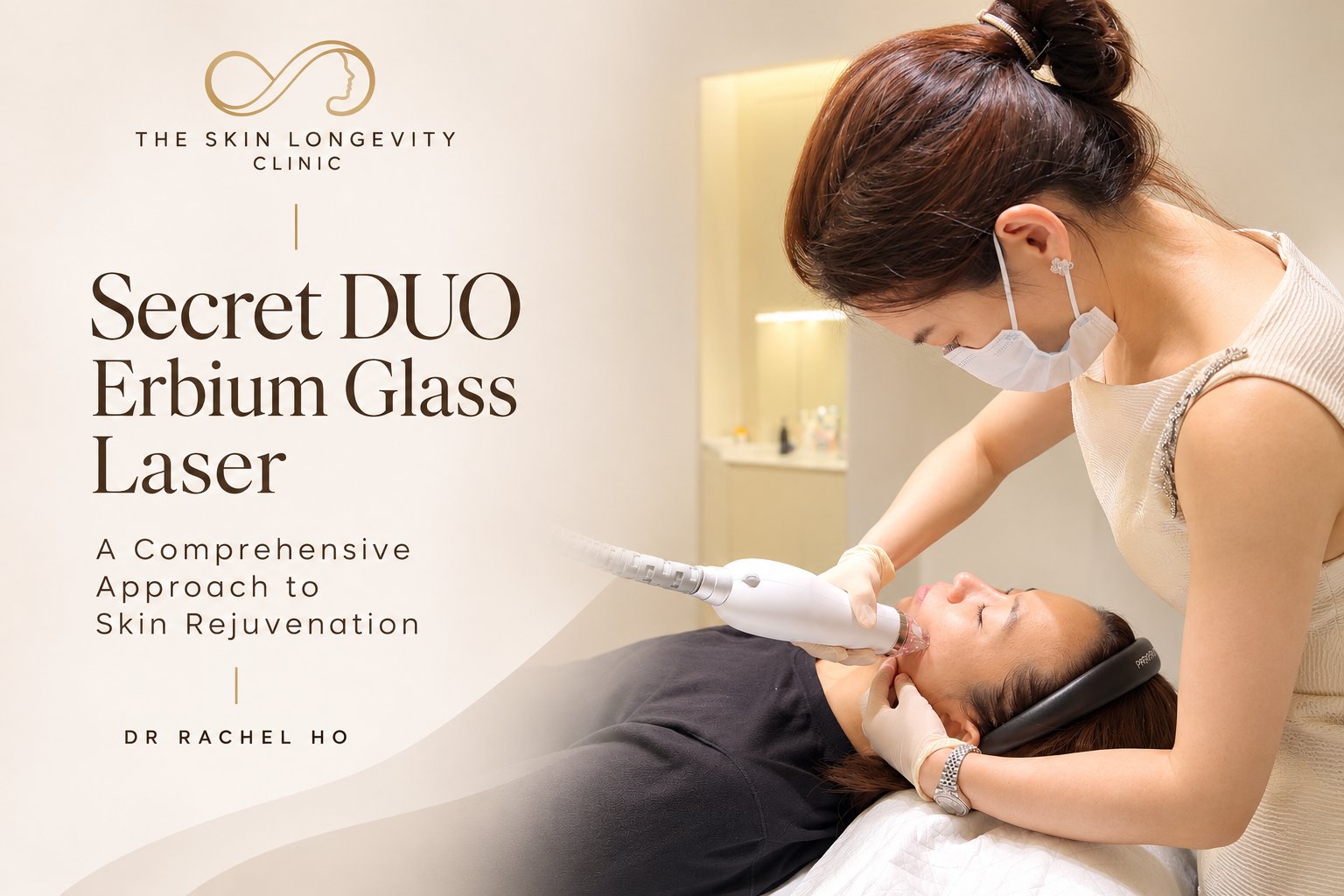
Secret DUO is one platform with two ways of treating the skin: a 1540 nm erbium glass laser for the surface and Secret RF microneedling for the deeper layers. The laser improves pores, fine lines, rough texture and dullness with a day or two of redness. The microneedling reaches deeper for acne scars, oily skin and early laxity. At The Skin Longevity Clinic the two are chosen, combined or sequenced according to what your skin actually needs, after an assessment, and never as a fixed package.
This page covers the laser side in detail, because the 1540 nm erbium glass wavelength is less well known in Singapore than CO2 or pico lasers and deserves a clear explanation. For the needle side, read our RF microneedling in Singapore page.
What is a 1540 nm erbium glass laser?
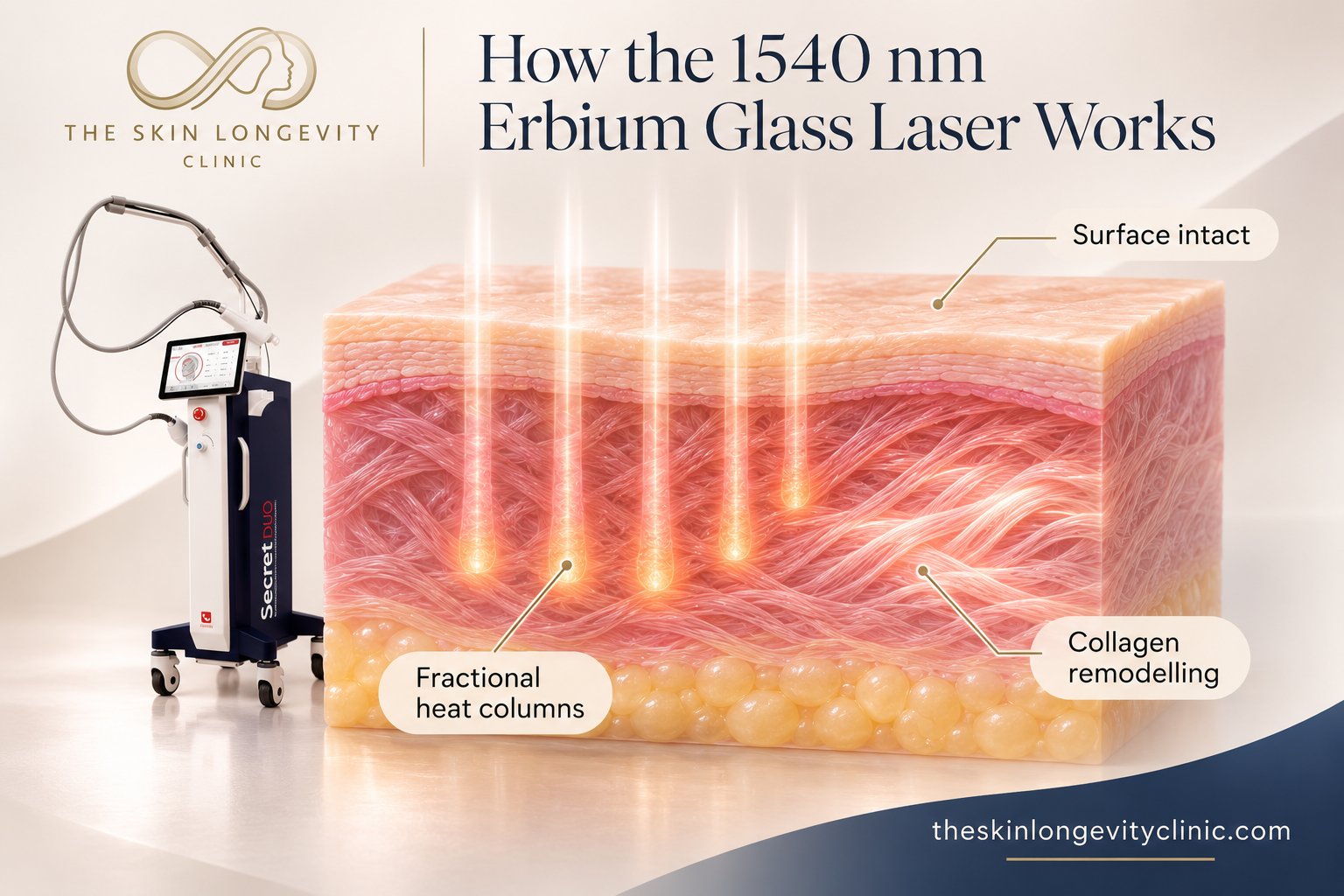
It is a non-ablative fractional laser: it heats the skin from the inside without removing the surface. “Erbium glass” is the material inside the laser that produces infrared light at 1540 nanometres. Water in the skin absorbs this wavelength moderately, which lets the beam pass through the surface and release its heat in the dermis, the collagen-rich layer beneath. “Fractional” means the beam is split into a grid of tiny spots, so each pass treats a fraction of the skin and leaves healthy tissue in between to speed healing.
The result is controlled micro-injury where you want it, and intact skin where you do not. Each heated column triggers the skin’s repair response, and over the following weeks new collagen forms around it. This is what tightens the rim of the pore, softens fine lines and evens out rough texture. Because the surface stays closed there is no open wound, no scabbing and much lower infection risk than with ablative resurfacing.
How the 1540 nm erbium glass laser treatment works, step by step
Assessment first. The doctor examines the pores, texture, lines and any pigmentation under magnification, asks about your history of dark marks after irritation, and decides whether the laser, Secret RF or both are the right tools.
Numbing cream for about 30 minutes, then the skin is cleaned. Most patients describe the laser as a hot, prickling sensation that is well tolerated after numbing. Each pass takes a few minutes; a full face is usually 15 to 20 minutes of laser time.
Redness and mild swelling for one to two days, sometimes a faint grid pattern that fades within hours. Makeup can usually be worn the next day. The skin may feel slightly dry or rough for a few days as the treated columns resolve, which is normal.
Results build over two to three months. Collagen remodelling is slow, so the smoothest skin is seen six to twelve weeks after the final session, not the next morning.
What Secret DUO treats: pores, fine lines, texture, dull skin and skin longevity
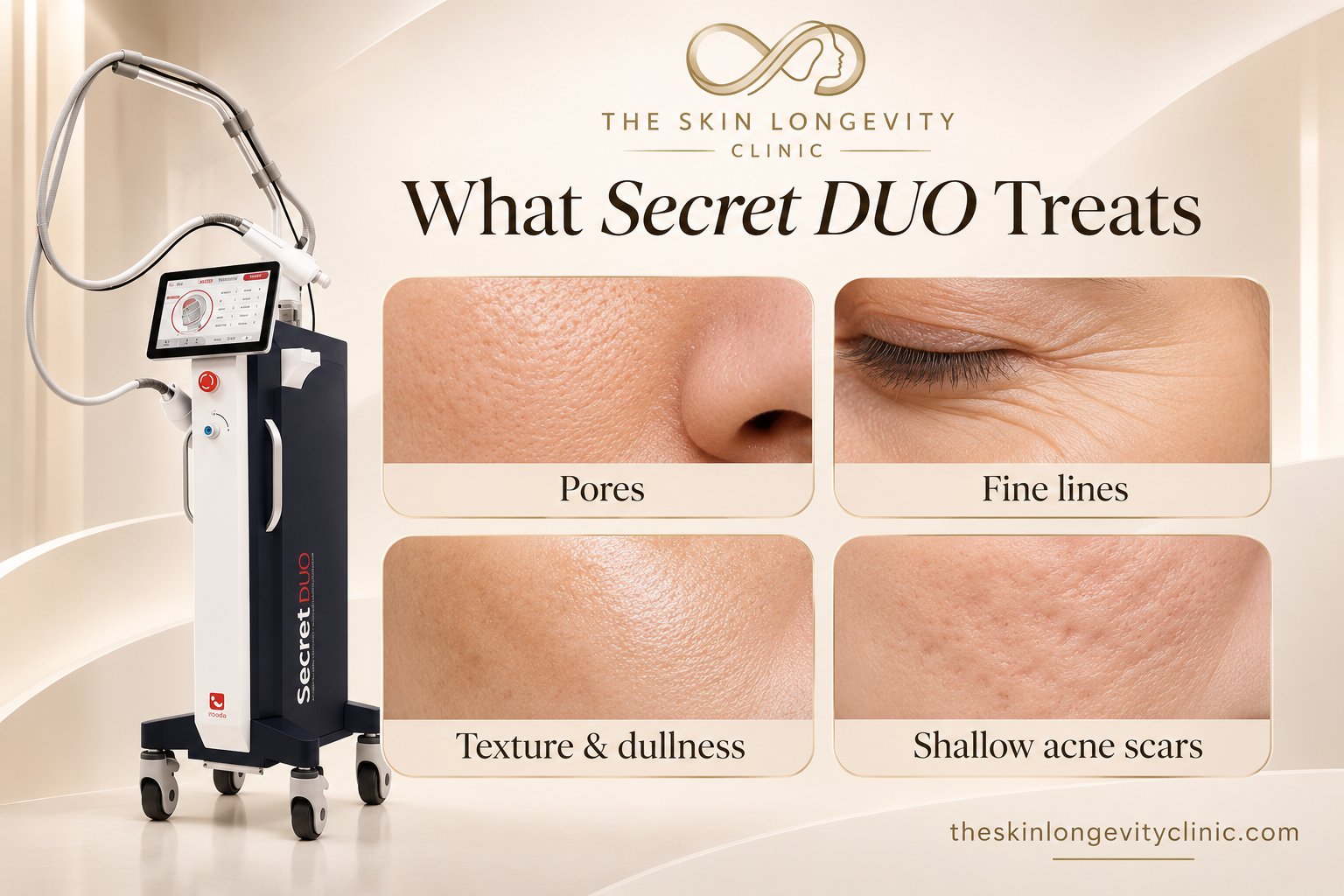
Enlarged pores. Non-ablative fractional lasers in the 1540 to 1565 nm range have been tested against other pore treatments in randomised split-face trials. Against a long-pulsed 1064 nm laser, both sides showed a significant drop in pore count at two months with no significant difference between them4. Against a fractional pico laser, pore reduction was again comparable5. A separate randomised comparison in the British Journal of Dermatology also used the 1565 nm laser specifically for enlarged facial pores3. For a full comparison of options, read our large pores treatment in Singapore page.
Fine lines and wrinkles. In 16 patients treated three to four times with a high-fluence 1540 nm erbium glass laser, blinded dermatologists graded moderate to significant improvement in lines across the forehead and around the eyes three months after the last session, with only mild, short-lived redness reported1. For line-specific options, see our crow’s feet treatment and forehead lines treatment guides.
Rough texture and dull skin. Dullness is often texture: a surface that scatters light instead of reflecting it. In a 15-patient study, 3D imaging showed significant reductions in skin roughness, roughness area and maximum depth after five monthly 1540 nm sessions2. Smoother skin reflects light more evenly, which is the “glow” patients describe.
Early and shallow acne scars. In a randomised trial of 58 patients, the 1540 nm erbium glass laser and fractional CO2 laser both improved atrophic acne scars after four sessions; CO2 scored slightly higher but not significantly so, while the erbium glass laser caused less pain and shorter downtime6. Deeper scars usually do better with RF microneedling, subcision or CO2; see our acne scar treatment in Singapore hub.
Skin longevity. A treatment that stimulates collagen without wounding the surface fits a maintenance approach: a short course, then one or two sessions a year to keep texture and firmness ahead of ageing rather than correcting damage later. This is the thinking behind Dr Rachel Ho’s collagen-first approach to skin longevity, and why the laser is often paired with a skin longevity assessment.
Secret DUO for stretch marks and the décolletage: the body areas the 1540 nm laser treats
The same laser that smooths pores on the face also treats stretch marks on the body. Stretch marks (doctors call them striae) happen when skin is stretched faster than it can keep up: pregnancy, a growth spurt, muscle gain or weight change. New marks are red or purple. Older marks are white, slightly sunken and thinner than the skin around them. The 1540 nm laser sends tiny columns of heat into the thinned skin and tells it to rebuild collagen. The surface is not broken. It can be used on the tummy, hips, buttocks, thighs, breasts and chest, so the tummy and thighs can be treated in one plan.
Post-pregnancy stretch marks on the tummy: this is the best-studied use. In a study of 50 women who had three monthly sessions, both the doctors and the women themselves rated the marks as improved, for red and white marks alike. Side effects were redness, swelling and some temporary darkening, all of which settled12. In a 2026 study of Chinese women after childbirth, three dermatologists who did not know the treatment details graded the marks as mildly to moderately improved, and every patient was satisfied. The only side effects were discomfort during the session, redness and small bruises11. If the tummy skin is also loose, the laser is paired with XERF for post-pregnancy loose abdominal skin: XERF tightens, the laser works on the marks.
Stretch marks on the buttocks, thighs and hips. The first large 1540 nm study treated 51 people on nine body areas, including the hips, breasts and tummy, with marks anywhere from one to forty years old. Two to four sessions were given four to six weeks apart9. A later study took skin samples after six sessions and found the skin had become thicker, with more collagen and elastin10. Old white marks take longer than fresh red ones. The aim is narrower, flatter, less noticeable marks. No treatment removes them completely.
Laser or Secret RF for stretch marks? Both work; they feel different. In a trial of 14 Chinese women with white post-pregnancy marks, one half of the tummy had the laser and the other half had RF microneedling. Both halves improved. The needles scored a little higher and built more collagen, but the laser was much less painful, and the women were equally happy with both sides13. A 2024 review of 18 trials found that radiofrequency, ablative lasers and non-ablative lasers all narrow stretch marks, and none is clearly best14. At the clinic the laser is the first choice for large areas and for anyone who wants minimal discomfort. Secret RF is added for deep, wide white marks. Our stretch mark treatment in Singapore page explains how collagen injections fit in.
The décolletage: the chest skin that ages before the face. The chest between the neck and the breasts gets a lot of sun and shows it early: crepey skin, fine vertical lines and patchy colour. This skin is thin and heals slowly, so lasers that remove the surface are usually avoided here. The 1540 nm laser suits the chest for the same reason it suits the face: it builds collagen without an open wound. It is usually done together with neck rejuvenation in Singapore so the face, neck and chest match. Sunscreen on the chest afterwards is essential.
Safe for Asian skin when the settings are kept gentle. A review of the evidence found strong support for fractional lasers in stretch marks and skin rejuvenation in darker skin types, with non-ablative lasers preferred because they are less likely to leave dark marks15. On the body we use lower energy than on the face and spread it over more sessions.
What to expect on the body. Numbing cream for 30 to 45 minutes. A session takes 20 to 40 minutes depending on the area. Expect redness and mild swelling for two to three days, sometimes a little longer on the thighs. Most people need three to five sessions, four to six weeks apart. Results are judged three months after the last session. We wait at least three months after delivery and until breastfeeding has finished, and we do not treat tanned skin.
Secret DUO vs Secret RF: laser or microneedling, and when both
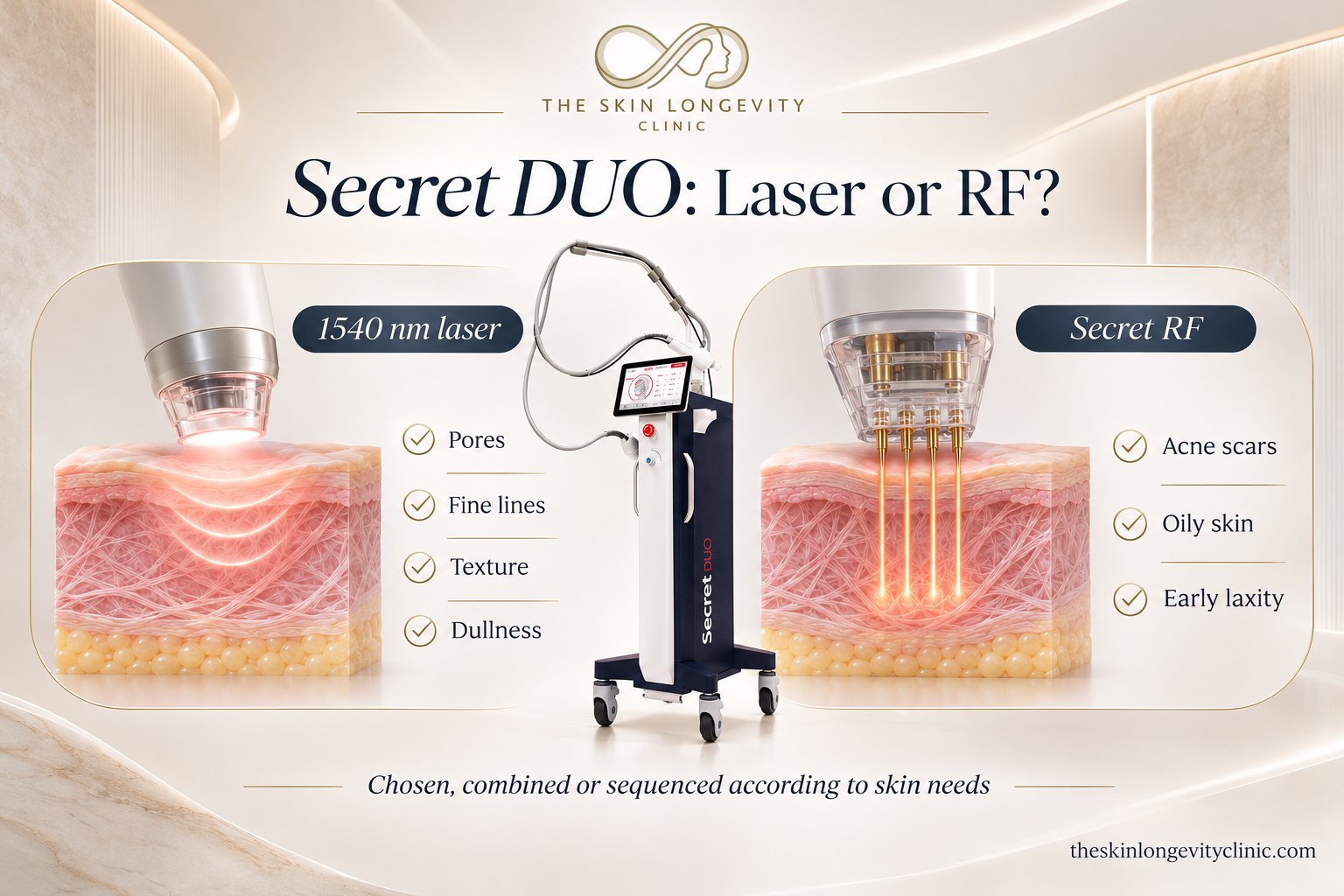
Same platform, different depth and different job. Secret RF uses insulated gold microneedles to deliver radiofrequency heat at a chosen depth, from the upper dermis down to the deeper layers, which makes it the tool for acne scars, oily and acne-prone skin and early sagging. The 1540 nm erbium glass laser treats the upper to mid dermis evenly across the surface, which makes it the tool for texture, pores, fine lines and dullness.
The evidence says they perform similarly where they overlap, and differ in recovery. In a split-face trial of 15 Chinese patients, microneedle RF and a non-ablative fractional laser both significantly improved laxity, wrinkles and pores with no significant difference between them; the laser side recovered in about 4.6 days against 7 for the RF side7. For patients with both texture and scarring, the two are often combined: Secret RF for the scars and laxity, the laser for the surface, usually on separate visits so each can be assessed. Our Secret RF vs Sylfirm X vs Morpheus8 vs Potenza comparison explains how the RF devices differ.
Erbium glass laser vs fractional CO2 vs Fraxel: the wavelengths compared
| Laser | Wavelength | Ablative? | Main use | Typical downtime |
|---|---|---|---|---|
| Secret DUO erbium glass | 1540 nm | No | Pores, fine lines, texture, dull skin, shallow scars | 1 to 2 days of redness |
| Fraxel Dual (erbium fibre) | 1550 nm (+1927 nm thulium) | No | Texture, lines, pigmentation (1927 nm) | 2 to 4 days |
| Fractional pico laser | 1064 nm / 532 nm | No | Pigmentation, acne marks, pores | Up to 1 day |
| Fractional CO2 | 10,600 nm | Yes | Deeper scars, marked texture change, lines | 5 to 7 days of peeling |
1540 and 1550 nm are the same family of laser. Fraxel is the best-known brand name for non-ablative fractional resurfacing in Singapore, and its main wavelength, 1550 nm, behaves almost identically in skin to the 1540 nm used in Secret DUO. Most published Fraxel-type evidence therefore applies to both. The CO2 laser is a different category: it vaporises the surface, which gives stronger results for deep scars at the cost of a week of recovery and a higher risk of dark marks in Asian skin. Read our fractional CO2 laser in Singapore and pico laser in Singapore pages for the alternatives.
Is the 1540 nm erbium glass laser safe for Asian skin?
Non-ablative is the preferred laser type for skin that tans or marks easily. A 2024 review of 40 studies found that non-ablative fractional lasers are preferred in darker skin phototypes because the risk of post-inflammatory hyperpigmentation is lower than with ablative lasers, with the strongest evidence for atrophic scars and melasma and moderate evidence for rejuvenation8. The same review stresses conservative settings and careful device choice, which is how we treat Fitzpatrick type III to V skin.
The main risks are temporary. Redness, swelling, dryness and a grid pattern for a few days are expected. Less common are prolonged redness, a flare of acne, cold sores in people prone to them, and dark marks, which are more likely if the skin is tanned or if sun protection is skipped afterwards. Rare risks include blistering or scarring if energy is set too high. The consultation covers your history of pigmentation and any recent sun exposure before treatment is scheduled.
How many Secret DUO sessions are needed and how long do results last?
Typically three to five laser sessions, three to four weeks apart, then maintenance. The published studies used three to five sessions for pores, lines and texture, with assessments two to three months after the last one1,2,4. Results are gradual and last as long as the new collagen does, usually a year or more, after which a single top-up session helps hold the improvement. Where Secret RF is added for scars, it is usually planned as three to four sessions six weeks apart, as described on our RF microneedling downtime and aftercare guide.
Who is suitable for Secret DUO, and who is not
Suitable: adults with enlarged pores, rough or dull skin, fine lines, shallow acne scars, or early loss of firmness who want visible improvement with minimal time off. Also suitable as a maintenance treatment for people who have had RF microneedling or biostimulators and want to keep texture smooth.
Not suitable or deferred: pregnancy and breastfeeding; active skin infection or cold sores in the area; isotretinoin in the past six months; a recent tan or sunburn; a history of keloid scarring; and uncontrolled active acne, which is treated first. Anyone whose main concern is sagging rather than texture is usually better served by skin tightening in Singapore options such as XERF.
Secret DUO treatment at The Skin Longevity Clinic
Every treatment starts with the assessment, not the device. Dr Rachel Ho examines the skin, explains which of the two Secret DUO technologies fits your concern, sets expectations in plain terms, and agrees the number of sessions and the review date. Photographs are taken under the same lighting at each visit so the change can be judged honestly. To discuss whether the 1540 nm erbium glass laser or Secret RF is right for you, book a consultation.
Secret DUO and erbium glass laser FAQs
What is an erbium glass laser?
A laser that uses erbium-doped glass to produce 1540 nm infrared light. The light passes through the skin surface and heats the dermis in tiny columns, stimulating new collagen without removing the top layer of skin. It is classed as a non-ablative fractional laser.
Is Secret DUO painful?
With numbing cream most patients describe a hot, prickling feeling that is tolerable. The laser side is generally less uncomfortable than RF microneedling, and the published split-face trial reported shorter recovery on the laser side7.
Erbium glass laser vs CO2 laser: which is better?
CO2 is stronger for deep scars but needs about a week of recovery and carries a higher risk of dark marks in Asian skin. The erbium glass laser gives milder results per session with one to two days of redness. In a randomised trial of acne scars the two were not significantly different in outcome, and the erbium glass laser was less painful with shorter downtime6.
What are the side effects of the 1540 nm erbium glass laser?
Expected: redness, mild swelling, dryness and a faint grid pattern for one to three days. Uncommon: prolonged redness, acne flare, cold sores, dark marks. Rare: blistering or scarring if settings are too aggressive. Non-ablative lasers carry a lower pigmentation risk than ablative lasers in darker skin8.
How soon will I see results from Secret DUO?
Skin often looks brighter within a week as the surface recovers, but the improvement in pores, lines and texture builds over six to twelve weeks as collagen forms, which is when the published studies measured their results1,2.
Can Secret DUO be combined with other treatments?
Yes. It is commonly sequenced with Secret RF for scars, with skin boosters for hydration and skin quality, and with collagen biostimulators for firmness. Treatments are spaced so each can be assessed.
Secret DUO before and after: what should I expect to see?
Smaller-looking pores on the nose and cheeks, softer fine lines around the eyes and forehead, more even light reflection, and a smoother feel. Changes are gradual rather than dramatic, and we judge them with standardised photographs rather than marketing images.
Does the 1540 nm erbium glass laser work on post-pregnancy stretch marks?
Yes, if you expect improvement rather than removal. In studies of women after childbirth who had three to six sessions, independent graders saw mild to moderate improvement in how wide, deep and dark the marks were, and most women were satisfied11,12. The marks become narrower, flatter and closer to your normal skin colour. They do not vanish. White marks need more sessions than red ones.
Can Secret DUO treat stretch marks on the thighs and buttocks?
Yes. The 1540 nm laser has been studied on nine body areas including the hips, tummy and breasts9, and the thighs and buttocks are treated the same way. Large areas take longer and may be split over two visits. For wide, deep marks we add Secret RF microneedling, which built more collagen than the laser when the two were compared directly13.
References
Show all 15 references
- Solomon-Cohen E, Lapidoth M, Mimouni D, et al. 1540-nm fractional erbium:glass laser is a safe and effective modality for nonablative facial rejuvenation. Journal of Cosmetic Dermatology. 2021. PubMed 33522710
- Naranjo García P, Llamas Martín R, Ifrach E, et al. Visible and quantifiable improvement in skin roughness and texture using a high power non-ablative 1540-nm fractional erbium:glass laser. Journal of Clinical and Aesthetic Dermatology. 2022. PubMed 36312824
- Yu Z, Zhu H, Ma J, et al. Randomized split-face, controlled comparison of treatment with 1565-nm nonablative fractional laser for enlarged facial pores. British Journal of Dermatology. 2018;178(1):e271 to e272. PubMed 29192959
- Wang Y, Zheng Y, Cai S, et al. Efficacy and safety of 1565-nm non-ablative fractional laser versus long-pulsed 1064-nm Nd:YAG laser in treating enlarged facial pores. Lasers in Medical Science. 2022. PubMed 35971017
- Liu C, Zeng W, Liu Y, et al. Comparison of the 1064-nm picosecond laser with fractionated microlens array and 1565-nm non-ablative fractional laser for the treatment of enlarged pores: a randomized, split-face, controlled trial. Lasers in Medical Science. 2024. PubMed 38396012
- Elsaie ML, Ibrahim SM, Saudi W. Ablative fractional 10 600 nm carbon dioxide laser versus non-ablative fractional 1540 nm erbium-glass laser in Egyptian post-acne scar patients. Journal of Lasers in Medical Sciences. 2018. PubMed 29399309
- Dou Y, Yang Y, Yin Y, et al. Fractional microneedle radiofrequency device and fractional erbium-doped glass 1,565-nm device treatment of human facial photoaging: a prospective, split-face, random clinical trial. Journal of Cosmetic and Laser Therapy. 2021. PubMed 35083965
- Aggarwal I, Rossi AM, Puyana C, et al. Review of fractional nonablative lasers for the treatment of dermatologic conditions in darker skin phototypes. Dermatologic Surgery. 2024. PubMed 38335306
- de Angelis F, Kolesnikova L, Renato F, Liguori G. Fractional nonablative 1540-nm laser treatment of striae distensae in Fitzpatrick skin types II to IV: clinical and histological results. Aesthetic Surgery Journal. 2011. PubMed 21551432
- Wang K, Ross N, Osley K, et al. Evaluation of a 1540-nm and a 1410-nm nonablative fractionated laser for the treatment of striae. Dermatologic Surgery. 2016. PubMed 26783689
- Wang Y, Xu Y, Qiang Y, et al. Non-ablative fractional 1540-nm Er:glass laser for the treatment of striae gravidarum: a case series. Frontiers in Medicine. 2026. PubMed 42643280
- Nourmohammadpour P, Ehsani AH, Hatami P, et al. Striae gravidarum treatment: evaluating non-ablating fractional laser (NAFL) efficacy and safety. Journal of Cosmetic and Laser Therapy. 2023. PubMed 37309187
- Tang Z, Wen S, Liu T, et al. Comparative study of treatment for striae alba stage striae gravidarum: 1565-nm non-ablative fractional laser versus fractional microneedle radiofrequency. Lasers in Medical Science. 2021. PubMed 33411130
- Wu Y, Huang X, Kang H, et al. Comparing energy-based devices for striae improvement: a systematic review and network meta-analysis of randomized controlled trials. Dermatologic Surgery. 2024. PubMed 38820425
- Kaushik SB, Alexis AF. Nonablative fractional laser resurfacing in skin of color: evidence-based review. Journal of Clinical and Aesthetic Dermatology. 2017. PubMed 28979657