

18 Sep ECM Skin Booster Recovery: Bumps, Swelling and When to Seek Review
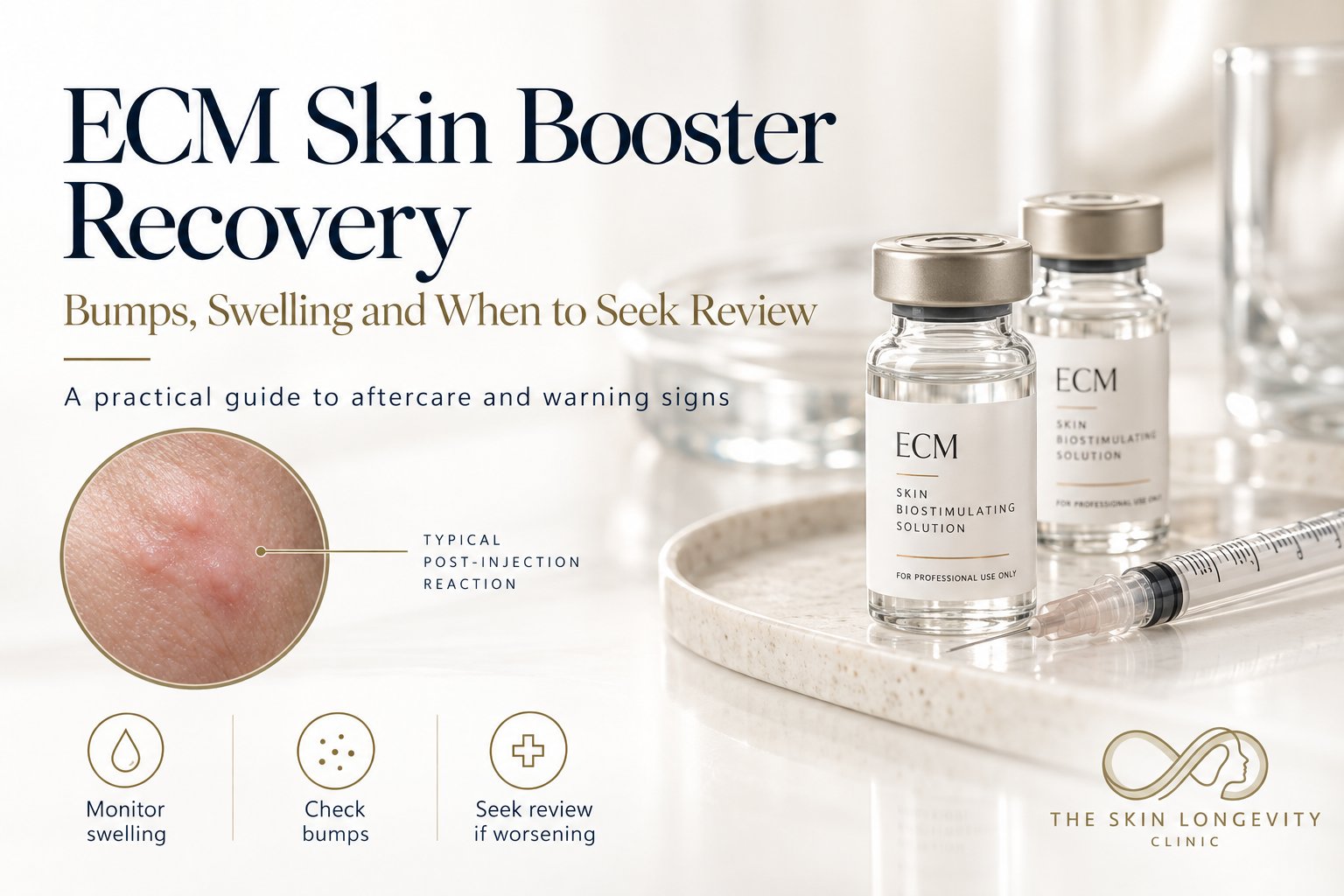
Seeing bumps or puffiness after an injectable treatment can leave you wondering whether your skin is recovering as expected. Whether you are preparing for treatment or checking a change you have noticed afterwards, it helps to know what to monitor and when to contact your doctor.
Mild redness and swelling have been reported after ECM skin booster injections, but worsening symptoms deserve assessment rather than simply more time1,2. Increasing pain or unusual skin colour changes are particularly important reasons to seek prompt medical review3.
What affects ECM skin booster recovery?
ECM stands for extracellular matrix, and this guide concerns injectable preparations containing human acellular dermal matrix, processed dermal tissue retaining structural components such as collagen1. Our ECM skin booster guide explains this treatment category and the questions to discuss before proceeding.
In the broader facial injectable literature, swelling varies with the material, injection volume, technique, treated area and individual response2. Your aftercare instructions should therefore reflect the procedure you actually received, including any other treatments performed during the same visit.
How long does swelling after an ECM skin booster last?
A 2026 study followed 20 adults for 20 weeks, comparing a dermal matrix preparation mixed with hyaluronic acid against hyaluronic acid alone on opposite facial sides1. The researchers reported mild redness and slight swelling that settled without treatment, with no serious adverse events recorded in that small trial1.
The study did not specify an exact number of days for these reactions to resolve, so it cannot establish a universal ECM recovery timetable1. Ask your treating doctor what changes they expect after your procedure and when they would like to review swelling that persists.
Why can bumps appear after injections?
Facial injectable literature describes raised areas associated with swelling or the placement of material close to the skin surface2,4. A persistent lump can have a different explanation from an early injection mark, particularly when redness, tenderness or renewed swelling develops4.
The appearance of a bump alone cannot establish its cause. Its timing, progression and accompanying symptoms help your doctor decide whether examination or further investigation is needed4.
Bumps and swelling: when should you seek review?
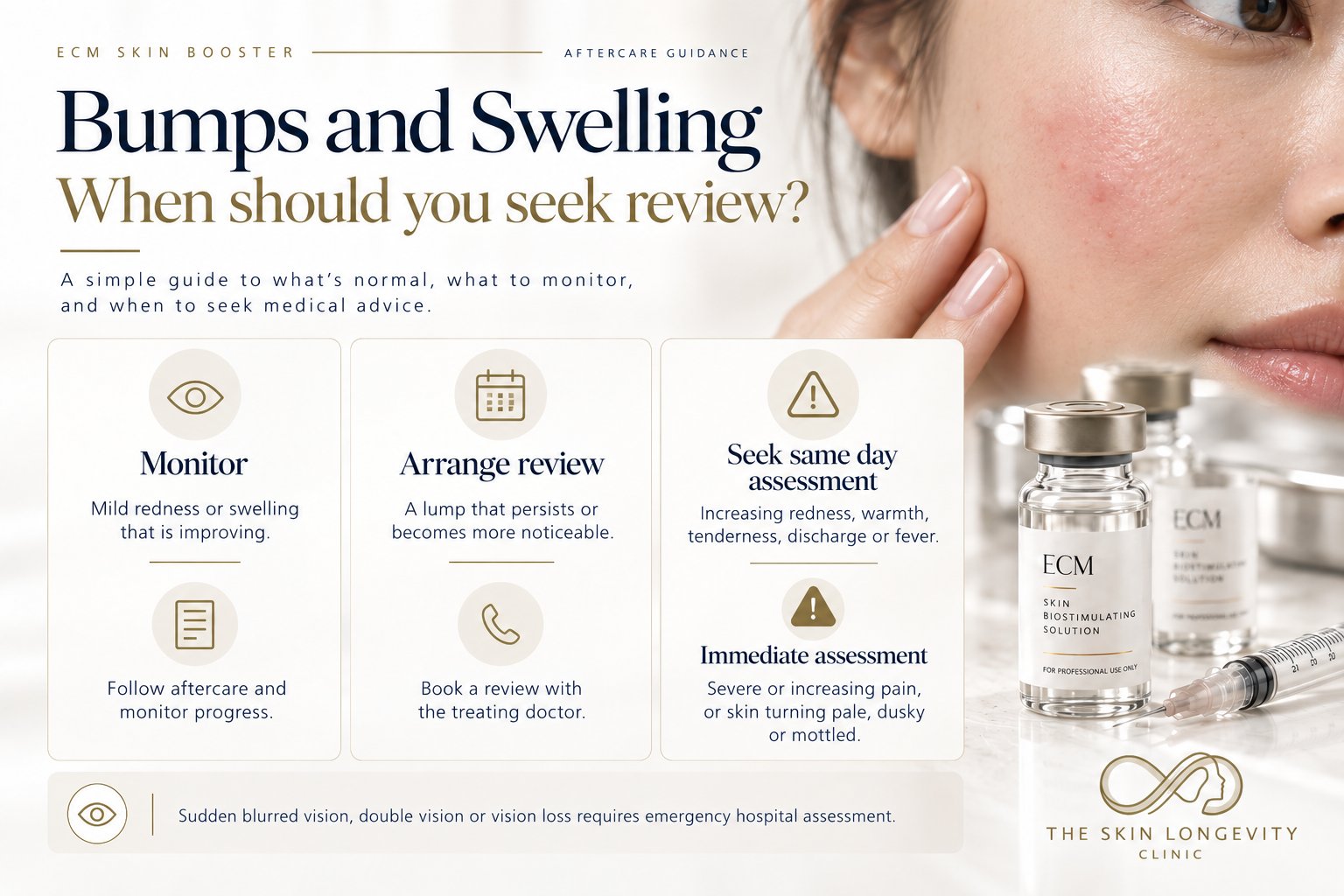
The following guide draws on published recommendations for recognising problems after facial injections2,3,4,5. It helps identify when assessment is appropriate, while a diagnosis requires clinical review.
| What you notice | Recommended next step |
|---|---|
| Mild local redness or swelling that is improving, with comfortable skin | Follow your aftercare instructions and monitor progress1,2. |
| A lump that persists, becomes more noticeable or appears after the initial swelling has settled | Arrange a review with the treating doctor4. |
| Increasing redness, warmth, tenderness, discharge or fever | Seek medical assessment the same day because infection or another inflammatory reaction needs consideration2,4. |
| Severe or increasing pain, or skin becoming unusually pale, dusky or mottled | Seek immediate assessment in person, even when pain is slight or absent3. |
| Sudden blurred vision, double vision or any loss of vision | Seek emergency hospital assessment immediately5. |
For urgent skin changes, contact the treating clinic immediately and attend an emergency department when prompt assessment is unavailable3. Sudden visual symptoms require immediate emergency care rather than waiting for a message reply5.
ECM safety literature includes a case report of suspected impaired blood supply, with symptoms developing two days after injection6. A single report cannot establish how often this occurs, but it illustrates why new symptoms matter even after an initially comfortable recovery6.
ECM skin booster aftercare
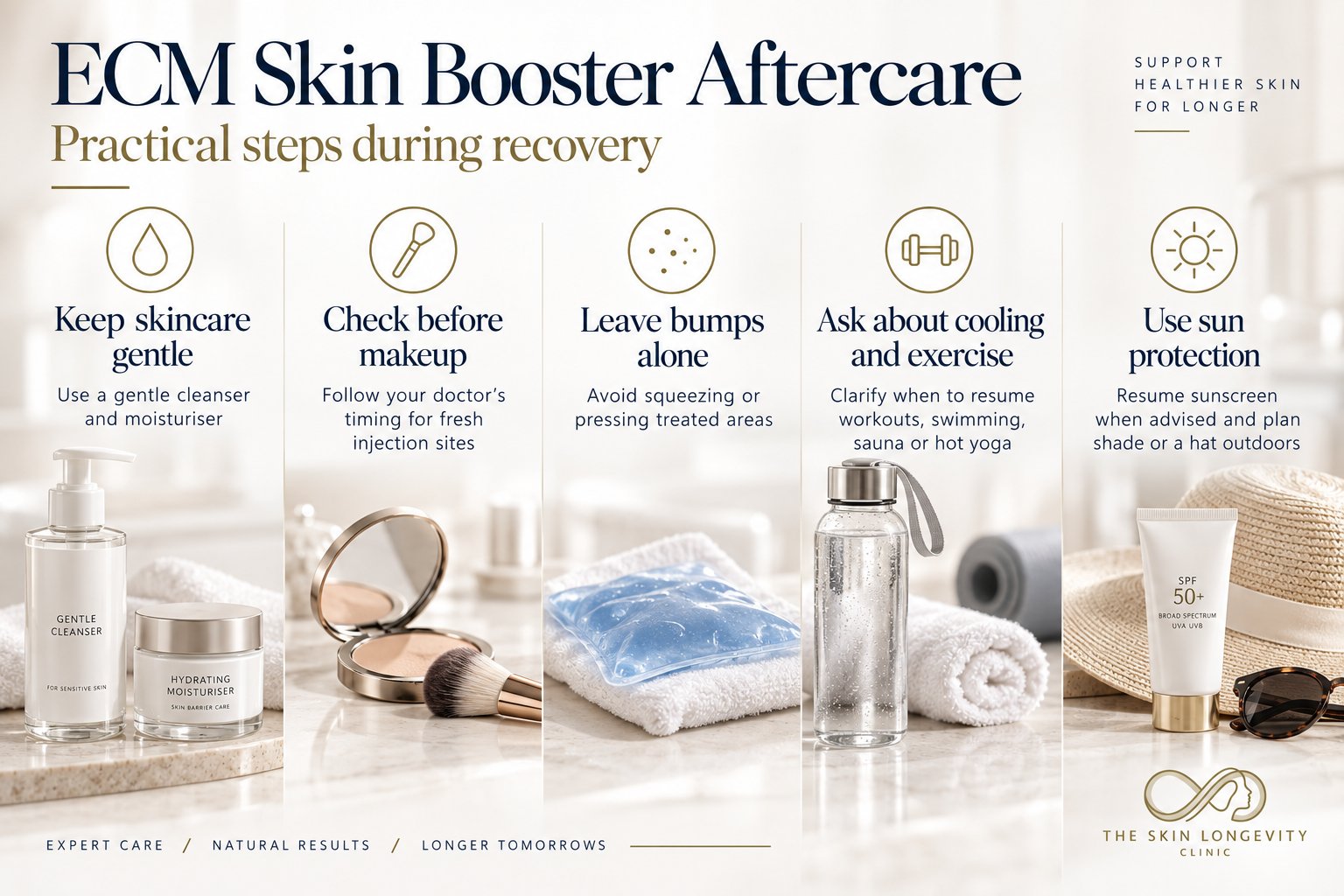
The practical recommendations below also draw on expert guidance for facial injectables and skincare around aesthetic procedures2,4,7. They should be adapted by your treating doctor rather than interpreted as an ECM specific protocol proven in a recovery trial.
Keep skincare gentle
Once your doctor advises resuming skincare, use a gentle cleanser and moisturiser7. Discuss when to restart retinoids, exfoliating acids and other potentially irritating products, particularly when the skin remains sensitive7.
Check when you can wear makeup
Keep makeup off fresh injection sites and follow the timing specified in your aftercare instructions4. Published expert recommendations vary, so your doctor should confirm when application is appropriate for the procedure and condition of your skin4.
Leave bumps alone
Keep your hands clean and avoid squeezing or repeatedly pressing the treated areas4. Massage should follow specific instructions from your treating doctor, rather than being used as a general remedy for every bump4.
Ask about cooling and exercise
A cool compress may help uncomplicated swelling or bruising when your doctor recommends it2. Increasing pain or unusual colour changes require assessment rather than continued home treatment3.
Expert guidance for facial fillers advises avoiding strenuous exercise for the first 24 hours to reduce bruising and swelling2. Ask whether that interval is appropriate for your ECM procedure, and clarify when you can resume swimming, hot yoga or sauna use.
Include sun protection in your routine
General guidance for skincare around aesthetic procedures supports broad spectrum sunscreen and avoiding excessive sun exposure7. Ask when to resume sunscreen after your injections, and plan shade or a hat for outdoor journeys while following those instructions.
For everyday life in Singapore, discuss activities such as outdoor commuting, lunchtime walks and weekend sport during the consultation. This makes it easier to plan aftercare around your routine.
What happens if a lump persists?
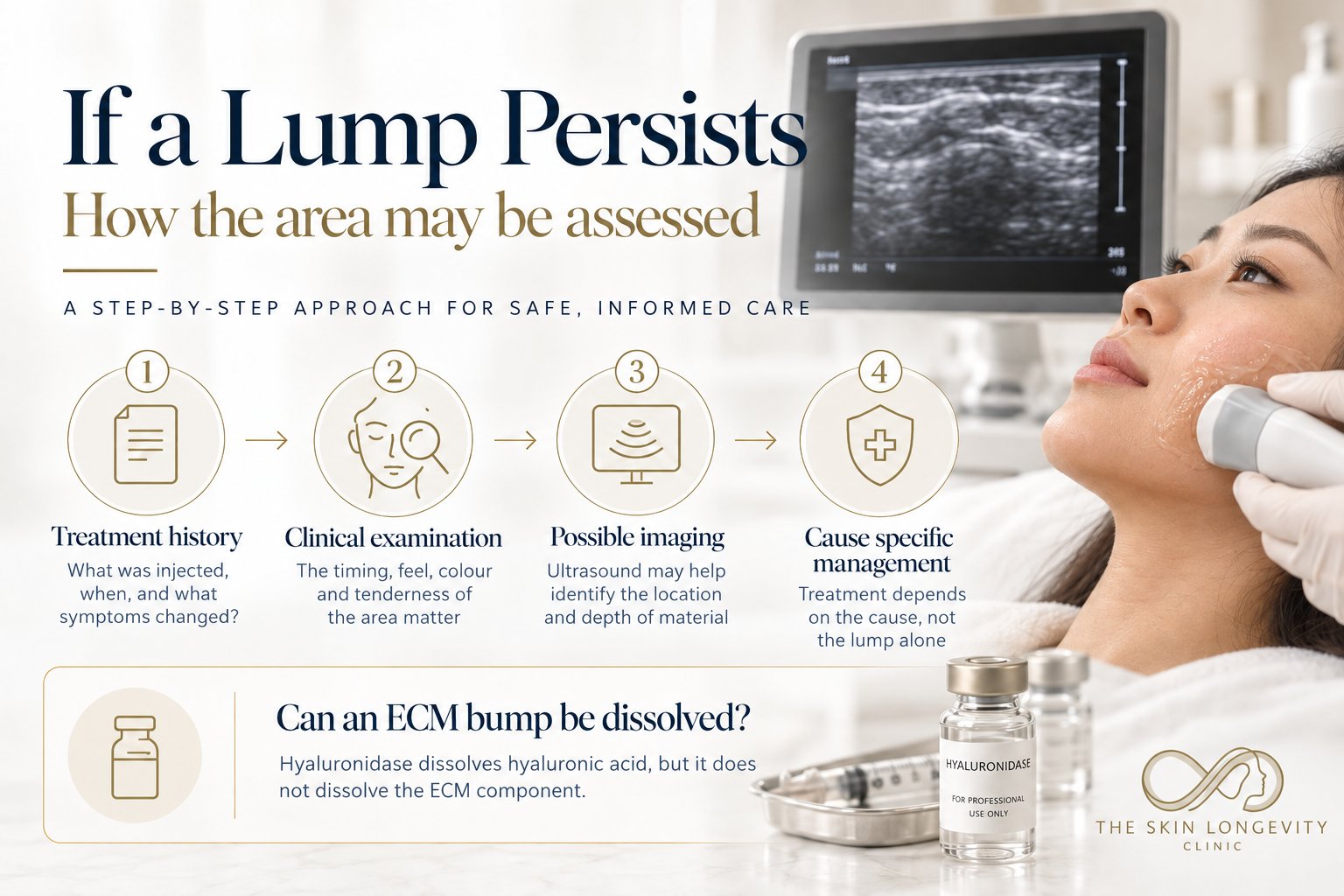
Assessment usually begins with the treatment history and examination of the area4. Depending on the findings, a doctor may consider additional investigations; ultrasound is used in some facial filler assessments to identify the location and depth of injected material4.
Treatment depends on the cause rather than the presence of a lump alone4. For a broader discussion of the material and informed consent, read Dr Rachel Ho’s article on ECM skin booster safety and ethics.
Can an ECM bump be dissolved?
Hyaluronidase breaks down hyaluronic acid, while the dermal matrix component is a different material and would not be dissolved by that enzyme6. Even when a preparation contains both materials, assessment is needed to establish the cause of the lump and select an appropriate treatment4,6.
Planning work, travel and follow up

Before treatment, tell your doctor about important meetings, photographs, flights and sporting activities. Ask for an expected recovery range for your procedure, how to arrange a review and whom to contact outside normal opening hours.
When reporting a concern, explain when it began, whether it is changing and whether there is pain, warmth, discharge or altered skin colour. Keep details of the injected preparation and previous facial procedures available, especially when seeking care from a different clinician.
A practical approach to recovery
Ask for written aftercare instructions and a clear plan for follow up before leaving the clinic. When a change concerns you, contacting the treating team for advice is more useful than comparing your recovery with someone who may have received a different preparation or procedure.
References
-
Lee YI, Chau NH, Nguyen NH, et al. Injectable Particulated Human Acellular Dermal Matrix Booster for Skin Restoration: An Integrated Randomized, Split Face, Double Blinded Clinical Trial and Preclinical Study. International Journal of Molecular Sciences. 2026;27(5):2193. ResearchGate
-
Urdiales Gálvez F, Delgado NE, Figueiredo V, et al. Treatment of Soft Tissue Filler Complications: Expert Consensus Recommendations. Aesthetic Plastic Surgery. 2018;42(2):498 to 510. Springer Link
-
Murray G, Convery C, Walker L, Davies E. Guideline for the Management of Hyaluronic Acid Filler Induced Vascular Occlusion. Journal of Clinical and Aesthetic Dermatology. 2021;14(5):E61 to E69. PubMed
-
Philipp Dormston WG, Goodman GJ, De Boulle K, et al. Global Approaches to the Prevention and Management of Delayed Onset Adverse Reactions with Hyaluronic Acid Based Fillers. Plastic and Reconstructive Surgery Global Open. 2020;8(4):e2730. PubMed Central (PMC)
-
Walker L, Convery C, Davies E, Murray G, Croasdell B. Consensus Opinion for the Management of Soft Tissue Filler Induced Vision Loss. Journal of Clinical and Aesthetic Dermatology. 2021;14(12):E84 to E94. PubMed Central (PMC)
-
Sung SW, Lee SY, Seok J, Kim BJ. Vascular Complication Following Injection of Particulated Human Acellular Dermal Matrix: A Case Report. Journal of Cosmetic Dermatology. 2026;25(7):e71049. ResearchGate
-
Alexis AF, Andriessen A, Beach RA, et al. Periprocedural Skincare for Nonenergy and Nonablative Energy Based Aesthetic Procedures in Patients With Skin of Color. Journal of Cosmetic Dermatology. 2025;24:e16712. Wiley Online Library