


27 Aug ECM Skin Booster for Wrinkles Singapore: Evidence and Limits
By Dr Rachel Ho | Aesthetic Doctor, Founder, The Skin Longevity Clinic, Singapore
Medically reviewed by Dr Rachel Ho, MBBS, MRCS, MMed (ENT), August 2026.
Wrinkles are often discussed as though they were one problem. A crease created mainly by facial movement behaves very differently from a fine line held in thin, collagen depleted skin, and the treatment needs to reflect that distinction.
ECM skin boosters are most relevant when dermal quality is contributing to fine static wrinkles, crepiness and reduced skin support. Early clinical evidence suggests that one particulated human acellular dermal matrix formulation can improve wrinkle depth, skin density, elasticity and hydration, but the evidence remains small, product specific and much newer than the research supporting established wrinkle treatments.
ECM skin boosters can be considered for selected fine lines that remain visible at rest. They do not relax the muscles that cause dynamic forehead lines, frown lines or crow’s feet, and they do not replace volume restoration or surgery when the main concern lies deeper than the skin.
ECM skin boosters are one of the options covered in wrinkle treatment in Singapore.
ECM skin boosters for wrinkles at a glance
FAQ about ECM skin booster for wrinkles
| Question about ECM skin booster for wrinkles | Evidence based answer |
|---|---|
| What is an ECM skin booster? | An injectable treatment containing extracellular matrix material, often processed human acellular dermal matrix |
| Which wrinkles can it support? | Fine static lines, crepey texture and wrinkles associated with dermal thinning |
| Can it treat dynamic wrinkles? | It cannot reduce the muscle contraction creating the line |
| Can it treat deep folds? | Selected folds can soften, but volume loss, ligament anatomy and tissue descent often require another treatment |
| Is there human evidence? | One 20 person skin booster trial and a separate larger filler trial support selected applications |
| How quickly do results appear? | Improvement is gradual and was assessed over 20 weeks in the main skin booster study |
| Is it a filler? | Some acellular dermal matrix products are used as fillers, while skin booster protocols focus more on dermal quality |
| What are the main risks? | Swelling, bruising, tenderness, nodules, infection, asymmetry and rare vascular injury |
Can ECM skin boosters reduce wrinkles?
ECM skin boosters can soften selected fine static wrinkles when reduced dermal density, hydration and elasticity are important contributors. They are less suited to wrinkles produced mainly by repeated muscle contraction.
A simple mirror test helps. A line that appears or deepens when you raise your eyebrows, frown or smile is mainly dynamic. A line that remains after the face relaxes contains a static component related to the skin itself.
The clinic guide to dynamic versus static wrinkles explains this distinction in greater detail. The broader wrinkle treatment in Singapore guide covers forehead lines, frown lines and crow’s feet.
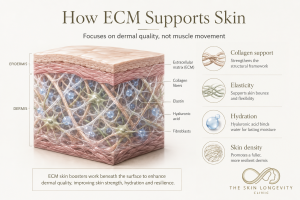
How does the extracellular matrix support skin? Collagen contributes strength, elastin supports recoil, hyaluronic acid helps retain water and fibroblasts maintain the dermal environment. ECM skin boosters focus on this skin-quality layer rather than facial muscle movement.
Why the extracellular matrix is relevant to wrinkles
The extracellular matrix is the structural environment around cells in the dermis. It contains collagen, elastin, glycosaminoglycans, hyaluronic acid, proteoglycans and other molecules that influence skin strength, elasticity, hydration and repair.
Ageing skin is not simply skin with less collagen. Collagen fibrils become fragmented, fibroblasts lose secure attachment to the surrounding matrix, and the mechanical signals that normally support collagen production weaken. Ultraviolet exposure accelerates this cycle by increasing matrix degrading enzymes and oxidative stress2,3.
These changes contribute to a thinner, less resilient dermis. Fine creases become easier to form, and folds created repeatedly by facial movement are less able to spring back after the expression has passed.
What is an ECM skin booster?
Many current ECM skin boosters use processed human acellular dermal matrix. Donor cells are removed during manufacturing, leaving extracellular matrix material that can be prepared as small particles for placement within the skin.
The word acellular refers to the removal of living donor cells. It does not mean that the material is synthetic or that every ECM product has the same source, particle size, processing method, concentration or clinical evidence.
The proposed role is different from that of a conventional hydrating skin booster. Rather than relying mainly on water binding or short lived plumping, an ECM formulation is intended to provide a scaffold that surrounding cells can enter and remodel.
Patients can read the full treatment overview at ECM Skin Boosters in Singapore.
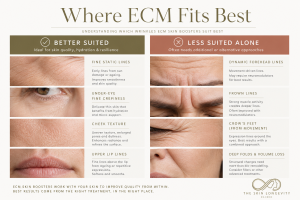
Which wrinkles are most suited to ECM skin boosters? Fine static lines, under-eye crepiness and texture changes linked to dermal quality are the clearest potential fit. Forehead lines, frown lines, movement-related crow’s feet and deep folds commonly need another or an additional treatment.
How could an ECM skin booster improve wrinkles?
The 2026 phADM study examined ECM skin boosters at four levels. These levels should be separated because a laboratory finding does not carry the same clinical weight as a result observed in patients1.
Evidence for ECM skin boosters
| Evidence level | What was studied | Main finding | What it cannot prove |
|---|---|---|---|
| Human clinical trial | 20 adults received a phADM containing preparation on one cheek and hyaluronic acid on the other | Greater improvements in wrinkle depth, skin density, elasticity, hydration, pores and other skin measurements | Results for every ECM product, every wrinkle type or long term safety |
| Ex vivo human skin | Human skin maintained outside the body | Dermal distribution and preservation of matrix architecture, with restoration of selected basement membrane proteins after ultraviolet injury | Performance in a living face with circulation, immunity and facial movement |
| In vitro cell studies | Human fibroblasts, keratinocytes and immune cells | Increased fibroblast proliferation, collagen I, collagen III, elastin and hyaluronic acid related activity | Visible clinical wrinkle improvement |
| In vivo animal study | Matrix implanted in rats | Fibroblast infiltration and localised new collagen formation | An identical response in human facial skin |
This layered evidence gives the treatment a credible biological rationale. The most clinically important evidence still comes from the small human trial rather than from the larger number of laboratory endpoints.
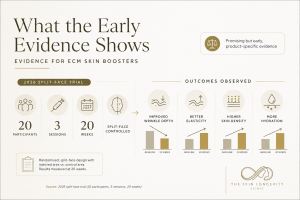
What does the early human evidence show? In one small split-face study, the phADM-treated side showed greater improvements in wrinkle depth, elasticity, skin density and hydration than the hyaluronic acid-treated side over 20 weeks. The findings are encouraging but apply to one formulation and a small study population
What did the 2026 human study find?
The randomised, split face, double blinded trial involved 20 adults with moderate cheek roughness. Participants received three intradermal treatments approximately one month apart, with the phADM containing preparation placed on one side and hyaluronic acid used as the comparison on the other1.
Over 20 weeks, the ECM treated side showed greater improvement in measured skin density, volume, elasticity, wrinkle depth, infraorbital wrinkles, nasolabial fold depth, pore area, hydration and barrier related parameters. No serious adverse event was observed during the study1.
The result is encouraging, although several limitations affect how confidently it can be applied in practice. The trial included only 20 people, tested one specific formulation, followed patients for less than six months and enrolled participants for cheek roughness rather than for one defined wrinkle diagnosis.
The test preparation also contained hyaluronic acid, so the study does not isolate an ECM only effect. One study author had served as an adviser in developing the product, which is relevant when interpreting early product specific research1.
What about deeper nasolabial folds?
A separate multicentre trial studied micronised acellular dermal matrix as a filler for moderate to severe nasolabial folds. Among 202 randomised participants, mADM produced improvement comparable with a cross linked collagen filler at three and six months, although early swelling and pain occurred more frequently with mADM4.
This larger trial strengthens the wider evidence for injectable acellular dermal matrix. It should still be distinguished from a superficial ECM skin booster protocol because nasolabial fold filling uses a different product, volume, depth and treatment objective.
A nasolabial fold can also reflect cheek deflation, ligament anatomy, facial movement and tissue descent. Skin quality treatment alone will not correct every fold.
Which wrinkles are most suitable?
Fine static wrinkles
Fine lines that remain at rest and occur with thin, crepey or poorly supported skin are the clearest potential indication. ECM treatment aims to improve the quality of the dermis rather than immediately erase the crease.
Under eye fine lines
Selected under eye wrinkles can reflect thin skin and reduced dermal support. Hollowing, pigmentation, visible blood vessels, eye bags and fluid retention create different problems, so the lower eyelid requires careful anatomical assessment.
The dedicated guide to ECM skin boosters for under eye fine lines explains where the treatment can fit and where another approach is more appropriate.
Dynamic forehead lines, frown lines and crow’s feet
These lines are driven largely by muscle contraction. ECM treatment can support the quality of the overlying skin, but it cannot reduce the movement repeatedly folding it.
A muscle focused treatment is more directly matched to a dynamic wrinkle. The skin component can then be treated separately when a fixed crease remains.
Deep static lines and facial folds
Established lines often combine skin thinning, repeated movement, volume loss and deeper anatomical change. ECM can form one part of a treatment plan, although resurfacing, volume restoration, collagen biostimulation or tightening can be more important depending on the diagnosis.
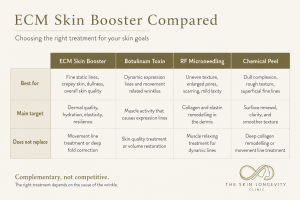
How do wrinkle treatments differ? ECM skin boosters focus on dermal quality, botulinum toxin addresses muscle-driven lines, RF microneedling remodels deeper texture and chemical peels renew the surface. These treatments are complementary rather than interchangeable.
ECM skin boosters compared with complementary wrinkle treatments
ECM skin boosters in combination with other treatments
| Treatment | Main target | Where it can complement ECM | Main limitation |
|---|---|---|---|
| Botulinum toxin | Muscle movement | Dynamic forehead lines, frown lines and crow’s feet | Does not rebuild thin or crepey skin |
| RF microneedling | Controlled dermal injury and thermal collagen remodelling | Static wrinkles, texture, pores and mild laxity | Requires needles and several days of recovery |
| Chemical peels | Controlled epidermal exfoliation and renewal | Fine surface lines, roughness, dullness and selected pigmentation | Does not restore deeper volume or relax muscles |
| ECM skin booster | Dermal matrix support | Fine static lines, crepey skin and reduced dermal quality | Newer and product specific evidence |
| Dermal filler or collagen support | Volume and structural support | Deep folds, hollowing and facial deflation | Performs a different job from a superficial skin booster |
| RF or ultrasound tightening | Laxity and deeper support | Wrinkles occurring with loose skin or loss of firmness | Improvement is gradual and does not equal surgery |
Botulinum toxin has a considerably broader evidence base for movement related facial wrinkles. A Cochrane review concluded that treatment reduces wrinkles within four weeks, while recognising risks such as eyelid drooping and limitations in long term repeated treatment data5.
RF microneedling targets dermal remodelling rather than muscle movement. A small Korean study found clinical and histological improvements in fine lines and laxity four months after one treatment, including increased collagen and elastin, although the retrospective study involved only 15 patients6.
Chemical peels work closer to the surface. A randomised study of 55 women found that three glycolic acid peel sessions improved crow’s feet depth and several photoageing measurements, although irritation occurred more often than with the comparison retinaldehyde cream7.
How many ECM skin booster sessions are needed?
The main clinical trial used three sessions at approximately monthly intervals. That protocol belongs to one research formulation and should not become a standard package for every patient1.
The treatment area, wrinkle pattern, skin thickness, product quantity, previous procedures and response all influence the plan. A review after the skin has had time to remodel is more useful than committing automatically to an indefinite course.
When should results of ECM skin boosters appear, and how long do they last?
ECM results are expected to develop gradually. The main study followed changes over 20 weeks, with improvements recorded at multiple time points rather than as an immediate final result1.
Current evidence does not define a universal duration for ECM skin booster results. The six month mADM filler trial involved a different formulation and injection objective, so its durability should not be transferred directly to a superficial skin quality treatment4.
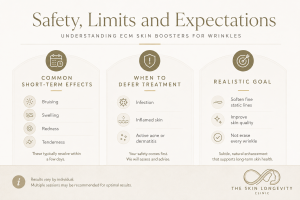
What should patients expect after an ECM skin booster? Temporary bruising, swelling, redness, tenderness and injection-site bumps can occur. Treatment should be deferred during active infection or inflammation, and the realistic objective is softer fine lines and improved skin quality rather than complete wrinkle removal.
Side effects and safety of ECM skin boosters for wrinkles
Common short term effects include visible injection points, redness, swelling, tenderness and bruising. Persistent inflammation, infection, nodules, unevenness and an unsatisfactory cosmetic result are less common considerations.
A 2026 case report described delayed vascular compromise following phADM injection into the forehead and cheeks, with residual atrophic scarring visible at later follow up8. One case cannot establish how frequently this occurs, but it confirms that ECM injectables are not exempt from vascular risk.
Patients should know the exact product, tissue source, preparation method, supporting ingredients and complication plan before treatment. The material is not equivalent to a pure hyaluronic acid gel, so product specific reversibility also deserves discussion.
Treatment is generally delayed when there is active infection, inflammatory acne, dermatitis, a rosacea flare or marked barrier disruption. Elective injectable treatment during pregnancy or breastfeeding also requires individual medical review.
Dr Rachel Ho’s clinical perspective on ECM skin boosters for wrinkle treatments
I would consider an ECM skin booster when a wrinkle assessment shows that thin, crepey or poorly supported skin is a major part of the problem. I would not use it as a generic answer for every line on the face.
The first questions are whether the line appears with movement, whether it remains at rest and whether volume loss or laxity sits underneath it. Once the cause is clear, ECM, botulinum toxin, RF microneedling, a chemical peel or another treatment can be given a specific job.
The Skin Longevity Clinic is located at 9 Scotts Road, #06-05 Scotts Medical Center at Pacific Plaza, Singapore 228210, near Orchard Road. A skin longevity assessment evaluates skin quality, facial anatomy, inflammation, pigmentation and recovery capacity before treatment is recommended.
Frequently asked questions
Can ECM skin boosters remove wrinkles completely?
ECM treatment can soften selected fine wrinkles and improve surrounding skin quality. Complete wrinkle removal is unrealistic because lines can also involve facial movement, volume loss and deeper structural ageing.
Are ECM skin boosters better than botulinum toxin?
The two treatments address different causes. Botulinum toxin is better matched to dynamic movement lines, while ECM is considered when dermal quality and static crepiness are important.
Is ECM better than RF microneedling for wrinkles?
ECM places matrix material into the dermis, while RF microneedling creates controlled injury and heat to stimulate remodelling. The choice depends on wrinkle depth, texture, skin thickness, pigment risk and acceptable downtime.
Can ECM skin boosters be combined with botulinum toxin?
Combination treatment can be useful when a wrinkle has both dynamic and static components. The treatments can be staged so that movement and skin quality are assessed separately rather than treated indiscriminately.
Are ECM skin boosters fillers?
Some acellular dermal matrix products are formulated and studied as fillers. ECM skin booster protocols usually focus on broad dermal quality rather than contouring or replacing substantial volume.
How long do ECM wrinkle results last?
The main skin booster trial followed participants for 20 weeks. Longer term durability, maintenance intervals and the performance of different commercial products remain incompletely defined.
Related reading at TheSkinLongevityClinic.com
Readers can continue with:
ECM Skin Boosters in Singapore
Dynamic vs Static Wrinkles: How to Tell the Difference
Wrinkle Treatment in Singapore
ECM Skin Booster Under Eye Singapore
Skin Boosters in Singapore: HA, Polynucleotide, PDLLA, ECM and Exosome Compared
References
- Lee YI, Chau NH, Nguyen NH, et al. Injectable Particulated Human Acellular Dermal Matrix Booster for Skin Restoration: An Integrated Randomized, Split Face, Double Blinded Clinical Trial and Preclinical Study. International Journal of Molecular Sciences. 2026;27:2193. PMID 41828422.
- Quan T, Fisher GJ. Role of Age Associated Alterations of the Dermal Extracellular Matrix Microenvironment in Human Skin Aging. Gerontology. 2015;61:427 to 434. PMID 25660807.
- Fisher GJ, et al. Skin Aging From the Perspective of Dermal Fibroblasts. Ageing Research Reviews. 2023.
- Zhang C, Chang X, Chen L, et al. Safety and Efficacy of Micronized Acellular Dermal Matrix Injection for Correction of Moderate to Severe Nasolabial Folds. Aesthetic Plastic Surgery. 2026;50:3710 to 3719. PMID 41381953.
- Camargo CP, Xia J, Costa CS, et al. Botulinum Toxin Type A for Facial Wrinkles. Cochrane Database of Systematic Reviews. 2021. PMID 34224576.
- Suh DH, Cho M, Kim HS, et al. Clinical and Histological Evaluation of Microneedle Fractional Radiofrequency Treatment on Facial Fine Lines and Skin Laxity in Koreans. Journal of Cosmetic Dermatology. 2023;22:1507 to 1512. PMID 36718800.
- Rouvrais C, Baspeyras M, Mengeaud V, Rossi AB. Antiaging Efficacy of a Retinaldehyde Based Cream Compared With Glycolic Acid Peel Sessions. Journal of Cosmetic Dermatology. 2018;17:1136 to 1143. PMID 30027612.
- Sung SW, Lee SY, Seok J, Kim BJ. Vascular Complication Following Injection of Particulated Human Acellular Dermal Matrix: A Case Report. Journal of Cosmetic Dermatology. 2026;25:e71049.