


26 May ECM Skin Boosters in Singapore: What They Are and Who May Suit Them
By Dr Rachel Ho | Aesthetic Doctor, Founder, The Skin Longevity Clinic, Singapore
Learn what ECM skin boosters are, how extracellular matrix boosters work, who may suit them and what patients should know before treatment in Singapore.
ECM skin boosters have become one of the newer categories of skin quality treatments in Korea and Singapore. Patients are asking about them because they are described differently from conventional skin boosters. Instead of focusing only on hydration or glow, ECM skin boosters are discussed in relation to the extracellular matrix, dermal support and skin repair.
At The Skin Longevity Clinic, ECM skin boosters are assessed as part of a broader skin quality plan. The decision depends on the patient’s skin quality, texture, scars, pores, under eye concerns, inflammation, pigment tendency and recovery capacity.
For readers who want the science and controversies in greater detail,I have written two indepth reviews: ECM Skin Boosters Explained: What the Extracellular Matrix Has to Do With Skin Ageing and ECM Skin Booster Controversies: Safety, Ethics and What Patients Should Know.
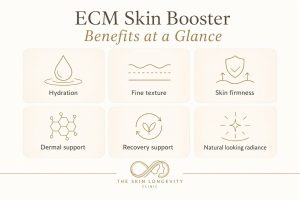
ECM skin booster benefits
What are ECM skin boosters?
ECM stands for extracellular matrix. In the skin, the extracellular matrix is the support network around skin cells. It contains collagen, elastin, glycosaminoglycans, hyaluronic acid and other structural molecules that help influence firmness, elasticity, hydration and repair.
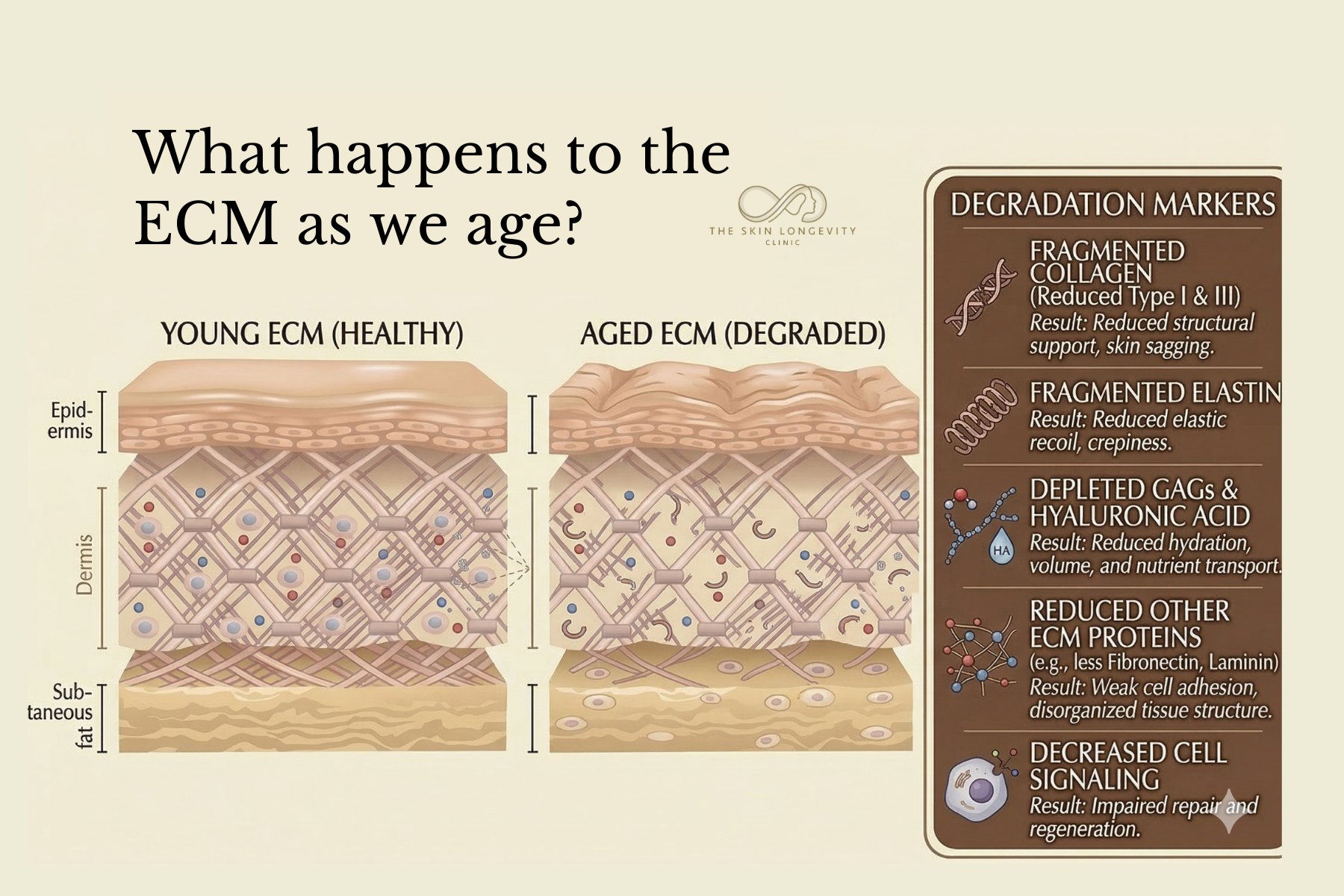
With age and ultraviolet exposure, the extracellular matrix changes. Collagen fibres become more fragmented. Elastin structure becomes less organised. Glycosaminoglycans can decrease in parts of the dermis. These changes contribute to thinner skin, reduced structural support, wrinkles, texture change and slower recovery.
ECM skin boosters are injectable skin quality treatments that aim to support the dermal matrix environment. Some ECM skin boosters use acellular dermal matrix material. Acellular means the cellular components are removed, leaving behind a matrix scaffold that may contain extracellular matrix components.
Why are ECM skin boosters different from conventional skin boosters?
Conventional hyaluronic acid skin boosters are often used for hydration, smoothness and skin glow. Polynucleotide or PDRN skin boosters are often discussed around repair, inflammation support and recovery. Collagen stimulating treatments are used for gradual collagen support.
ECM skin boosters add another category. They are discussed as matrix support treatments because they focus on the dermal scaffold. This makes them especially interesting for patients whose main concerns are skin quality, texture, enlarged pores, acne scars, fine lines or tired looking eyes.
The categories can overlap, but they are not identical. A patient with dehydrated skin may need a different treatment from someone with acne scars, dermal thinning or under eye skin quality concerns.

What ECM skin boosters can treat
How the extracellular matrix changes with age
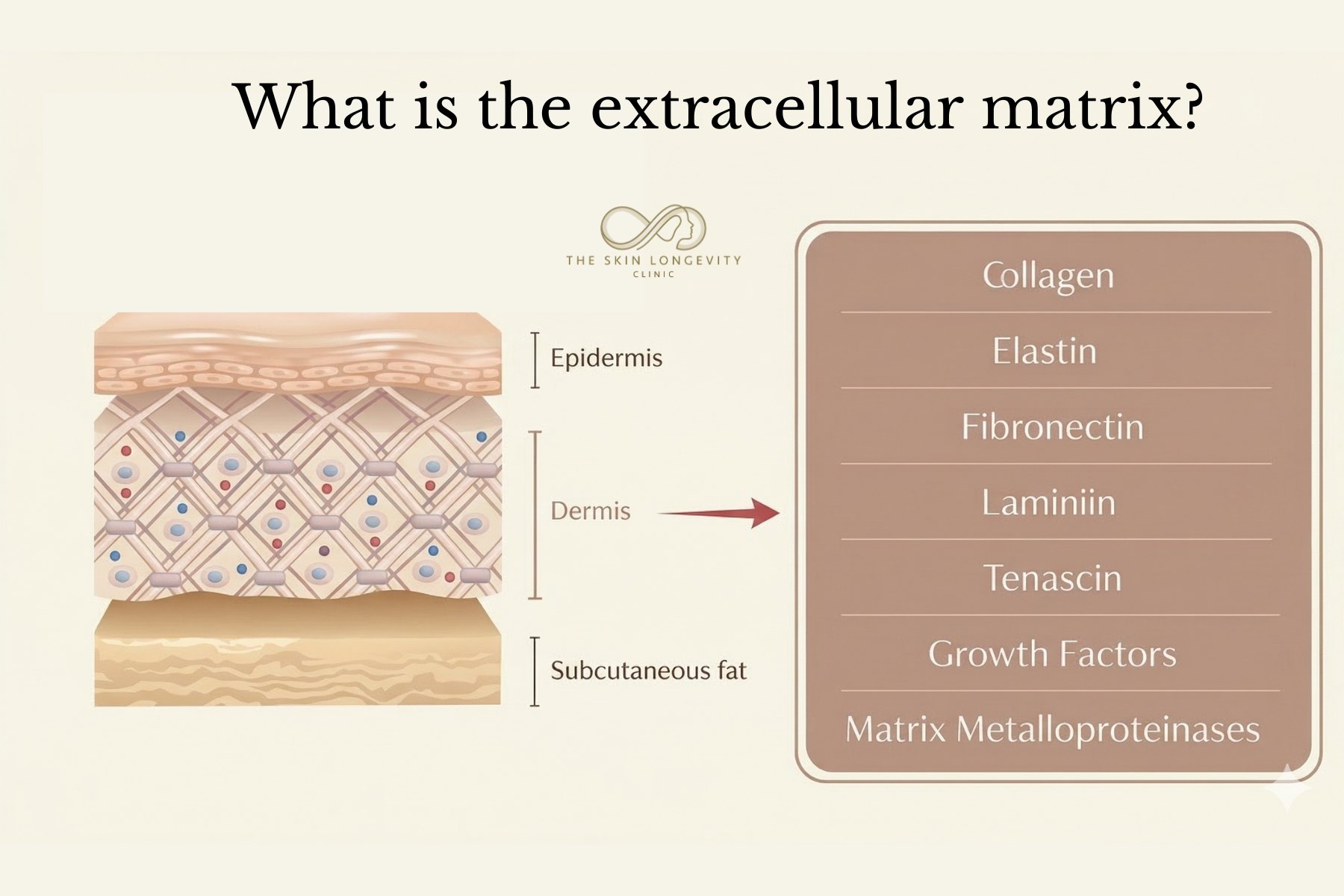
The dermal matrix is collagen (types I and III), elastin, glycosaminoglycans including hyaluronic acid, and the adhesion proteins that anchor cells to it. With age and sun exposure, collagen production falls and existing fibres fragment, elastin becomes disorganised, glycosaminoglycans and their bound water decline, and fibroblasts respond less to signals2,3,4. The visible results are fine lines, enlarged pores as support around follicles is lost, laxity, rougher texture and slower repair. Hydration alone or collagen stimulation alone addresses one part of this; the rationale for an ECM skin booster is to supply matrix components rather than a single ingredient.
Are ECM skin boosters safe?
The product used at the clinic is derived from donated human dermis processed to remove cells and immunogenic material, which is why hypersensitivity reactions are expected to be less frequent than with animal-derived collagen1. Common effects are redness, swelling and small papules at the injection points, usually settling within 24–48 hours; bruising is possible in thin skin or with blood-thinning medication. Most patients return to normal activity the same day and wear make-up from the next morning. ECM skin boosters are deferred in pregnancy and breastfeeding, over active skin infection, and in anyone with a known hypersensitivity to the material. Any lump lasting beyond two weeks is reviewed.
Can ECM skin boosters be combined with other treatments?
Yes. ECM skin boosters are often placed first so that later energy-based treatments act on better-supported skin, then paired in sequence with RF microneedling, fractional laser, collagen biostimulators, hyaluronic acid fillers, botulinum toxin, chemical peels or LED. Sessions are spaced two to four weeks apart and the order is set at consultation. The categories are compared on the skin boosters in Singapore page.
What are the potential benefits of ECM skin boosters?
Reported benefits of ECM skin boosters include improvement in skin texture, hydration, enlarged pores, fine lines, redness and barrier related parameters. They may also be considered for selected acne scars and under eye rejuvenation when skin quality is part of the concern.
A 2026 randomised, split face, double blinded clinical study evaluated injectable particulated human acellular dermal matrix in 20 adults with moderate cheek roughness. One side received the acellular matrix booster and the other side received hyaluronic acid. The study followed participants over 20 weeks and reported improvements in skin density, volume, elasticity, wrinkle depth, pore area, hydration and barrier related parameters, with no serious adverse events reported during the trial.
The study is encouraging, but it should be interpreted carefully. The clinical sample was small. Follow up was limited to 20 weeks. Product differences, injection technique, patient selection and combination treatments can influence real world outcomes.

ECM vs other skin boosters
Who may suit ECM skin boosters treatments in Singapore?
ECM skin boosters may be considered in selected patients with enlarged pores, fine texture, acne scars, fine wrinkles, crepey skin quality or tired looking under eyes.
They may also suit patients who want skin quality improvement without obvious facial volumisation. The aim is usually dermal support and gradual skin quality improvement, rather than lifting, filling or reshaping the face.
Patients with active acne, eczema, rosacea flares, skin infection or unstable pigmentation may need skin stabilisation before injectable treatments. Patients with significant volume loss, advanced sagging or deep scars may require a different treatment direction.
What is the procedure like for ECM skin booster injections?
The treatment begins with a consultation and skin assessment. Dr Rachel Ho assesses skin quality, scars, pores, texture, under eye anatomy, inflammation, pigment risk, prior treatments and recovery tolerance.
The skin is cleansed and prepared. Depending on the treatment area and protocol, the ECM skin booster is injected into selected skin areas. Temporary redness, swelling, small bumps, tenderness or bruising may occur after treatment.
Aftercare usually includes avoiding excessive heat, alcohol, heavy exercise and strong skincare actives for a short period, depending on the treatment performed.
How long does it take to see results of ECM skin boosters?
Some patients may notice early changes in hydration or skin smoothness. More visible improvement in texture, pores, scars or fine lines usually develops gradually over weeks.
This timeline reflects dermal response and remodelling. ECM skin boosters should not be judged like a same day cosmetic treatment. A review is useful to assess skin response and decide whether further sessions or combination treatments are needed.
Doctor Rachel’s takeaway on ECM skin boosters in Singapore
ECM skin boosters are a scientifically interesting category because they bring the extracellular matrix into skin quality treatment planning. They may be useful for selected patients with pores, scars, fine texture, fine wrinkles and under eye skin quality concerns.
They are also relatively new in aesthetic medicine. Patients should understand the evidence, limitations, source of material, risks and alternatives before treatment.
At The Skin Longevity Clinic, ECM skin boosters are not treated as routine skin boosters. They are considered after diagnosis, consent and careful treatment planning.
References
- Injectable Particulated Human Acellular Dermal Matrix Booster for Skin Restoration: An Integrated Randomized, Split Face, Double Blinded Clinical Trial and Preclinical Study. Lee YI, Chau NH, Nguyen NH, Ham S, Baek Y, Kim J, Lee JH. International Journal of Molecular Sciences. 2026. Volume 27, Issue 5.
- Alterations in Extracellular Matrix Composition During Aging and Photoaging of the Skin. McCabe MC, Hill RC, Calderone K, Cui Y, Yan Y, Quan T, Fisher GJ, Hansen KC. Matrix Biology Plus. 2020. Volume 8.
- Age Related Changes in Dermal Collagen Physical Properties in Human Skin. He X, et al. PLoS One. 2023. Volume 18, Issue 12.
- Intrinsic Aging and Photoaging Dependent Level Changes of Glycosaminoglycans and Their Correlation With Water Content in Human Skin. Oh JH, et al. Journal of Dermatological Science. 2011. Volume 62, Issue 3.
- ECM Skin Boosters Explained: What the Extracellular Matrix Has to Do With Skin Ageing. Rachel Ho. Dr Rachel Ho Blog. 2026.