

15 Aug Juvelook Skincare vs PDLLA Skin Booster: Does It Work?
By Dr Rachel Ho | Aesthetic Doctor, Founder, The Skin Longevity Clinic, Singapore
By Dr Rachel Ho | Aesthetic Doctor, Founder, The Skin Longevity Clinic, Singapore
Medically reviewed by Dr Rachel Ho, MBBS, MRCS, MMed (ENT), August 2026.
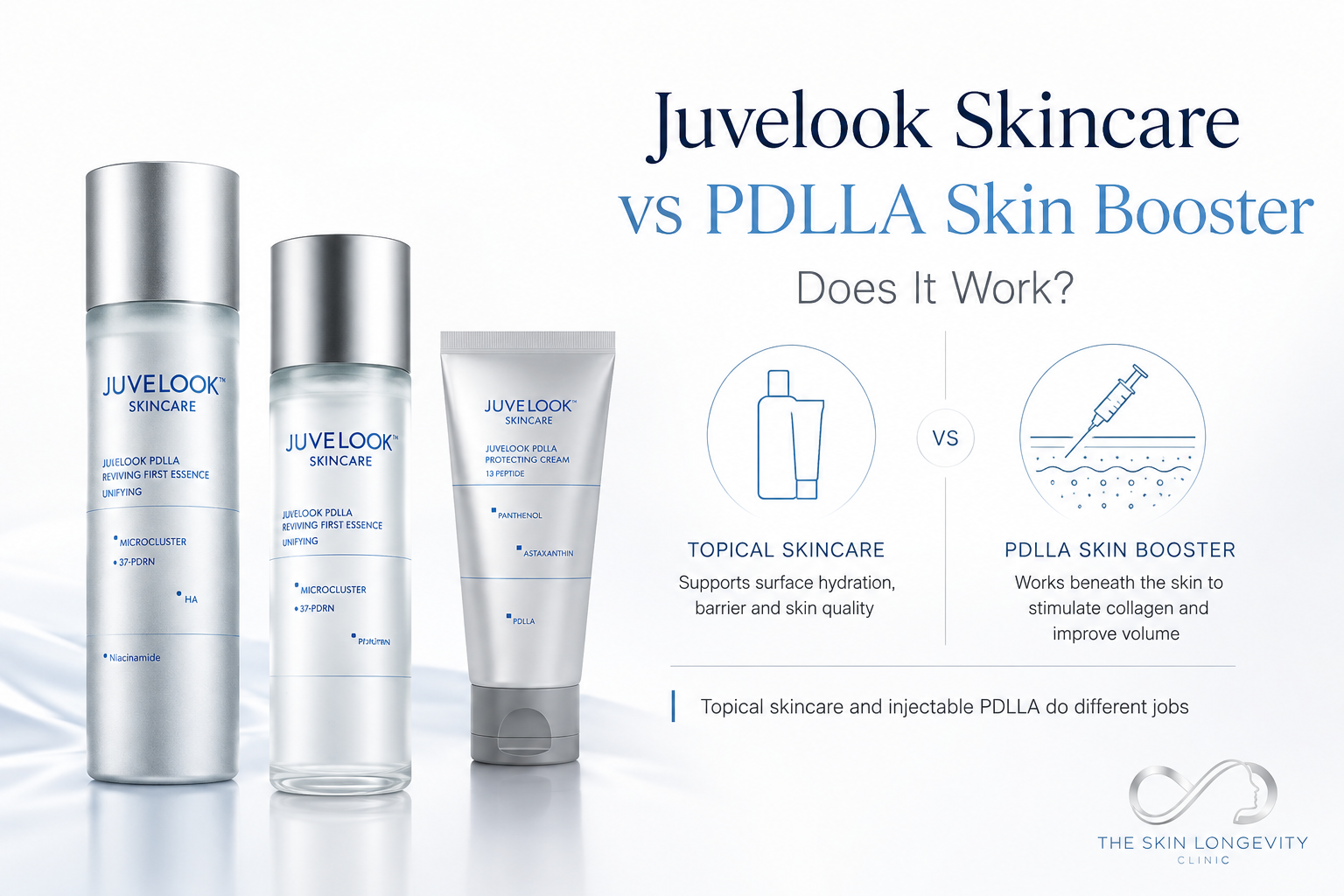
Juvelook skincare and an injectable PDLLA skin booster share an ingredient story, but they do not deliver PDLLA in the same way. The skincare range applies PDLLA within an essence, ampoule, mask or cream, while a medical PDLLA skin booster places biodegradable microparticles directly into the dermis.
Juvelook skincare can provide hydration, exfoliation, barrier support and temporary surface plumping through its complete formulations. Current evidence does not show that applying topical PDLLA to intact skin reproduces the collagen stimulation achieved by an injectable PDLLA skin booster.
For the injectable options themselves, see the guide to skin booster injections in Singapore.
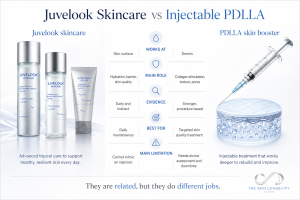
Juvelook skincare versus injectable PDLLA skin booster at a glance
Juvelook skincare VS PDLLA skin booster
| Feature | Juvelook skincare | Injectable PDLLA skin booster |
|---|---|---|
| Category | Cosmetic skincare | Doctor administered injectable treatment |
| Delivery | Applied to the skin surface | Placed within the dermis |
| Main components | PDLLA plus peptides, acids, humectants and barrier ingredients | PDLLA microparticles with non cross linked hyaluronic acid |
| Expected early effect | Hydration, smoothness and brightness | Hydration, swelling and gradual skin quality improvement |
| Collagen evidence | Direct evidence for the current retail range has not been established | Small human studies support collagen and skin quality changes |
| Downtime | Usually none, although irritation can occur | Temporary redness, swelling, bruising and injection bumps |
| Best suited to | Daily cosmetic maintenance | Selected texture, pore, fine line and firmness concerns |
| Main limitation | Dermal delivery remains uncertain | Technique sensitive and unable to correct every structural concern |
What is Juvelook skincare?
Juvelook skincare is a current Korean cosmetic range built around a branded topical PDLLA ingredient. As of August 2026, retail listings include a refining essence, collagen ampoule, collagen mask, collagen cream and advanced collagen cream, with the mask sold in different pack sizes.
The products contain several established cosmetic ingredients in addition to PDLLA. This is important because visible hydration, brightness or smoothness can come from niacinamide, hyaluronic acid, hydrolysed collagen, acids, ceramides, panthenol, adenosine and the occlusive effect of a cream or sheet mask.
Juvelook skincare at a glance
| Current product | Main formulation features in current listings | How to interpret it |
|---|---|---|
| PDLLA Refining First Essence | PDLLA, a multi acid exfoliating complex, peptide complex, niacinamide, sodium hyaluronate, centella and panthenol | Smoother texture can result from exfoliation and hydration as well as the PDLLA concept |
| PDLLA Collagen Ampoule | Current listing states 10 mg PDLLA with hydrolysed collagen, sodium hyaluronate, adenosine and niacinamide | Plumping and glow are likely influenced by humectants and supporting ingredients |
| PDLLA Collagen Mask | Current listing states 5 mg PDLLA per sheet with hydrolysed collagen, sodium hyaluronate, niacinamide, panthenol and allantoin | Immediate improvement is likely to reflect hydration and sheet mask occlusion |
| PDLLA Collagen Cream | PDLLA, ceramide NP, hydrolysed collagen, niacinamide and adenosine | The clearest role is moisturising and barrier support |
| PDLLA Advanced Collagen Cream | PDLLA, ceramide NP, centella, panthenol, hydrolysed collagen, niacinamide and adenosine | Better suited to dry or stressed skin when the complete formula is tolerated |
The formulation details above were checked against current StyleKorean listings in August 2026. Retail descriptions contain manufacturer led claims, and they should not be treated as independent evidence that topical PDLLA stimulates dermal collagen.
What is the difference between topical and injectable PDLLA? Topical skincare mainly acts at the skin surface, while a doctor-administered PDLLA treatment bypasses the skin barrier and places the material at a selected dermal depth. The delivery route changes the expected effect, evidence and risks.
What is an injectable PDLLA skin booster?
PDLLA stands for poly D,L lactic acid. In an injectable PDLLA skin booster, the microparticles are placed within the skin, where they produce a controlled tissue response that activates fibroblasts and supports gradual collagen formation before the polymer biodegrades1.
The non cross linked hyaluronic acid component provides earlier hydration, while the PDLLA component works over a longer period. The treatment is therefore used mainly for skin quality, pores, early fine lines, texture and mild loss of firmness rather than for major facial reshaping.
For the complete treatment overview, read PDLLA Skin Boosters in Singapore and How PDLLA and Hyaluronic Acid Work Together.
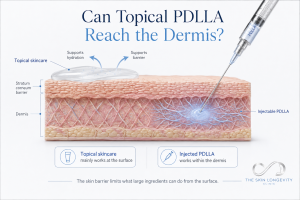
Can topical PDLLA reach the dermis? The stratum corneum limits the passive penetration of large polymers and particles. Current evidence does not show that ordinary daily application of Juvelook skincare reproduces the controlled dermal delivery of an injectable PDLLA skin booster.
Can topical PDLLA reach the dermis?
Intact skin is an effective physical barrier. The widely cited 500 Dalton principle states that passive penetration decreases sharply as molecules become larger, while PDLLA used in aesthetic medicine is a polymer formed into particles rather than a small soluble skincare molecule2.
Some Juvelook skincare products use a proprietary peptide and spicule delivery concept called Peptiscule. Sponge and silica spicules can increase the penetration of selected ingredients in experimental systems by creating temporary pathways in the upper skin, but this does not establish that topical PDLLA reaches the dermis in the same amount, depth or distribution as an injection3,4.
Independent peer reviewed studies on the specific Peptiscule and topical Juvelook skincare system remain unavailable. Claims about deep delivery should therefore be interpreted as product claims rather than proof of injectable level collagen stimulation.
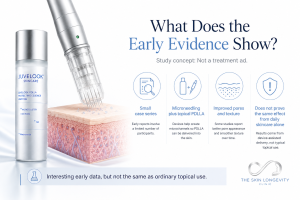
What does the early topical PDLLA evidence show? A small study combining microneedling with topical application reported improvements in pores and texture. The treatment included device-created microchannels, so its findings do not prove that daily PDLLA skincare used on intact skin produces the same result.
PDLLA particles are far too large to pass through intact skin, so topical PDLLA cannot reach the dermis where collagen is made.
What about microneedling with topical PDLLA?
A 2025 case series studied 15 patients with enlarged pores who received three sessions of 0.5 mm microneedling followed by topical application of 1 mL of injectable PDLLA solution. Pore scores improved from an average of six to three at 12 weeks, and the improvement was maintained to 22 weeks5.
The study is interesting but cannot be used as proof that daily Juvelook skincare produces the same result. It had no untreated control group, involved only 15 patients, combined PDLLA with a procedure that independently stimulates collagen and used an injectable PDLLA preparation rather than the retail essence, mask or cream.
What does the injectable PDLLA skin booster evidence show?
A preliminary study involving 16 patients used two or three injectable PDLLA and non cross linked hyaluronic acid sessions at four week intervals. Clinical imaging and histology showed improvements in several skin ageing measures, together with increased collagen and elastic fibres, but the study was small and lacked a control group6.
A separate multicentre randomised study followed patients for 52 weeks and found injectable PDLLA effective for nasolabial fold correction compared with hyaluronic acid. That study supports injectable PDLLA as a biostimulatory medical material, although fold correction is a different indication from daily topical skincare77.
The evidence for injectable PDLLA is therefore stronger than the evidence for topical PDLLA. Even so, many injectable studies remain small, product specific and technique dependent.
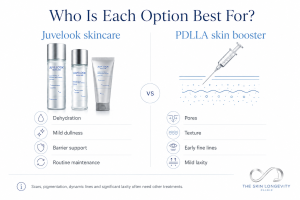
Who is each option best suited to? Juvelook skincare can suit people seeking hydration, mild brightening and routine maintenance. Injectable PDLLA can be considered for selected pores, uneven texture, early fine lines and mild loss of firmness after a doctor evaluates the skin and treatment goals.
PDLLA skin booster vs Juvelook skincare: Which option is more effective?
Effectiveness of PDLLA skin booster VS Juvelook skin care depends on the result being sought. Juvelook skincare can be considered for cosmetic hydration, a smoother surface and a supportive routine, while an injectable PDLLA skin booster is more appropriate when the aim is gradual change within the dermis.
The two should not be treated as substitutes. A topical cream cannot be expected to create the same dermal concentration or controlled distribution as a doctor administered injection.
How should Juvelook skincare be used?
Introduce one product at a time rather than beginning the complete range together. This makes it easier to identify whether improvement or irritation comes from the essence, ampoule, mask or cream.
The refining essence contains several exfoliating acids, so sensitive skin can begin two or three evenings each week rather than daily. The ampoule is applied after a toner or essence, while either cream is used as the final moisturising step. Daily sunscreen remains essential when acids, pigmentation or photoageing are concerns.
Spicule containing skincare can produce prickling, redness and barrier disruption when overused. Avoid combining it immediately with strong retinoids, exfoliating acids or recently treated skin unless a doctor has advised that exact routine.
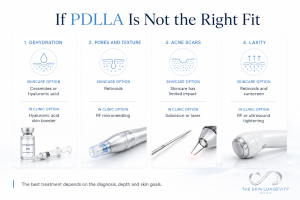
What are the alternatives when PDLLA is not the right fit? Dehydration can be addressed with ceramides, hyaluronic acid skincare or a hydrating skin booster. Pores and texture can require retinoids or RF microneedling, acne scars can require subcision or laser, and significant laxity needs a separate tightening assessment.
Side effects and who should delay use of Juvelook skicare and PDLLA skin boosters
Topical products can cause burning, dryness, redness, itching or contact dermatitis. People with active eczema, a rosacea flare, broken skin or a recently disrupted barrier should stabilise the skin before using exfoliating or spicule based products.
Injectable PDLLA skin boosters commonly causes temporary swelling, bruising, tenderness and visible injection points. Less common complications include persistent nodules, delayed inflammation and granulomatous reactions, with preparation, dilution, depth and distribution affecting risk8,9.
Elective PDLLA injection is generally deferred during pregnancy and breastfeeding, active infection and significant skin inflammation. A history of keloids or autoimmune disease also requires individual medical assessment.
Alternatives to Juvelook skincare or PDLLA skin boosters
Alternatives to PDLLA skin boosters
| Main concern | Skincare alternatives | In clinic options |
|---|---|---|
| Dehydration | Glycerin, hyaluronic acid, ceramides and niacinamide | Hyaluronic Acid Skin Booster |
| Early photoageing | Sunscreen, retinoids, vitamin C and peptides | RF microneedling or fractional resurfacing |
| Enlarged pores and texture | Retinoids, niacinamide and cautious acid use | RF microneedling, chemical peels or fractional laser |
| Indented acne scars | Skincare cannot restore deep dermal loss | Subcision, RF microneedling, fractional laser or selected injectable support |
| Skin laxity | Sunscreen and retinoids support long term skin quality | Radiofrequency tightening, ultrasound, collagen biostimulators or surgery |
| Pigmentation | Sunscreen, vitamin C, azelaic acid and retinoids | Pigment specific laser or chemical peel after diagnosis |
| Shelby | Dunlap | shelby.dunlap@gmail.com |
For acne scars, read PDLLA for Acne Scars in Singapore. For a broader injectable comparison, see PDLLA vs PLLA vs ECM Skin Boosters.
Dr Rachel Ho’s clinical perspective on Juvelook skincare VS PDLLA skin care
Juvelook skincare is most fairly judged categorically as skincare. Its products can hydrate, exfoliate, moisturise and improve the feel of the surface, but current evidence does not show that topical PDLLA recreates an injectable collagen biostimulator or skin boosters.
Injectable PDLLA skin booster has a more direct biological rationale because the particles are placed within the dermis. I still select it according to the diagnosis, since pores, scars, muscle driven wrinkles, volume loss and significant laxity require different treatments.
PDLLA skin booster assessment at The Skin Longevity Clinic
The Skin Longevity Clinic assesses skin quality, active inflammation, facial anatomy, pigment risk and the expected degree of improvement before recommending a PDLLA skin booster. The clinic is located at Scotts Medical Center, Pacific Plaza, near Orchard Road in Singapore.
Patients who are unsure whether they need skincare, an injectable or another procedure can begin with a Skin Longevity Assessment.
Frequently asked questions
Does topical PDLLA stimulate collagen?
Direct independent human evidence for the current Juvelook skincare products has not been established. A small microneedling case series supports device assisted delivery of an injectable PDLLA solution, but it does not prove that ordinary daily application reaches the dermis.
Can Juvelook skincare replace a PDLLA skin booster?
The two perform at different depths and should not be viewed as equivalents. Skincare can support hydration and surface quality, while injection is used when a dermal collagen response is the clinical goal.
Can Juvelook skincare improve acne scars?
Hydration and exfoliation can make the surface look temporarily smoother. Rolling, boxcar and ice pick scars involve dermal structure and usually require scar specific procedures.
Can Juvelook skincare be used after injections or laser?
Use only the aftercare recommended by the treating doctor. Acids, spicules and fragranced products can irritate recently treated skin even when the product is marketed for recovery.
How long do injectable PDLLA results take?
Early hydration can appear within days, while collagen related changes develop over several weeks and continue to refine over months. The number of sessions and maintenance plan depend on the product, treatment area and individual response.
References
- Lee KWA, Lee AWK, Chan KW, Yi KH. Poly D,L Lactic Acid Application in Dermatology: A Literature Review. Polymers. 2024.
- Bos JD, Meinardi MMHM. The 500 Dalton Rule for the Skin Penetration of Chemical Compounds and Drugs. Experimental Dermatology. 2000. PMID 10839713.
- Tansathien K, et al. Development of Sponge Microspicule Cream as a Transdermal Delivery System. 2019. PMID 31257296.
- Zhang S, et al. Skin Delivery of Hydrophilic Biomacromolecules Using Sponge Spicules. 2017. PMID 28763230.
- Wan J, Seo SB, Yoon SE, Yi KH. The Efficacy of Combined Microneedling and Topical PDLLA for Facial Pore Reduction and Skin Texture Improvement. Plastic and Reconstructive Surgery Global Open. 2025. PMID 40469551.
- Seo SB, Park H, Jo JY, Ryu HJ. Skin Rejuvenation Effect of Combined PDLLA and Non Cross Linked Hyaluronic Acid. Journal of Cosmetic Dermatology. 2024. PMID 37969055.
- Ting W, et al. A Randomized Study Comparing Injectable PDLLA and Hyaluronic Acid for Nasolabial Fold Augmentation. Aesthetic Surgery Journal. 2024. PMID 39178357.
- Magacho Vieira FN, et al. Consensus Recommendations for the Reconstitution and Administration of Injectable PDLLA. 2024.
- Seo SB, et al. Energy Based Device Management of Nodular Reaction Following PDLLA Injection. 2024.