

31 Jul PDLLA vs PLLA vs ECM Skin Boosters: How Collagen-Stimulating Treatments Compare
By Dr Rachel Ho | Aesthetic Doctor, Founder, The Skin Longevity Clinic, Singapore
Ask about a collagen skin booster in Singapore and you will quickly meet a confusing alphabet soup: PDLLA, PLLA, ECM, each promising firmer, better-quality skin. They are related ideas, but they are not interchangeable, and they do not share the same safety profile. This guide compares the three main families of collagen-stimulating skin booster, explains the real differences, and sets out how an aesthetic doctor decides which one suits a particular patient.
For the foundational explanation of PDLLA itself, see our complete guide to PDLLA skin boosters in Singapore. Here, the focus is comparison to help you choose the skin booster that best suits your concerns and skin type.
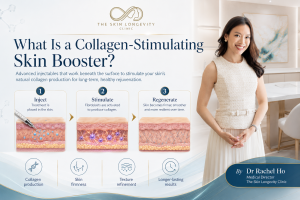
How collagen-stimulating skin boosters work: these treatments aim to stimulate collagen production over time rather than simply add hydration.
What a Collagen-Stimulating Skin Booster Actually Is
Traditional skin boosters, based on hyaluronic acid, work mainly by hydrating the skin. A collagen-stimulating skin booster does something more ambitious. Rather than adding hydration alone, it prompts the skin to regenerate its own structural proteins. These treatments are often called biostimulators, because the visible result is built by the patient’s own cells over weeks and months. The trade-off is patience: biostimulators reward a course and a realistic timeline rather than offering an instant change.
PDLLA, PLLA and ECM boosters all aim at better collagen and a healthier dermal matrix, but they reach it by different routes, and they differ in how settled their evidence and safety records are.
The growing interest in this category reflects a wider change in what patients want. Where the focus was once on filling lines and restoring volume, more patients now ask for better skin quality: firmness, smoothness and a healthy, even surface. Collagen-stimulating skin boosters answer that demand directly, which is why understanding the differences between them has become genuinely useful rather than merely academic.
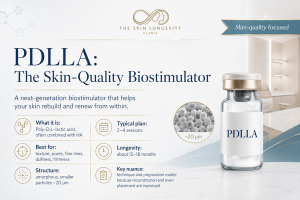
PDLLA skin booster in Singapore: often chosen for skin quality concerns such as texture, pores, fine lines and firmness.
PDLLA: The Skin-Quality Biostimulator
PDLLA, or poly-D,L-lactic acid, is an amorphous polymer, a racemic mixture of D- and L-lactic acid units. That randomised, low-crystallinity structure gives it distinctive handling: its microparticles are comparatively small, with a median size of around 20 micrometres, and they tend to form aggregates after dispersion. In skin-booster form it is frequently combined with hyaluronic acid, as in the widely used product PDLLA-HA skin booster, which adds immediate light hydration while the PDLLA stimulates collagen in the background.
The clinical emphasis of PDLLA is skin quality: firmness, texture, fine lines, enlarged pores and a general improvement in skin condition, alongside moderate correction of folds. A 2024 review of PDLLA in dermatology by Lee and colleagues, in the journal Polymers, summarised studies reporting improved elasticity, reduced wrinkles and tissue regeneration, and a 2024 randomised, evaluator-blinded trial by Ting and colleagues, in Aesthetic Surgery Journal, found injectable PDLLA non-inferior to hyaluronic acid for nasolabial-fold correction, with improvement sustained over 52 weeks. PDLLA is typically delivered over two to four sessions, with results commonly lasting around twelve to eighteen months. Our guide to the PDLLA-HA skin booster explains the formulation in more depth.
One honest nuance follows from PDLLA’s amorphous structure. Because its particles aggregate and deform more readily than crystalline ones, complete reconstitution and even placement are important; comparative work, including a 2026 study by Jang and colleagues in the journal In Vivo, has linked PDLLA’s aggregation tendency to a potentially heightened inflammatory response and less uniform remodelling than PLLA. This does not make PDLLA an inferior treatment; it makes technique and product preparation genuinely important, which is a theme across every biostimulator.
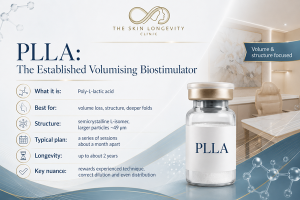
PLLA skin booster in Singapore: a more established collagen biostimulator often used when volume loss and structural support are priorities.
PLLA: The Established Volumising Biostimulator
PLLA, or poly-L-lactic acid, is the longer-established biostimulator, best known under the brand name Sculptra. It is an optically pure, semicrystalline L-stereoisomer, and its particles are larger, with a median size of around 49 micrometres. That more ordered structure means PLLA degrades more slowly, redisperses more cleanly and tends to produce firmer, more homogeneous collagen remodelling. PLLA has a long regulatory history; it was first approved for facial volume loss associated with HIV and subsequently for cosmetic use.
A 2025 review by Haykal and colleagues, in Aesthetic Surgery Journal, describes how PLLA has evolved over a decade from a volumising filler into a foundational regenerative biostimulator, acting through a measured cascade of macrophage and fibroblast activation that drives sustained collagen production. PLLA is often chosen where the goal is to restore lost facial volume or soften deeper folds across broad areas such as the cheeks or temples. It usually requires a series of sessions about a month apart, and its results can persist for up to roughly two years. In short, PLLA leans towards structure and volume; PDLLA leans towards skin quality.
Because PLLA degrades slowly and acts gradually, it is a treatment that particularly rewards an experienced injector and a conservative hand. Correct reconstitution, the right dilution and an even, well-planned distribution all matter, and over-correction is harder to address than with a hyaluronic acid filler. None of this makes PLLA a treatment to avoid; it makes it a treatment to have done well, a principle that applies across every biostimulator in this comparison.
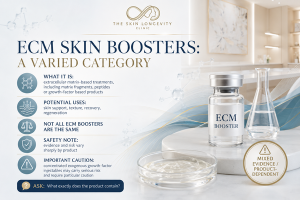
ECM skin boosters in Singapore: a broad category with product-dependent differences in composition, evidence and safety.
ECM Skin Boosters: A Varied Category
Extracellular matrix, or ECM, skin boosters are the newest and the most varied of the three. The extracellular matrix is the supportive mesh of collagen, elastin, hyaluronic acid and other proteins that gives skin its structure. ECM boosters are not a single product but a category that includes decellularised, skin-derived matrix, matrikine peptides, which are short bioactive peptides released when matrix proteins fragment, and preparations based on growth factors. Rather than only asking the skin to build more matrix, they aim to modulate the dermal matrix directly.
The underlying science is genuinely interesting. Researchers such as Widgerow and colleagues, writing in the Journal of Drugs in Dermatology, have explored ECM modulation as a route to skin rejuvenation, and a randomised controlled trial by Kadoya and colleagues, in the same journal, reported that a fibroblast-derived growth-factor preparation upregulated extracellular-matrix genes and improved fine lines. Decellularised matrix and matrikine-peptide products remain an active and promising area of research.
The serious caveat concerns injectable products containing concentrated exogenous growth factors. Case series in the plastic surgery literature, including reports by Long and colleagues and by Xiong and colleagues in Aesthetic Plastic Surgery, describe uncontrollable soft-tissue overgrowth following such injections, which can be difficult to treat and prone to recurrence; one set of authors concluded that injecting exogenous growth factors into soft tissue should be avoided. ECM boosters therefore range from promising to genuinely risky depending entirely on what the product contains. Anyone considering one should ask precisely what is in it, and a cautious clinic will treat concentrated growth-factor injectables very differently from established biostimulators.
PDLLA vs PLLA vs ECM Skin Boosters
| Feature | PDLLA | PLLA | ECM Booster |
|---|---|---|---|
| Core material | Amorphous poly-D,L-lactic acid, often with HA | Semicrystalline poly-L-lactic acid | Matrix, peptides or growth factors |
| Particle size (median) | Smaller, around 20 micrometres | Larger, around 49 micrometres | Not particle-based |
| Main action | Collagen biostimulation, skin quality | Collagen biostimulation, volume and structure | Direct modulation of the dermal matrix |
| Best suited to | Texture, pores, fine lines, moderate folds | Volume loss, structural restoration, broad areas | Matrix support (varies sharply by product) |
| Typical longevity | About 12 – 18 months | Up to about 2 years | Varies by product |
| Safety / evidence | Established; technique-sensitive | Long-established; technique-sensitive | Mixed; growth-factor injectables carry real risk |
PDLLA vs PLLA vs ECM: Side-by-Side
The table above summarises the practical differences. It is a general guide; the right choice for any individual depends on a clinical assessment.
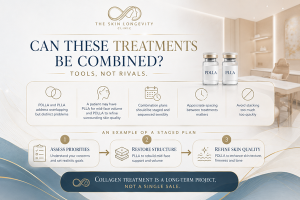
Can PDLLA and PLLA be combined? In selected patients, a staged plan may use different collagen stimulators for different goals.
Can These Treatments Be Combined?
Patients often assume they must pick one collagen skin booster and commit to it. In practice, PDLLA and PLLA address overlapping but distinct problems, and an experienced doctor may use more than one over time. A patient might, for example, have PLLA to restore lost volume in the mid-face and a PDLLA skin booster to refine the quality and texture of the surrounding skin. The two are not in competition; they are doing different jobs.
What matters is that any combination is planned and sequenced sensibly, with appropriate spacing between treatments and a clear order of priority. Combining biostimulators casually, or stacking too much in a short period, is not good practice. A considered, staged plan, often delivered over months, is the hallmark of a clinic treating collagen as a long-term project rather than a single sale.
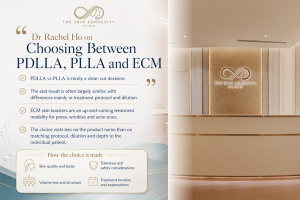
Dr Rachel Ho on Choosing Between PDLLA, PLLA and ECM Skin Boosters
Asked how she chooses between the two lactic-acid biostimulators, Dr Rachel Ho is candid that it is rarely a clear-cut decision. PDLLA versus PLLA is a genuinely difficult call, she says: there are many technical differences between the two products, but in her experience the end result is largely similar, with only minor nuances in treatment protocol and dilution.
On the newer category she is optimistic. ECM skin boosters, in her view, are an up-and-coming treatment modality that performs excellently for pores, wrinkles and acne scars. The practical conclusion Dr Ho draws is that the choice rests less on the product name than on the doctor: on matching protocol, dilution and depth to the individual patient.
How to Choose the Right Collagen Skin Booster
The most useful question is not “which is best?” but “which is best for this concern, in this skin?” As a broad guide, PDLLA tends to suit patients whose main issue is skin quality: rough texture, enlarged pores, early lines, dullness and a loss of firmness, especially those who want a skin-led rather than a volumising result. Our article on PDLLA for fine lines and dull skin explores that profile further.
PLLA tends to suit patients whose face has lost volume and where restoring structure across larger areas is the priority. ECM boosters are best approached selectively and with a clear understanding of what a given product contains, given the safety differences within that category. In practice, these treatments are tools rather than rivals, and the genuine value of an experienced doctor lies in matching the tool to the patient.
At The Skin Longevity Clinic, the choice between collagen skin boosters follows an individual assessment rather than a fixed package, consistent with Dr Rachel Ho’s skin longevity philosophy. To find out which collagen-stimulating skin booster suits your skin, you are welcome to arrange a consultation. You may also find our PDLLA skin booster FAQ helpful for the practical questions on sessions and recovery.
Continue Reading: More From Our PDLLA Skin Booster Series
These guides form one connected series. The articles below have already been published, and you may find them useful alongside this one: