

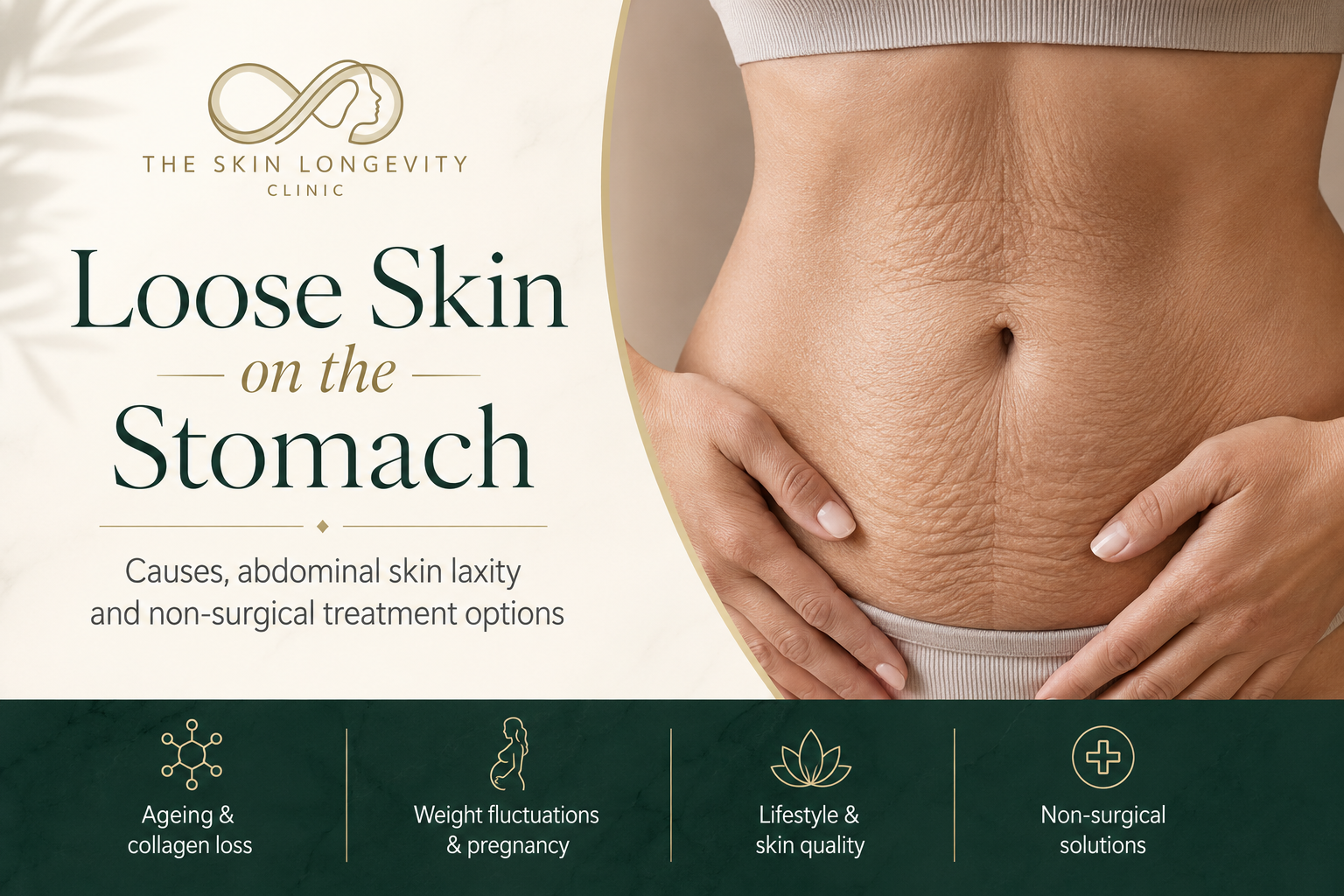
14 Jul Loose Skin on the Stomach: Causes, Abdominal Skin Laxity and Non-Surgical Treatment Options
By Dr Rachel Ho | Aesthetic Doctor, Founder, The Skin Longevity Clinic, Singapore
Loose Skin on the Stomach: Causes, Abdominal Skin Laxity and Non-Surgical Treatment Options
Loose skin on the stomach is one of the most common reasons people in Singapore look at non-surgical body treatments. It can be the visible aftermath of weight loss, the soft change that lingers after pregnancy, or the gradual reflection of collagen loss as skin ages. If you are trying to understand what is actually causing loose abdominal skin and what your treatment options realistically are, this guide is the place to start. It is the broad reference for our cluster of XERF and skin tightening articles, and it is written to help you decide whether a non-surgical option such as RF skin tightening or XERF makes sense for your skin, or whether something else is more appropriate.
At The Skin Longevity Clinic, abdominal skin laxity is approached the same way as facial laxity: through a doctor-led assessment that looks at the cause of the change, not just the surface appearance. This guide explains the biology, the treatment options and the honest limits of non-surgical abdominal skin tightening. For the clinic’s dedicated XERF page, see XERF in Singapore.
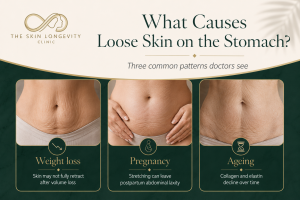
The three common causes of loose abdominal skin are weight loss, pregnancy and ageing related collagen and elastin decline.
What Causes Loose Skin on the Stomach?
Loose skin on the stomach is the result of dermal collagen and elastin not fully retracting after the skin has been stretched, or losing volume and structure with age. Skin is a layered organ — the epidermis on the outside, the dermis underneath, and the deeper subcutaneous and fascial structures below that. The dermis is the layer that gives skin its firmness, and it depends on a network of collagen and elastin fibres. When that network is stretched repeatedly, lost more quickly than it can be replaced, or damaged by ultraviolet exposure and inflammation, the skin no longer snaps back.
Three patterns explain most cases of loose abdominal skin. The first is post-weight-loss laxity, where significant weight change leaves the skin without the underlying volume it was supporting. The second is post-pregnancy laxity, where rapid expansion of the abdomen stretches the dermis and abdominal wall during gestation. The third is age-related abdominal skin laxity, where the slow decline in collagen production from the mid-twenties onwards becomes more visible from the forties.
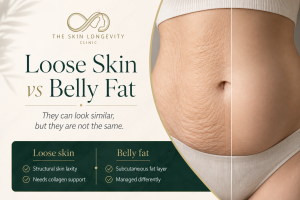
Loose abdominal skin and belly fat can look similar, but they are different concerns that require different treatment plans.
Loose Skin Is Not the Same as Belly Fat
This distinction matters more than any other when thinking about treatment. Stomach fat sits beneath the skin and can be addressed by diet, exercise and, in some cases, body contouring treatments. Loose abdominal skin is a structural problem in the skin itself, and no amount of weight loss or exercise will rebuild a dermal collagen network that has been depleted.
A practical way to tell the difference is to lie down. If the stomach flattens and a soft layer of tissue still sits above the muscle, much of that is probably fat. If the skin lies loose and crepey even with no weight or pressure pushing it out, you are looking at skin laxity. Most patients have a combination of both.
Abdominal Skin Laxity: The Clinical Picture
Abdominal skin laxity is the medical description of skin on the stomach that has lost its firmness and elastic recoil. Mild laxity might show as slight crepiness in the lower abdomen. Moderate laxity may include visible looseness when sitting or bending. Severe laxity describes skin that hangs in folds even at rest, often after substantial weight loss or following multiple pregnancies. The clinical picture matters because mild-to-moderate skin laxity is the range where non-surgical treatment is genuinely useful, while severe laxity usually points to a surgical opinion.
Why Weight Changes, Pregnancy and Ageing Loosen Abdominal Skin
After weight loss, the dermis has stretched to accommodate a larger volume. When the volume disappears, the dermal architecture does not always retract proportionally. Younger skin with more elastin tends to recover better; older skin or skin that has been stretched for years often does not.
During pregnancy, the abdomen expands rapidly. The dermis is stretched, the rectus abdominis muscles can separate (a condition called diastasis recti) and connective tissue is loaded in ways that take time to recover. Some women see their abdominal skin firm up within months of delivery, while others find that the postpartum laxity remains.
With ageing, skin loses roughly one percent of its collagen each year from the mid-twenties onwards. The decline becomes visible through the forties and beyond, and for women it accelerates around menopause when oestrogen-driven collagen support drops. Cumulative sun exposure adds to the picture, which in Singapore is a real factor given year-round ultraviolet exposure. The clinic’s page on sagging skin and facial laxity explains the underlying biology in more detail.
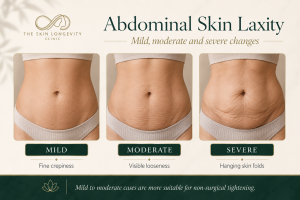
Mild to moderate abdominal skin laxity is more suitable for non surgical skin tightening, while severe laxity may need surgical assessment.
How Collagen and Elastin Loss Show Up on the Stomach
Loose abdominal skin almost always reflects loss of dermal collagen and elastin support. Visually, the surface may look crepey or thin. To the touch, the skin may feel softer and less elastic than firmer areas of the body. The change often starts subtly, then becomes more noticeable as you move, sit or wear closer-fitting clothes.
Non-Surgical Treatment Options for Loose Abdominal Skin
For mild to moderate abdominal skin laxity, several non-surgical treatments are used. They differ in how they deliver energy and which tissue layer they act on.
Radiofrequency (RF) skin tightening uses radiofrequency energy to heat the dermis, supporting controlled collagen contraction and the formation of new collagen over time. RF skin tightening for the abdomen, including XERF, is non-invasive, does not target pigment and tends to be a reasonable option for patients with mild to moderate abdominal laxity.
Microfocused ultrasound (HIFU) uses focused sound waves to produce small, precise heating points at set depths, often in the deeper support layers. It is more often used on the face and neck, but body protocols exist.
RF microneedling combines fine needles with radiofrequency energy delivered through them, producing tightening alongside texture improvement. It is more invasive than surface RF, involves some downtime, and is sometimes used for stretch-mark-prone skin.
Body contouring treatments such as cryolipolysis act on fat rather than skin, and are not skin-tightening treatments. They are mentioned here because they are often confused with skin tightening.
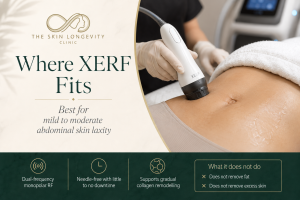
XERF may support gradual collagen remodelling in selected patients with mild to moderate abdominal skin laxity.
Where XERF Fits for Mild-to-Moderate Abdominal Skin Laxity
XERF is a non-invasive dual-frequency monopolar radiofrequency treatment originally developed for skin tightening and collagen support. Its defining feature is the dual-frequency design — 6.78 MHz for the more superficial layers and 2 MHz for the deeper tissue — which allows energy to be delivered across more than one depth. Cynosure describes XERF as a needle-free, no-numbing, no-downtime RF skin tightening option positioned around “structural skin tightening”. For abdominal skin in the mild-to-moderate laxity range, XERF can be used to support collagen remodelling and a gradual improvement in firmness and texture, rather than to remove fat or excess skin.
It is important to be clear about what XERF is not. It is not a fat-reduction treatment, so it will not reduce the size of the abdomen. It is not surgery, so it does not remove skin. And it is not a substitute for an abdominoplasty when laxity is severe.
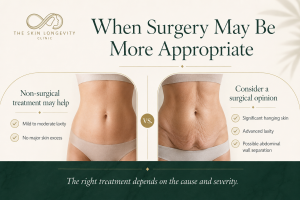
Non surgical treatment may help mild to moderate laxity, but significant hanging skin or abdominal wall separation may require a surgical opinion.
When Surgery May Be More Appropriate
When abdominal skin laxity is advanced, when there is significant skin excess that hangs in folds, or when there is also abdominal wall separation (diastasis recti) that needs repair, a surgical opinion is more honest. A tummy tuck (abdominoplasty) physically removes excess skin and tightens the abdominal wall — something no non-invasive device can do. Reputable cosmetic-surgery guidance notes that non-surgical tightening is not effective for more advanced sagging after pregnancy or substantial weight loss. The right test of a non-surgical treatment is not whether it is needle-free, but whether the cause and severity of your laxity is in the range where energy-based tightening realistically helps.
What to Expect From Non-Surgical Abdominal Skin Tightening
RF skin tightening of the abdomen, including XERF, is generally well tolerated. The handpiece delivers heat in controlled pulses, and the sensation builds and then eases with each one. There is usually little or no downtime. Results follow the underlying biology: some early firmness from collagen contraction, then a more meaningful change as new collagen forms over weeks to months. A sensible review interval is two months after treatment, when the collagen-driven phase of the result is becoming clearer.
This biology is something Dr Rachel Ho, MBBS, MMed(ENT), Founder and Medical Director of The Skin Longevity Clinic, explains often in consultation. The patient who tends to get the most out of non-surgical abdominal skin tightening is someone with early-to-moderate skin laxity, realistic expectations and an honest sense of whether laxity is the main driver of the visible change. The common misconception she corrects is that non-surgical RF treatments will produce a dramatic, immediate lift; in her experience, it is better understood as collagen support and gradual firmness, with most of the visible change developing over weeks to months.
At The Skin Longevity Clinic, abdominal skin tightening begins with a doctor-led skin longevity assessment that evaluates skin quality, pigmentation, inflammation, collagen support, facial and body structure, treatment history and recovery capacity. The same layered assessment used for facial laxity is applied to the abdomen: we look at whether the visible change is skin laxity, residual fat, abdominal wall changes or a combination, and we recommend XERF only when radiofrequency tightening is the right tool for the job. If you are unsure where to begin, a skin longevity assessment is a sensible first step.
Frequently Asked Questions about XERF abdomen and body tightening
What is the difference between loose skin and belly fat?
Belly fat is the soft tissue that sits beneath the skin, while loose skin is a structural change within the dermis itself. The two can look similar, but they respond to very different treatments — diet and body contouring for fat, and collagen-supporting treatments such as RF skin tightening for skin laxity.
Can RF skin tightening help loose skin on the stomach?
For mild to moderate abdominal skin laxity, RF skin tightening can support collagen remodelling and a gradual improvement in firmness. For more severe laxity, particularly when significant skin excess is present, a surgical opinion is usually more appropriate.
Does XERF remove belly fat?
No. XERF is a skin-tightening treatment, not a fat-reduction treatment. It is designed to support collagen and a gradual change in skin firmness and texture, not to reduce the volume of fat under the skin.
How long does abdominal skin tightening take to show results?
RF skin tightening works in two stages — a small immediate effect from collagen contraction, and a larger gradual effect as new collagen forms over the following weeks and months. Most patients see the more meaningful change at the two-to-three-month mark.
Related XERF and Skin Tightening Guides
For more on the technology behind XERF, see our complete guide to XERF in Singapore. For radiofrequency in general, see RF skin tightening in Singapore. For the full range of skin tightening options across the face and body, see skin tightening in Singapore.
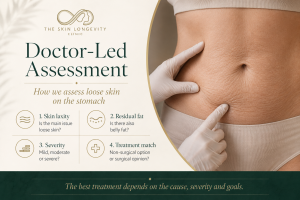
The best treatment for loose skin on the stomach depends on the cause, severity and whether laxity, fat or abdominal wall changes are present.
Loose Skin on the Stomach at The Skin Longevity Clinic
The Skin Longevity Clinic is a doctor-led practice in the Orchard area of Singapore. Loose abdominal skin is approached through the same layered framework the clinic uses for facial laxity: an honest assessment of cause, severity and the realistic match between treatment and result.
If you are considering treatment for loose skin on the stomach, the most useful next step is an assessment rather than a booking. You can contact The Skin Longevity Clinic to arrange a consultation and find out whether XERF, another non-surgical option, or a surgical opinion is the right fit for your skin.