

15 Jul PDLLA for Acne Scars Singapore: An Honest Guide
By Dr Rachel Ho | Aesthetic Doctor, Founder, The Skin Longevity Clinic, Singapore
PDLLA for Acne Scars in Singapore: What Collagen Stimulation Can and Cannot Do
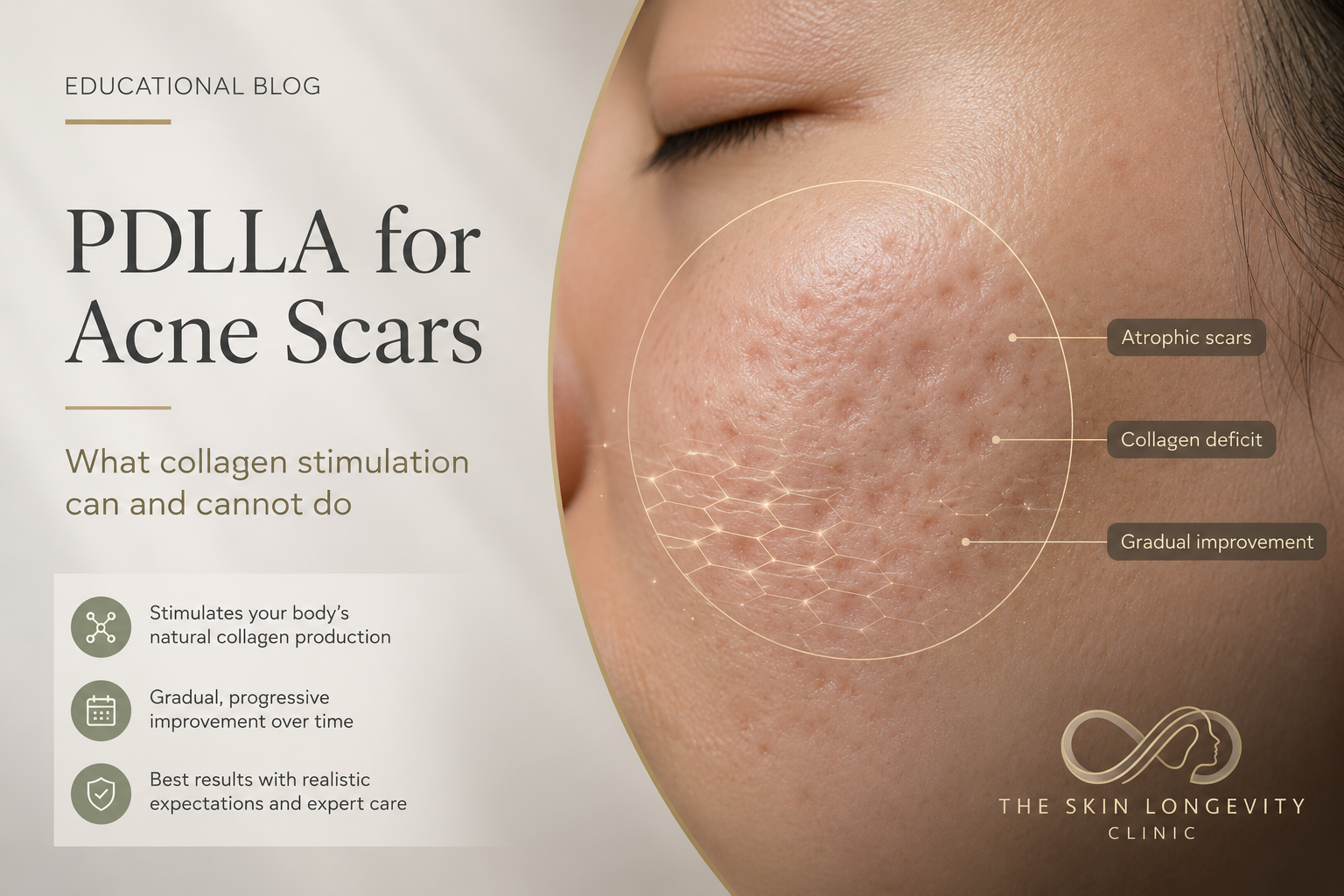
Acne scars are one of the most searched-for concerns in Singapore aesthetic medicine, and PDLLA skin boosters are increasingly mentioned as a treatment for them. There is real substance to that, but also a good deal of overstatement. This guide gives an honest, evidence-based account of what a PDLLA skin booster, can and cannot do for acne scars.
If you are new to the treatment, our complete guide to PDLLA skin boosters covers the fundamentals. Here, the focus is acne scarring specifically.
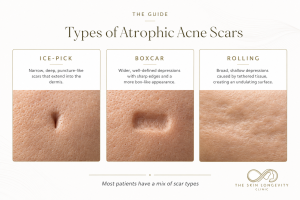
Ice pick, boxcar and rolling acne scars behave differently, which is why acne scar treatment should begin with scar diagnosis.
Understanding Atrophic Acne Scars
Most acne scars that prompt people to seek treatment are atrophic, meaning indented. They form when inflammation from acne damages collagen in the dermis and the skin heals with a deficit rather than a flat surface. Atrophic scars are usually grouped into three types, and the distinction matters because they respond very differently to treatment.
- Ice-pick scars are narrow, deep and steep-sided, like a small puncture extending into the skin.
- Boxcar scars are wider, with relatively defined edges and a flat or shallow base.
- Rolling scars are broad and shallow with sloping edges, often caused by fibrous tethering that pulls the surface down, giving the skin an undulating look.
Most people with acne scarring have a mix of types, alongside general roughness and enlarged-looking pores. That mix is the reason no single treatment, PDLLA included, is a complete answer on its own.
Why Some Acne Leaves Scars
Scarring is not simply a matter of how severe acne was, although severity does raise the risk. When a pore becomes inflamed, the inflammation can extend into the dermis and damage collagen and surrounding tissue. The body then repairs that damage, and the quality of the repair determines whether the skin heals flat or with a defect. When too little collagen is laid down during healing, the result is an atrophic, indented scar.
Several factors increase the likelihood of scarring: deep, inflammatory or cystic acne; acne left untreated for a long time; a genetic tendency to scar; and, importantly, picking or squeezing lesions, which deepens tissue damage. Understanding this helps in two ways. It explains why controlling active acne early is the best scar-prevention strategy, and it reinforces why scar treatment is about rebuilding lost collagen, which is precisely the mechanism a PDLLA skin booster offers.
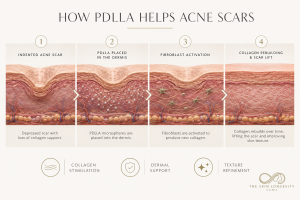
Ice pick, boxcar and rolling acne scars behave differently, which is why acne scar treatment should begin with scar diagnosis.
How PDLLA Helps Acne Scars
Atrophic scars are, at their core, a collagen deficit. A PDLLA skin booster addresses precisely that. By stimulating fibroblasts to produce new collagen in the dermis, PDLLA can gradually build up the tissue beneath a depressed scar, lifting the floor of the scar closer to the surrounding skin and softening its appearance. It also improves the quality and firmness of the skin around the scars, which reduces the shadowing and unevenness that make scarring look worse.
The supporting science is consistent with this. A 2024 review of PDLLA in dermatology by Lee and colleagues, published in the journal Polymers, identified scar remodelling and improved skin texture among PDLLA’s recognised applications, alongside its role in wider tissue regeneration. Innovations in delivery, including needle-free injection systems designed to disperse product evenly through the skin with minimal trauma, have been studied specifically to make treatment of uneven, scarred skin more uniform. The mechanism, in other words, is a genuine fit for the problem. Our guide to how a PDLLA-HA skin booster works explains the cellular detail.
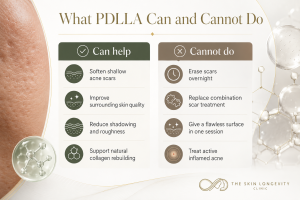
What PDLLA can and cannot do for acne scars including scar softening, skin quality improvement and treatment limitations
What PDLLA Skin Boosters Can and Cannot Do for Acne Scars
Placed correctly, a PDLLA skin booster performs well across the main atrophic scar types. It can improve boxcar and ice-pick scars, and for rolling scars it can be placed in the deep dermis to rebuild the support beneath the depression. The decisive factors are placement and protocol: the depth, the dilution and the combination of treatments are matched to the scars in front of the doctor, which is why a tailored, individualised plan matters more than the product alone.
What PDLLA does not do is work overnight, or work best in isolation. Collagen remodelling is gradual, and the strongest results come from a combined, well-sequenced plan rather than a single session. A realistic goal is meaningful, progressive improvement in the scars and in the quality of the surrounding skin. Any clinic promising a flawless surface from one treatment is overpromising, whatever product it uses.
PDLLA Skin Booster for Acne Scars
PDLLA-and-hyaluronic-acid skin boosters were developed in South Korea, and is often discussed for acne scars in Singapore. It applies the PDLLA biostimulation described above, with the hyaluronic acid component adding early hydration. When patients ask about PDLLA skin boosters for acne scars, they are asking about this collagen-stimulating approach to scar repair, and the same principle holds: results depend on matching depth, dilution and combination to the individual scars, and on patience while new collagen forms.
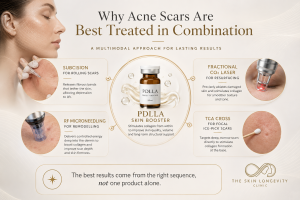
Acne scars often respond best to a combination plan, because different scar types need different treatment depths and mechanisms.
Why Acne Scars Are Best Treated in Combination
Because scar types differ, the most effective scar treatment is usually a combination tailored to the individual. A PDLLA skin booster commonly works best as one component of a wider plan. Depending on the scars present, that plan may also include subcision to release the fibrous tethers under rolling scars, fractional laser or microneedling to resurface and remodel, and focal techniques for individual ice-pick scars.
Sequencing and timing these treatments safely is a clinical skill in itself. The value of an experienced doctor lies less in any single treatment than in assembling the right combination for the scars in front of them.
There is also a logic to the order in which treatments are used. Scar-releasing procedures such as subcision are often best done before or alongside collagen stimulation, so that the freed tissue can be filled in by new collagen rather than re-tethering. A PDLLA skin booster frequently works well as the collagen-building layer of such a plan. This is why a single-treatment promise should prompt caution; thoughtful scar treatment is a sequence, not a product.
A 2026 case series in JPRAS Open described gas subcision combined with PDLLA skin booster as a hybrid mechanical–biologic approach for atrophic acne scars1.
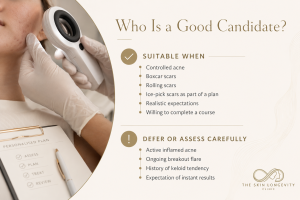
PDLLA acne scar treatment is usually considered when active acne is controlled and the patient is suitable for gradual collagen remodelling.
Who Is a Good Candidate for PDLLA Acne Scar Treatment?
The best candidates for a PDLLA skin booster as part of acne scar treatment are patients whose active acne is well controlled and who understand that improvement is built gradually over a course. Boxcar, ice-pick and rolling scars can all be addressed when the product is placed at the right depth and combined appropriately, so the question at assessment is less which scars rule a patient in or out, and more how the plan should be designed for the scars they have.
Treatment is deferred where acne is still active and inflamed, and assessed with extra care in patients with a history of keloid scarring. As with every biostimulator, suitability is confirmed at an in-person assessment of the actual skin, never assumed from a description.
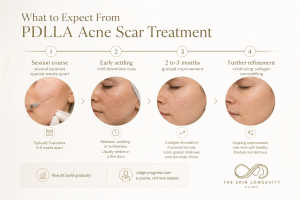
PDLLA acne scar results build gradually over a course, with collagen stimulation becoming more visible over two to three months.
What to Expect From PDLLA Skin Booster Acne Scar Treatment
A course for acne scarring usually involves several PDLLA sessions spaced a few weeks apart, with improvement developing gradually over two to three months and continuing to refine thereafter. Because scar remodelling is slow, patience is essential, and a single session should not be judged as the final result. Our PDLLA skin booster FAQ covers sessions, downtime and timelines, and our cost and side effects guide explains pricing and what to expect afterwards.
One important caution: PDLLA is not injected into actively inflamed or breaking-out skin. Active acne should be brought under control first, both for safety and because treating scars is far more predictable once new scarring is no longer forming.
Managing Expectations Over a Course of PDLLA Skin Boosters
Acne scarring can affect confidence deeply, and that makes honest expectation-setting especially important. Improvement from a PDLLA skin booster is measured in degrees, not in before-and-after transformation. A useful way to track real progress is photography in consistent lighting, because day-to-day mirror checks under variable light can be misleading and often understate genuine change. Most patients find that scars look softer and skin looks better overall, while some texture remains.
It also helps to remember that scar treatment is rarely a single event. A staged plan over months, reviewed as the skin responds, gives both the doctor and the patient the information needed to decide what, if anything, to do next. Patience and a clear plan are as much a part of the treatment as the injections themselves.
The Skin Longevity Clinic’s Acne Scar Protocol
Dr Rachel Ho regards PDLLA as a strong performer across acne-scar types, provided it is placed and combined correctly. In her clinical experience it works well for boxcar and ice-pick scars, and for rolling scars she places it in the deep dermis to rebuild the support beneath the depression.
At The Skin Longevity Clinic it is rarely used alone. Depending on the scars present, PDLLA is combined with subcision, fractional carbon-dioxide laser or microneedle fractional radiofrequency, all sequenced within a tailored, individualised treatment plan. Good improvement, in Dr Ho’s experience, is very achievable on this approach, and it is the individualised protocol, rather than any single product, that delivers it.
A Realistic Path Forward
For the right patient, a PDLLA skin booster can be a valuable part of acne scar treatment, improving texture and softening shallower scars in a natural, collagen-led way. The key is an accurate assessment of which scars are present and an honest plan that may combine more than one treatment. Patients also often notice that the same collagen improvement helps with the enlarged pores and uneven texture that frequently accompany acne-prone skin.
At The Skin Longevity Clinic, acne scar treatment begins with a careful assessment and a candid conversation about what is achievable, consistent with the clinic’s evidence-based approach. To discuss your acne scars, you are welcome to arrange a consultation.
References
- Yi K-H, Rosellini I, Lee S, Lee HE. Gas subcision with PDLLA (Juvelook): Evaluating a hybrid mechanical-biologic approach for atrophic acne scars. JPRAS Open. 2026;51:129–133. PMID 42389218.
Continue Reading: More From Our PDLLA Skin Booster Series
These guides form one connected series. The articles below have already been published, and you may find them useful alongside this one: