

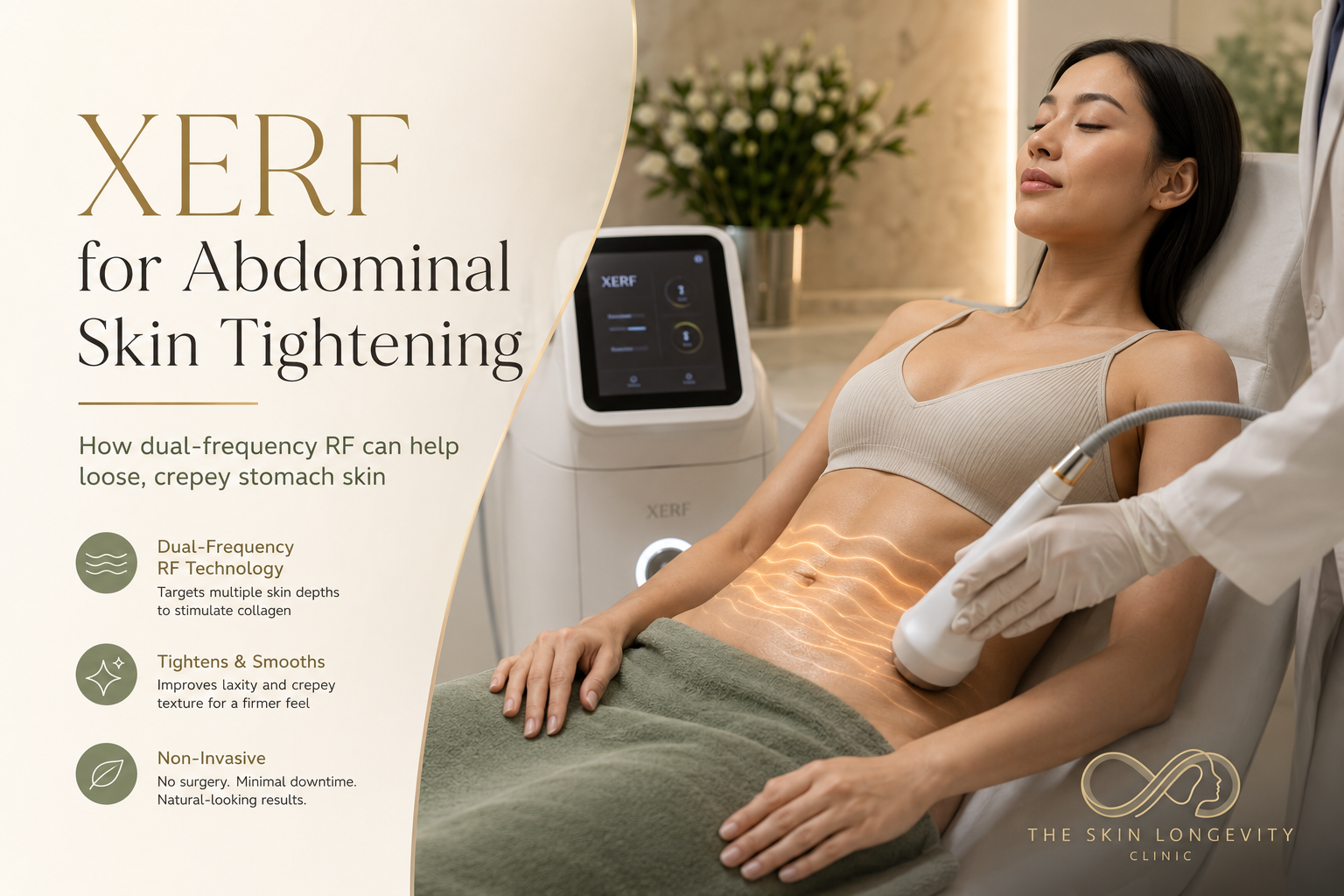
24 Jul XERF for Abdominal Skin Tightening: RF for Loose Skin
By Dr Rachel Ho | Aesthetic Doctor, Founder, The Skin Longevity Clinic, Singapore
XERF for Abdominal Skin Tightening: How Dual-Frequency RF Can Help Loose, Crepey Stomach Skin
XERF has quickly become one of the most discussed non-surgical skin tightening treatments in Singapore, and patients increasingly ask whether it can be used for loose skin on the stomach as well as the face. The short answer is yes — for the right kind of laxity, XERF can be used for abdominal skin tightening, and it does so as a non-invasive radiofrequency treatment without needles, numbing or downtime. This guide explains how XERF works on the abdomen, who it suits, what it can and cannot do, and what to realistically expect from a course of treatment.
For the wider context of what XERF is and how it fits within radiofrequency tightening in general, see our complete guide to XERF in Singapore. For the underlying pathology for abdominal laxity, see our pillar guide to loose skin on the abdomen.
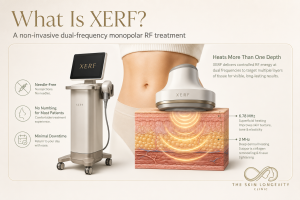
XERF is a non invasive dual frequency monopolar RF treatment that delivers controlled heat to support firmer abdominal skin over time
What Is XERF?
XERF is a non-invasive monopolar radiofrequency skin tightening treatment. Its defining feature is a dual-frequency design — it delivers radiofrequency energy at two frequencies, 6.78 MHz and 2 MHz, which allows controlled heating at more than one depth. The official positioning from Cynosure describes XERF as “structural skin tightening” using needle-free, no-numbing, no-downtime monopolar RF. For abdominal skin, the implication is straightforward: a treatment originally designed for facial tightening can be applied to other zones where the dermis is the layer that needs support.
XERF has also received US FDA approval in August 2025 for skin tightening and revitalizing via soft tissue coagulation.
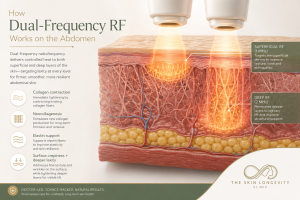
Dual frequency RF allows XERF to deliver controlled heat at more than one depth, helping to support surface crepiness and deeper dermal laxity.
How Dual-Frequency Radiofrequency Works on the Abdomen
Radiofrequency works by passing a high-frequency alternating electrical current through the skin. The tissue’s resistance to the movement of charged particles converts that energy into heat, and it is the heat — not the current itself — that produces the treatment effect. When the dermis is heated to the right range, two things happen. Existing collagen fibres contract slightly, producing a small immediate firming effect. The controlled heat also creates a mild, intentional stress that triggers a wound-healing response. Over the following weeks and months, fibroblasts lay down new collagen and elastin in a process known as neocollagenesis.
For abdominal skin, the dual-frequency design matters because laxity on the stomach is rarely confined to a single depth. The higher 6.78 MHz frequency acts on the more superficial dermal layers, where crepiness and surface laxity show. The lower 2 MHz frequency reaches deeper tissue, where structural support has weakened. Being able to direct energy across more than one layer is a practical advantage when the goal is firmness as well as smoother texture.
What “Structural Skin Tightening” Means in Practice
“Structural skin tightening” is Cynosure’s positioning phrase for XERF. In simple terms, it means heat-based stimulation of the dermal collagen and elastin network with the intention of supporting firmness rather than removing or repositioning tissue. It is a useful phrase because it tells you what XERF is for — supporting skin’s structure — and what it is not for — removing fat, removing skin or replacing surgery.
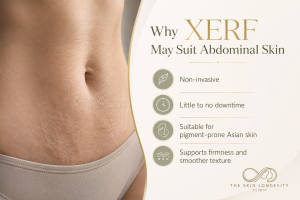
XERF may suit patients with mild to moderate abdominal skin laxity who want non invasive collagen support without needles or significant downtime.
Why XERF Suits Abdominal Skin
Several features make XERF a reasonable consideration for mild-to-moderate loose abdominal skin. First, it is non-invasive: no needles, no numbing required for most patients, and the comfort is generally manageable in pulses. Second, it does not target melanin, which is a useful safety characteristic for Singaporean and Asian skin where pigment-related side effects are a real consideration. Third, the dual-frequency design lets the operator address both superficial crepiness and deeper laxity within a single session, which is relevant on the abdomen where surface texture and structural firmness are often both involved.
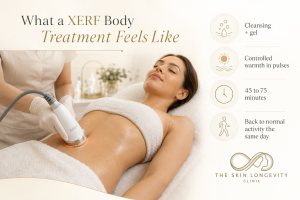
A XERF abdomen session typically involves cleansing, gel application and controlled warmth in pulses, with most patients returning to normal activity the same day.
What a XERF Body Treatment Feels Like
A XERF body treatment typically begins with cleansing the abdominal area, applying a coupling gel and mapping the treatment zones. The handpiece is then glided across the skin, delivering radiofrequency energy in controlled pulses. Most patients describe the sensation as warmth that builds and then eases with each pulse, rather than sharp pain. Comfort varies, and thinner skin tends to feel more; the operator should adjust settings if the heat becomes uncomfortable. A typical XERF abdomen session lasts roughly forty-five to seventy-five minutes depending on the size of the treatment area. Downtime is minimal: temporary warmth, mild redness or some tenderness afterwards, with most people returning to normal activity the same day.
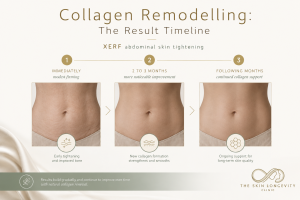
XERF results build gradually as collagen remodelling develops, with visible improvement usually assessed over weeks to months rather than immediately.
Collagen Remodelling: The Result Timeline
XERF results follow the same biology as facial RF. The immediate change after a session is usually modest — a small firming effect from collagen contraction. The more meaningful change develops over the following weeks and months as new collagen and elastin form. Most patients see the more noticeable improvement at the two-to-three-month mark, with continued benefit over the following months. The number of sessions depends on the individual response and the degree of laxity; some patients see a useful change after a single well-delivered session with periodic maintenance, while others benefit from a planned course.
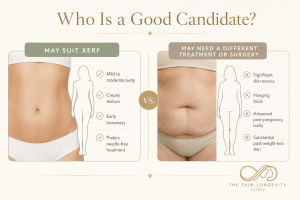
XERF is best suited for mild to moderate abdominal skin laxity. Significant excess skin or hanging folds may require a surgical opinion
Who Is a Good Candidate for XERF Abdominal Treatment?
The right candidate for XERF on the abdomen is someone with mild to moderate skin laxity, including soft crepey texture, slight looseness when sitting or bending, and dermal thinning that is making the abdomen look less firm. It tends to suit patients who still have reasonable underlying volume, hold realistic expectations and prefer a needle-free treatment with little disruption.
Dr Rachel Ho, MBBS, MMed(ENT), Founder and Medical Director of The Skin Longevity Clinic, makes a similar point about XERF on the face: the patient who gets the most out of XERF is someone with early-to-moderate laxity who understands that the result is gradual collagen support rather than an instant, dramatic lift. The same principle applies on the abdomen — XERF is better understood as radiofrequency-based tightening and collagen support, with results that build over time.
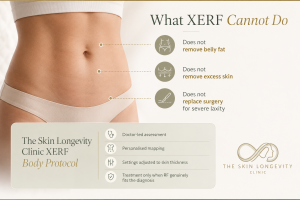
XERF does not remove belly fat, remove excess skin or replace surgery for severe laxity. It is a skin tightening treatment for suitable patients.
Who May Need a Different Treatment or Surgery
XERF is not the right answer for everyone. Patients with significant skin excess, hanging folds, advanced post-pregnancy laxity or substantial post-weight-loss laxity are usually better served by a surgical opinion, because no non-invasive device can match the result of an abdominoplasty when there is genuine excess skin to remove. Patients whose main problem is fat rather than skin will not see the change they want from a skin-tightening treatment. Patients with active skin inflammation or unstable pigmentation need careful assessment first.
What XERF Cannot Do: Fat and Severe Laxity
This needs to be stated plainly. XERF will not reduce belly fat. It is not a fat-reduction treatment, and the heat profile of an RF skin-tightening device is not designed to target fat cells. XERF also will not remove excess skin — only surgery does that. Honest expectation setting is part of any responsible consultation.
The Skin Longevity Clinic XERF Body Protocol
At The Skin Longevity Clinic, XERF for the abdomen begins with a doctor-led skin longevity assessment that evaluates skin quality, dermal thickness, laxity pattern, pigment risk, inflammation, treatment history and recovery capacity, alongside an honest read of whether the visible change is genuinely skin laxity or whether residual fat or abdominal wall separation is contributing. Treatment is then mapped on the patient’s abdomen, with energy settings and the number of passes adjusted to skin thickness, the zones being treated and comfort tolerance, rather than a fixed setting applied uniformly to every patient. If you are unsure where to begin, a skin longevity assessment is a sensible first step.
Frequently Asked Questions about XERF for body or abdominal skin tightening
Is XERF good for abdominal skin laxity?
For mild-to-moderate abdominal skin laxity, XERF can be a reasonable option in the right candidate. For severe laxity or significant skin excess, a surgical opinion is usually more appropriate.
Does XERF remove belly fat?
No. XERF is a skin-tightening treatment, not a fat-reduction treatment. It does not reduce the volume of fat beneath the skin.
How many XERF sessions are needed for loose abdominal skin?
This depends on the degree of laxity, individual response and the maintenance plan. Most patients benefit from a planned course rather than a single session, and the right number is decided after a full assessment.
Is there downtime after a XERF abdomen treatment?
Usually no. Most patients return to normal activity the same day, though temporary warmth, mild redness or some tenderness can occur for a short time after the session.
Related XERF and Skin Tightening Guides
For the broader picture of loose abdominal skin, see our pillar guide to loose skin on the stomach. For the underlying XERF technology, see our complete guide to XERF in Singapore.
XERF Abdominal Skin Tightening at The Skin Longevity Clinic
The Skin Longevity Clinic is a doctor-led practice in the Orchard area of Singapore. XERF is one of several tools the clinic uses for skin laxity, and it is recommended for the abdomen only when radiofrequency tightening genuinely fits the diagnosis.
If you are considering XERF for abdominal skin tightening, the most useful next step is an assessment rather than a booking. You can contact The Skin Longevity Clinic to arrange a consultation and find out whether XERF, or another approach, is the right fit for your skin.