

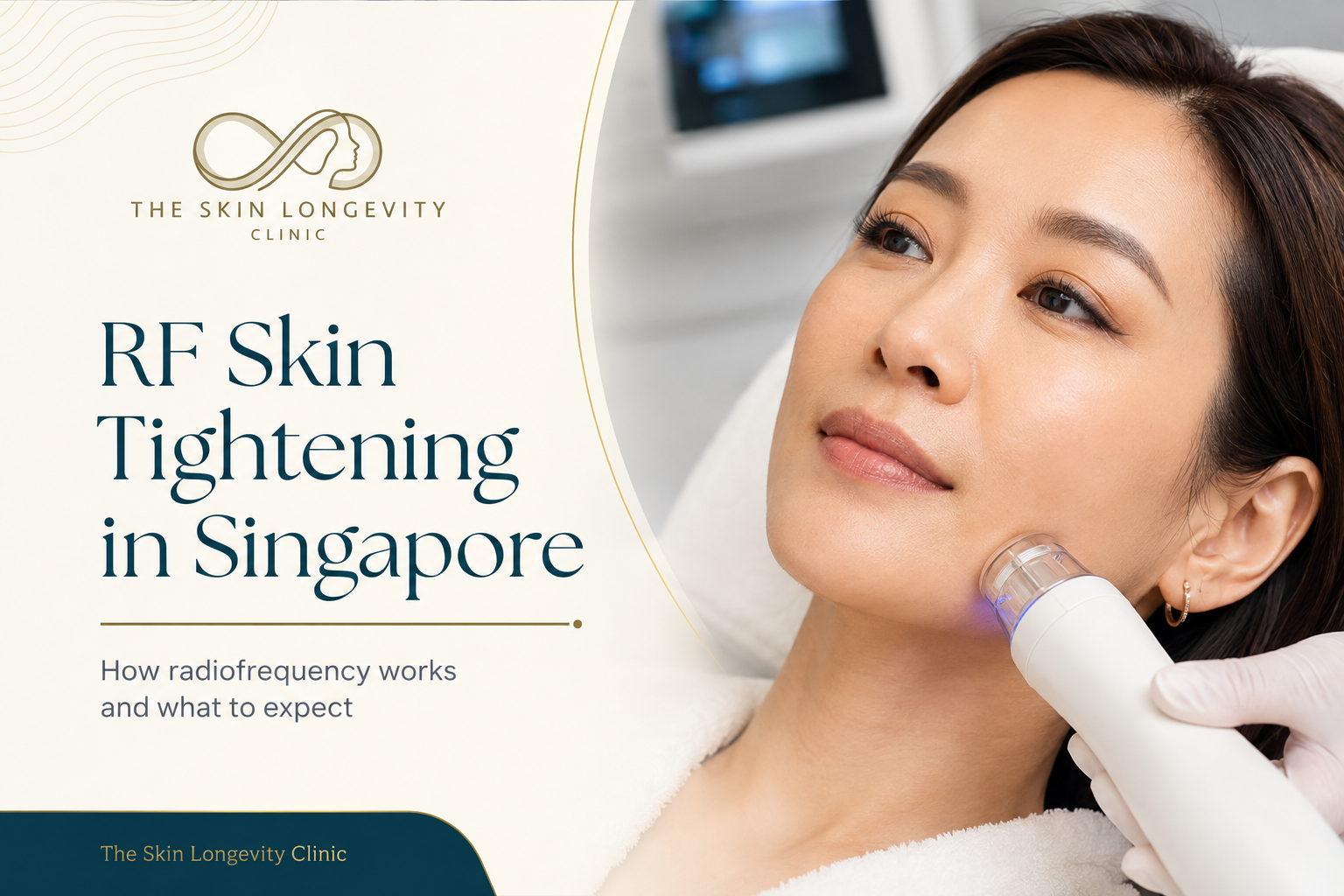
03 Aug RF Skin Tightening in Singapore: How Radiofrequency Works and What to Expect
By Dr Rachel Ho | Aesthetic Doctor, Founder, The Skin Longevity Clinic, Singapore
RF Skin Tightening in Singapore: How Radiofrequency Works and What to Expect
Radiofrequency, usually shortened to RF, is one of the most widely used technologies for non-surgical skin tightening in Singapore. It is the technology behind a long list of treatments, including XERF, and understanding how it works makes it far easier to choose between them. This guide explains what RF skin tightening is, how it tightens skin, the main types available and what the clinical evidence actually shows.
If you have arrived here looking specifically at XERF, our complete guide to XERF in Singapore covers that treatment in detail. This article takes the wider view of radiofrequency as a category.
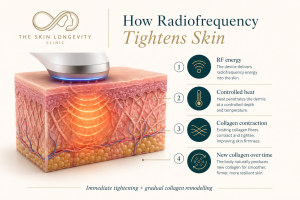
Radiofrequency lifting works by creating controlled heat in the dermis, leading to immediate collagen contraction and gradual collagen remodelling.
What Is RF Skin Tightening?
RF skin tightening is a group of non-surgical treatments that use radiofrequency energy to heat the skin in a controlled way, with the aim of firming it and stimulating collagen. It does not cut, freeze or remove tissue. It works entirely through heat, delivered to a depth and temperature intended to tighten existing collagen and encourage the skin to make more.
Radiofrequency has been used in aesthetic medicine for more than two decades, which means it is a well-studied modality rather than a novelty. What has changed over the years is the engineering, with newer devices offering better control over depth, temperature and comfort.
How Radiofrequency Tightens Skin
The mechanism is worth understanding, because it explains everything else about RF treatments. Radiofrequency devices pass a high-frequency alternating electrical current through the skin, typically in a range of around 0.3 to 10 MHz. The skin’s natural resistance to the movement of charged particles converts that current into heat.
When the dermis reaches the right temperature, two effects follow. First, existing collagen fibres contract, which gives an immediate but modest tightening. Second, the controlled heat creates a mild, intentional stress that triggers a wound-healing response, prompting fibroblasts to produce new collagen over the following months. The radiofrequency literature commonly describes a small immediate improvement followed by a larger, gradual improvement that peaks over roughly three to six months. This two-stage pattern is why RF results are never fully visible on the day of treatment.
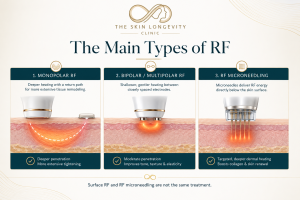
The main types of radiofrequency treatment include monopolar RF, bipolar or multipolar RF and RF microneedling, each with different treatment depths and uses.
The Main Types of RF Skin Tightening Available in Singapore
Not all RF treatments are the same. They differ in how the energy is delivered, and that affects depth, comfort and what they are suited to.
- Monopolar RF sends energy from a single electrode through the body to a return pad, which allows it to reach deeper tissue. XERF and Thermage are monopolar RF treatments.
- Bipolar and multipolar RF pass energy between two or more electrodes set close together, which tends to give shallower, gentler heating, often used in lighter and more frequent treatments.
- RF microneedling combines fine needles with radiofrequency, delivering energy below the skin surface through the needle tips. It is a different, more invasive treatment used largely for texture, scarring and pores rather than for lifting.
A useful distinction is between surface RF, where the device stays on top of the skin, and RF microneedling, where needles penetrate it. XERF is a surface treatment.
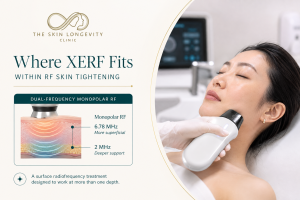
XERF is a surface radiofrequency treatment in Singapore that uses dual-frequency monopolar RF to support skin tightening at different depths.
Where XERF Fits Within RF Skin Tightening
XERF is a monopolar RF treatment, and its particular feature is a dual-frequency design that delivers energy at 6.78 MHz and 2 MHz. The higher frequency works on the more superficial layers and the lower frequency reaches deeper, which allows the treatment to be directed at more than one depth. Within the broad category of RF skin tightening, XERF sits among the newer monopolar devices that aim for better depth control. Our guide to the XERF treatment procedure explains how this works in practice.
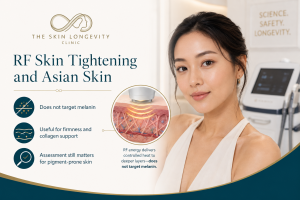
For suitable patients, RF skin tightening can be a useful option in Asian skin because it does not primarily work by targeting melanin.
RF Skin Tightening and Asian Skin
This is a point Dr Rachel Ho, MBBS, MMed(ENT), Founder and Medical Director of The Skin Longevity Clinic makes often in consultation. In her experience, radiofrequency can be a good fit for Singaporean and Asian skin because it does not rely on targeting pigment, and it is most useful for collagen support and firmness. The limitation patients need to understand is that RF tightening is not a substitute for surgery, and it cannot replace volume restoration when facial deflation is the main issue.
Radiofrequency has a characteristic that is genuinely useful for skin of colour. Unlike many laser and light-based treatments, RF energy does not target melanin, the pigment in skin. It heats tissue through electrical resistance instead. This means the risk of pigment-related side effects is comparatively low, which matters in a diverse population such as Singapore’s. Research evaluating monopolar radiofrequency in Asian patients has supported its use for skin tightening in this group. RF is not entirely free of risk, and pigment-prone skin still needs careful assessment, but it is a reasonable starting point for many Asian patients.
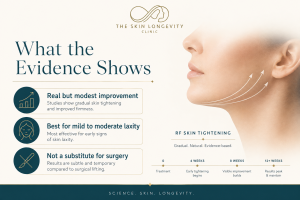
Clinical evidence supports radiofrequency lifting for mild to moderate saggy skin, with gradual and modest improvement over time.
What the Evidence Shows for RF Skin Tightening
The evidence base for RF skin tightening is reasonably solid for mild to moderate laxity. The 2011 review by El Domyati and colleagues in the Journal of the American Academy of Dermatology described measurable collagen effects from radiofrequency facial rejuvenation. A 2024 systematic review by Shin and colleagues in the journal Cosmetics assessed the efficacy and safety of monopolar radiofrequency for skin tightening and supported its use in suitable patients. A 2019 study by Tanaka and colleagues in the Journal of Clinical and Aesthetic Dermatology examined skin tightening following radiofrequency treatment, and a 2025 randomised controlled study by Wang and colleagues in Lasers in Surgery and Medicine looked at longer-term efficacy and safety.
The consistent message across this research is that RF skin tightening produces a real but modest improvement in mild to moderate laxity. It is not a substitute for surgery, and it is not dramatic, but it is genuine.
Is RF Skin Tightening Safe?
For non-invasive surface RF, the safety profile is reasonably favourable. The common side effects, warmth, mild redness and tenderness, are usually short-lived. More serious effects are uncommon when the treatment is properly assessed and delivered.
One point deserves clarity. RF microneedling, which is a different and more invasive treatment, has been the subject of a United States Food and Drug Administration safety communication regarding burns and scarring. This does not apply to non-invasive surface RF such as XERF, but it is a reminder that the operator and the settings matter. RF is safe in careful hands and less so in careless ones, which is why a doctor-led assessment is worth seeking.
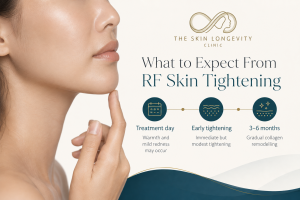
RF skin tightening results are not instant. Mild early tightening may appear first, while collagen remodelling develops over the following months.
What to Expect From RF Skin Tightening
At The Skin Longevity Clinic, the decision about which radiofrequency treatment to use is made by Dr Rachel Ho on the basis of skin thickness, laxity severity, facial volume, pigment tendency, inflammation, comfort tolerance and prior procedures. RF may be the right choice for patients who need firmness and mild tightening, while scars, pigmentation, volume loss or more advanced laxity will usually point to a different treatment plan. This sits inside the skin longevity assessment, the clinic’s doctor-led consultation that evaluates skin quality, structure and recovery capacity before any treatment is recommended. For the clinic’s dual-frequency RF treatment specifically, see XERF in Singapore, and for ultrasound-based tightening see the clinic’s HIFU treatment page.
A non-invasive RF treatment usually involves a comfortable session of warmth delivered in pulses, lasting somewhere between thirty minutes and an hour depending on the area. Downtime is generally minimal, with temporary redness and warmth the most common after-effects. Results follow the two-stage pattern described earlier, so a review after a few months is the right time to judge the outcome. Our guide to XERF before and after results explains this timeline in more detail.
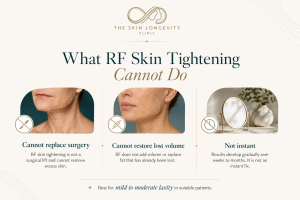
Radiofrequency skin tightening can help selected patients with mild laxity, but it cannot replace surgery or restore lost volume.
What RF Skin Tightening Cannot Do
If you are unsure where to begin, a skin longevity assessment is a sensible first step.
An honest guide to radiofrequency has to be as clear about the limits as about the benefits. RF skin tightening cannot reverse ageing. It works with collagen that is already in gradual decline, so it manages and slows visible laxity rather than stopping the process.
It cannot lift advanced sagging. When there is a large amount of loose skin and heavy jowls, no non-invasive radiofrequency device matches what surgery achieves, and a course of RF treatments in that situation is likely to disappoint.
It cannot restore lost volume. As the face ages it deflates as well as loosens, and a deflated face needs volume support, not heat. Tightening loose skin over a face that has lost its underlying support does not address the real cause.
And it cannot deliver its result instantly. Because most of the improvement comes from new collagen forming over months, RF is a treatment for patients who can wait for a gradual change.
Recognising these limits is not a criticism of radiofrequency. It is what allows RF skin tightening to be used well, for the mild to moderate laxity it genuinely helps, rather than being asked to solve problems it was never designed for.
Frequently Asked Questions about RF Skin Tightening
How is RF skin tightening different from HIFU?
RF uses electrical energy converted to heat through tissue resistance. HIFU, or high-intensity focused ultrasound, uses focused sound waves to create heat at set depths. Both stimulate collagen but reach tissue differently, and they suit different patterns of laxity. The clinic’s HIFU treatment page explains the ultrasound approach.
How many RF skin tightening sessions do I need?
This depends on the device, the degree of laxity and how your skin responds. Some monopolar RF treatments are done in a single session with maintenance, while gentler bipolar treatments are often given as a course. The number is best decided after assessment rather than from a package price.
Is RF skin tightening painful?
Non-invasive RF is generally described as warm rather than painful. The heat builds and eases in pulses, and thinner skin feels it more. Settings can be adjusted for comfort. RF microneedling, being invasive, is a different experience and usually involves numbing cream.
Does RF skin tightening really work?
For mild to moderate skin laxity, the clinical evidence supports a genuine, if modest, improvement. It works less well, or not at all, for advanced sagging and volume loss. Honest expectations and proper patient selection are the strongest predictors of a satisfying result.
Related XERF and Skin Tightening Guides
These articles form a connected library on XERF and skin tightening at The Skin Longevity Clinic. You may also find the following guides helpful:
- XERF in Singapore: a complete guide
- XERF price in Singapore
- XERF treatment: the procedure explained
- XERF review: an evidence-based look
- XERF before and after results
- XERF vs Ultherapy compared
RF Skin Tightening at The Skin Longevity Clinic
The Skin Longevity Clinic is a doctor-led practice in the Orchard area of Singapore that uses radiofrequency, including XERF, as part of a wider, individualised plan. RF is recommended only when it genuinely fits the diagnosis. You can contact the clinic to arrange a consultation and find out whether RF skin tightening suits your skin.