

10 Aug Post-Pregnancy Loose Abdominal Skin: Treatment Options
By Dr Rachel Ho | Aesthetic Doctor, Founder, The Skin Longevity Clinic, Singapore
Post-Pregnancy Loose Abdominal Skin: Non-Surgical Skin Tightening Options
Post-pregnancy loose abdominal skin is one of the most common reasons women in Singapore look at non-surgical body treatments. Pregnancy is an intense biological event, and the abdomen carries much of the visible aftermath. This guide explains why pregnancy can stretch abdominal skin, the practical difference between loose skin, diastasis recti and residual fat, and which non-surgical options — including RF skin tightening and XERF — can realistically help with postpartum abdominal skin laxity.
For the broader context, see our guide to loose skin on the stomach, and our complete guide to XERF in Singapore for the underlying treatment.
Why Pregnancy Stretches Abdominal Skin
During pregnancy, the abdomen expands rapidly. The dermis stretches to accommodate the growing uterus, the rectus abdominis muscles can separate, and connective tissue is loaded in ways that take months to recover from. Some women find that their abdominal skin firms up substantially within six to twelve months of delivery, helped by the natural recovery of dermal collagen and elastin. Others find that the postpartum laxity remains, particularly after multiple pregnancies or larger babies.
The biology matters because it sets a realistic timeline. If you are within the first six to twelve months postpartum, much of the recovery is still in progress. Non-surgical treatment can be considered, but a careful consultation will usually include a discussion about giving the body more time before making a treatment plan.
Loose Skin, Diastasis Recti and Fat: Different Problems
Post-pregnancy abdominal change is often a combination of three different problems, and the treatment for each is different.
Loose abdominal skin is a structural change in the dermis — the skin no longer retracts to the abdominal wall and looks crepey or soft. RF skin tightening, including XERF, can support this.
Diastasis recti is a separation of the rectus abdominis muscles. It can produce a visible bulge or doming of the abdomen, particularly when sitting up or lifting. RF skin tightening does not repair the muscle. Targeted physiotherapy can help in many cases; in others, a surgical repair is needed.
Residual fat is, well, fat. It responds to diet, exercise and, where appropriate, body contouring treatments, but it is not loose skin.
Most postpartum patients have some combination of the three. Identifying which is the dominant problem is the first job of a sensible consultation.
Why Collagen and Elastin Matter Postpartum
Pregnancy stretches the dermal collagen and elastin network. Skin that retracts well postpartum tends to be skin with a relatively intact, well-maintained collagen structure. Skin that does not retract well may reflect a combination of repeated stretching, age, and genetic factors. RF skin tightening works by supporting the collagen-and-elastin network — heating the dermis in a controlled way to stimulate new collagen formation over time. This is why non-surgical body treatments such as XERF can have a role in postpartum laxity, particularly in the mild-to-moderate range.
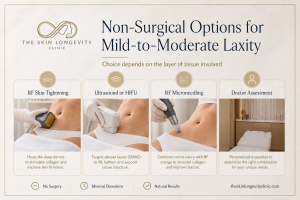
Comparison of radiofrequency skin tightening, ultrasound, RF microneedling and doctor assessment for postpartum abdominal laxity.
Non-Surgical Options for Mild-to-Moderate Postpartum Laxity
Several non-surgical treatments are used. RF skin tightening, including XERF, is one of the most studied categories. There is published research on RF-based approaches for postpartum abdominal skin laxity; one study of forty-six postpartum women using RF combined with targeted pressure energy reported improvements in skin elasticity and laxity scores after treatment, though that specific device was not XERF. It is honest to use this as support for radiofrequency as a category rather than as proof that XERF specifically produces the same result.
HIFU and ultrasound-based tightening, RF microneedling and other energy-based treatments may also be considered. The right choice depends on the layer of tissue that is driving the visible change — the dermis, the deeper support, or the surface texture — and on the patient’s comfort with downtime.
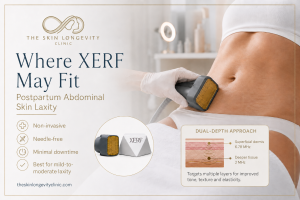
Where can XERF fit after pregnancy? XERF uses dual-frequency monopolar radiofrequency to address superficial dermal laxity and deeper tissue support. It is a needle-free, low-downtime option for selected patients with mild to moderate postpartum abdominal skin looseness
Where XERF Can Help with Post Partum Loose Abdominal Skin
XERF is a non-invasive dual-frequency monopolar RF skin tightening treatment. Its dual-frequency design — 6.78 MHz for the more superficial dermis and 2 MHz for deeper tissue — lets the operator address both surface laxity and deeper firmness within a single session. For postpartum patients with mild-to-moderate abdominal skin laxity, XERF can be used to support collagen remodelling and a gradual improvement in firmness and texture. It is needle-free, requires no numbing for most patients, and has minimal downtime.
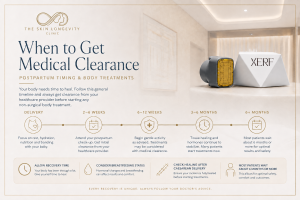
When can postpartum skin tightening begin? Timing depends on physical recovery, breastfeeding, caesarean wound healing, hormonal stability and medical history. Many patients are advised to allow several months of natural recovery before starting an elective body treatment.
When to Get Medical Clearance before Skin Tightening Treatments for Post Partum Abdomen
Postpartum patients need medical clearance before any energy-based body treatment. The usual considerations include time since delivery, breastfeeding status, whether the body is still recovering from surgery (for example, after a caesarean delivery), and any conditions that affect skin healing. The honest answer for many patients is to wait six months or more postpartum, particularly while breastfeeding, before starting a non-surgical course.
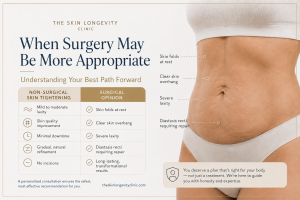
When is surgery more appropriate? Nonsurgical treatment can improve selected mild to moderate laxity. Skin folds at rest, a clear abdominal overhang, severe looseness or diastasis recti requiring repair usually justify a surgical opinion rather than repeated tightening sessions
When Surgery May Be More Appropriate for Post Partum Abdominal Skin
When postpartum laxity is severe — when skin hangs in folds at rest, when there is a clear skin overhang, or when diastasis recti needs surgical repair — an abdominoplasty (with or without diastasis recti repair) is often the more honest answer. Non-surgical treatments can support firmness but cannot remove excess skin or close a muscle separation. Reputable cosmetic-surgery guidance is clear that non-surgical tightening is generally not effective for the more advanced sagging that follows some pregnancies.
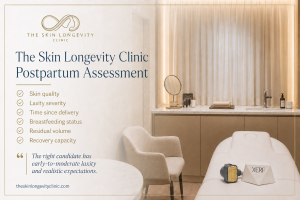
A postpartum abdominal assessment at The Skin Longevity Clinic near Orchard Road reviews skin quality, laxity severity, time since delivery, breastfeeding status, residual volume and recovery capacity before XERF or another treatment is recommended.
The Skin Longevity Clinic Postpartum Assessment
Dr Rachel Ho, MBBS, MMed(ENT), Founder and Medical Director of The Skin Longevity Clinic, takes the same view on postpartum laxity as she does on facial laxity: the right candidate for XERF is someone with early-to-moderate skin laxity and realistic expectations, not someone hoping for an instant, surgical-grade lift. Postpartum patients with mild-to-moderate abdominal skin laxity often find XERF useful; those with significant skin excess are guided towards a surgical opinion rather than a longer course of non-invasive treatment.
At The Skin Longevity Clinic, every postpartum body consultation begins with a doctor-led skin longevity assessment. We evaluate skin quality, dermal thickness, laxity severity, time since delivery, breastfeeding status, residual volume, pigment risk and recovery capacity. The same honest question applies as for facial laxity: is XERF the right tool for this patient’s specific postpartum picture, or is another treatment — or a surgical opinion — more appropriate? If you are unsure where to begin, a skin longevity assessment is a sensible first step.
Frequently Asked Questions about Post Pregnancy Loose Abdominal Skin
Can XERF help post-pregnancy loose abdominal skin?
For mild-to-moderate postpartum laxity, yes, in suitable candidates. For severe laxity with skin excess, a surgical opinion is usually more appropriate.
When should I start non-surgical skin tightening after delivery?
Most clinicians recommend waiting at least six months postpartum, sometimes longer, depending on individual recovery and breastfeeding status. Medical clearance is part of every responsible consultation.
Is XERF safe while breastfeeding?
Many clinicians prefer to defer non-essential energy-based treatments until after breastfeeding has ended. This is a question for your treating doctor.
Does XERF treat diastasis recti?
No. Diastasis recti is a separation of the rectus muscles and is not corrected by skin tightening. Physiotherapy or surgical repair is the relevant treatment for the muscle separation itself.
Related XERF and Skin Tightening Guides
For the broader picture, see our pillar guide to loose skin on the stomach, and the dedicated treatment article on XERF for abdominal skin tightening. For the underlying technology, see our complete guide to XERF in Singapore.
Post-Pregnancy Abdominal Skin Tightening at The Skin Longevity Clinic
The Skin Longevity Clinic is a doctor-led practice in the Orchard area of Singapore. Postpartum abdominal skin laxity is approached the same way as facial laxity: through an honest assessment of cause, severity and the realistic match between treatment and result.
If you are considering treatment for post-pregnancy loose abdominal skin, you can contact The Skin Longevity Clinic to arrange a consultation.