

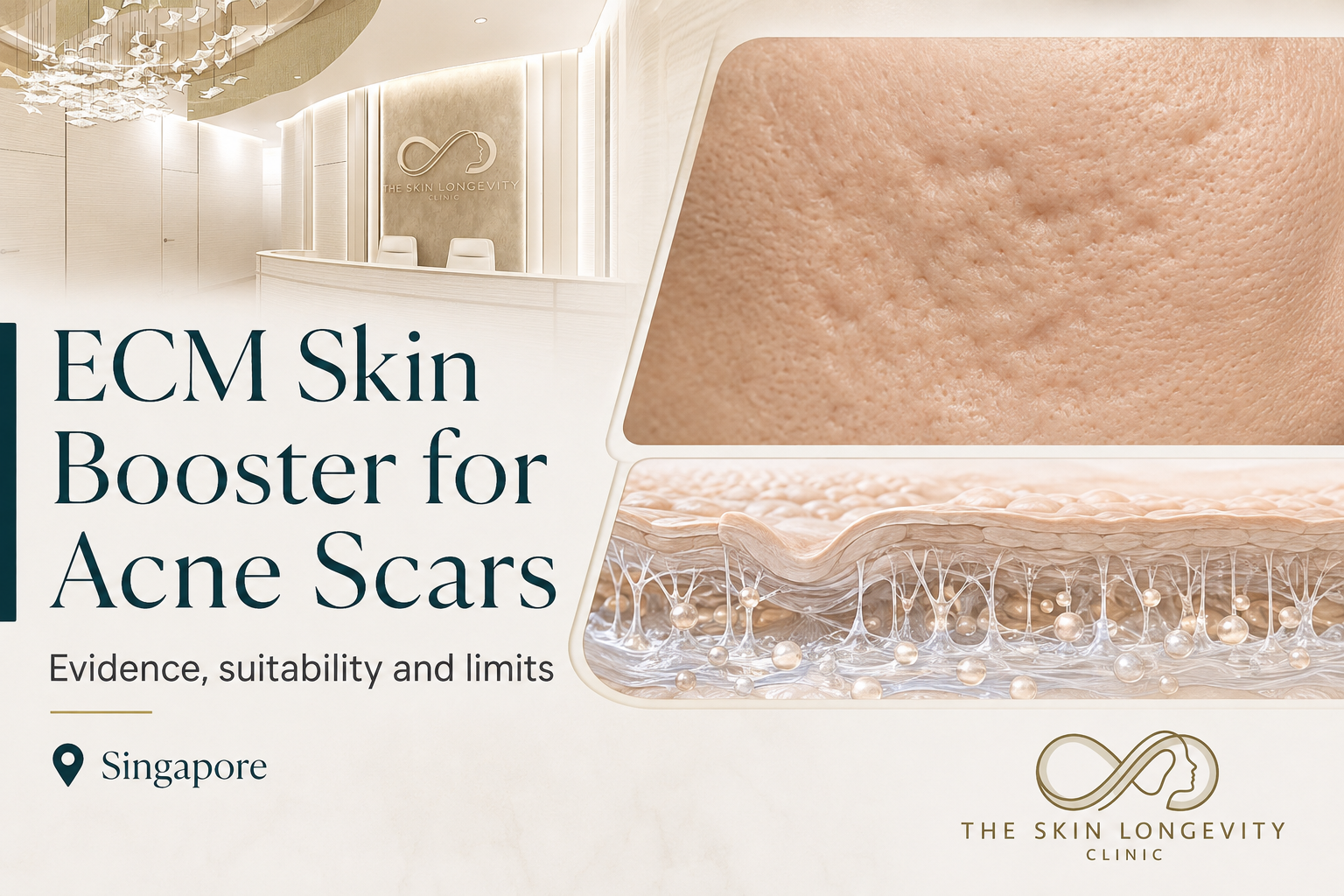
13 Aug ECM Skin Booster for Acne Scars in Singapore: Evidence, Suitability and Limits
By Dr Rachel Ho | Aesthetic Doctor, Founder, The Skin Longevity Clinic, Singapore
ECM skin boosters are injectable treatments that contain extracellular matrix material intended to support the dermal environment. They can form part of treatment for selected shallow atrophic acne scars, particularly where reduced dermal support and uneven texture are significant concerns.
Their role needs to be defined carefully. An ECM skin booster does not release the fibrous bands beneath a tethered rolling scar, resurface the edges of a deep boxcar scar or close a narrow ice pick tract. Patients with mixed acne scars usually need a staged combination of treatments rather than one injectable used across every scar.
ECM skin boosters for acne scars at a glance
ECM skin boosters for acne scars at a glance
| Question | Evidence based answer |
|---|---|
| What is an ECM skin booster? | An injectable skin quality treatment containing extracellular matrix material, often derived from acellular dermal matrix |
| Which acne scars can ECM skin booster support? | Selected shallow atrophic scars and areas with reduced dermal quality |
| Can ECM skin booster treat rolling scars? | It can support the dermis, but tethered rolling scars usually require subcision |
| Can ECM skin booster treat boxcar scars? | Shallow boxcar scars can be considered within a combination plan; deep scars usually need resurfacing or focal treatment |
| Can ECM skin booster treat ice pick scars? | Ice pick scars generally require a focal scar procedure rather than an ECM skin booster alone |
| Is the evidence strong for ECM skin booster? | Direct acne scar evidence is promising but comes from a small combination study |
| Can ECM skin booster be combined with RF microneedling or laser? | Yes, when separate treatments are needed for dermal support, remodelling and resurfacing |
| What are the main risks of ECM skin boosters? | Swelling, bruising, tenderness, infection, nodules and rare vascular injury |
What is an ECM skin booster?
ECM stands for extracellular matrix. In normal skin, the extracellular matrix forms the support network around cells and contains structural molecules such as collagen, elastin, glycosaminoglycans and hyaluronic acid.
Some injectable ECM skin boosters use human acellular dermal matrix. During manufacturing, cellular components are removed to leave a matrix scaffold that can be processed into an injectable form. Formulations differ in particle size, processing, concentration and supporting ingredients, so evidence from one product should not automatically be applied to every treatment described as an ECM booster1.
Patients will also encounter terms such as hADM, micronised acellular dermal matrix and particulated human acellular dermal matrix. These terms describe related materials rather than one standardised product.
Acne scars and acne marks are different
Atrophic acne scars are depressions created by inflammation and abnormal dermal repair. Brown post inflammatory hyperpigmentation and red post acne marks represent pigment or vascular change rather than missing dermal structure.
ECM skin boosters are considered for dermal support and texture. They are not primary treatments for brown or red acne marks, which are better managed through acne control, sunscreen, pigment treatment or vascular treatment according to the diagnosis. The distinction prevents patients from receiving an injectable for a concern that lies mainly in the epidermis or blood vessels.
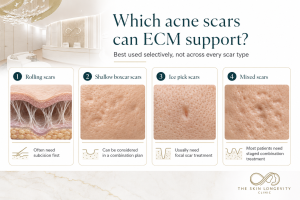
Which acne scars can an ECM skin booster support? Tethered rolling scars often need subcision first. Shallow boxcar scars can be considered within a combination plan, ice-pick scars usually need focal treatment, and mixed scars commonly require several carefully staged procedures.
Which acne scars can ECM skin boosters treat?
Rolling scars
Rolling scars have broad, sloping edges and are often anchored by fibrous bands beneath the skin. Subcision mechanically releases these tethers and has shown more consistent benefit for rolling and selected boxcar scars than for ice pick scars2.
ECM treatment can be added after release where dermal support remains reduced, but injecting above an unreleased tether does not remove the structure pulling the scar downward.
Boxcar scars
Boxcar scars have clearer edges and vary from shallow to deep. A shallow boxcar scar can sometimes be softened through dermal support and collagen remodelling, while a deep scar usually needs fractional resurfacing, focal treatment or another structural procedure.
An ECM skin booster can therefore support selected shallow scars, but the depth and edge shape still determine whether it is likely to add useful improvement.
Ice pick scars
Ice pick scars are narrow, deep tracts. A broadly injected skin booster is poorly matched to this anatomy because the defect extends deeper than the surrounding surface depression.
Focal procedures are usually more relevant for ice pick scars. ECM treatment can still support the surrounding skin quality, but it should not be presented as the procedure that closes the tract.
Mixed acne scars
Most patients have more than one scar type. Treatment can include subcision for tethering, RF microneedling for dermal remodelling, fractional laser for resurfacing, focal treatment for narrow scars and ECM support for selected depressions or reduced dermal quality.
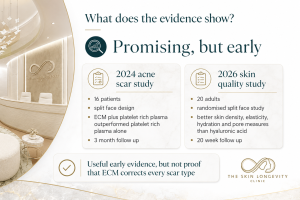
What does the evidence for ECM skin boosters show? Early findings are promising, but direct acne scar evidence comes from a small combination trial. The 2026 study examined general cheek roughness and skin-quality measures rather than individual rolling, boxcar or ice-pick scars. The findings do not prove that every ECM injectable treats every scar type.
What does the evidence show for ECM skin boosters in treating acne scars?
The most relevant direct study was published in 2024. It included 16 patients and 48 atrophic acne scar sites in a split face design. One side received micronised acellular dermal matrix combined with platelet rich plasma, while the comparison side received platelet rich plasma alone.
After three months, the combination side had better acne scar assessment and ECCA scores. The result supports further study of ECM material in acne scars, but it does not establish the independent effect of ECM because the treatment was combined with platelet rich plasma. The sample was small, follow up was short and the findings relate to one specific material and protocol1.
A separate 2026 randomised split face study involved 20 adults with moderate cheek roughness. Particulated human acellular dermal matrix was compared with hyaluronic acid over 20 weeks. The ECM treated side showed greater improvements in measured skin density, elasticity, wrinkle depth, pore area, hydration and other skin quality parameters, with no serious adverse events reported during the study3.
This study supports the broader concept of dermal restoration, but it was not an acne scar trial. Cheek roughness, pores and hydration are not equivalent to rolling, boxcar or ice pick scars, so the findings should not be used as proof that ECM treatment corrects every scar type.
The evidence is therefore promising and early. It supports ECM skin boosters as a possible component of acne scar care, rather than a replacement for established scar specific procedures.
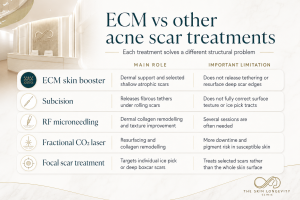
How does ECM compare with other acne scar treatments? ECM supports selected shallow dermal defects, subcision releases fibrous tethering, RF microneedling remodels collagen, fractional CO2 laser resurfaces broader texture, and focal procedures target individual ice-pick or deep boxcar scars.
ECM skin booster versus other acne scar treatments
ECM skin boosters VS other acne scar treatments
| Treatment | Main role | Important limitation |
|---|---|---|
| ECM skin booster | Dermal support and selected shallow atrophic scars | Does not release tethering or resurface deep scar edges |
| Subcision | Releases fibrous tethers under rolling scars | Does not fully correct surface texture or ice pick tracts |
| RF microneedling | Dermal collagen remodelling and texture improvement | Several sessions are often needed |
| Fractional CO2 laser | Resurfacing and collagen remodelling | More downtime and pigment risk in susceptible skin |
| Focal scar treatment | Targets individual ice pick or deep boxcar scars | Treats selected scars rather than the whole skin surface |
| PDLLA or other biostimulators | Gradual collagen stimulation | Results develop slowly and technique affects nodule risk |
| PDRN or PN skin boosters | Recovery and skin quality support | Limited ability to correct deep structural scars |
Both fractional CO2 laser and RF microneedling have evidence for atrophic acne scars. Their treatment effect, downtime and suitability differ, so the choice should be based on scar type, skin tone, previous procedures and recovery tolerance rather than on which option is newest4.
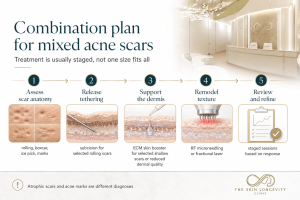
How are mixed acne scars treated? A staged plan can assess the scar anatomy, release tethering, support selected dermal depressions with ECM, remodel broader texture and review the response before adding treatment. Brown or red acne marks and indented acne scars are different diagnoses.
Can ECM skin boosters be combined with subcision, RF microneedling or laser?
Combination treatment is appropriate when separate anatomical problems coexist. Subcision can first release tethering, followed by ECM support for selected depressions or reduced dermal quality. RF microneedling or fractional laser can then address broader texture and collagen remodelling.
The treatments do not always need to be performed at the same appointment. Staging allows inflammation to settle and makes it easier to judge what each step has achieved. This is particularly relevant in Asian skin, where excessive procedural inflammation can lead to prolonged post inflammatory pigmentation.
At The Skin Longevity Clinic, active acne, dermatitis, infection and unstable pigmentation are controlled before elective scar treatment begins. The plan is then sequenced according to scar anatomy and recovery capacity.
What happens during ECM skin booster treatment?
The consultation begins with an assessment of scar type, depth, tethering, active acne, pigment tendency and previous procedures. Standardised photographs help document the baseline and distinguish genuine change from differences in lighting.
After cleansing and numbing, the ECM skin booster is injected into selected areas using a technique chosen for the scar pattern and product. Temporary bumps, redness, tenderness, swelling or bruising can follow treatment. These reactions usually settle over several days, although recovery varies with the amount injected and whether another procedure was performed at the same session.
How many sessions of ECM skin boosters are needed for acne scars?
There is no established universal course for ECM skin booster treatment of acne scars. The small direct acne scar study assessed one specific combination protocol over three months, while the broader skin quality study followed one product for 20 weeks1,3.
A clinic should therefore avoid promising a standard number of sessions before examining the scars. The number and spacing depend on the material used, treatment area, scar severity, response and whether ECM is combined with subcision, RF microneedling or resurfacing.
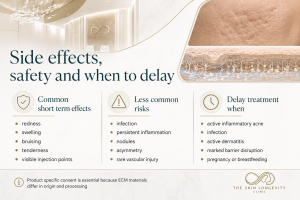
What are the risks of ECM skin booster treatment? Redness, swelling, bruising, tenderness and visible injection points are common short-term effects. Less common risks include infection, persistent inflammation, nodules, asymmetry and rare vascular injury. Treatment is usually delayed during active inflammatory acne, infection, dermatitis, marked barrier disruption, pregnancy or breastfeeding.
Side effects and safety of ECM skin boosters for acne scars
Expected short term effects include redness, swelling, bruising, tenderness and visible injection points. Less common complications include infection, persistent inflammation, nodules, asymmetry and an unsatisfactory result.
A 2026 case report described vascular compromise after injection of particulated human acellular dermal matrix, with residual atrophic scarring reported during follow up.<sup>5</sup> One case cannot establish how frequently this occurs, but it confirms that ECM injectables are not exempt from vascular risk and should be administered with appropriate anatomical knowledge and complication planning.
Patients should also be told whether the material is human derived, how it is processed and what alternatives are available. ECM products do not all share the same composition, safety data or reversibility, which makes product specific consent essential.
Who should delay ECM skin booster treatment?
Treatment is generally delayed when active inflammatory acne is still producing new scars, or when there is infection, active dermatitis, a rosacea flare or marked barrier disruption. Pregnancy and breastfeeding also alter the timing of elective injectable treatment.
Patients seeking removal of deep ice pick scars, release of severe rolling scar tethering or correction of extensive textural change usually need another procedure as the main treatment. ECM support can be reconsidered after the primary structural problem has been addressed.
Can ECM skin boosters help enlarged pores?
Enlarged pores come from several causes: genetics, increased sebum production, collagen loss and scarring can all contribute. ECM skin boosters are one option for enlarged pores by building collagen and restoring dermal support. The 2026 phADM study reported improvement in pore area, although the study was small and product-specific. Other options for pore size are compared on the large pores treatment page.
For pores driven mainly by oiliness or active acne, medical acne treatment, skincare, lasers or RF microneedling are also needed. Pores cannot be erased, as they are the natural openings of the pilosebaceous units, so the realistic goal is refinement of enlarged pores, smoother texture and better skin quality.
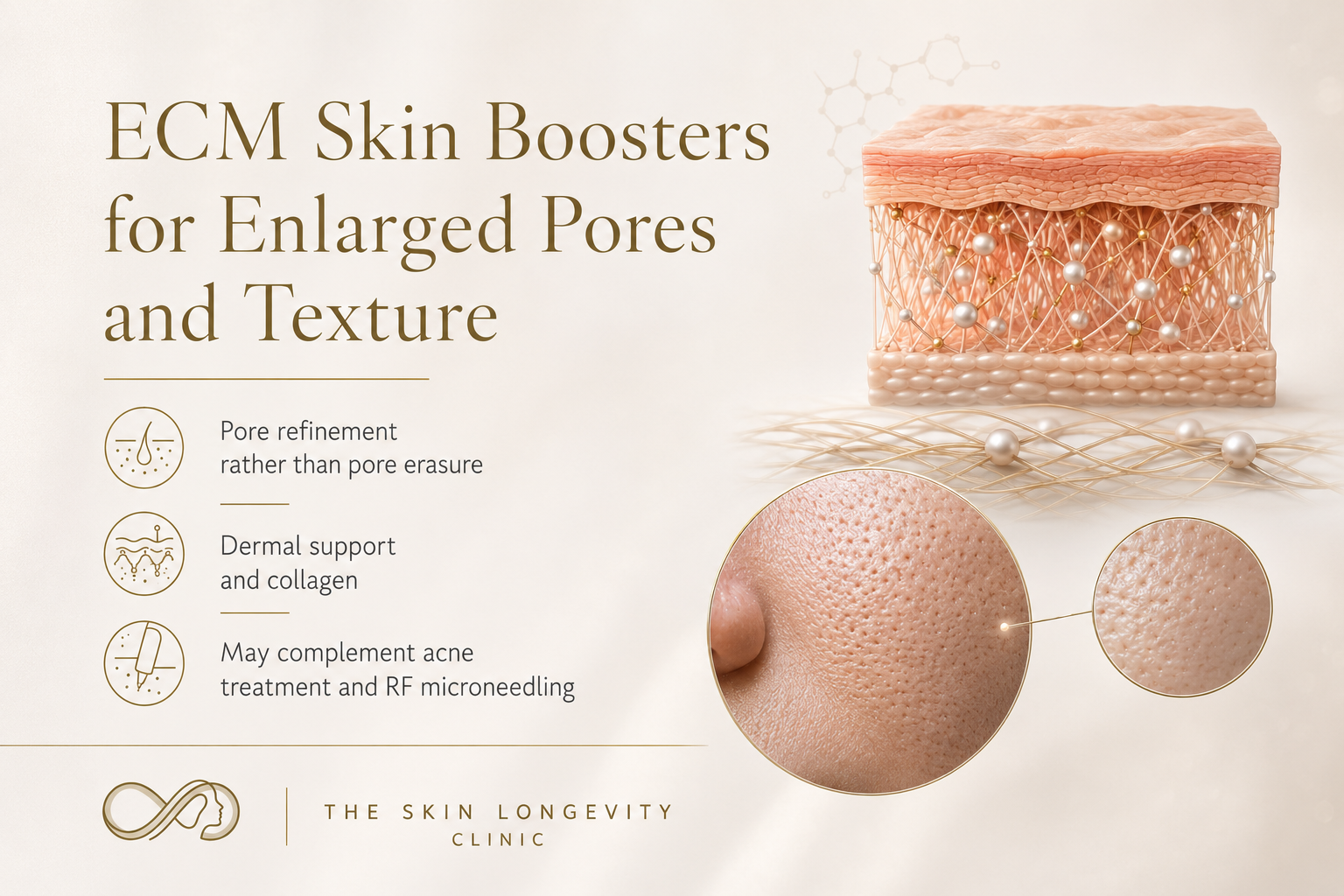
Enlarged pores may be related to sebum, acne history, collagen support and skin texture. The goal is pore refinement rather than pore erasure.
Dr Rachel Ho’s clinical perspective
An acne scar is not one diagnosis. ECM skin boosters can support selected shallow scars and dermal quality, but tethering, deep edges and narrow scar tracts still need treatments directed at those structures.
The evidence for ECM treatment is encouraging but product specific and early. I use it as one part of a scar plan where matrix support is genuinely relevant, rather than using the same injectable across every scar.
ECM skin booster treatment at The Skin Longevity Clinic
Dr Rachel Ho is the founder of The Skin Longevity Clinic and has more than 16 years of clinical experience in Singapore. The clinic assesses acne activity, scar type, pigment stability, dermal quality and recovery tolerance before recommending ECM treatment or another acne scar procedure.
The Skin Longevity Clinic is located at 9 Scotts Road, #06-05 Scotts Medical Center at Pacific Plaza, Singapore 228210, near Orchard Road.
Frequently asked questions
Can ECM skin boosters fill acne scars?
They can provide dermal support and soften selected shallow depressions. They do not behave as a universal filler for every acne scar, and tethered or deep scars usually need another procedure.
Is ECM better than RF microneedling?
The treatments perform different jobs. ECM provides injectable matrix support, while RF microneedling creates controlled thermal injury to stimulate dermal remodelling.
Is ECM better than subcision?
Subcision is more directly suited to fibrous tethering beneath rolling scars. ECM can be added for dermal support but does not mechanically release the tether.
Can ECM skin boosters treat acne marks?
Brown and red post acne marks are pigmentary or vascular changes rather than true atrophic scars. They require acne control and pigment or vascular treatment according to the diagnosis.
How much does ECM skin booster treatment cost in Singapore?
Cost depends on the amount used, treatment area, number of sessions and whether subcision, RF microneedling or laser is included. An itemised quotation can be provided after the scar pattern and treatment sequence have been assessed.
Related reading
The following clinic pages provide useful supporting information:
ECM Skin Boosters in Singapore: What They Are and Who May Suit Them.
Skin Boosters in Singapore: HA, Polynucleotide, PDLLA, ECM and Exosome Compared.
Radiofrequency Microneedling in Singapore and Fractional CO2 Laser for acne scar remodelling.
Scar Treatments in Singapore for a broader assessment of acne scars and other scar types.
ECM Skin Booster for the Under Eye Area for dark circles, hollowing and fine under eye lines.
ECM Skin Booster for Fine Wrinkles and Crepey Skin for hydration loss, collagen fragmentation and dermal thinning.
References
- Park S, Huang L, Ao X, et al. Micronized Acellular Dermal Matrix Combined With Platelet Rich Plasma in the Treatment of Atrophic Acne Scars: A Self Controlled Split Face Study. Journal of Cosmetic Dermatology. 2024. PMID 38558364.
- Vempati A, et al. Subcision for Atrophic Acne Scarring: A Comprehensive Review of Surgical Instruments and Combinatorial Treatments. 2023.
- Lee YI, Chau NH, Nguyen NH, et al. Injectable Particulated Human Acellular Dermal Matrix Booster for Skin Restoration: A Randomized Split Face Double Blinded Clinical Trial and Preclinical Study. International Journal of Molecular Sciences. 2026. PMID 41828422.
- Xiang X, et al. Comparative Efficacy and Safety of Fractional Carbon Dioxide Laser and Microneedling Radiofrequency for Acne Scars. 2026.
- Sung SW, et al. Vascular Complication Following Injection of Particulated Human Acellular Dermal Matrix: A Case Report. Journal of Cosmetic Dermatology. 2026.