


01 Sep How Long Does Botulinum Toxin Last? Singapore Guide
By Dr Rachel Ho | Aesthetic Doctor, Founder, The Skin Longevity Clinic, Singapore
Medically reviewed by Dr Rachel Ho, MBBS, MRCS, MMed (ENT), August 2026.
Botulinum toxin does not switch off on a fixed date. Its effect builds over several days, is usually clearest at about two weeks and then fades gradually as communication between the nerve and muscle recovers1,3,4.
For facial wrinkles, three to four months is the average duration of botulinum toxin results. Some people notice movement returning earlier, while selected studies report benefits lasting four to five months depending on the facial area, muscle strength, treatment plan and the way duration is measured1,5,6.
Readers who want a broader overview of treatment areas, suitability and safety can continue with Botulinum Toxin in Singapore: Areas, Results, Safety and Medical Assessment. This article focuses more specifically on when the effect appears, how long it lasts and why individual experiences differ.

Botulinum toxin duration at a glance. Early changes may appear within several days, while a two week review gives a clearer assessment of the settled result. Jaw contour changes usually develop more slowly than facial expression lines.
Botulinum toxin duration at a glance
FAQ about botulinum toxin in Singapore
| Question | Typical answer | What this means |
|---|---|---|
| When might the first change appear? | Often within about two to five days.1,6,7 | Movement usually softens gradually rather than changing immediately. |
| When is the effect clearer? | The result commonly develops more fully over about two weeks.1,4 | Day fourteen is usually more useful than day two for judging the outcome. |
| How long does it last for facial wrinkles? | About three to four months is a reasonable average.1,5 | Individual results may be shorter or longer. |
| Can the effect last beyond four months? | Some studies report benefits lasting four to five months or longer in selected patients.5,8 | Study results depend on the product, area, treatment plan and definition of response. |
| Does jaw treatment follow the same timeline? | Changes in muscle function and bulk develop more gradually than the softening of expression lines.9 | Jaw contour should not be assessed using the same timeline as forehead wrinkles. |
| Does the effect disappear suddenly? | Movement usually returns gradually as nerve signalling recovers.3,4 | Early movement does not necessarily mean the full result has disappeared. |
| When should treatment be repeated? | The interval should follow the individual response, treatment area and goal.1,5 | A calendar date cannot replace a medical assessment. |
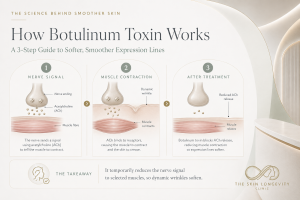
Why is the effect temporary? Botulinum toxin reduces acetylcholine release at selected nerve and muscle junctions, which weakens muscle contraction and softens movement related wrinkles. Movement gradually returns as nerve signalling recovers.
How does botulinum toxin work?
Facial muscles contract when nerves release acetylcholine at the junction between the nerve and muscle. Botulinum toxin temporarily reduces the release of this chemical signal, allowing selected muscles to contract less strongly3,4.
When the muscle beneath a movement related wrinkle becomes less active, the overlying skin folds less deeply. The effect remains temporary because nerve function gradually recovers and communication with the muscle is re established over time3,4.
In Singapore, botulinum toxin is a prescription only medicine that should be administered by a qualified medical practitioner using an appropriately approved product. Different formulations also have different characteristics and units, so they should not be treated as directly interchangeable1,13.
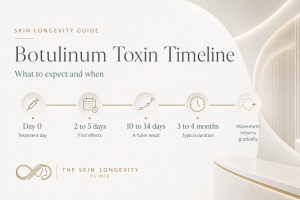
What happens after botulinum toxin treatment? Changes commonly begin within two to five days, become clearer around ten to fourteen days and gradually fade over several months rather than disappearing suddenly.
How soon does botulinum toxin start working?
A first change may be noticed within two to five days, although onset varies between individuals and formulations1,6. One clinical study of glabellar frown lines reported a median onset of approximately two days, but that finding came from a specific product and protocol and should not be applied universally7.
The early change often feels like reduced strength during frowning, squinting or lifting the brows. A person may still be able to move the treated area during this stage because the full effect has yet to develop1,4.
When does the full effect become visible?
The result usually develops more fully over approximately ten to fourteen days1,4. This is why a review around two weeks is generally more informative than judging the result during the first few days1.
Small differences between the two sides of the face may also become less noticeable as the effect settles. An earlier review may still be appropriate when there is pain, significant swelling, visual disturbance or another unexpected symptom, but routine aesthetic assessment is usually clearer after the treatment has had time to develop1,2.
How long does botulinum toxin last for wrinkles?
For forehead lines, frown lines and crow’s feet, the visible effect commonly lasts around three to four months.1,5. Reviews of aesthetic studies have found considerable variation, with some patients retaining improvement for four to five months and a smaller number reporting a longer response5.
The end of the effect is rarely a single moment. A person may first notice stronger movement, followed later by deeper folding of the skin and a gradual return towards the original appearance3,4.
If you’re comparing forehead lines, frown lines and crow’s feet can read Wrinkle Treatment in Singapore: Forehead Lines, Frown Lines and Crow’s Feet . That guide explains why brow position, eye shape and facial movement need to be assessed before treating an individual line.
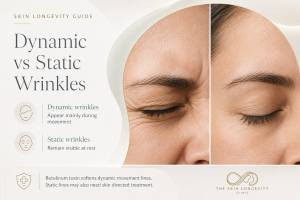
Why can a wrinkle remain even when the muscle has responded? Botulinum toxin primarily softens wrinkles caused by facial movement. A fixed line may remain visible because collagen loss and structural skin changes also contribute to the crease.
Dynamic wrinkles and static wrinkles do not age in the same way
Dynamic wrinkles appear mainly during expression and tend to respond more clearly to treatment that reduces muscle movement1,2. Static wrinkles remain visible when the face is resting because repeated folding has become combined with collagen loss, dermal thinning and other structural skin changes1,2.
A static crease can therefore remain visible even when the underlying muscle has responded well. This can make a successful treatment appear weaker or shorter lasting when the remaining concern is actually within the skin rather than the muscle.
The distinction is explained more fully in Dynamic vs Static Wrinkles: How to Tell the Difference. If you have fixed wrinkles, you will find ECM Skin Booster for Wrinkles Singapore: Evidence and Limits useful because it discusses treatments directed at dermal quality rather than muscle activity.

Why does botulinum toxin last longer for some people? Muscle strength, treatment area, intended movement, formulation, individual biological response and previous treatment history can all influence when movement becomes noticeable again.
Why does the duration vary between people?
Muscle size and activity
A larger or more active muscle may regain noticeable movement differently from a smaller muscle5,6. Frequent frowning, strong brow elevation or habitual squinting can also make the return of movement easier to notice5,6.
This does not mean the treatment has failed. It means the clinical effect is being observed against a different level of baseline muscle strength and daily activity.
Treatment area
Forehead lines, frown lines and crow’s feet are produced by different muscles with different functions. The duration and visible outcome therefore cannot be assumed to be identical across all three areas1,5.
The forehead also contributes to brow elevation, while muscles between the brows pull the brows down and inward. Treatment planning must therefore consider brow position and balance rather than pursuing maximum weakness in every muscle1.
Intended amount of movement
Some patients prefer a stronger reduction in movement, while others want only a subtle softening that preserves more expression. A conservative result may allow movement to become noticeable earlier even though the wrinkle remains improved1.
Duration should therefore be interpreted in relation to the original goal. A natural looking result and complete immobility are different treatment endpoints.
Product and formulation
Botulinum toxin products vary in formulation, biological activity and unit measurement1,5. Their units should not be compared directly, and results from a trial involving one formulation cannot automatically be transferred to another1,2,5.
A 2024 comparative study involving five formulations did not find a statistically significant difference in the duration of wrinkle improvement or masseter bite force reduction, although the study included only 50 participants9. Larger independent comparisons would be needed before concluding that all formulations behave identically2,9.
Individual biological response
People differ in their neuromuscular anatomy, muscle strength and response to the medicine4,6. Two patients receiving treatment on the same day can therefore notice different onset and duration without either result being abnormal.
Perception also plays a part. One person may define the end of treatment as the first return of movement, while another may consider the effect finished only when the wrinkles have returned close to baseline5,11.
Treatment history
Repeated treatment may produce a more consistent response in some patients, partly because the treated muscle can become less bulky or active over time5,11. Long term studies have generally found maintained efficacy across repeated treatment cycles, although an increasingly long duration cannot be promised for every person11.
Treatment history is therefore useful information during a consultation. A record of onset, two week response and return of movement gives a more accurate forecast than a population average.
Why might botulinum toxin seem to wear off early?
The first return of muscle movement is frequently mistaken for complete loss of effect. Partial movement can return while the muscle remains weaker than baseline and the wrinkle still looks softer3,5.
A fixed wrinkle may also remain visible throughout treatment because the skin has developed a permanent crease. In that situation, the muscle response may be satisfactory even though the surface line has not disappeared completely1,2.
Strong muscles, a deliberately subtle treatment plan and individual variation can also make the perceived duration shorter5,6. A review of photographs and movement at rest and during expression can help distinguish true early loss of effect from a difference in expectation.
True secondary nonresponse caused by neutralising antibodies appears uncommon in aesthetic use10. A systematic review found nil to insignificant rates in aesthetic indications, although the included reviews were heterogeneous and generally of low methodological quality10.
Can a larger treatment amount make the effect last longer?
Product specific dose ranging studies have found that larger treatment amounts can extend the median duration for selected frown lines8. These results cannot be converted into a universal instruction because the appropriate amount depends on the formulation, muscle strength, anatomy and desired degree of movement18.
A longer duration is also not automatically a better result. Excessive weakness can affect expression, brow position or nearby muscle balance, so treatment should aim for an appropriate outcome rather than the greatest possible duration1,2.
Can skincare make botulinum toxin last longer?
Skincare cannot prolong the temporary reduction in nerve signalling produced by botulinum toxin3,4. It can still improve hydration, surface texture, photodamage and the appearance of static lines, which may make the overall result look more complete.
Daily sunscreen and an appropriate skin care routine also help protect collagen from ultraviolet damage. These measures support the skin around a movement related wrinkle, although they do not determine when the treated muscle regains activity.
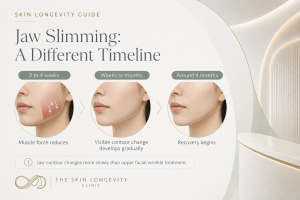
Why does jaw contour change more slowly than facial wrinkles? Masseter treatment reduces the activity of a large chewing muscle first. Visible lower face contour changes then develop gradually as muscle bulk changes over several weeks.
Keeping to the review schedule, avoiding very heavy exercise on treatment day and protecting the skin from sun help results last the expected three to four months.
Does Singapore’s heat make the effect wear off faster?
A 2024 study compared women receiving treatment for frown lines in Malta and the United Kingdom. Participants in the higher sun environment required a slightly greater treatment amount to achieve complete muscle paralysis, but the study did not directly show that heat caused a shorter duration and it did not involve patients in Singapore12.
Singapore’s climate should therefore not be used to predict an individual treatment interval. Anatomy, muscle activity, treatment plan and previous response remain more useful clinical guides5,6,12.
How long does botulinum toxin last for jaw slimming?
Jaw slimming treatment targets the masseter, which is substantially larger than the small muscles responsible for many upper facial wrinkles. Reduction in muscle activity can begin before a visible change in lower facial width becomes apparent9.
In one 2024 comparative study, the largest reduction in masseter bite force occurred between two and four weeks, with recovery towards baseline at about four months9. Jaw contour develops more gradually because visible slimming depends on a change in muscle bulk rather than only a reduction in facial expression9.
Readers considering treatment for a wider lower face can continue with Masseter Hypertrophy and Jaw Slimming in Singapore: Causes and Treatment Options. That article explains how muscle, bone, facial fat and skin laxity can each contribute to jaw width and why they require different approaches.
When should the results of botulinum toxin injections be reviewed?
A review at approximately two weeks allows the effect to develop before symmetry, movement and the original treatment goal are assessed1,4. This timing also helps separate a true residual muscle pattern from a result that was simply judged too early.
Follow up becomes even more useful across repeated treatments. Recording how quickly the effect appeared, when movement began returning and how the wrinkles looked at rest creates an individual treatment history that is more informative than a standard calendar interval.
How often should botulinum toxin treatment be repeated?
A fixed repeat schedule does not suit every patient. The appropriate interval depends on the treatment area, return of muscle activity, persistence of improvement, individual preference and the clinical reason for treatment1,5.
Retreatment should therefore follow reassessment rather than a countdown. Very frequent treatment intervals and unnecessary escalation should be avoided, particularly when the previous effect is still present10.
For a wider discussion of medical assessment, contraindications and possible complications, read Botulinum Toxin in Singapore: Areas, Results, Safety and Medical Assessment before deciding whether treatment is suitable. HSA also advises that botulinum toxin products require regulatory approval and should be administered by qualified medical practitioners rather than purchased as injectable kits online13.
Dr Rachel Ho’s clinical perspective on botulinum toxin results
I am cautious about promising a fixed number of months because duration differs more than online treatment charts suggest. A truthful range, a review at the right time and a record of how your own muscles respond provide more useful information than a guarantee.
I also ask patients what they mean when they say the treatment has worn off. The return of a little movement, the return of a visible wrinkle and the complete return to baseline are three different points in time.
A measured result should suit the person’s anatomy and preference rather than pursue immobility for as long as possible. Preserving the right amount of expression can be as important as softening the wrinkle itself.
Frequently asked questions
How soon does botulinum toxin start working?
A first change is often noticed within two to five days1,6,7. The effect continues to develop after this point, so the early appearance should not be treated as the final result.
When will I see the full effect?
The result commonly becomes clearer over approximately ten to fourteen days1,4. A two week review is therefore more useful than judging symmetry or strength during the first few days.
How long does botulinum toxin last for forehead wrinkles?
Forehead treatment commonly lasts around three to four months, although duration varies with the muscle, treatment plan and individual response1,5. Brow position and natural forehead movement should also be considered when assessing the result.
How long does it last for frown lines?
Frown line treatment commonly remains effective for approximately three to four months1,5. Selected studies have reported longer responses, but these results depend on the formulation, treatment amount and definition of improvement5,8.
How long does it last for crow’s feet?
Crow’s feet commonly improve for around three to four months, with individual variation1,5. Static eye area lines caused by skin ageing may remain visible even while the movement related component has improved.
Why did my treatment last less than three months?
Strong muscle activity, a subtle treatment goal, individual response and the definition used for wearing off can all influence perceived duration5,6. A clinical review can determine whether the muscle has genuinely returned to baseline or whether only partial movement has reappeared.
Can repeated treatments last longer?
Some patients experience more consistent or longer lasting effects after repeated treatment, possibly because the treated muscle becomes less active over time5,11. The evidence does not support promising that every treatment will last longer than the previous one.
Does Singapore’s weather shorten the result?
Current evidence does not establish that Singapore’s heat or humidity directly shortens treatment duration. One overseas study found slightly different treatment requirements in a high sun climate, but it did not prove faster wearing off and did not study Singapore residents12.
Can botulinum toxin permanently remove wrinkles?
The reduction in muscle activity is temporary, so movement gradually returns3,4. Dynamic wrinkles may soften substantially, while established static lines can require additional treatment directed at the skin itself1,2.
How often should treatment be repeated?
The interval should be based on the individual response, treatment area and clinical goal rather than a fixed online schedule1,5. Follow up assessment allows future treatment to be planned from actual experience instead of an average.
Conclusion
Botulinum toxin commonly begins working within a few days, develops more fully over about two weeks and lasts around three to four months for facial wrinkles1,4,5. Individual results can extend beyond this range or fade sooner because muscles, treatment areas, formulations and treatment goals are different.
The most useful timeline is therefore your own. A careful assessment, an appropriately timed review and a record of how movement returns provide a safer and more accurate basis for future treatment than any promise of a fixed number of months.
Scientific references
- Small R. Botulinum Toxin Procedures: A Practical Approach to Cosmetic Injections. American Family Physician. 2026;113(5):449 to 456.
- Camargo CP, Xia J, Costa CS, et al. Botulinum Toxin Type A for Facial Wrinkles. Cochrane Database of Systematic Reviews. 2021;(7):CD011301.
- Hallett M. One Man’s Poison: Clinical Applications of Botulinum Toxin. New England Journal of Medicine. 1999;341:118 to 120.
- Hallett M. Explanation of Timing of Botulinum Neurotoxin Effects, Onset and Duration, and Clinical Ways of Influencing Them. Toxicon. 2015;107:64 to 67.
- Flynn TC. Botulinum Toxin: Examining Duration of Effect in Facial Aesthetic Applications. American Journal of Clinical Dermatology. 2010;11(3):183 to 199.
- Nestor M, Ablon G, Pickett A. Key Parameters for the Use of AbobotulinumtoxinA in Aesthetics: Onset and Duration. Aesthetic Surgery Journal. 2017;37 Suppl 1:S20 to S31.
- Monheit GD, Baumann L, Maas C, et al. Efficacy, Safety, and Subject Satisfaction After AbobotulinumtoxinA Treatment for Moderate to Severe Glabellar Lines. Dermatologic Surgery. 2020;46(1):61 to 69.
- Kerscher M, Fabi S, Fischer T, et al. IncobotulinumtoxinA Demonstrates Safety and Prolonged Duration of Effect in a Dose Ranging Study for Glabellar Lines. Journal of Drugs in Dermatology. 2021;20(10):1052 to 1060.
- Sirisuthivoranunt S, Wongdama S, Phumariyapong P, et al. Comparative Study on the Duration and Efficacy of Various Botulinum Toxin Type A Injections for Reducing Masseteric Muscle Bite Force and Treating Facial Wrinkles. Dermatology and Therapy. 2024;14(5):1315 to 1325.
- Rahman E, Banerjee PS, Asghar A, Gupta NK, Mosahebi A. Botulinum Toxin Type A Immunogenicity Across Multiple Indications: An Overview Systematic Review. Plastic and Reconstructive Surgery. 2022;149(4):837 to 848.
- Rzany B, Flynn TC, Schlöbe A, Heinz M, Harrington L. Long Term Results for IncobotulinumtoxinA in the Treatment of Glabellar Frown Lines. Dermatologic Surgery. 2013;39(1 Pt 1):95 to 103.
- Borsky KL, Rodrigues JN, Rodrigues R. The Effect of Climate on the Dose Requirements of Botulinum Toxin A in Cosmetic Interventions. Plastic and Reconstructive Surgery. 2024;154(1):57e to 62e.
Singapore regulatory reference
- Health Sciences Authority Singapore. Consumer advisory on unapproved aesthetic injectable products and botulinum toxin supplied through online platforms. Updated 2024.