

19 Sep Sunscreen for Melasma in Singapore: SPF, UVA and Tinted Protection
You may already use sunscreen every morning and still wonder whether you have chosen the right one for your melasma. Is SPF 50 enough, does the tint matter, and how do you find a formula that looks natural and feels comfortable on your skin? Let’s work through what these labels mean and what to look for, so choosing sunscreen for everyday life in Singapore feels a little easier.
Sunscreen science explained
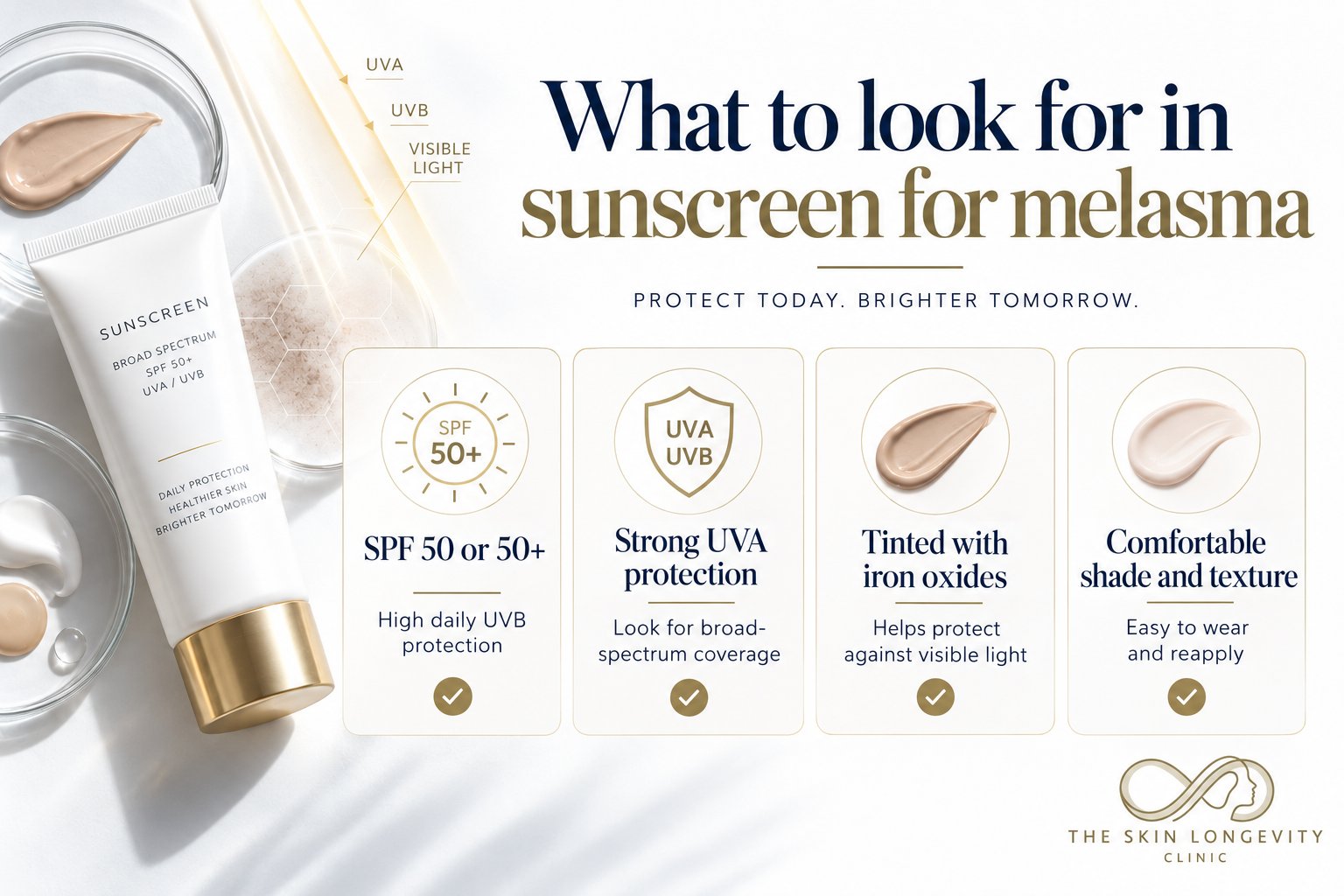
For melasma, choose a broad spectrum sunscreen with SPF 50 or 50+, strong UVA protection and iron oxide pigments for additional protection against visible light1,2. A tinted formula that meets these requirements and suits your skin tone is a practical choice for daily use, alongside shade and other sun protection measures1,2.
Sunscreen forms an important part of melasma treatment because sunlight can encourage existing patches to darken and contribute to recurrence1,3. Understanding what SPF, UVA ratings and tint actually provide helps you choose protection that addresses these concerns1,2.
Why sun protection matters for melasma
Melasma causes brown or grey brown patches, usually appearing symmetrically on the cheeks, forehead or upper lip3. Its development involves genetic susceptibility, hormonal influences and exposure to ultraviolet and visible light, which helps explain why pigmentation may return after initially improving1,3.
Visible light can produce persistent pigmentation, particularly in darker skin phototypes2. For people with melasma, protecting against this part of sunlight is relevant alongside protection against UVA and UVB1,2.
Our guide to melasma treatment in Singapore explains the condition and where different treatments fit. The focus here is choosing and using sunscreen as part of that longer term care.
SPF, UVA and visible light protection: what to look for
| What to check | What it tells you | What to look for with melasma |
|---|---|---|
| SPF | Protection against sunburn, which is mainly caused by UVB4. | SPF 50 or 50+1,2. |
| UVA rating | Protection against UVA, assessed separately from SPF4. | Strong UVA protection, such as PA++++, the highest category in the PA system4. |
| Broad spectrum | Coverage against both UVA and UVB4. | Check this alongside the SPF and UVA rating1,2. |
| Iron oxide tint | Pigments that can improve protection against visible light5,6. | A suitable shade, ideally with evidence of visible light protection for the finished formula6. |
SPF and PA ratings describe UV protection, rather than visible light protection4,6. Two products with similar UV ratings can therefore differ in the additional protection their pigments provide6.
For a broader explanation of sunscreen labels and formulations, read Dr Rachel Ho’s sunscreen guide. It also addresses common questions about choosing and using sunscreen.
Why tinted sunscreen can help melasma
Iron oxides are coloured pigments used in some tinted sunscreens and cosmetics to reduce the amount of visible light reaching the skin5,6. In an experimental study involving people with skin phototype IV, formulas containing iron oxides protected against visible light induced pigmentation more effectively than an untinted mineral SPF 50+ sunscreen5.
Is mineral sunscreen enough?
Zinc oxide can provide broad UV protection, including UVA4. However, many transparent mineral formulations offer limited visible light protection, so a mineral label alone does not establish the additional coverage relevant to melasma5,6.
The useful distinction is therefore the protection offered by the complete formula, rather than whether its UV filters are described as mineral or chemical1,6. A suitable tinted sunscreen combines effective UV protection with pigments that address visible light1,6.
Does every tinted sunscreen provide the same protection?
Visible light protection varies with the pigments, their concentrations and the overall formulation6. A tint is a useful feature to look for, but its presence alone cannot tell you exactly how much protection a product provides6.
Shade suitability also matters because an unacceptable colour can make consistent application difficult1,6. Choose a product that looks acceptable when applied generously, rather than judging its appearance from a very thin layer.
What clinical studies show about sunscreen and melasma
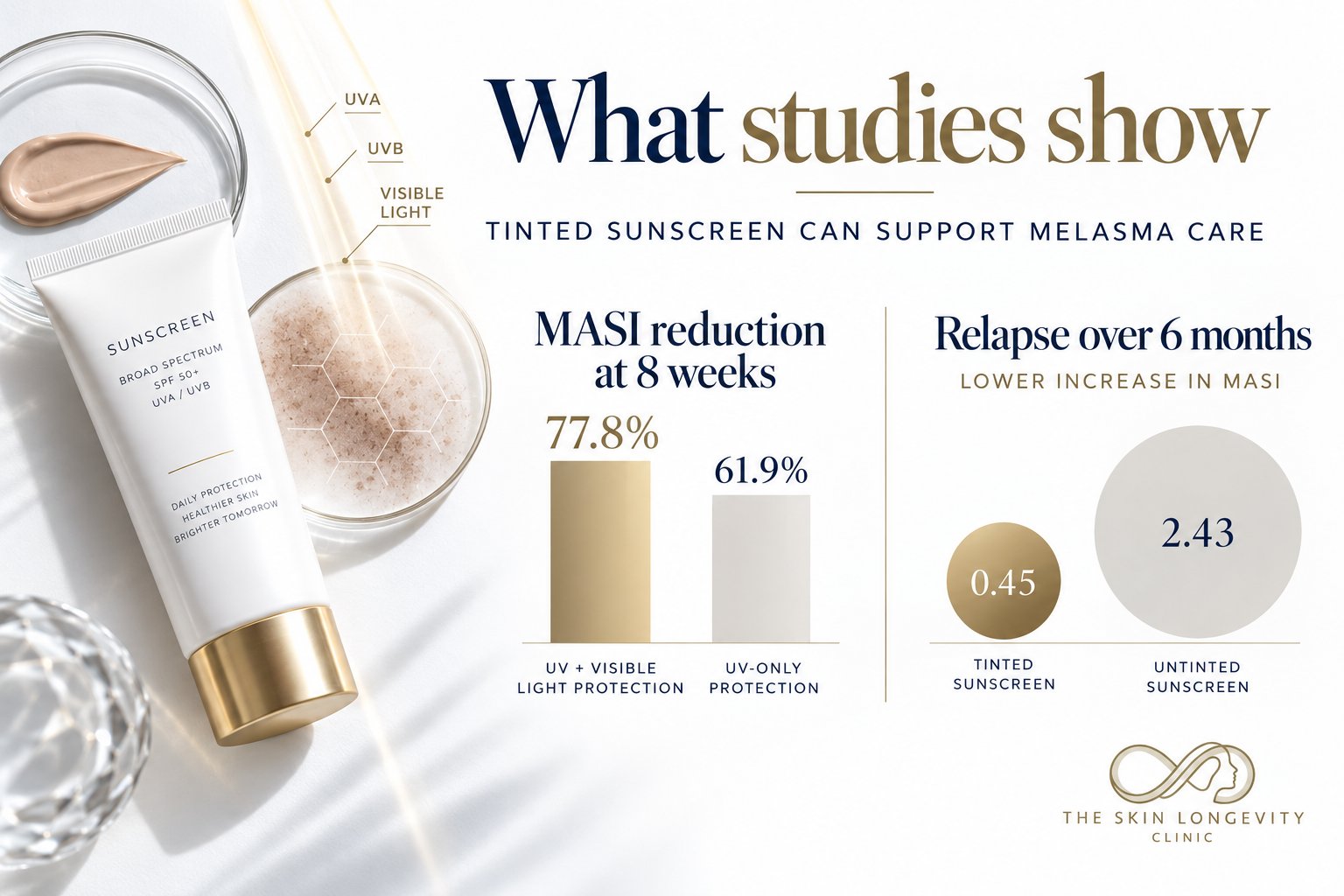
In an eight week randomised trial, patients used either a sunscreen protecting against UV and visible light or one protecting against UV alone, while everyone also received 4% hydroquinone3,7. Average melasma severity scores fell by 77.8% with UV and visible light protection, compared with 61.9% with UV protection alone3,7. These figures describe improvement in a clinical severity score during combined treatment, rather than the percentage of patients whose melasma disappeared7.
A separate six month randomised trial examined protection against melasma relapse8. The median increase in the Melasma Area and Severity Index, or MASI, was 0.45 with the tinted sunscreen, compared with 2.43 with the untinted sunscreen, indicating less worsening in the tinted sunscreen group8.
A systematic review of topical treatments also found that sunscreen covering both UV and visible light enhanced the efficacy of hydroquinone9. Together, these findings support sunscreen as an active part of a treatment plan, while established melasma may still require prescription treatment and ongoing review3,7,9.
How to use sunscreen for melasma in Singapore
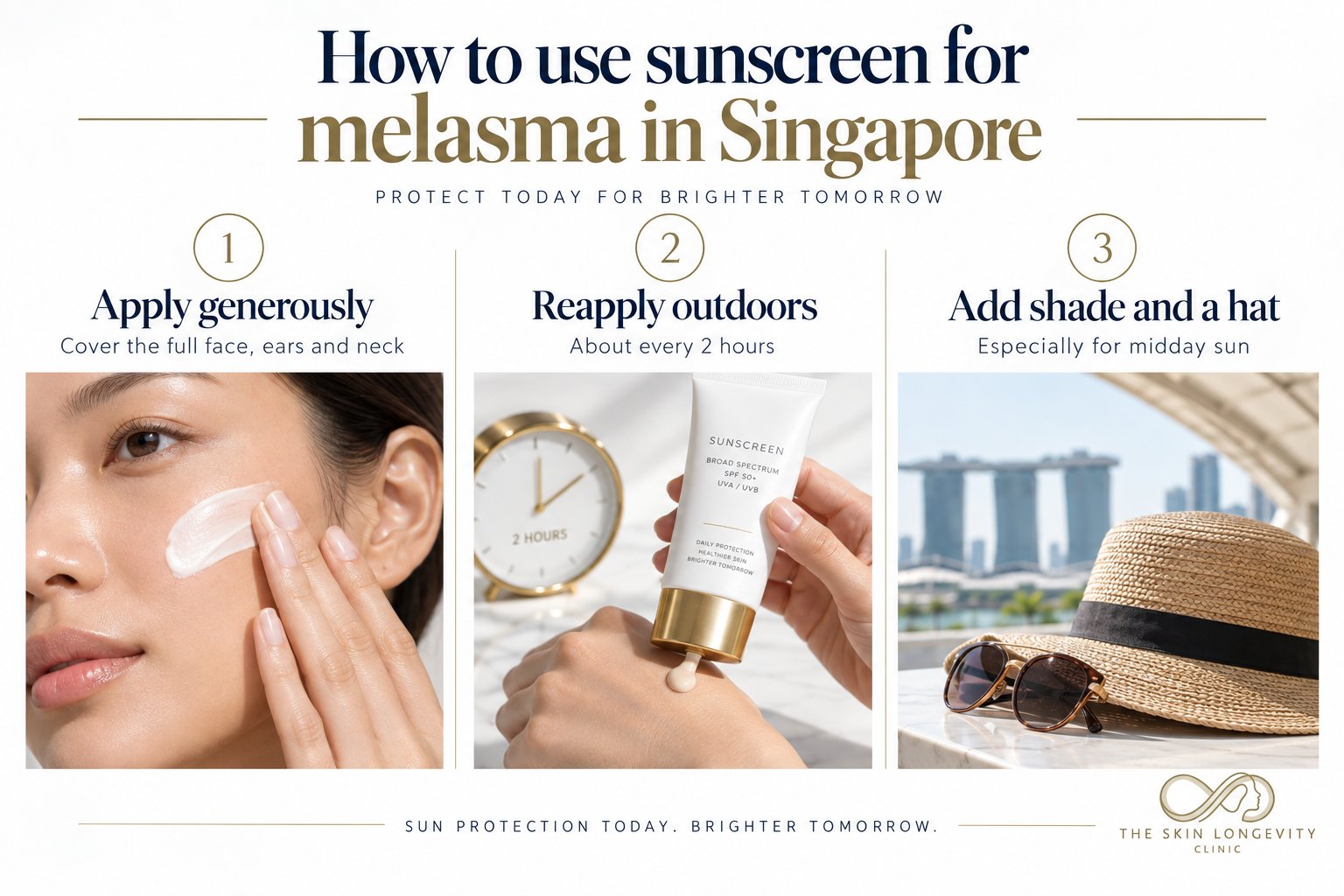
Choose a formula you can apply comfortably
A sunscreen’s texture, shade and tolerability influence how consistently it is used1,6. For daily use, choose a formula that feels comfortable at an adequate application amount and fits your skincare routine1,2.
Try the product across the face rather than relying only on a small colour swatch. Check whether the shade remains acceptable around the jawline and whether you can reapply it comfortably.
Apply an adequate, even layer
Sunscreen protection is tested at an application amount of 2 milligrams per square centimetre, and applying less can reduce the protection obtained2,4. Cover the face evenly, including areas beyond the visible melasma patches, and remember exposed ears and the neck2,4.
Follow the product’s application instructions before going outdoors. Building this into the morning routine can make it easier to remember before commuting, school drop offs or an outdoor lunch.
Reapply around outdoor exposure
Reapply approximately every two hours while outdoors, and sooner after swimming, heavy sweating or towelling4. For exercise or swimming, choose an appropriately water resistant formula and follow its reapplication instructions2.
In Singapore, consider where outdoor exposure occurs during your day, including the journey to work, lunchtime walks and weekend activities. These are useful moments to plan access to sunscreen, a hat or shade.
Use shade and clothing as well
A broad brimmed hat, shade and protective clothing complement sunscreen by reducing the amount of sunlight reaching the skin2,10. Photoprotection works best as a combination of measures adapted to your activities and exposure, rather than relying on sunscreen alone10.
For an outdoor meal or sporting event, choose shaded areas where practical and keep your sunscreen accessible. A routine that fits the activity is easier to maintain than one that depends on remembering it afterwards.
Common questions about sunscreen for melasma
Can I use foundation instead of tinted sunscreen?
Some foundations containing iron oxides provide additional protection against visible light, although performance varies between products5,6. A broad spectrum sunscreen remains the basis of UV protection; an iron oxide containing foundation applied over it can be an option when a suitable tinted sunscreen shade is difficult to find1,6.
Do I need sunscreen when I spend most of the day indoors?
UVA can pass through window glass, so time spent near daylight exposed windows is relevant when considering protection4. Plan your routine around actual exposure, including commuting and outdoor breaks, rather than treating every indoor setting as equivalent2.
Can sunscreen lighten existing melasma?
Sunscreen can reduce light driven pigmentation and improve the response to other melasma treatments1,7,9. Existing patches may need additional treatment, and improvement should be assessed over time rather than expecting sunscreen alone to remove them3.
Why does my melasma return even though I use sunscreen?
Melasma is influenced by hormonal and genetic factors as well as sunlight, and recurrence can occur despite treatment3. A review can assess the sunscreen’s UVA and visible light coverage, application habits and whether the wider treatment plan needs adjusting1,3.
Sunscreen before and after pico laser for melasma
Picosecond laser may be considered for selected patients as part of a broader melasma treatment plan3,11. A systematic review of randomised trials found that outcomes and adverse effects varied between laser wavelengths and protocols, supporting an individual assessment rather than treating every pico procedure as interchangeable11.
Sun protection remains important after improvement with laser, because treatment does not remove the underlying tendency for melasma to recur1,3. Our pico laser treatment page explains treatment suitability, while Dr Rachel Ho’s pico laser review examines the evidence, benefits and risks.
Ask your treating doctor which sunscreen to use and when to apply it after your particular procedure. Our pico laser downtime and recovery guide provides further information to help you prepare for aftercare.
Choosing protection that fits your treatment plan
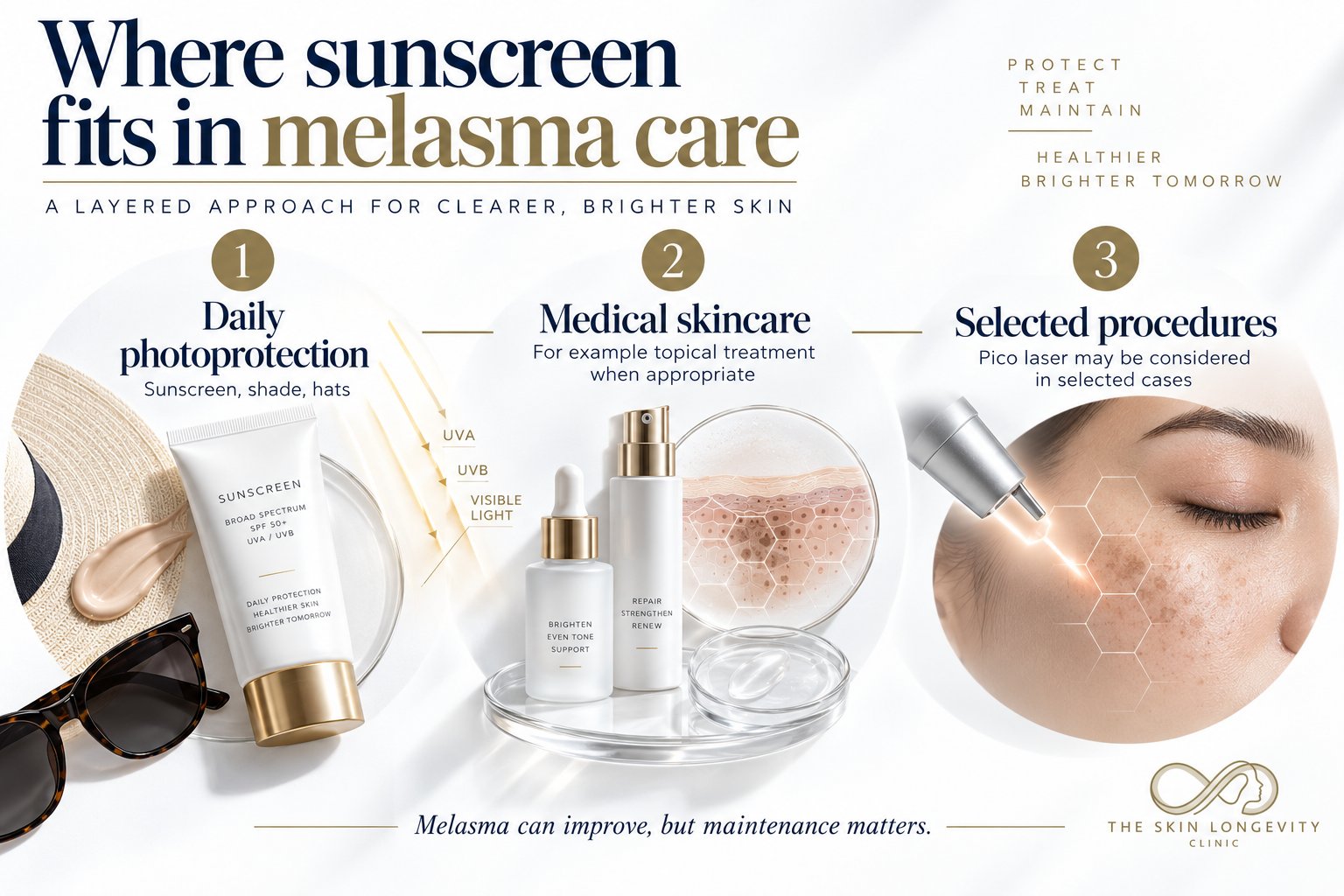
For melasma, the most useful sunscreen features are high SPF, strong UVA protection and suitable visible light protection, together with a formula you can use consistently1,2. These measures support treatment and maintenance, while persistent or changing pigmentation deserves an individual assessment3.
Bring your current sunscreen and skincare products to your consultation. Reviewing them together can help clarify what protection you already have and where a change may be useful.
References
-
Morgado Carrasco D, Piquero Casals J, Granger C, Trullàs C, Passeron T. Melasma: The need for tailored photoprotection to improve clinical outcomes. Photodermatology, Photoimmunology & Photomedicine. 2022;38(6):515 to 521. doi:10.1111/phpp.12783. PubMed
-
Passeron T, Lim HW, Goh CL, et al. Photoprotection according to skin phototype and dermatoses: practical recommendations from an expert panel. Journal of the European Academy of Dermatology and Venereology. 2021;35(7):1460 to 1469. doi:10.1111/jdv.17242. PubMed Central (PMC)
-
Gan C, Rodrigues M. An Update on New and Existing Treatments for the Management of Melasma. American Journal of Clinical Dermatology. 2024;25:717 to 733. PubMed Central (PMC)
-
Salih H, Psomadakis C, George SMC. Sunscreens: A narrative review. Skin Health and Disease. 2024;4(6):e432. doi:10.1002/ski2.432. Wiley Online Library
-
Dumbuya H, Grimes PE, Lynch S, et al. Impact of Iron Oxide Containing Formulations Against Visible Light Induced Skin Pigmentation in Skin of Color Individuals. Journal of Drugs in Dermatology. 2020;19(7):712 to 717. doi:10.36849/JDD.2020.5032. PubMed
-
He M, Chen X, Jin S, Zhang C. Visible Light Protection: An Updated Review of Tinted Sunscreens. Photodermatology, Photoimmunology & Photomedicine. 2025;41(4):e70033. doi:10.1111/phpp.70033. Wiley Online Library
-
Castanedo Cazares JP, Hernandez Blanco D, Carlos Ortega B, Fuentes Ahumada C, Torres Álvarez B. Near visible light and UV photoprotection in the treatment of melasma: a double blind randomized trial. Photodermatology, Photoimmunology & Photomedicine. 2014;30(1):35 to 42. doi:10.1111/phpp.12086. PubMed
-
Boukari F, Jourdan E, Fontas E, et al. Prevention of melasma relapses with sunscreen combining protection against UV and short wavelengths of visible light: a prospective randomized comparative trial. Journal of the American Academy of Dermatology. 2015;72(1):189 to 190.e1. doi:10.1016/j.jaad.2014.08.023. PubMed
-
Pennitz A, Kinberger M, Avila Valle G, et al. Self Applied Topical Interventions for Melasma: A Systematic Review and Meta Analysis of Data From Randomized, Investigator Blinded Clinical Trials. British Journal of Dermatology. 2022;187(3):309 to 317. doi:10.1111/bjd.21244. PubMed
-
Álvarez Bobillo Z, Gracia Cazaña T, Gilaberte Y, Lim HW. What’s New in Photoprotection? American Journal of Clinical Dermatology. 2026;27:683 to 695. Springer Link
-
Feng J, Shen S, Song X, Xiang W. Efficacy and safety of picosecond laser for the treatment of melasma: a systematic review and meta analysis. Lasers in Medical Science. 2023;38:84. Springer Link