


10 Sep Pico Toning vs Fractional Pico Laser: What Is the Difference?
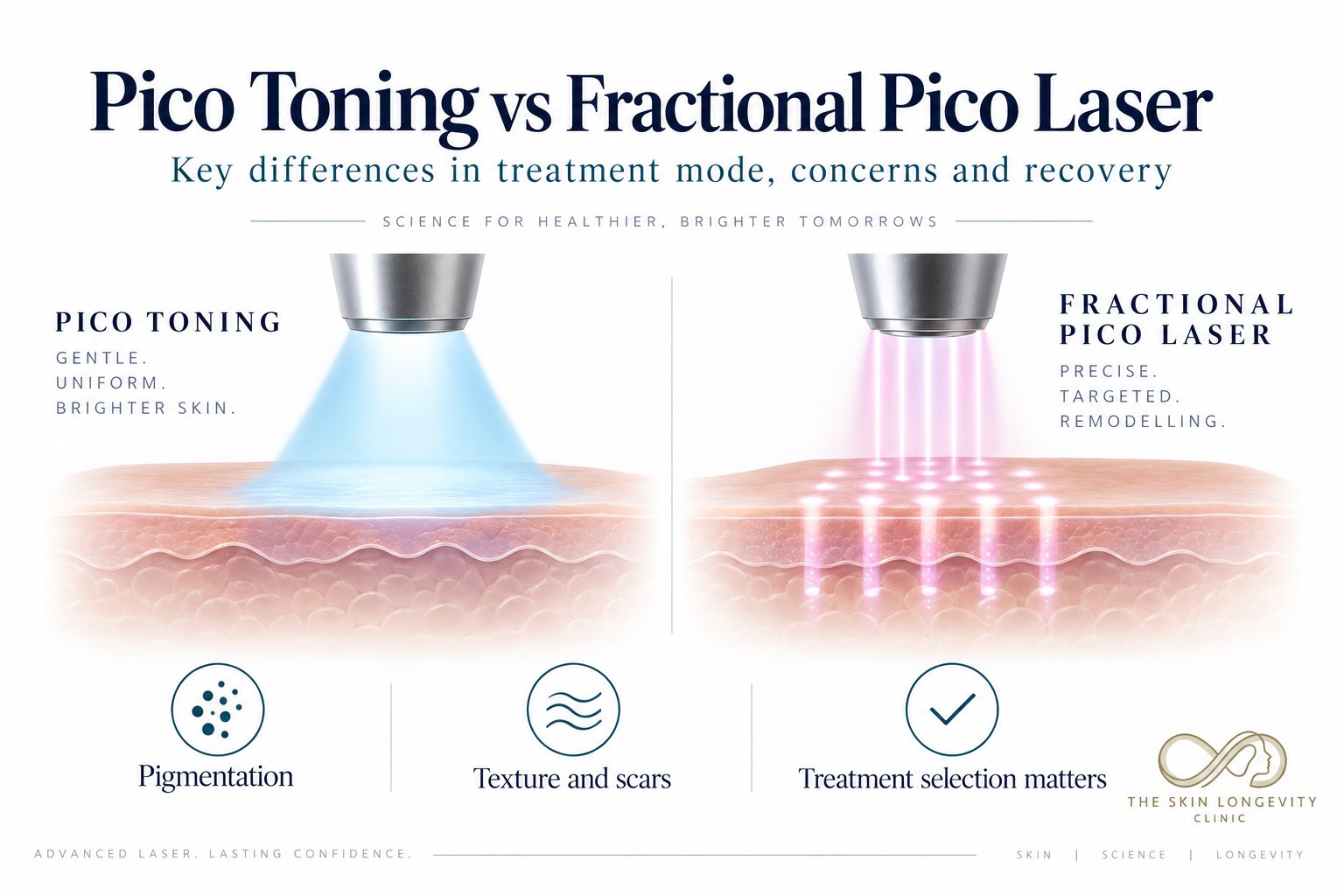
Pico toning uses lower energy laser passes over a broader area for selected pigmentation concerns1. Fractional pico laser uses specialised optics to concentrate energy into microscopic treatment zones, with studies examining improvements in acne scars, pores and texture2,3. The main difference is how the energy reaches the skin and what the treatment is intended to change.
For someone comparing pico laser treatments in Singapore, understanding the proposed mode helps make sense of the recommendation. Ask whether the priority is lighter pigmentation, smoother texture or both, and how the doctor plans to assess that change.
Pico toning and fractional pico laser at a glance
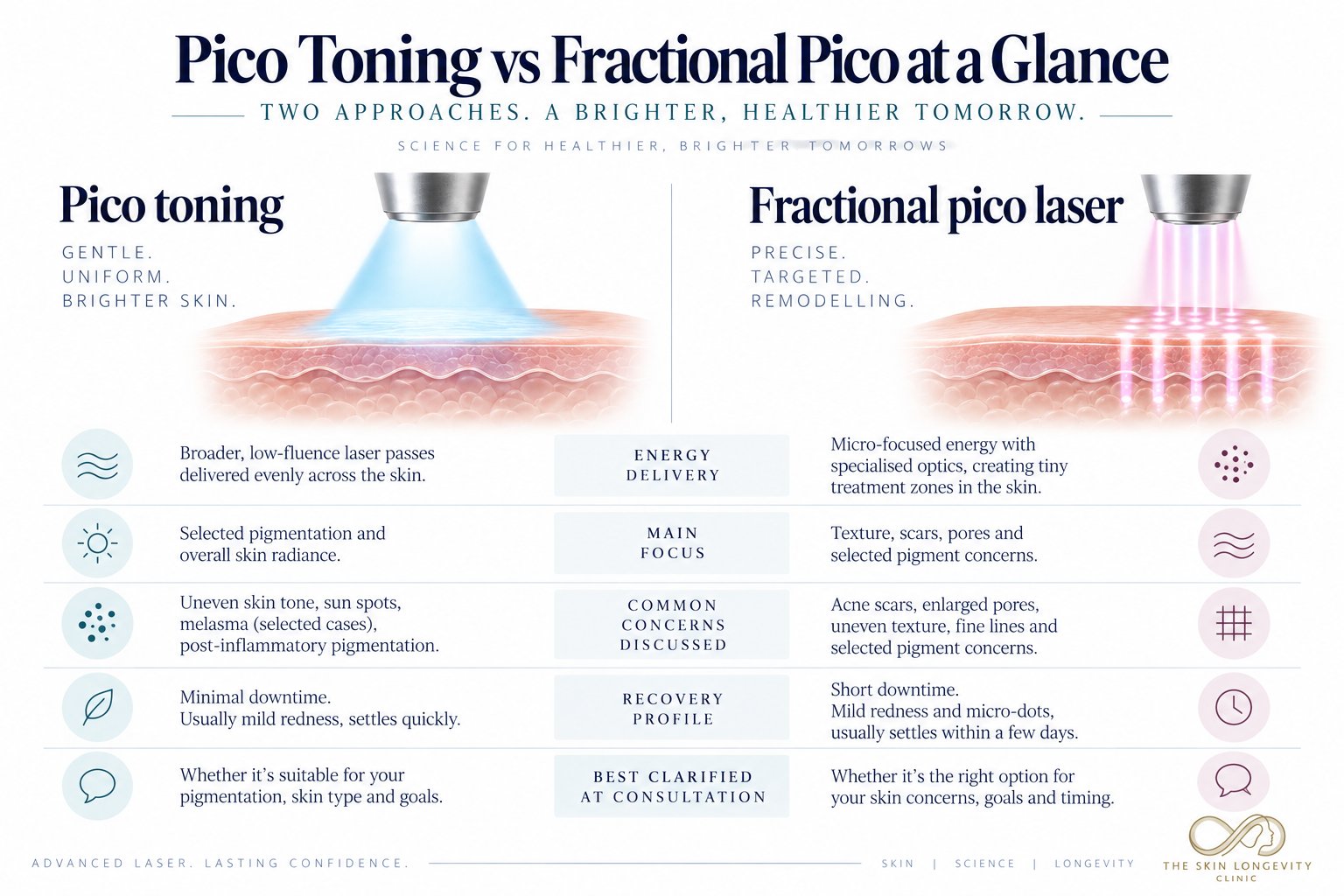
| Feature | Pico toning | Fractional pico laser |
|---|---|---|
| Energy delivery | Lower energy treatment without a fractional lens1. | Specialised optics create concentrated microspots surrounded by areas receiving less energy2,3. |
| Main treatment discussion | Selected pigmentation concerns, including melasma1. | Indented acne scars, texture and pore appearance, with some protocols also studied for pigmentation3,5,6. |
| What the name describes | A treatment approach using lower energy passes1. | The microscopic pattern in which energy is delivered2. |
| What to clarify | Which pigmentation condition is being treated and why toning is appropriate. | Which feature needs remodelling and what the particular fractional system has been studied to improve. |
The treatment name should be accompanied by an explanation of the wavelength, handpiece and intended outcome. Dr Rachel Ho’s review of pico laser provides a broader discussion of the technology, its evidence and its limitations.
What happens during pico toning?
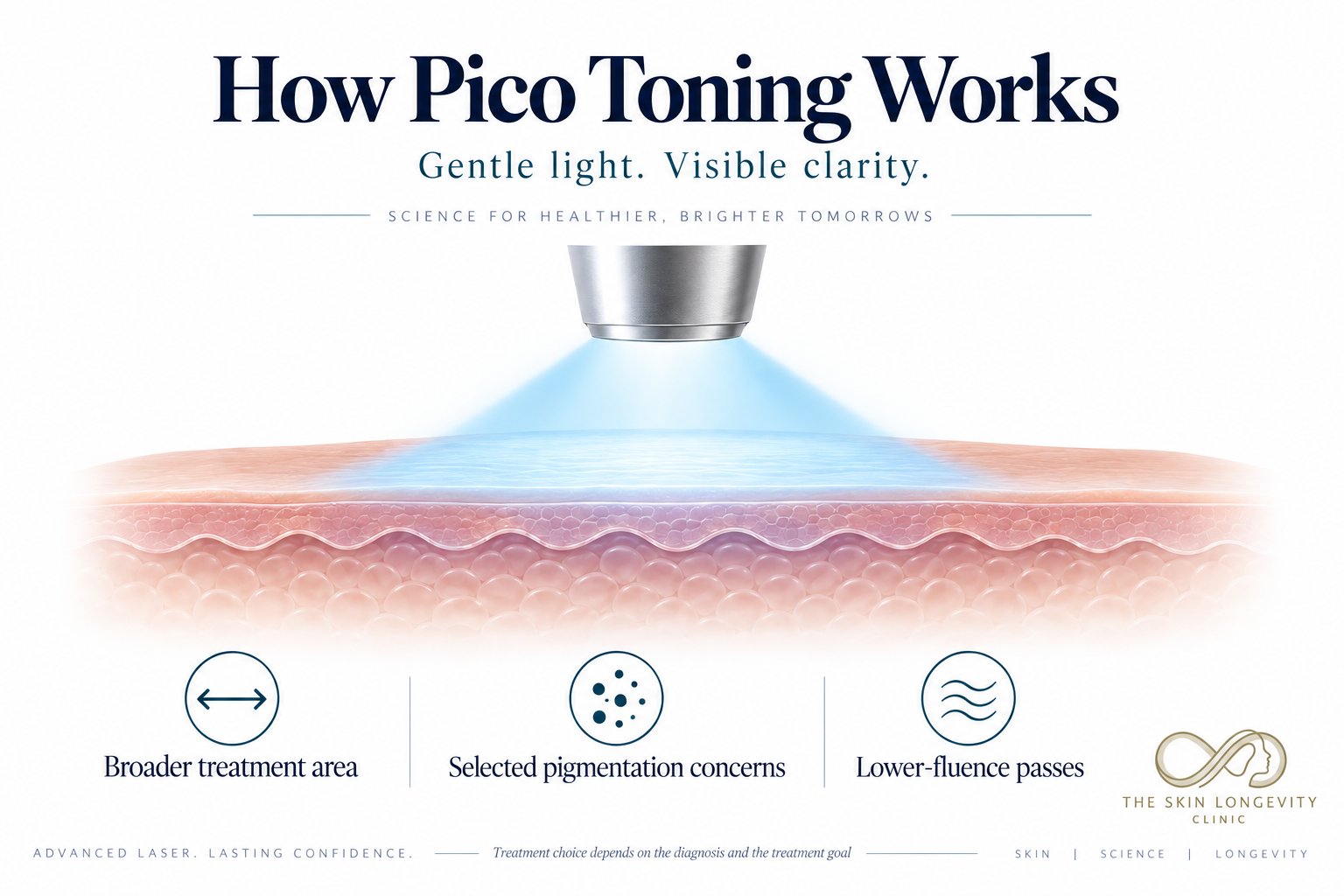
Pico toning commonly refers to treatment using a lower energy, nonfractional beam for pigmentation1. Published research includes low fluence 1064 nm picosecond treatment, where fluence describes the energy delivered per unit area of skin1.
Ask which pigment condition the doctor has identified and how the proposed treatment addresses it. A recommendation should explain the expected change rather than rely on a general promise of brighter skin.
What happens during fractional pico laser?
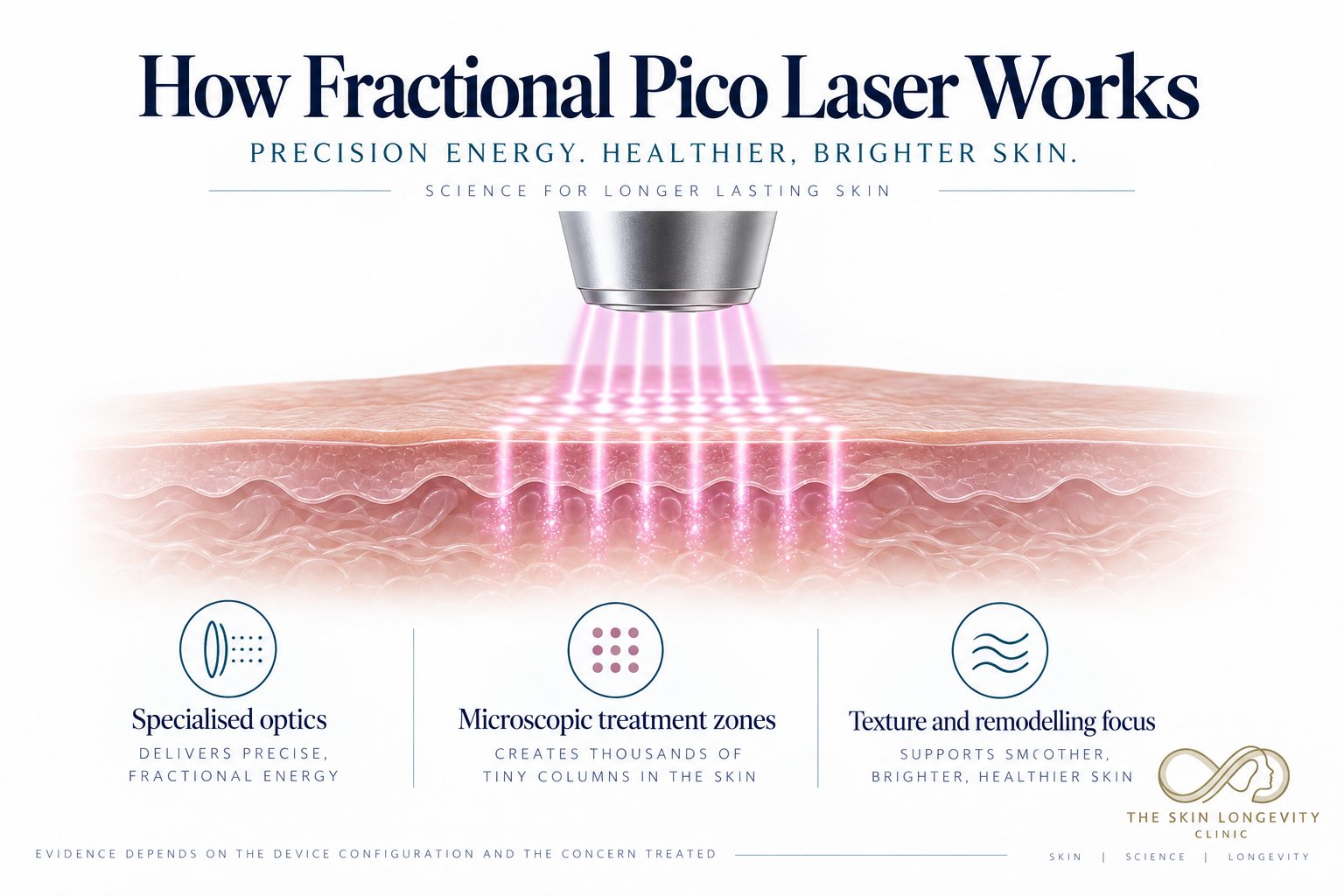
A fractional lens redistributes the laser energy into a pattern of concentrated microscopic spots2,3. Tissue studies have demonstrated tiny cavities within the skin, described as laser induced optical breakdown, alongside changes associated with tissue repair and remodelling2. The response varies with the delivered energy and the skin’s pigment content2.
Fractional describes this microscopic delivery pattern rather than the size of the facial area being treated2. A fractional session can therefore cover a broader area while still concentrating energy into separate microspots2,3.
Where does targeted treatment for individual dark spots fit?
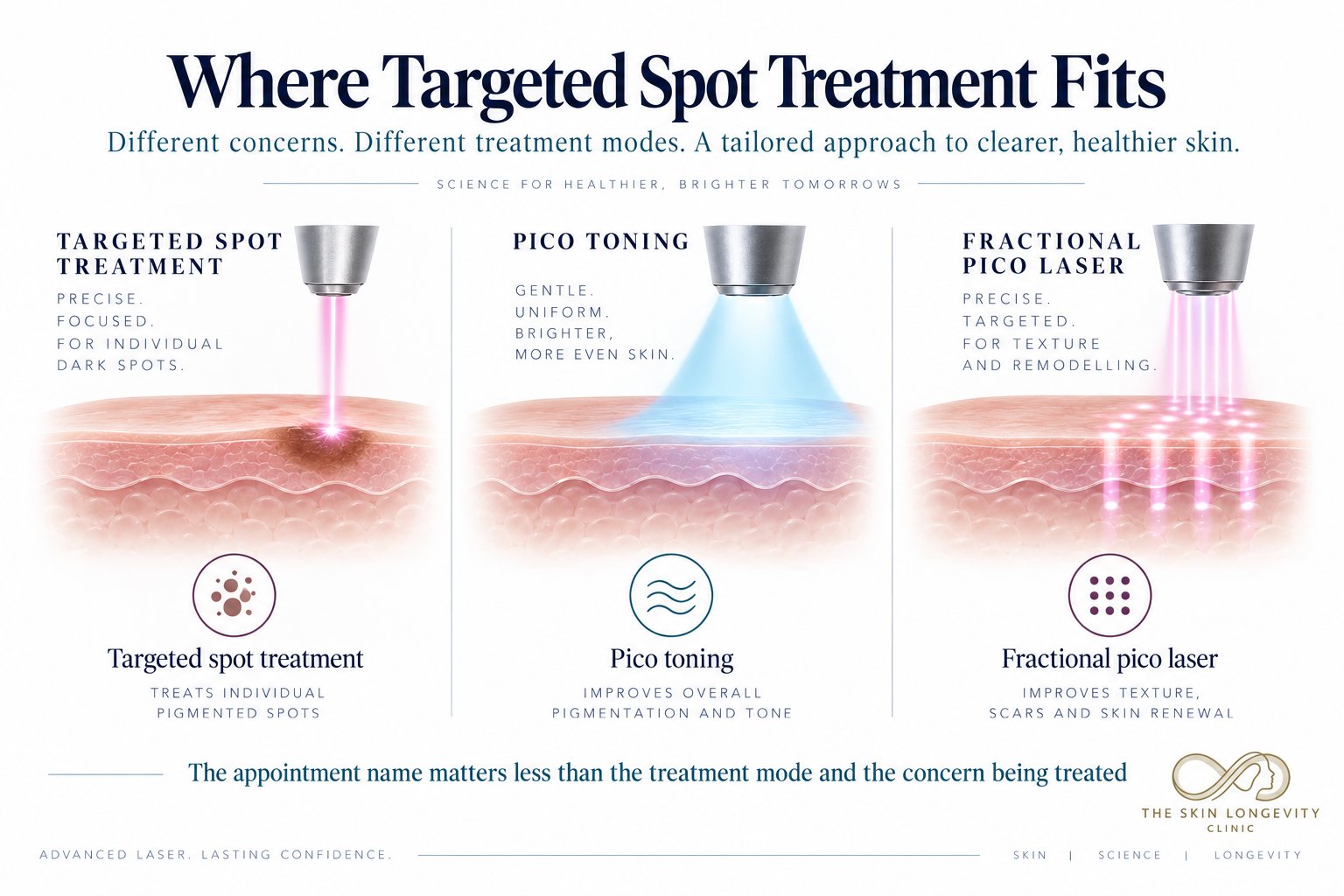
Treatment directed at individual sun spots is another approach, distinct from broader toning or fractional treatment for texture4. In a randomised study of twenty patients, a targeted 532 nm picosecond laser improved solar lentigines, commonly called sun spots, after one treatment4.
That finding applies to the lesions and treatment studied rather than every brown patch4. When comparing quotations, clarify whether individual spots will receive targeted treatment or whether the appointment covers broader toning alone.
Is pico toning or fractional pico better for pigmentation?
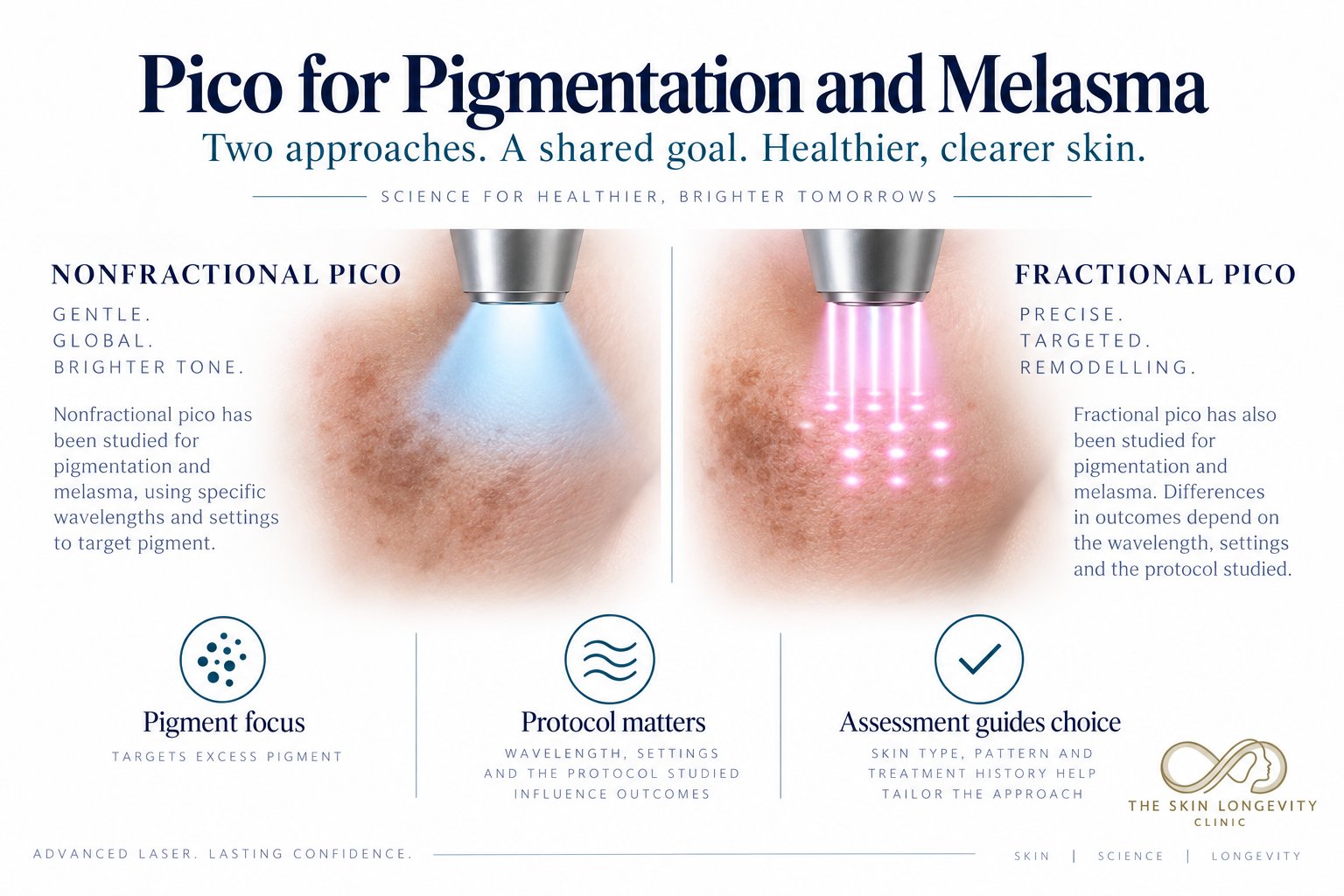
Both nonfractional and fractional picosecond treatment have been studied for melasma, with results depending on the particular protocol1,5. A randomised study of eighteen people compared a 755 nm picosecond laser with a fractional lens on one side of the face and without that lens on the other5. Both sides improved, with no statistically significant difference in pigment clearance, while the nonfractional side had fewer episodes of post inflammatory darkening5.
These findings relate to that wavelength and treatment schedule rather than establishing a universal preference for either mode5. Ask the doctor to explain the evidence relevant to your pigmentation and the proposed configuration.
Our melasma treatment guide discusses how laser treatment fits into a wider care plan. Use that discussion to clarify the role of skincare and ongoing review alongside the procedure.
Which approach is studied for acne scars and pores?
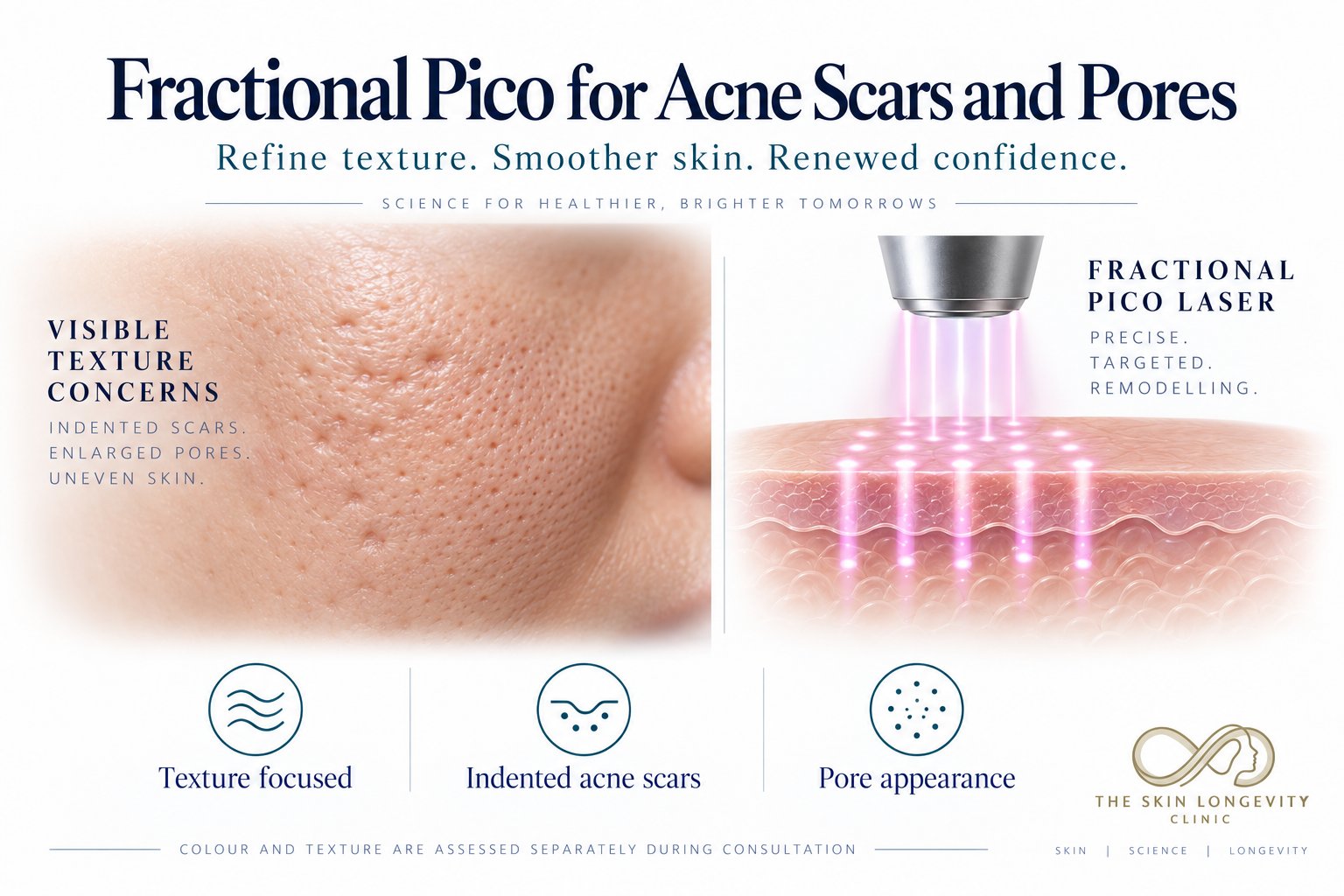
Fractional pico laser has been studied for changes in skin texture and indented acne scars3. A prospective study that included ten people treated for acne scars found improvement in scar assessments after fractional 1064 nm treatment3. The study lacked an untreated comparison group, which limits the conclusions that can be drawn about the size of the benefit3.
A separate study of twenty five people with enlarged pores found a reduction in measured pore size after three fractional treatments6. Improvement continued during follow up, but the study did not compare fractional treatment with pico toning6. Its findings therefore support a potential role for fractional treatment without establishing its superiority for every patient6.
During consultation, ask the doctor to assess colour and surface texture separately. Our guide to acne marks and acne scars explains why a concern described as an acne scar may lead to different treatment discussions.
Can pico toning and fractional treatment be combined?
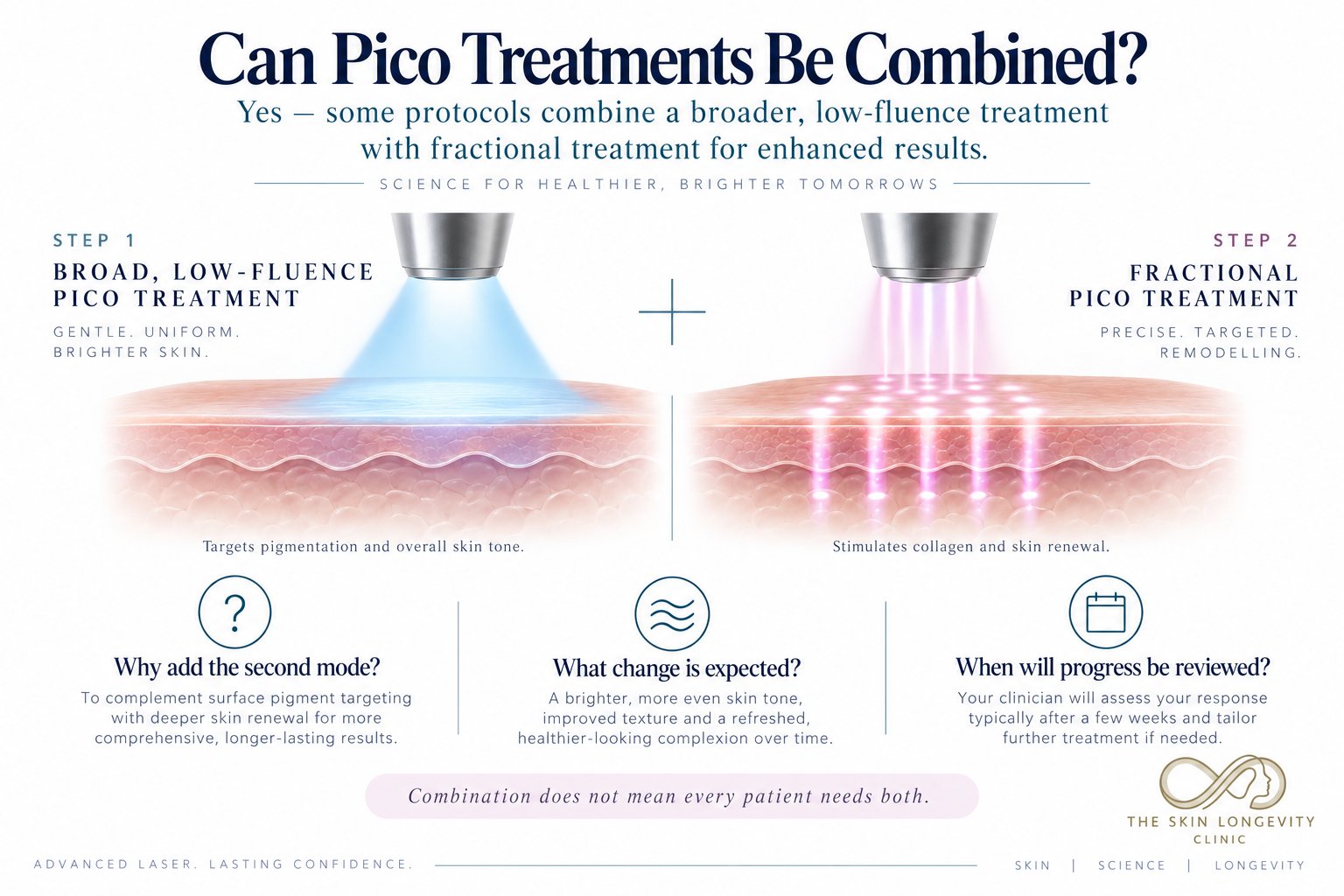
Combination protocols have been investigated, including a 2025 study of thirty patients with melasma who received low fluence treatment alone on one side and treatment incorporating a microlens array on the other1. Texture and pore measurements improved on the combination side, while the difference in measured spot reduction between sides was not statistically significant1.
This small study supports further investigation of selected combinations rather than adding both modes to every appointment1. Ask what the additional treatment is expected to contribute and how that benefit would be reviewed.
Does fractional pico laser involve more discomfort or downtime?
Recovery should be discussed for the specific protocol rather than inferred from the word pico. Reported reactions after fractional treatment include temporary redness, itching and pinpoint bruising3. Pigment changes were also recorded in the study comparing fractional and nonfractional treatment for melasma5.
Tell the doctor about your previous reactions to lasers and any upcoming events before agreeing to treatment. Ask what changes are expected with the proposed settings and when the clinic would want to review an unexpected response.
Our pico laser downtime and recovery guide covers aftercare in more detail. Follow the instructions given for your own procedure rather than using another patient’s recovery as a timetable.
Can results from one fractional device be applied to another?
Published studies use different wavelengths and optical systems, including 755 nm fractional lens arrays and 1064 nm diffractive or microlens systems2,3,6. Those differences mean that a result reported with one configuration should be interpreted in the context of the device, settings and condition studied2,3,6.
Ask which handpiece is proposed and whether the evidence being discussed relates to that treatment. This is more informative than comparing appointments by the machine name alone.
Choosing pico toning or fractional pico laser in Singapore
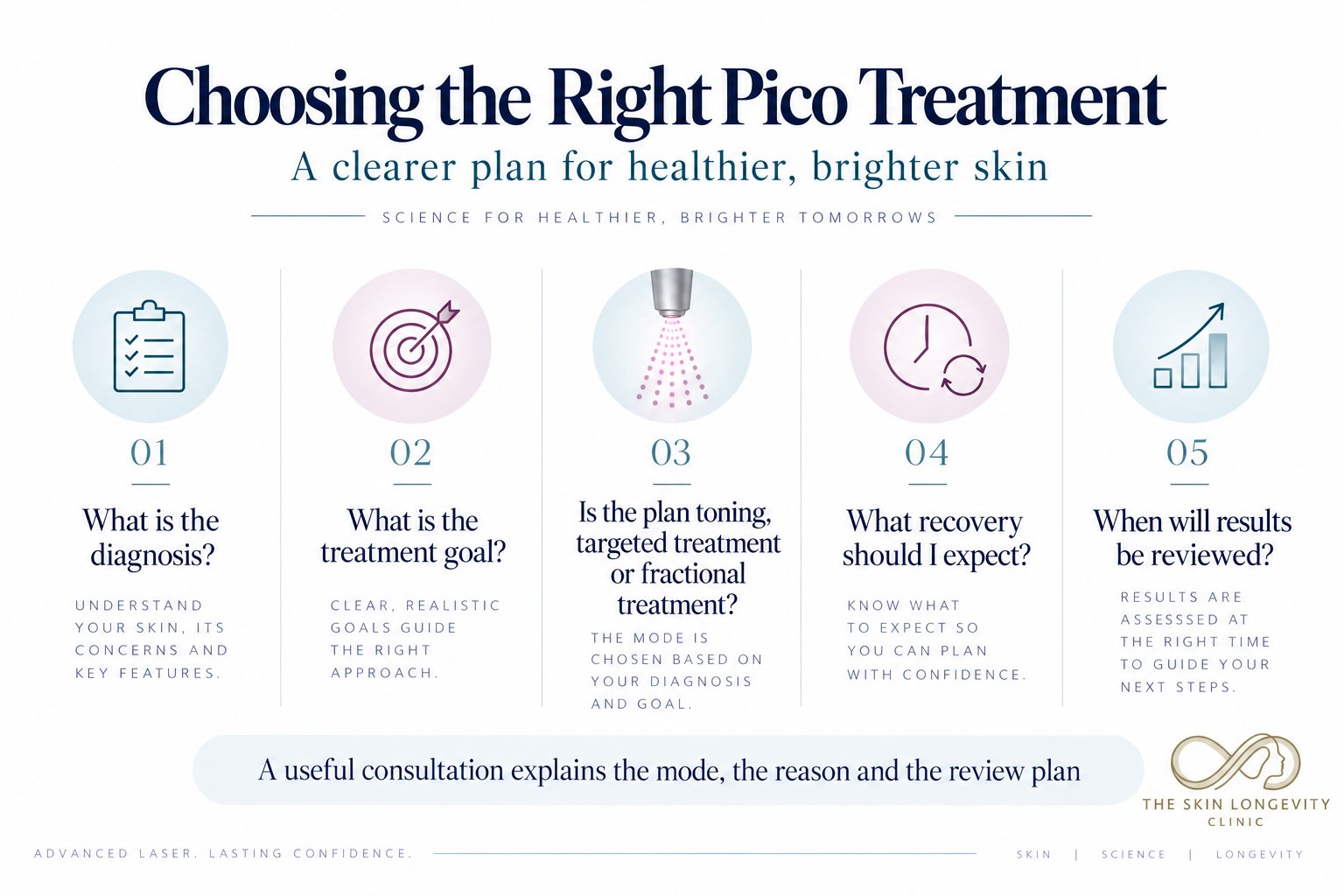
Before booking, ask the doctor to identify the concern being treated, explain the selected mode and describe the change that would count as a useful result. Clarify whether the plan includes toning, individual spot treatment, fractional treatment or a combination.
Our pico laser treatment guide explains the assessment at The Skin Longevity Clinic. For questions about progress, read pico laser results and session planning alongside the recommendation.
A written quotation should specify the treatment mode, area covered, proposed course and review arrangements. Our pico laser price guide explains what to compare, so the decision rests on the treatment being offered rather than the price of an unspecified session.
References
-
Wu X, Wang X, Lin X, et al. Efficacy and safety of low fluence 1064 nm picosecond laser with or without micro lens arrays for melasma treatment: a randomized, split face controlled study. Lasers in Medical Science. 2025;40:387.
-
Tanghetti EA. The histology of skin treated with a picosecond alexandrite laser and a fractional lens array. Lasers in Surgery and Medicine. 2016;48:646 to 652.
-
Lee CH, Jin EM, Seo HS, Ryu TU, Hong SP. Efficacy and Safety of Treatment with Fractional 1064 nm Picosecond Laser with Diffractive Optic Element for Wrinkles and Acne Scars: A Clinical Study. Annals of Dermatology. 2021;33:254 to 262.
-
Kim JY, Yang JH, Huh G, Choi YJ, Kim WS. A Split Face, Single Blinded, Randomized Controlled Comparison of 532 nm Picosecond Neodymium Doped Yttrium Aluminum Garnet Laser versus 532 nm Q Switched Neodymium Doped Yttrium Aluminum Garnet Laser in the Treatment of Solar Lentigines. Annals of Dermatology. 2020;32:8 to 13.
-
Manuskiatti W, Yan C, Tantrapornpong P, Cembrano KAG, Techapichetvanich T, Wanitphakdeedecha R. A Prospective, Split Face, Randomized Study Comparing a 755 nm Picosecond Laser With and Without Diffractive Lens Array in the Treatment of Melasma in Asians. Lasers in Surgery and Medicine. 2021;53:95 to 103.
-
Palawisuth S, Manuskiatti W, Apinuntham C, Wanitphakdeedecha R, Cembrano KAG. Quantitative assessment of the long term efficacy and safety of a 1064 nm picosecond laser with fractionated microlens array in the treatment of enlarged pores in Asians: A case control study. Lasers in Surgery and Medicine. 2022;54:348 to 354.