


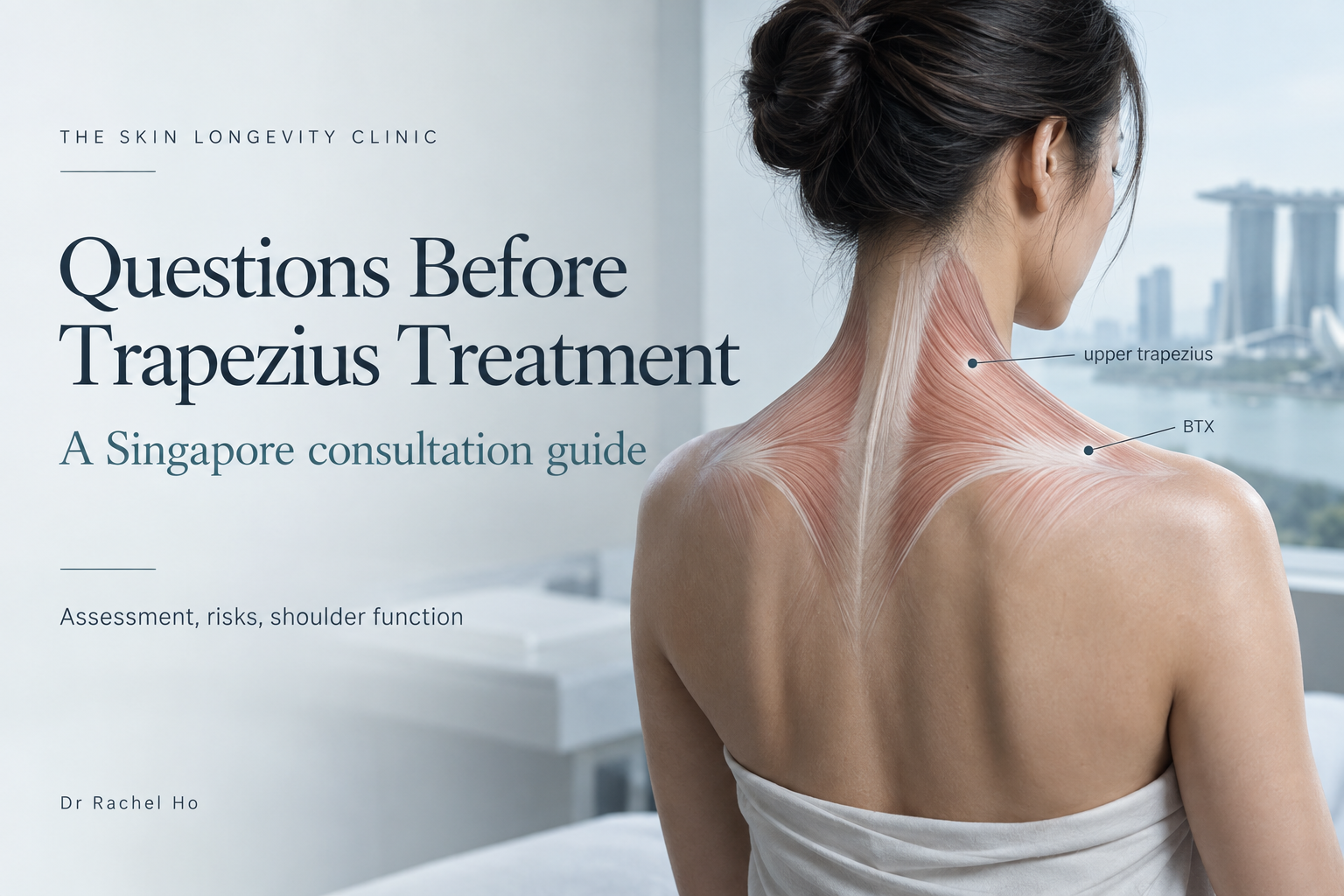
05 Sep Questions Before Trapezius BTX Treatment in Singapore
TrapTox, also written as trap tox, is an informal name for botulinum toxin type A injections into the upper trapezius muscles. The cosmetic aim is to reduce muscular prominence around the neck and shoulders by reducing muscle activity and, gradually, muscle bulk¹,².
Before considering shoulder slimming in Singapore, it is worth understanding what contributes to your shoulder shape and what treatment might change. A consultation should also address shoulder function, particularly when lifting, exercise or physical work forms part of your routine³.
These questions can help you prepare for an assessment before TrapTox. The aim is to leave with a clear understanding of your options, whether you proceed with treatment or decide to hold off trapezius BTX injections.

Consultation checklist for trapezius treatment in Singapore covering realistic change procedure shoulder strength review timing and urgent symptoms
1. Is the trapezius muscle causing the appearance I want to change?
The upper trapezius contributes to the slope between the neck and shoulders, but shoulder proportions also reflect the underlying skeleton and surrounding tissues. Treatment directed at muscle activity can alter muscle contour, rather than narrow shoulder bones or increase actual neck length¹,³.
An assessment should consider the shoulders at rest and during movement, including symmetry, existing weakness and previous injuries. Pain or difficulty moving the arm may require a broader neck and shoulder examination⁴.
Ask the doctor to identify which features are likely to change and which will remain. Our guide to enlarged shoulders and trapezius hypertrophy provides background on this assessment.
2. Are we discussing shoulder contouring, neck pain or both?
Appearance and pain are different treatment goals. A study showing a reduction in trapezius size does not establish that the same treatment reliably relieves neck pain².
A 2026 Cochrane review involving 16 trials and 855 participants found that botulinum toxin may provide a small improvement in persistent neck pain over the short term. Benefits for daily function and longer term outcomes were limited or uncertain, and the studies examined varied neck pain conditions rather than one cosmetic TrapTox protocol⁵.
When discomfort is the main concern, ask about the likely diagnosis and whether physiotherapy, exercise or another medical assessment should come first. Neck pain can involve muscles, joints, discs or nerves, so a feeling of tightness alone is insufficient to identify the appropriate treatment⁴.
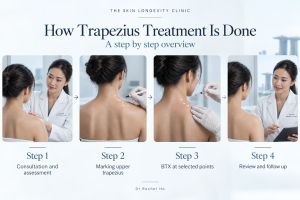
A trapezius BTX treatment plan usually begins with consultation and assessment, followed by marking, injection at selected points and clinical follow up.
3. How is trapezius botulinum toxin treatment performed?
After assessment and consent, the skin is cleansed and selected treatment sites are marked over the upper trapezius. A fine needle delivers the prescribed medicine into the muscle at several points, with placement determined by the treatment plan⁶,⁷.
Some published techniques use ultrasound to measure muscle thickness and guide injection. The available research does not establish that ultrasound is required for everyone or that it eliminates complications⁶.
Ask who will perform the procedure, how the injection sites are selected and whether imaging would add useful information in your case. It is also reasonable to ask about discomfort, pain relief and the aftercare instructions you will receive.
4. What results can I expect from TrapTox, and when should results of BTX trapezius be assessed?
Visible contour change develops gradually after botulinum toxin injections to the trapezius muscle, so the result should be assessed over weeks rather than immediately after treatment. A 2025 retrospective study of 22 patients who had trapezius BTX reported reduced trapezius measurements at one, three and six months².
That study had no untreated comparison group and was too small to reliably assess uncommon complications. Its findings also cannot guarantee a particular degree of shoulder slimming or establish how an individual patient’s sporting performance will be affected².
Agree on what improvement would count as worthwhile and when the outcome will be reviewed. Our article on how long botulinum toxin lasts provides broader context, although timing for facial expression lines should be distinguished from changes in shoulder muscle contour.
A 2024 systematic review in the Journal of Plastic, Reconstructive & Aesthetic Surgery examined the published evidence behind the trapezius botulinum toxin trend and found it limited10.
5. How is the dose for trapezius BTX decided?
Botulinum toxin preparations have product specific potency units. Unit numbers should not be treated as interchangeable between preparations, which makes a unit count alone an incomplete basis for comparing treatment plans⁸.
Ask how the proposed amount relates to your anatomy, intended change and previous treatment. Bring details of recent BTX injections elsewhere, including the dates and treatment areas, so the doctor can consider the overall treatment history.
Alongside the amount, ask whether the proposed use is within the particular medicine’s registered indications in Singapore. Where it falls outside those indications, discuss the supporting evidence, uncertainties and alternatives before deciding.
6. Could treatment weaken my shoulders, and what increases my risk?
Reducing muscle activity is the mechanism of treatment, and unwanted weakness is a possible consequence. The trapezius contributes to shoulder blade control, making its function relevant even when the reason for treatment is cosmetic¹,³.
In a study involving 20 women after trapezius BTX, one participant experienced temporary weakness during the first month. This small study cannot provide a dependable estimate of an individual patient’s risk⁶.
The discussion should cover bruising, tenderness, unwanted effects on nearby muscles and an unsatisfactory appearance. An unwanted muscle effect may take time to settle as nerve function recovers, rather than being immediately reversible¹,⁷.
Tell the doctor about existing weakness, neuromuscular conditions, previous reactions, medicines and supplements. Pregnancy, breastfeeding and any history of swallowing or breathing problems should also be discussed before an elective procedure is considered⁷.
7. When can I return to exercise or physical work after botulinum toxin injections to the trapezius muscle?
Recovery of the injection sites and readiness for demanding exercise are separate considerations. Comfortable movement at rest does not establish that the shoulders will tolerate heavy lifting or repeated overhead activity³.
The cosmetic studies cited here do not establish a validated timetable for returning to strenuous training²,⁶. Ask your doctor for an activity plan and clear advice about when new weakness, unusual fatigue or difficulty with familiar movements should prompt review.
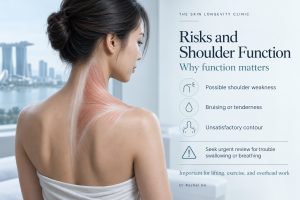
Because the trapezius contributes to shoulder movement, discussions about BTX should include possible weakness, tenderness, contour dissatisfaction and when urgent review is needed.
8. What follow up is provided, and what are the side effects of trapezius BTX?
Find out when the clinic will assess the result and how to arrange an earlier review if something feels wrong. Follow up should consider both the visible contour and your ability to perform normal activities.
Serious weakness beyond the intended muscles has been reported after therapeutic botulinum toxin injections, although these reports do not establish its frequency after cosmetic trapezius treatment⁹. Difficulty breathing or swallowing, or rapidly developing widespread weakness, requires urgent medical attention, rather than waiting for a routine appointment⁷,⁹.
Keep a record of what was administered and when. This information is useful if another clinician needs to assess symptoms after treatment.
9. What does the quoted cost of trapezius BTX include?
Request a clear explanation of the proposed fees before deciding. Ask whether the quotation includes consultation, treatment, GST, planned reviews and aftercare, and how additional assessment would be charged if needed.
It is also worth discussing how future treatment decisions would be made. A review based on your response and shoulder function is a more useful subject for the consultation than committing to a repeat schedule before seeing the initial outcome.
10. Do I need to decide during the first consultation for trapezius BTX?
You can use the appointment to understand the concern and compare options before choosing whether to proceed. Taking time is particularly useful when the expected cosmetic change needs to be weighed against uncertainty about strength or recovery.
Observation is a reasonable option for an appearance concern. Where pain or movement difficulties are present, the next step may instead be rehabilitation or another medical assessment⁴.
For broader preparation, read what to expect at your first aesthetic clinic consultation. The consultation should leave you able to explain the proposed benefit, limitations and risks in your own words.
Preparing for a trapezius consultation in Singapore
Bring a medication list, details of previous injections and a short description of your usual work and exercise activities. Note any shoulder injuries, neck symptoms and upcoming events that could affect your decision.
For the wider scientific discussion, read Dr Rachel Ho’s guide to TrapTox, results and shoulder function. You can also use The Skin Longevity Clinic’s guide to questions to ask before choosing an aesthetic clinic when comparing consultation quality and follow up arrangements.
A useful trapezius consultation connects the desired change with the anatomy, evidence and activities that are important to you. The decision should account for how your shoulders need to function, as well as how you would like them to look.
References
- Choudhury S, Baker MR, Chatterjee S, Kumar H. Botulinum Toxin: An Update on Pharmacology and Newer Products in Development. Toxins. 2021;13(1):58.
- Park JY, Park S, Lee JS, Lee DH. Efficacy and Safety of Incobotulinumtoxin A for Trapezius Muscle Reduction: Quantitative Evaluation With Imaging Studies. Plastic and Reconstructive Surgery Global Open. 2025;13(5):e6782.
- Camargo PR, Neumann DA. Kinesiologic considerations for targeting activation of scapulothoracic muscles, part 2: trapezius. Brazilian Journal of Physical Therapy. 2019;23(6):467 to 475.
- Loh RHW, Leong AZ, Lwin S, Goh LG. An approach to neck pain in primary care. Singapore Medical Journal. 2024;65(6):348 to 353.
- Gross AR, et al. Botulinum toxin type A for subacute/chronic neck pain. Cochrane Database of Systematic Reviews. 2026;5:CD008626.
- Chen W, et al. Ultrasound guided five point injection of botulinum toxin for patients with trapezius hypertrophy. Journal of Orthopaedic Surgery and Research. 2021;16:634.
- Witmanowski H, Błochowiak K. The whole truth about botulinum toxin: a review. Advances in Dermatology and Allergology. 2020;37(6):853 to 861.
- Brin MF, James C, Maltman J. Botulinum toxin type A products are not interchangeable: a review of the evidence. Biologics: Targets and Therapy. 2014;8:227 to 241.
- Crowner BE, et al. Systemic weakness after therapeutic injections of botulinum toxin A: a case series and review of the literature. Clinical Neuropharmacology. 2010;33(5):243 to 247.
- Diaddigo SE, et al. “Barbie botox”: The systematic review of a popular trend. Journal of Plastic, Reconstructive & Aesthetic Surgery. 2024;88:45–46. PMID 37952434.