


03 Sep Best Aesthetic Treatments for Natural Results in Singapore?
By Dr Rachel Ho | Aesthetic Doctor, Founder, The Skin Longevity Clinic, Singapore
Medically reviewed by Dr Rachel Ho, MBBS, MRCS, MMed (ENT), September 2026.
For many patients, a successful aesthetic result leaves no obvious clue that treatment took place. The face looks more rested, the skin appears healthier and the person remains immediately recognisable.
Natural looking results rarely come from choosing the newest device or the treatment with the most dramatic before and after photographs. They come from identifying what is creating the concern, treating the correct tissue layer and stopping when facial balance has been restored.
Facial ageing reflects changes across the skin, fat compartments, ligaments, muscles and underlying bone. A treatment that works well for one of these structures may have little effect on another, which is why current reviews recommend tailoring facial rejuvenation to the patient’s anatomy, goals and pattern of ageing1.
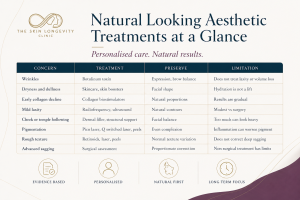
Natural looking aesthetic treatments at a glance. Wrinkles, dryness, collagen decline, laxity, hollowing, pigmentation and rough texture require different treatment categories, and every option has limits that should be understood before treatment.
What are the best aesthetic treatments for natural looking results?
The best aesthetic treatment is the least intensive option that addresses the main cause while preserving facial identity, proportion and normal movement. Depending on the concern, this may involve skincare, botulinum toxin, a skin quality injectable, collagen stimulation, carefully selected volume support, an energy based treatment, a laser or a chemical peel.
For location and how a first visit works, see the aesthetic clinic in Orchard, Singapore.
A natural result also depends on dose, placement, timing and review. Even an appropriate treatment can look obvious when too much is performed, the wrong area is treated or several procedures are added before the first result has settled.
Natural looking aesthetic treatments at a glance
Aesthetic treatments for natural looking results
| Main concern | Treatment commonly considered | What a natural result should preserve | Important limitation |
|---|---|---|---|
| Forehead lines, frown lines and crow’s feet | Botulinum toxin | Facial expression, brow balance and a familiar smile | It treats movement related lines rather than skin laxity or facial volume loss |
| Dryness, dullness and fine crepey texture | Evidence based skincare, hyaluronic acid skin boosters or selected skin quality injectables | Facial shape and expression | Hydration treatment does not replace volume or lift loose skin |
| Early collagen decline | Collagen biostimulators | Existing proportions while firmness develops gradually | Results take time and depend on the material, treatment plane and patient response |
| Mild to moderate skin laxity | Radiofrequency or focused ultrasound | Natural contours without adding artificial fullness | Improvement is usually gradual and more modest than surgery |
| Temple or cheek hollowing | Carefully selected dermal filler or structural support treatment | Ethnic features, facial width, movement and existing proportions | Excess volume or unsuitable placement can create heaviness and distortion |
| Pigmentation and uneven tone | Diagnosis specific skincare, Pico laser, Q switched laser or chemical peels | Natural skin texture and an even complexion | Melasma and pigment prone Asian skin can worsen after excessive inflammation |
| Photoageing and rough surface texture | Sunscreen, retinoids, selected lasers or chemical peels | Facial structure and normal texture variation | Surface treatment cannot correct deeper laxity or volume loss |
| Advanced skin excess or tissue descent | Surgical assessment | Proportionate correction | Repeated non surgical treatment cannot reproduce surgical tissue repositioning |
The table is a guide rather than a prescription. Suitability still depends on medical history, skin condition, facial anatomy, previous procedures, recovery tolerance and the amount of improvement the patient expects1.
What does a natural looking aesthetic result mean?
A natural looking result remains consistent with the person’s age, anatomy and existing facial identity. It can be clearly visible while still appearing believable.
The brows should continue to move naturally, the cheeks should remain proportionate to the rest of the face and the smile should still look familiar. Skin may appear smoother or brighter without looking polished to the point where normal texture has disappeared.
Undetectable aesthetic treatment follows the same principle. The improvement can be noticed, while the particular treatment remains difficult for another person to identify.
The word undetectable should not imply that the result is too small to see. It describes a change that belongs naturally within the face rather than drawing attention to a newly altered feature.
The overfilled look comes from adding volume where none was lost. Undetectable results restore what has changed with age and leave the rest alone.
Why less is more means more than using less product
A less is more approach uses the minimum intervention needed to produce a proportionate improvement. The principle may involve a smaller amount, a more suitable treatment category, a longer interval between sessions or a decision to leave one feature alone.
Meaningful treatment remains the goal. Using a very small amount in the wrong tissue layer can still disappoint, while treating the correct structure conservatively may create a clearer and more elegant improvement.
Restraint also includes knowing when another procedure would add little value. Our article, Dr Rachel Ho’s Approach to Collagen First Aesthetics explains why healthier skin, gradual collagen support and long term planning can produce outcomes that age more gracefully than repeated quick corrections.
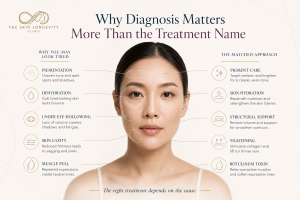
Why diagnosis matters more than the treatment name. A tired looking face may reflect pigmentation, dehydration, under eye hollowing, skin laxity or muscle pull. The appropriate aesthetic treatment depends on the cause rather than the device or injectable requested.
Why diagnosis matters more than the treatment name
A tired appearance can come from pigmentation, dehydration, under eye hollowing, skin laxity, muscle pull or several changes occurring together. Each cause requires a different treatment direction.
A soft jawline provides a useful example. Loose skin may benefit from tightening, while facial deflation may require structural support and a heavy lower face may respond poorly to added volume.
Reviews of facial ageing describe changes across several anatomical layers and emphasise that treatment selection should follow the structure producing the concern1.The clinic’s Skin Tightening in Singapore guide similarly explains why volume loss and laxity can appear similar while requiring different approaches.
Which aesthetic treatments give the most natural results?
Skincare for healthier skin without changing facial shape
Skincare can improve hydration, pigmentation, surface texture and selected features of photoageing without changing the shape of the face. It is also the foundation that supports recovery and maintenance around many aesthetic procedures.
Prescription tretinoin has the strongest topical evidence for photoaged skin, while sunscreen, antioxidants and other retinoids may also form part of a suitable routine9. Skin tolerance matters because repeated irritation can undermine adherence and worsen pigmentation in susceptible skin.
A patient seeking subtle aesthetic treatments may therefore benefit more from improving the skin first than from immediately changing facial volume. Dr Rachel Ho discusses this broader approach in What Skin Longevity Means to Me as an Aesthetic Doctor in Singapore on her blog.
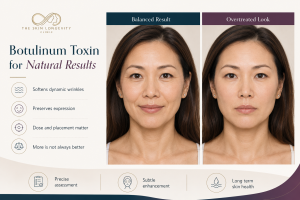
Botulinum toxin for natural looking results. Carefully planned treatment can soften dynamic wrinkles while preserving appropriate expression and brow balance. Dose, placement, anatomy and the patient’s preferred level of movement all influence the result. Conceptual illustration; individual outcomes vary.
Botulinum toxin for movement related wrinkles
Botulinum toxin temporarily reduces selected muscle activity and is most useful for dynamic wrinkles, including frown lines, forehead lines and crow’s feet. A Cochrane review found that botulinum toxin type A reduces facial wrinkles, while recognised risks include eyelid drooping and other effects related to the treated muscles2.
A natural result should soften excessive movement without removing every expression. Brow position, baseline asymmetry, muscle strength and the function of nearby muscles all influence the treatment plan.
Stronger treatment is not always more flattering. Excessive relaxation can create brow heaviness, stiffness or a smile that feels unfamiliar, even when the wrinkle itself has improved.
Readers considering this treatment can continue with Botulinum Toxin Treatment in Singapore: BTX for Wrinkles and Natural Looking Results. That guide explains how facial movement and muscle balance influence dose and placement.
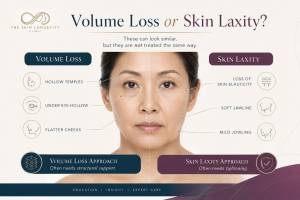
Facial volume loss and skin laxity can look similar but need different treatment directions. Hollow temples or flatter cheeks may require selected structural support, while suitable jawline laxity may respond to radiofrequency or focused ultrasound after assessment.
Dermal fillers for true facial volume loss
Hyaluronic acid fillers can restore selected facial volume, improve contour and support areas affected by structural deflation. Systematic reviews generally find that most reported adverse effects are temporary injection site reactions, although uncommon serious vascular complications can occur4.
A natural filler result usually depends on selective placement rather than filling every hollow or line. The aim is to restore proportion and support while avoiding unnecessary facial width, projection or heaviness.
Facial overfilled syndrome is a recognised complication associated with excessive volume, repeated unsuitable placement and reliance on filler as the answer to every sign of ageing3. Distortion can become more apparent during smiling and may worsen as tissue laxity develops over time3.
A review of facial overfilling also highlights the importance of anatomy, ethnic differences and treatment planning before injections are performed3. These considerations are especially relevant in Asian faces, where indiscriminate midface expansion can alter natural contours rather than restore them.
Readers concerned about hollow cheeks, temples or facial deflation can read Facial Hollowness and Contour Restoration in Singapore. The article explains why structural support should be planned around facial proportions rather than the amount of product available.
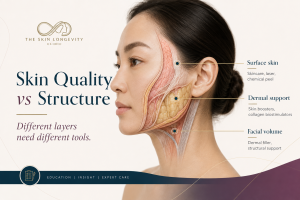
Skin quality and facial structure require different tools. Skincare, lasers and chemical peels mainly address surface concerns. Skin boosters and collagen biostimulators support selected dermal concerns, while fillers or structural treatments are used for appropriate facial volume loss.
Collagen biostimulators for gradual support
Collagen biostimulators create a controlled tissue response that encourages collagen formation over time. They may be considered for selected concerns involving dermal support, elasticity, wrinkles or gradual volume change.
A recent systematic review of poly L lactic acid and calcium hydroxyapatite reported improvements in elasticity, wrinkles and facial volume, although treatment protocols, study quality and follow up varied across the included literature7. Results should therefore be discussed according to the specific material and clinical indication rather than treating every biostimulator as equivalent7.
The gradual onset can suit patients who prefer a progressive change. Collagen stimulation is less suitable when the patient expects an immediate, precisely defined correction.
The clinic’s Collagen Biostimulator Treatments in Singapore and PLLA Collagen Biostimulator Singapore: Results and Safety guides explain the differences between material categories, timing and possible adverse effects.
Skin boosters and injectable moisturisers for hydration
Hyaluronic acid skin boosters and injectable moisturisers are designed primarily to support hydration and skin quality. A 2025 systematic review and meta analysis found significant improvements in hydration and radiance, while changes in elasticity and melanin index did not reach statistical significance8.
This distinction helps prevent unrealistic expectations. A hydration treatment can make skin look fresher without providing the structural effect of filler or the tightening effect of an energy based treatment.
Readers comparing hyaluronic acid, ECM skin boosters and collagen stimulators can continue with the clinic’s guide Skin Boosters in Singapore: HA, Polynucleotide, PDLLA, ECM and Exosome Compared. The purpose of the comparison is to match the injectable category to hydration, dermal quality or structural support rather than assuming that every skin booster performs the same job.
Radiofrequency for mild to moderate skin laxity
Radiofrequency devices deliver controlled energy into tissue to support collagen remodelling and improve selected features of skin laxity. A systematic review found improvements in laxity, elasticity and overall facial appearance, although devices and study protocols varied substantially5.
Radiofrequency tends to suit mild to moderate laxity better than advanced skin excess. Treatment should also consider facial fat and anatomy because some studies reported changes in facial fat volume after radiofrequency treatment5.
A natural looking result should improve firmness without making a naturally lean face appear more hollow. The clinic’s Skin Tightening in Singapore and XERF in Singapore guides explain how radiofrequency fits into a broader assessment of laxity, volume and facial structure.
Focused ultrasound for selected deeper tightening
Microfocused ultrasound creates thermal treatment zones at selected tissue depths and may produce measurable tightening in suitable patients. A systematic review of 16 studies reported improvement in many treated patients, while also calling for stronger controlled research and more consistent outcome measurement6.
The expected result is usually gradual and modest. Focused ultrasound does not replace lost cheek volume or remove significant excess skin.
Patients comparing ultrasound with radiofrequency can read XERF versus Ultherapy: Radiofrequency or Ultrasound for Skin Tightening. That article explains why treatment depth, facial anatomy and the location of laxity matter more than choosing a device from its popularity alone.
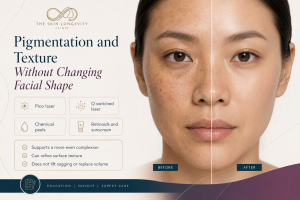
Pigmentation and texture can be treated without intentionally changing facial shape. Diagnosis specific skincare, Pico laser, Q switched laser and chemical peels may improve selected tone and surface concerns while preserving facial proportions. Conceptual illustration; results vary.
Pico laser, Q switched laser and chemical peels for skin tone
Pigment treatments can create a natural improvement because they change skin tone without changing facial structure. Their success depends on identifying whether the concern is melasma, post inflammatory hyperpigmentation, sun spots, freckles or deeper dermal pigment.
European laser guidance recommends matching the diagnosis, pigment depth and skin phototype to the wavelength and treatment parameters11. This is particularly important in Asian skin, where excessive heat or inflammation can trigger post inflammatory pigmentation11.
Chemical peels can be used for selected concerns involving photoageing, pigmentation, acne and surface texture, with the result depending on the peeling agent and treatment depth10. A chemical peel cannot replace volume or lift a loose jawline, even when it improves brightness and surface smoothness10.
Readers concerned about uneven tone can continue with Pigmentation Treatment in Singapore for Asian Skin and Stubborn Pigmentation in Asian Skin: Why Dark Spots Return After Laser. These guides explain why melasma and a discrete sun spot should not receive the same laser plan.
Which treatments improve skin without changing facial shape?
Skincare, selected chemical peels, pigment lasers, resurfacing treatments and skin quality injectables can improve aspects of the skin while largely preserving facial shape. The degree of structural change varies by treatment, so the intended target should still be clearly defined.
Hyaluronic acid skin injections have better evidence for hydration and radiance than for lifting or pigment reduction8. Radiofrequency and focused ultrasound may alter firmness and contour, while fillers and structural injectables intentionally change volume5,6,8.
A patient who wants better skin without changing facial proportions should state this clearly during consultation. The doctor can then separate surface skin treatment from structural rejuvenation.
What causes an overdone aesthetic result?
An overdone result often develops when the treatment goal shifts from improving the main concern to correcting every line, hollow or asymmetry. Repeated additions can gradually alter facial width, projection, movement and expression.
Filler related distortion may follow excess volume, unsuitable placement or repeated attempts to treat facial ageing with filler alone3. Botulinum toxin can also look unnatural when treatment disrupts the functional balance between neighbouring muscles2.
The newest device can become another source of overtreatment when its indication is poorly matched. More energy will not correct a volume deficit, while more filler will not remove loose skin.
Aesthetic clinic packages can further obscure priorities when several procedures are presented together without explaining which treatment is most important. The clinic’s Aesthetic Clinic Red Flags Singapore: Hard Selling and Packages guide explains why examination, informed consent and a clear treatment hierarchy should come before a package decision.
Should aesthetic treatments be combined?
Combination treatment can be sensible when separate treatments address separate causes. Botulinum toxin may soften movement related lines while a pigment treatment improves dark spots, for example.
Every component should have a defined purpose. A longer list does not automatically create a better or more natural result.
Staging treatments over separate visits allows the doctor and patient to assess the effect of each step before adding another. It also reduces the temptation to continue past the point where the face already looks balanced.
A 2024 review of noninvasive facial rejuvenation supports matching treatment modalities to patient characteristics, preferences and the specific components of facial ageing1. A 2026 review of skincare around aesthetic procedures also supports tailoring care to the procedure and individual skin response, while noting that high quality evidence for many detailed protocols remains limited.
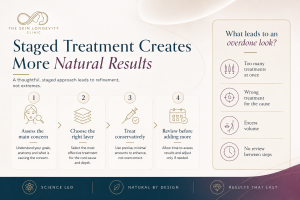
Staged aesthetic treatment can help preserve natural looking results. Dr Rachel Ho’s approach is to identify the main concern, choose the correct tissue layer, treat conservatively and review the result before deciding whether another step would add genuine value.
When waiting is the better decision
Treatment can reasonably be delayed when the diagnosis is uncertain, the skin is inflamed or the expected improvement is too small to justify the risks and cost. Waiting also allows time for a previous injectable or energy treatment to settle before further decisions are made.
A changing pigmented lesion, active infection, significant dermatitis or an unexplained new facial change should be assessed before elective aesthetic treatment. Pregnancy, breastfeeding, medication, medical conditions and previous complications may also alter suitability.
The Skin Longevity Clinic’s First Aesthetic Clinic Consultation Singapore: What to Expect explains why treatment does not have to take place during the first visit. A useful consultation can end with a skincare plan, a period of observation or a decision that treatment is unnecessary.
When surgery may produce the more natural result
Advanced tissue descent and substantial skin excess place a limit on what injectables and energy based treatments can achieve. Current reviews of facial rejuvenation continue to recognise surgery as the standard treatment when meaningful tissue repositioning is required1.
Repeated filler can make a lax face look heavier, while repeated tightening treatments may offer diminishing visible change. A surgical opinion can therefore be more honest and, in selected patients, more natural than continuing to add non surgical treatments.
Seeking a surgical opinion does not commit a patient to an operation. It provides a clearer comparison of realistic outcomes, recovery, scars, risks and longevity.
How do you choose an aesthetic doctor in Singapore?
People searching for an aesthetic doctor Singapore often focus on years of experience, social media presence or the number of technologies available. More useful questions concern how the doctor examines the face, explains uncertainty, responds to complications and decides when treatment should stop.
Ask whether the doctor regularly treats your particular concern and whether the proposed result suits your existing features. A doctor who produces natural looking results should be able to discuss facial identity and movement as clearly as wrinkle reduction or lifting.
Dr Rachel Ho is an aesthetic physician and founder of The Skin Longevity Clinic, with more than 16 years of clinical experience in Singapore. Her published approach combines skin science, facial anatomy, restraint and long term planning, with the aim of preserving natural expression and facial identity.
To check licensing, diagnosis, cost and aftercare before booking, see how to choose the best aesthetic clinic in Singapore and 12 questions to ask an aesthetic clinic.
Dr Rachel Ho’s clinical perspective
I define a natural aesthetic result as an improvement that remains coherent with the person’s face. The patient should still look recognisably themselves when resting, speaking, smiling and moving.
Less is more does not mean that every patient receives less treatment. It means that each treatment must earn its place in the plan.
I often begin by deciding which layer is creating the concern. Skin quality, muscle movement, laxity and volume loss may appear together, but treating the wrong layer can create more change without creating more beauty.
My preference is to prioritise the main concern, allow the result to develop and review the face before adding anything else. The point at which the patient looks refreshed and balanced is usually the point to stop.
Natural looking aesthetic care at The Skin Longevity Clinic
The Skin Longevity Clinic is a doctor led aesthetic clinic in Singapore founded by Dr Rachel Ho. Consultations consider skin quality, pigmentation, inflammation, collagen support, facial structure, movement and the patient’s longer term goals before treatment is recommended.
The clinic is located at 9 Scotts Road, #06-05 Scotts Medical Center at Pacific Plaza, Singapore 228210, near Orchard Road. Patients seeking subtle aesthetic treatments can begin with a Skin Longevity Assessment in Singapore, which helps clarify what may benefit from treatment, what can wait and what may be better left alone.
Frequently asked questions
What are the best aesthetic treatments for natural looking results?
The best option depends on the concern and the tissue causing it. Botulinum toxin suits movement related wrinkles, fillers suit selected volume loss, radiofrequency and focused ultrasound suit mild laxity, skin boosters suit hydration, collagen biostimulators suit gradual dermal support, while lasers and peels may improve pigment or texture.
What are undetectable aesthetic results?
An undetectable result produces visible improvement without making the specific procedure obvious. Facial identity, proportions and movement remain familiar, while the person may look more rested, balanced or refreshed.
Can botulinum toxin look natural?
Botulinum toxin can look natural when selected muscles are treated with an amount and placement that preserve appropriate movement. Excessive relaxation may alter brow position or expression, which is why facial assessment matters before treatment2.
How can dermal filler look natural?
Natural filler results begin with true volume loss and careful anatomical placement. Conservative treatment should restore support or proportion without creating excess width, projection or stiffness, while repeated filling of every hollow increases the risk of facial overfilling3,4.
Are skin boosters more natural than fillers?
The two categories have different purposes. Hyaluronic acid skin boosters mainly support hydration and radiance, while fillers are designed to restore volume or contour, so one cannot be considered universally more natural than the other8.
What is the most natural looking non surgical lifting treatment?
The answer depends on whether the concern is true skin laxity or facial deflation. Radiofrequency or focused ultrasound may suit mild laxity, while volume loss may require selective structural support and advanced sagging may be better assessed surgically1,5,6.
How can I avoid looking overdone?
Begin with a diagnosis, agree on one main priority and allow each treatment to settle before adding more. Ask the doctor what can wait, which features should remain untreated and how the proposed plan will preserve movement and facial identity.
Is treatment stacking safe?
Combining treatments can be appropriate when every procedure has a separate indication. Safety depends on the treatments, timing, skin condition, medical history and recovery capacity, which is why an individual plan is safer than an automatic package.
Does the newest aesthetic treatment give the best result?
New technology can be useful when it offers meaningful evidence, safety and a genuine advantage for the concern being treated. Established treatments may remain the better choice when their outcomes, risks and limitations are better understood.
How do I choose an aesthetic clinic in Singapore for natural results?
Check the clinic’s licence and the doctor’s registration, then assess the quality of the consultation. The doctor should explain the diagnosis, realistic improvement, risks, alternatives, total cost, follow up and the point at which further treatment would become unnecessary13, 14.
Conclusion on natural looking results from aesthetic treatments
Natural looking aesthetic results come from treating the correct concern with proportion, precision and restraint. The treatment may involve skincare, botulinum toxin, skin quality injectables, collagen stimulation, radiofrequency, ultrasound, laser, chemical peels or selective structural support.
The treatment type and settings determine part of your results. Diagnosis, anatomy, dose, placement, sequencing and restraint usually matter more.
The goal of natural looking aestethetic treatments is recognisable improvement rather than transformation. A good outcome allows the skin and face to look healthier, calmer and more balanced while the person remains unmistakably themselves. It is therefore important you find an aesthetic doctor and aesthetic clinic that can align with your goals and priorities for best outcomes.
Scientific references
- Bustos SS, Vyas K, Huang TCT, et al. Pharmacologic and Other Noninvasive Treatments of the Aging Face: A Review of the Current Evidence. Plastic and Reconstructive Surgery. 2024;154(4):829e to 842e. doi:10.1097/PRS.0000000000010767.
- Camargo CP, Xia J, Costa CS, et al. Botulinum Toxin Type A for Facial Wrinkles. Cochrane Database of Systematic Reviews. 2021;(7):CD011301. doi:10.1002/14651858.CD011301.pub2.
- Lim T. Facial Overfilled Syndrome. Dermatologic Clinics. 2024;42(1):121 to 128. doi:10.1016/j.det.2023.06.007.
- Kyriazidis I, Spyropoulou GA, Zambacos G, et al. Adverse Events Associated with Hyaluronic Acid Filler Injection for Nonsurgical Facial Aesthetics: A Systematic Review of High Level of Evidence Studies. Aesthetic Plastic Surgery. 2024;48(4):719 to 741. doi:10.1007/s00266-023-03465-1.
- Austin GK, Struble SL, Quatela VC. Evaluating the Effectiveness and Safety of Radiofrequency for Face and Neck Rejuvenation: A Systematic Review. Lasers in Surgery and Medicine. 2022;54(1):27 to 45. doi:10.1002/lsm.23506.
- Contini M, Hollander MHJ, Vissink A, et al. A Systematic Review of the Efficacy of Microfocused Ultrasound for Facial Skin Tightening. International Journal of Environmental Research and Public Health. 2023;20(2):1522. doi:10.3390/ijerph20021522.
- Ferreira ACM, Silva LR, Espasandin I, et al. Efficacy, Durability and Safety of Collagen Biostimulators Based on Poly L Lactic Acid and Calcium Hydroxyapatite in the Face: A Systematic Review. Aesthetic Plastic Surgery. 2026;50(3):1291 to 1300. doi:10.1007/s00266-025-05412-8.
- Zhou R, Yu M. The Effect of Local Hyaluronic Acid Injection on Skin Aging: A Systematic Review and Meta Analysis. Journal of Cosmetic Dermatology. 2025;24(1):e16760. doi:10.1111/jocd.16760.
- Griffiths TW, Watson REB, Langton AK. Skin Ageing and Topical Rejuvenation Strategies. British Journal of Dermatology. 2023;189 Suppl 1:i17 to i23. doi:10.1093/bjd/ljad282.
- O’Connor AA, Lowe PM, Shumack S, Lim AC. Chemical Peels: A Review of Current Practice. Australasian Journal of Dermatology. 2018;59(3):171 to 181. doi:10.1111/ajd.12715.
- Passeron T, Genedy R, Salah L, et al. Laser Treatment of Hyperpigmented Lesions: Position Statement of the European Society of Laser in Dermatology. Journal of the European Academy of Dermatology and Venereology. 2019;33(6):987 to 1005. doi:10.1111/jdv.15497.
- Nikolis A, Nestor MS, Czuwara J, et al. Concomitant Use of Dermocosmetic Skin Care in Aesthetic Procedures: Systematic Review with Expert Panel Recommendations. Clinical, Cosmetic and Investigational Dermatology. 2026;19:577 to 628. doi:10.2147/CCID.S577128.
Singapore regulatory references
- Singapore Medical Council. Guidelines on Aesthetic Practices for Doctors. 2016 edition.
- Ministry of Health Singapore and HealthHub. Healthcare Services Act licensing, registered healthcare professional directories and public guidance on licensed healthcare services. Updated 2026.